

This checklist is built to be used on a supplier who has already passed the conversation stage: someone who seems credible, has answered your questions well, and is asking for an order. It has eight steps, each one producing a piece of evidence rather than an impression, and it is designed so that a buyer can run the same eight steps against every supplier in a shortlist and compare the results like for like.
The single rule that makes the checklist work is that a step is not passed unless something exists. A good explanation is not a pass. A photo on a website is not a pass. A promise to send the document later is not a pass. Each step below names the artefact that closes it, so that the outcome of the exercise is a file per supplier rather than an impression in someone's head.

Factory vs trading company checklist: the eight steps and where the signal is
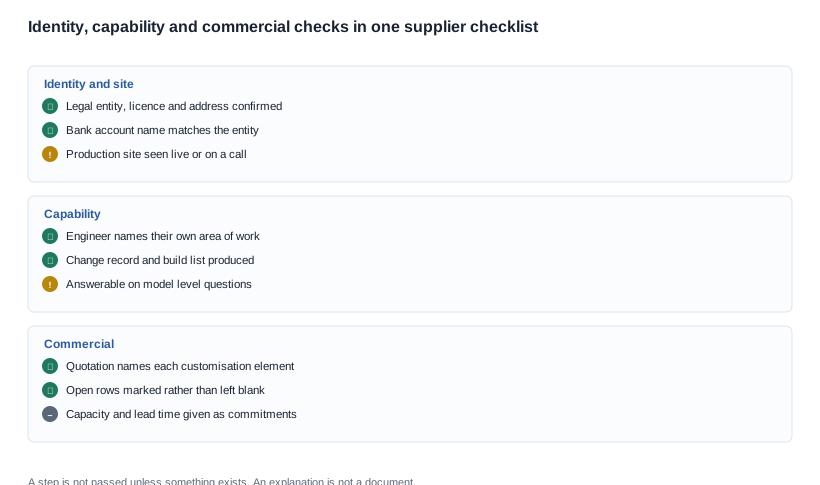
Step one — the entity. Get the legal name of the company you are contracting with, its business licence and its export registration, and check the address against the site the goods will come from. Then check the bank account: the account name should match the contracting entity, and this single check catches a surprising proportion of arrangements where the party on the invoice is not the party described in the presentation. This step is administrative, fast, and closes a category of risk that no amount of factory-tour enthusiasm will cover.
Step two — the site. See the production site, in person or live on a call. The worker and facility checks and the questions to ask on a video call both cover the detail; the signal here is simpler. You want to see the line that will build your product, people working on it, and an environment consistent with the volume being discussed. A supplier who can arrange this in days usually owns the site. A supplier who needs three weeks of coordination usually does not. Two practical notes. First, ask the supplier to walk the line rather than to show you a tour, because the difference between the two is visible within a minute — a tour is arranged, a walkthrough is not. Second, ask to see the area where the units are packed and labelled, because that is where the artwork, the inserts and the serial numbers come together, and it is the step most often subcontracted without being mentioned.
Step three — the people. Ask who owns firmware, who owns the mechanical work, who owns quality, and who signs a customer specification. Then keep talking. The point is not the names themselves but whether the answers come from people who can answer follow-up questions about their own area, or from a person reading from a page. On a call, ask the engineering contact to describe the last customisation they handled. The answer should be specific enough to be checked against something you ask for later. The follow-up that separates a real engineer from a presenter is: what was the hardest part of it, and what would you do differently. A specific difficulty is evidence; a general statement about attention to detail is not.
Step four — the process. Request two artefacts from a real recent programme: a change record, showing what changed and against which baseline, and a build or traceability list for one batch. These are the two documents that separate a manufacturer from an intermediary, because both are by-products of actually doing the work. A supplier that produces them within a day has them. A supplier that has to check with a partner is telling you something you need to know.
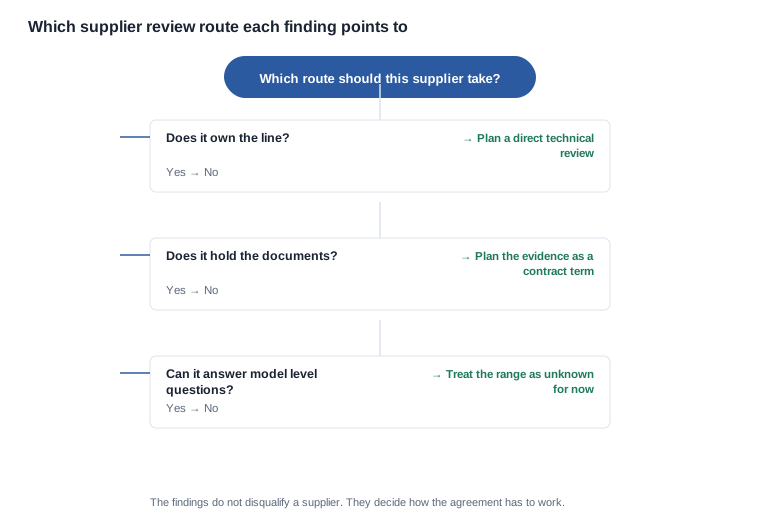
Step five — the product. Ask questions about the supplier's own range that only someone close to the product would know, and that a catalogue can verify. Ask which models publish an ingress rating, what the charge time figure means, whether a particular model ships with a case, and how many models in the range publish a weight. In our own catalogue the answers are specific and uneven: only two models publish an ingress rating, only one publishes a weight, and the case configurations differ from model to model. A supplier who answers with general claims about their range has not read their own specification, and a buyer who cannot get specific answers should assume the range is being described rather than known.
The best version of this step is to prepare the questions in advance and send them as a set, because a set of six specific questions sent to two suppliers will produce answers that can be compared directly. It is also the step where a supplier's own publishing gaps become visible, and that is informative rather than disqualifying. A supplier who says plainly that a figure is not published and will provide it in writing has given a better answer than one who fills the gap with an estimate. The difference matters because it predicts how that supplier will behave when a customer asks a question their catalogue does not cover.
Step six — the evidence. Ask what regulatory or assessment evidence covers the specific revision that will ship, and ask to see the scope rather than a certificate list. This is where our own position is worth stating plainly, because it is the standard we would want a supplier to meet: we publish no per-model certification row, and our export-certification page is a picture page showing ten patent certificates, eight design patents and two utility models. Those are patents rather than regulatory test records, and we would rather say so than let a page of pictures be read as a compliance file. A supplier who is straightforward about the difference between a certificate and a scope statement is a supplier you can work with; one who blurs them will blur something else later.
Step seven — the commercial document. Read the quotation as a document rather than as a price. Does it name each customisation element individually, so that an omitted element is visible? Are the rows we do not publish — unit price, minimum order quantity, lead time, sample cost, warranty, tooling and non-recurring engineering cost, production capacity — filled in or explicitly marked as open with a date and an owner? A quotation that names its elements is a quotation that can be compared. A quotation with blank rows cannot be negotiated against, and the blanks will become assumptions later.
Step eight — the reference. Ask for a customer who ran a customisation rather than a customer who bought stock, and ask a question that only a real programme could answer: what changed, and what did the documentation look like afterwards. A reference call is also where you learn what the supplier is like when something goes wrong, which is the part a sales conversation cannot show you. Prepare two questions for the reference in advance: one about how the customisation was handled, and one about what the supplier was like when a batch was not right. The second question produces a more informative answer than the first, because every supplier can describe a good programme and the descriptions diverge sharply when a defect occurs.

Factory vs trading company: what a passing answer sounds like
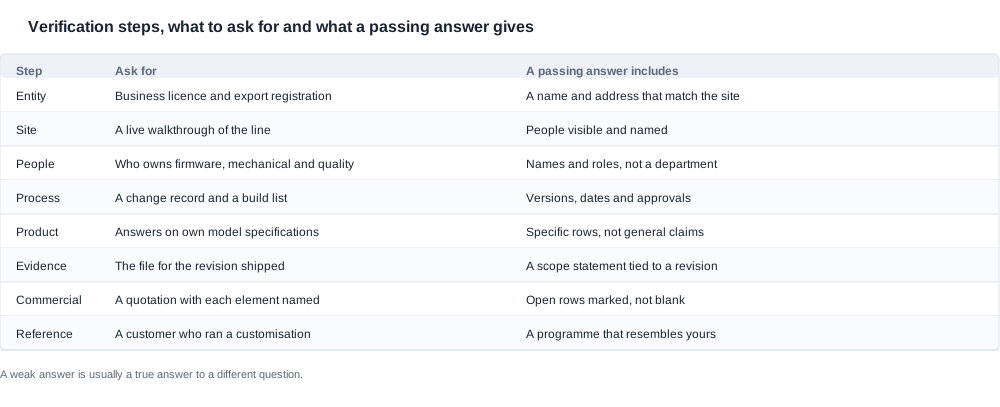
The eight steps produce answers, and the answers vary in quality in ways that are hard to judge if you have not seen many. The table below sets out the shape of a strong answer next to the shape of a weak one for each step. It is the single most useful artefact in this article for a buyer who is building a shortlist, because it converts a judgement into a comparison.
A weak answer is not always a false one. It is usually a true answer to a different question. "We work with partner factories" is true and answers a question about sourcing rather than about capability. "We have all the certificates" is true and answers a question about possession rather than about coverage. "We can get you a very good price" is true and answers a question about price rather than about terms. The reviewer's job is to notice the substitution and ask the original question.
The other pattern worth naming is the deflection from specifics to scale. Answers about how many years the company has been trading, how many employees it has and how many customers it serves are usually offered in place of answers about capability, and they are the easiest to substitute because they are available. They are also the least relevant, and the reason is structural: a trading company and a factory both have customers and years, but only one of them has a change record.
Factory vs trading company: the four supplier arrangements the checklist separates
The checklist is more useful if the buyer knows in advance that there is more than one kind of factory, because the four arrangements below produce different answers to the same questions, and only one of them is the arrangement most buyers assume they are dealing with.
The manufacturer. Owns the line, employs the engineers, holds the tooling and the build records, and signs the change. This is the arrangement in which the answers to steps three and four arrive in minutes and the artefacts are produced without escalation.
The manufacturer with an outsourced step. Owns most of the process and subcontracts one operation — a specific operation rather than the whole product. This is common and perfectly workable, and the checklist should not treat it as a trading company. What it needs is a specific question about the outsourced operation: who performs it, what controls apply, and what evidence exists. A buyer who asks about "quality" in general gets a general answer; a buyer who asks which operation is outsourced gets a useful one.
The sourcing company. Does not build, holds a relationship with a factory, and manages the commercial and sometimes the engineering interface. The eight steps produce a clear pattern here: the entity and site steps usually pass, the people step passes partially, and the process and evidence steps are the ones that come back as promises rather than artefacts. That is a legitimate arrangement, and for a small or simple order it may be the right one — but the agreement has to compensate for the indirection.
The rebrander. Buys complete finished units and applies the brand at the packaging and configuration level, with little or no manufacturing capability of its own. In this arrangement the answers about the product come easily, because the product is somebody else's, and the answers about the build records do not come at all. A rebrander can be a perfectly good partner for a brand that wants nothing more than a logo in a box, and it is the wrong partner for a brand that wants a new colour, a new interface or a new accessory.
The value of naming the four arrangements is that a buyer can decide which arrangement they need before they start, rather than discovering after the order which one they have. A brand that needs a custom interface and two markets needs the first or the third; a brand that needs a logo in the box is served by any of them. Which one to choose is a commercial judgement, and the structural comparison is the place to work through the implications of each.

Factory vs trading company: the five items the checklist cannot settle
A checklist that claims to settle everything will be ignored, because buyers know that no checklist settles everything. Five things have to stay outside it, and naming them in advance prevents them from being smuggled back in as conclusions.
Whether the supplier will treat this buyer well. That is a question of behaviour over time and it is answered by a first programme, not by an investigation. The sensible response is a small first order with a real deadline, rather than a large one that tests everything at once.
Whether the price is right. The checklist establishes what is included, what is excluded and which rows are open. It does not establish the number, and the number is a negotiation that depends on volume, terms, payment and the programme date. We publish none of those, and neither should a supplier that wants the order.
Production capacity. Capacity claims are representations, not facts, in this industry as everywhere else. They belong in the agreement, with consequences, rather than in a supplier's presentation.
The quality of an outsourced operation. A factory that outsources a step is not thereby a trading company, and no document will settle whether the partner is good. That judgement is made on the specific operation, the controls around it and the evidence that it is monitored.
Whether the specification being built is the specification that was agreed. This is settled by a sample, a golden sample and a change record, and by nothing else. The factory audit and supplier verification material covers how to run that check, and it is a separate exercise from the one described here.
The honest framing is this: the checklist establishes what kind of supplier you are dealing with and what kind of agreement the relationship needs. Everything else is either a negotiation or a verification of a specific claim, and both of those are better done directly than through a checklist.

Factory vs trading company: how to run the checklist across a shortlist
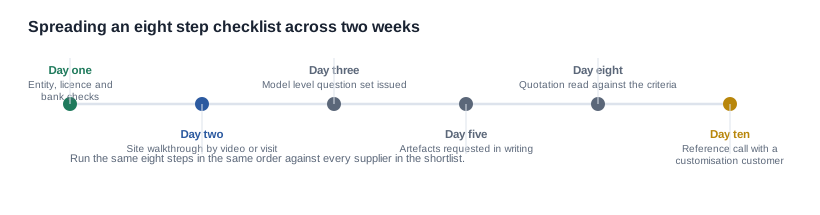
The value of the checklist multiplies when it is run identically against several suppliers, and it collapses when it is run differently for each one. Four rules make the comparison real.
Send the same questions in the same order. A supplier who is asked an easy question first and a hard one later gives different answers than one who is asked the hard one first. The order in the eight steps is deliberate, running from the cheapest and most objective check to the most expensive and most revealing.
Request the artefacts in writing, before the calls. Written requests create a comparable record, they let the supplier decide what it can produce, and they produce dates rather than impressions. A supplier that responds in a day and a supplier that responds in a week are both telling you something.
Set the pass criteria before the evidence arrives. The criteria should be written down in advance, and they should distinguish three outcomes rather than two: passed, failed, and not yet established. The third outcome is the one that matters most, because "not established" is where the risk hides and where a lazy review converts an unknown into a yes.
Score the unknowns, not just the passes. A supplier with eight passes and one unknown is in a different position from one with seven passes and no unknowns, and the difference is not visible unless the unknowns are tracked. Ask for the unknown list when you ask for the recommendation, because a supplier who volunteers the open items is telling you they have a process rather than a presentation.
The commercial trade-off at the end of this process is the same one every time: the supplier that passes every step is not automatically the cheapest, and the supplier that is cheapest is often the one with the most unknowns. Buyers who run the checklist properly find that the cheapest quotation is often the most expensive one, once the unknowns are priced. Which one to choose is still a commercial judgement, but it is a judgement made with the evidence visible rather than with a price alone.
Factory vs trading company: the record the checklist produces
Each supplier gets one file, and the file has the same structure for every supplier so that the results can be laid side by side.
- The entity record. Legal name, registrations, addresses, bank account name, and who signs.
- The step results. One line per step, marked passed, failed or not established, with the artefact that produced the result named against each line.
- The evidence received. A list, with dates, of everything the supplier actually supplied, including the redacted and incomplete items, because those are often more informative than the complete ones.
- The unknowns. Every question that could not be closed, with what it would take to close it and who owns it.
- The determination. In operational terms: what the supplier makes, what it sources, what it controls, what it does not, and how many layers sit between a question and an answer.
- The agreement consequences. What has to be written into the contract because the review found a gap: named approvers, evidence requirements, the claim route, the document set, the version rules, the support terms. This section is the point of the whole exercise, because a review that does not change the agreement is a review that was performed for its own sake.
We will run this checklist on ourselves, in the same form, with the same criteria. Send us the eight questions and the six sections, and we will fill them in for our own operation, mark the points where our answer is a commitment rather than a verified fact, and show you the artefacts — build records, change records, documentation sets — that back each line. We publish no capacity figures, no lead times and no certificate numbers, and we would rather be measured on what we can evidence than on what we can assert.
Related reading
- The structural difference between the two, and what it costs — factory versus trading company
- How to use a camera effectively — what to check on a video call
- Running the audit properly — factory audit and supplier verification
- The site checks in detail — worker and facility checks
- What to do with the findings — OEM risk factors


