
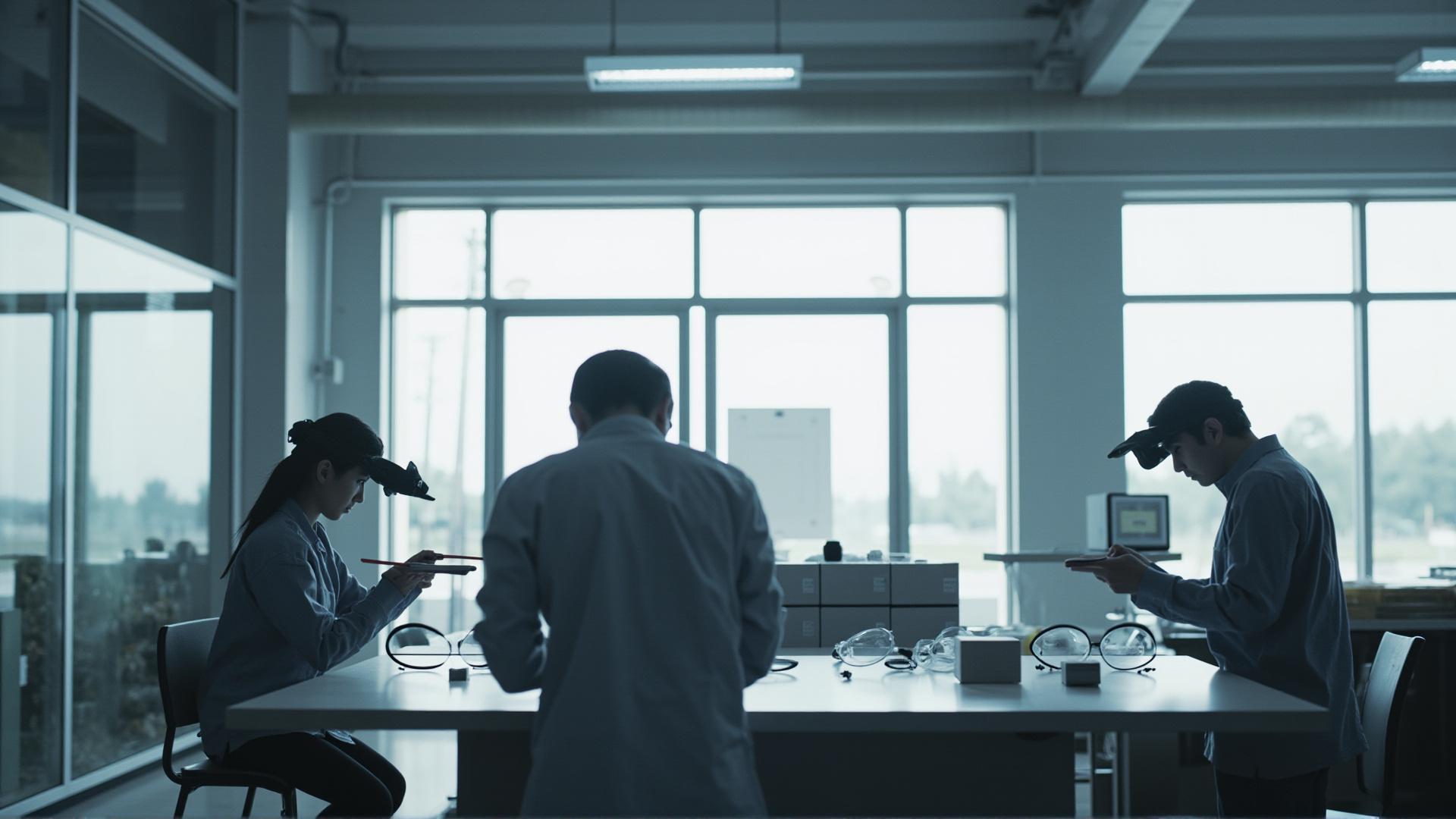
A video walkthrough is the cheapest verification a buyer can ask for and the easiest for a supplier to refuse, which is why it is worth more than the guided tour it replaces. A tour is staged by whoever conducts it. A live walkthrough, with the questions sent in advance and the camera left running, is harder to stage — not because anyone is trying to deceive, but because a working facility is busy in ways a prepared visit is not.
The signal that matters in a factory vs trading company comparison is inconsistency rather than appearance. A factory's answers come with texture: a line that is idle and a reason for it, a machine being cleaned down at the end of a shift, a supervisor who walks over to check something. A trading company has a smooth story, and the smoothness is the tell. The operator has a hundred small truths to keep track of; the intermediary has one.
None of that is proof. A video call cannot certify a supplier, and a buyer who treats a pleasant call as an audit has moved the risk rather than removed it. What a call can do is narrow the field, establish whether the counterparty operates equipment or merely arranges for it, and surface the questions a document request would have papered over.
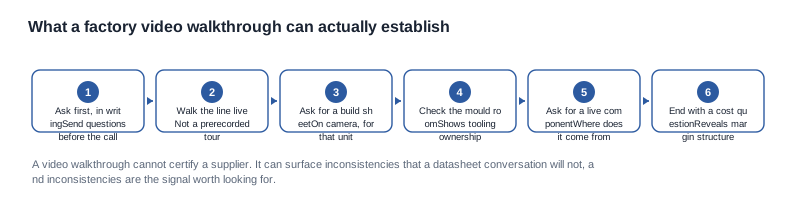
Factory vs trading company: six checks on a video call
Check one — send the questions in writing before the call and ask for them to be answered on camera. A written list does two things. It removes the temptation to answer the easiest version of each question, and it lets you see which answers take longer than the others. A factory will answer most of the list and will explain, specifically, the ones it cannot. An intermediary will read from a prepared sheet, will defer anything that touches the operation, and will offer to follow up. An offer to follow up is not itself a red flag; an offer to follow up on the same question twice is.
Check two — ask to see a line that is actually running. Not a line that is powered up for the demonstration. A factory can show you a line that is idle and explain why — waiting on a component, between shifts, running a different configuration this week — and that explanation is more informative than a running line would have been. A supplier who cannot show a running line will offer a video of somebody else's facility, or a walk that becomes conspicuously short as you approach the production area. Ask for the date and the shift, and ask which configuration is on the line today. The production line questions list goes deeper on this.
Check three — ask for a build sheet for a unit in front of the camera. A build sheet ties a serial or batch reference to components, firmware and date. A manufacturer can produce one live. Anyone else has to go and fetch it, which is fine and is not a red flag — but watch what comes back. A generic serial, a document for a different model, or a sheet that describes a unit you cannot see in the frame are all informative in different ways.
Check four — ask to see the mould room. This is the highest-signal moment in the call. If you are funding or will fund the tooling, you want to see it, you want to see it labelled, and you want to see whether other customers' tooling is there too. Tooling you cannot see is tooling you do not control, and the question of who owns the mould is the one most often left verbal. The OEM risk factors start precisely here, because an unowned mould is a programme that can be stopped by a telephone call.
Check five — ask where a specific component comes from. Pick something ordinary — a battery cell, a hinge, a lens assembly — and ask who supplies it. A factory usually knows its suppliers by name and can often talk about the relationship, the lead time and the last problem. An intermediary knows the brand of the distributor it buys from. This is not about whether the component is outsourced; factories outsource work as a matter of course. It is about whether the person on the call understands the bill of materials.
Check six — end with a cost question rather than a quality question. Ask what a specific change costs and what it costs to change it later — for example, the charge to alter the temple colour at a given quantity and the charge to alter it after production has started. Margin structure is the hardest thing to fake on a video call, because the answer reveals how much of the quoted price is the factory's own work and how much is layered on top. A supplier who quotes a change cost without a quantity basis is answering a different question.
Each of the six is chosen because it has a correct answer that only an operator can produce. Checks one and two are about responsiveness and access, which are cheap to fake but hard to sustain for an hour. Check three is about records, and records are either current or they are not. Check four is about assets, and assets either have labels or they do not. Check five is about the bill of materials, which is knowledge rather than performance. Check six is about economics, which cannot be rehearsed because it depends on quantities the supplier has to think about.
One of them deserves emphasis, because it is the one that is most often skipped. The mould room check works because it is binary and specific: the tooling either has a label on it or it does not, and a supplier who owns tooling for other customers will usually say so without being asked. If you see other customers' tooling in the rack, you have learned something important in the opposite direction — this is a factory that holds other people's assets, which is a normal business model but a different one from a factory that only holds its own. The follow-up question is not "why do you hold other people's tooling" but "who owns the tooling for my configuration, and where is the ownership recorded".
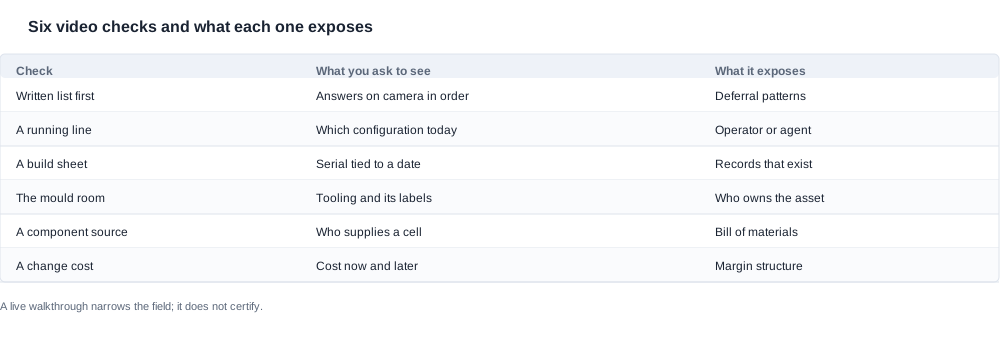
Factory vs trading company questions that produce a usable answer
The questions that work are about operations, because operations are hard to answer well if you are not the operator. The questions that do not work are about systems, because systems can be described by anyone.
- Can you show me a unit built this month, and what is its build date?
- If I change the temple shape, which tooling is affected and who pays?
- Which component has caused you the most returns, and how do you handle it?
- What happens to my tooling if this project ends?
- If I add a variant after production starts, what is the charge and how long does it take?
- Show me the drawer where the components for this week are stored.
- Which of the steps in this programme happen at your site, and which happen at a partner site?
- What is the first thing you check when a unit comes back from a customer?
Notice the pattern. Each question can only be answered well by somebody who does the work, and each answer can be checked against something visible on camera. That double test — answerable only by an operator, verifiable on screen — is what separates a useful video verification from a useful-looking one.
Two further tactics are worth using. Ask the same question twice, in different words, about an hour apart in the call. A prepared answer is retrieved from a script; a working answer is reconstructed from memory, and the second version will have different detail in it. And ask for something trivial at the end — where the toilets are, how many people are on shift, what the nearest station is. Intermediaries frequently cannot answer logistical questions about a site they visit occasionally, and the answer arrives with a delay or not at all.
There is also a question of what you do not ask. Avoid anything that can be demonstrated on a screen and is stored in a file: the quality system, the certificate, the test report, the company presentation. These are the questions every buyer asks, and answering them is what a call is easiest to survive, because the answer is a document that already exists. Save those questions for the written follow-up, where you can actually see the document, and spend the live call on the questions that require a person to have been present at the work.
One more design point, and it is about order rather than content. Put the hardest question third rather than first. A call that opens with the mould room question is a call where the supplier is braced, and bracing produces careful answers. A call that opens with a production question and reaches the tooling question in the middle produces a conversation, and a conversation is what tells you how people actually work.
What a factory vs trading company video call cannot establish
Being clear about the limits is part of using the tool well, because the most common failure is treating a successful call as a completed due diligence step.
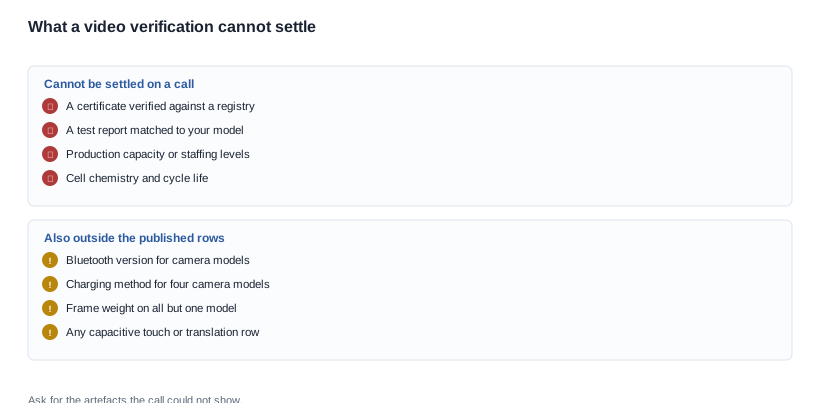
A call cannot verify a certificate. For that you take the reference from the document and check it in the relevant registry yourself. A call cannot establish that a test report belongs to the model you intend to buy — it can only establish that a document exists. It cannot confirm capacity, lead time or staffing, and we do not publish any of those figures ourselves. It cannot confirm the battery cell chemistry or the cycle life, because those are not published in our documentation.
It also cannot resolve the questions that most often decide whether a programme is viable, because those questions are about the product rather than about the supplier. In this category a large part of the specification is simply not published: the Bluetooth version is absent for all eleven camera models, for A05 and A06 and for the bone conduction entry; the charging method is not published for L1 Pro and the CY03, and MT6 and CY05; exactly one model in the whole range publishes a frame weight, the MT6 at 158 g for the glasses alone; and only the V06 and the S7 publish an ingress marking. The catalogue holds no capacitive-touch row, and no translation row either. A tour cannot settle any of those, and a supplier who seems to answer them on camera is either working from a document you have not seen or filling a gap.
Nor can a call tell you about the claims you will make after the launch. A supplier who demonstrates a translation feature on a phone screen is showing you a feature whose specification row does not exist in the published catalogue, and that is a claim problem, not a call problem.
There is a related limit that applies to our own catalogue rather than to anybody else's, and it is worth stating plainly because it changes what a buyer should expect from us. Our documentation publishes no certification entry that separates one model from another, and the catalogue body makes no mention of CE, FCC, RoHS, the Radio Equipment Directive or EN 18031 at all. The export-certification page in our documentation is a picture page: ten patent certificate images, of which eight are design patents and two are utility models. So there is no certification document for us to put on camera for a given model, and a buyer who asks to see one will be told that it is not published. That is not an evasion — it is the position — and it is also a reason the documentary part of the due diligence has to happen afterwards, in writing, and against the registry rather than against the supplier.
How to prepare a factory vs trading company video verification
The preparation is where the value sits, and it takes less time than buyers expect.
- Send the written list at least two working days ahead, numbered, and state that the call will answer them in order. A supplier who cannot answer on the day has told you something before the call has even started.
- Specify what you want to see, not merely what you want to discuss. "The assembly line running the audio configuration, the mould room, and the quality records for the last production run" is a request. "Let's have a look around the facility" is a suggestion.
- Ask for the camera to be on a phone held by the person walking, rather than a conference room with a fixed camera. The movement and the ambient sound are information; a fixed camera in a clean room is a set.
- Have a second person on the call who is not driving. One person asks and writes; the other watches the screen and the logistics. Asking and observing simultaneously is much harder than it sounds, and it is where the detail gets lost.
- Record what you saw, with times, while it is fresh — which line, which configuration, what was running, what was not running, what was explained and what was skipped.
- Close the call with the written follow-up, asking for the artefacts that the call could not show: the build sheet, the tooling ownership position, the substitution process, the escalation path and the audit terms.
The trade-off at every step is that a supplier who is genuinely busy may decline a live walkthrough, and a buyer who insists on one will read the refusal as concealment. It may not be. A better approach for a supplier who will not go live is a short unedited video of the line at a named date, with the sound left in, combined with the written answers — and then a physical audit later, since the supplier verification route exists precisely because some things cannot be settled remotely.
The written follow-up is the part that is usually skipped and the part that carries the most weight, because it converts a conversation into a record. Ask for the artefacts as attachments rather than as links to folders, ask for them addressed to you rather than to your colleague, and ask for the answer to each of the six checks in one line. A supplier who can answer in one line has done the work; a supplier who answers in four paragraphs has not, and the difference is visible. Set a date for the response and treat a missed date as a data point in the same way you would treat a missed question.


Scoring the factory vs trading company verification you get
After the call, the output is a short written record and a scoring decision, and the scoring should not be about how the call felt.
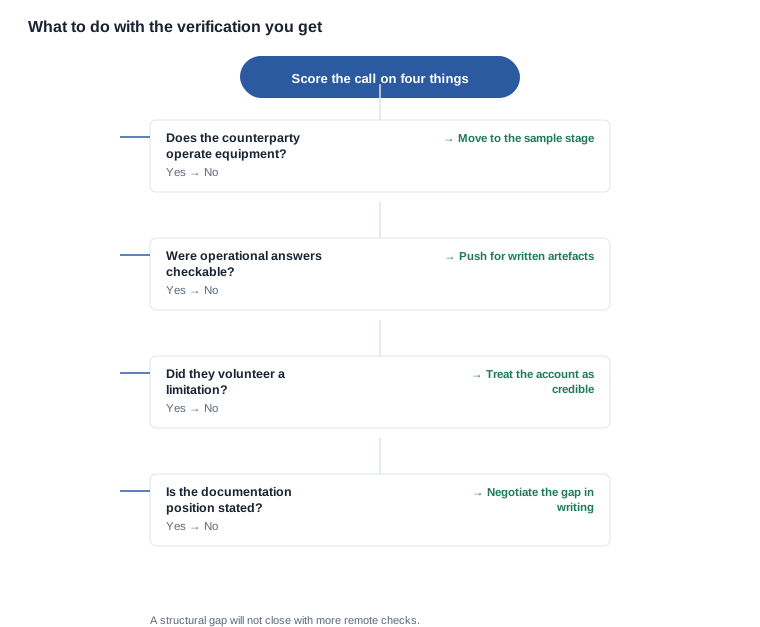
Score it on four things. Whether the counterparty operates equipment, or arranges for it to be operated. Whether the answers to the operational questions were specific enough to be checkable. Whether the areas you asked to see were shown, and the areas you did not ask to see were mentioned. And whether the supplier volunteered a limitation.
Score what you did not get as well. A verification in which every request was met is not a strong verification; it is a supplier who had nothing to hide, which is fine, or a supplier who controlled what you saw, which is not. The check is whether the record contains anything you did not ask for. A production line that was idle, a tool that was missing, a date that did not match, a step that was skipped — each of these is more useful than a smooth tour, because each one is a real fact about an operation, and real facts are what a programme is built on. The due diligence value of a call is in the incidental detail, not in the answer to the question you asked.
That last point carries more weight than it sounds. Suppliers who name what they cannot do — the tooling they do not own, the process they subcontract, the documentation they will have to obtain — are telling you how they operate. Suppliers who answer every question affirmatively have told you nothing, because no hardware supplier in this category can do everything.
The shortlist consequence is straightforward. A candidate that passes on all four can move to the sample stage; a candidate that passes on operations but not on documentation has a fixable gap; a candidate that fails on whether it operates equipment has a structural gap, and no amount of further remote verification will close it. Buy the sample from the first kind, negotiate with the second, and move on from the third.
Combining a factory vs trading company video check with a physical audit
A video verification and a physical audit are not competing tools, and a buyer who treats the second as the first's replacement will get the value of neither. They answer different questions, and the sequence that works runs from the remote check to the on-site one, not around it.
The remote check establishes access, responsiveness and operational fluency. It is cheap, fast, and good at finding candidates who should be removed from the shortlist. It is not good at establishing anything about the physical state of the operation — the working condition of a line, the storage and labelling discipline, the actual flow of material, the welfare and training arrangements, or the state of the calibration equipment. Those need to be seen, and they need to be seen by someone who knows what to look for.
Three things in particular are worth putting on the audit agenda because they are visible on site and invisible on camera. The first is material flow: whether components for a job are staged where the job happens or carried across the floor from a shared store, which is a fair proxy for how the factory handles a bespoke configuration. The second is the labelling and traceability discipline in the area where finished units are packed, which tells you whether a batch reference is a real record or a formality. The third is the condition and calibration of the test equipment used on the final line, because it is the equipment that decides what "passed" means at the moment of shipment.
The audit should also settle the questions that the call could not: which steps happen at the site, whether an audit reaches the assembly line or only the offices, and who holds the conformity documentation for the exact model being quoted. The factory audit and what to look for material covers how to request one that reaches the production area, and the sample that follows an audit is where the remaining product questions get settled — what a first sample should establish is covered under sample evaluation.
The practical rule is that the video call tells you whether to spend the money on a visit, and the visit tells you whether to spend the money on an order. Buyers who invert that order pay for a trip they did not need, and buyers who skip the call pay for a trip that tells them nothing they could not have asked by email.
We are a manufacturer, and we would rather be checked than described. If you want a live walkthrough of our line, ask for it and give us the date, and we will show you what is actually running, including the parts of it that are not running. We will also tell you now which things we cannot show you because they are not published in our documentation: the battery cell chemistry and cycle life, the acoustic measurements, the frame weights for all but one model, the ingress basis, the capacitive-touch and translation rows that do not exist, and every certificate number. None of those will appear in a video, because none of them exist in our source material to show. That list is the honest answer to "are you a factory", and it is more useful to you than a tour would have been.
Related reading
- The full risk picture beyond the call — smart glasses oem risk factors
- Confirming documents independently — supplier verification
- What a first sample should settle — sample evaluation
Tell us the date and the questions you want answered, and we will answer them on camera.


