

Most published guidance on this question begins with equipment, and equipment is the wrong place to begin. Machines can be leased, sub-contracted or shared between sites; a company can photograph a line it does not operate; an inventory list can be printed. People cannot be photographed. That is why the check that actually separates a manufacturer from an intermediary is not a machine count but a question about who is employed by the party named on your purchase order, and factory vs trading company worker and facility checks is best understood as a set of questions about process rather than about premises.

Factory vs trading company: what a visit settles and what it does not
A visit settles a narrower question than most buyers arrive expecting. It settles whether one organisation controls the process that makes your order: whether the people who assemble the unit are employed by the party you are contracting with, whether the tooling that forms the housing belongs to that party, whether a failed unit goes somewhere that has to be recorded, and whether the test equipment sits inside the organisation that signed the quotation. Those four things are observable in an afternoon, and they are the things that determine what happens to you in month four.
A visit does not settle the paperwork. It cannot establish a certificate number, a battery chemistry, an ingress test basis or a production capacity, because those are not properties of a room. They are properties of a file, and a file is verified by reading it rather than by standing in front of it. Any supplier who stages a visit around a printed certificate is telling you that the visit and the file are the same thing in their organisation, which is itself the finding.
The distinction matters commercially because the two models price risk differently. A factory absorbs the risk of its own process and quotes its own cost. An intermediary prices a margin and negotiates someone else's capacity. Both are legitimate. What is not legitimate is signing a contract without knowing which of the two you are buying from, because the remedy for a failed batch, the firmness of a lead time and the ownership of a mould all differ between them.
There is a third case worth naming, and it is more common than buyers expect: a factory that behaves like an intermediary. Its production is real, its people are employed, but the quotation is prepared by a sales office that has no authority over the schedule, and your change request goes to a partner rather than to a line. The workforce questions below will pass while the commercial questions fail. Both sets have to be run, which is why this article keeps them separate.
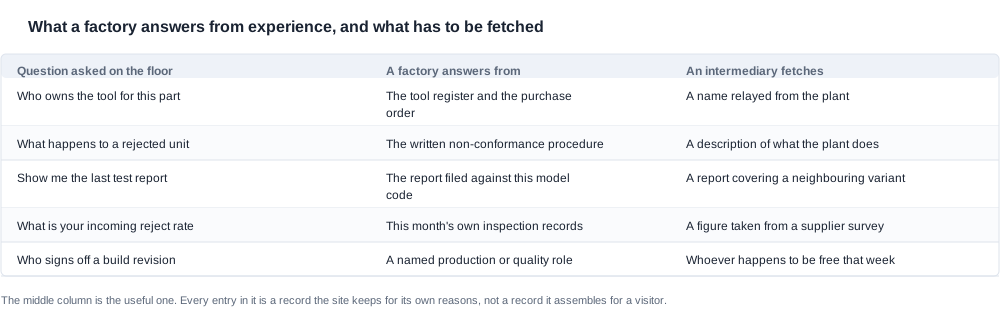
The middle column of that table is the useful one. Every entry in it is a record the site keeps for its own reasons — because it needs the number to buy components, to schedule maintenance, to answer a customer claim — not a record assembled for a visitor. That distinction is why the same question produces two very different answers, and why a supplier who cannot produce the middle column has not necessarily done anything wrong; it may simply be describing a relationship it does not control.
Two of those rows deserve emphasis because they are the ones buyers most often skip and most often regret. The rejected-unit row is the cheapest quality control test available to a visitor: a site with a real non-conformance procedure will show you the form, and the form is more persuasive than any description of a quality system. The build-revision row is the one that predicts whether your change request will be answered in a day or in a week, because a named role with authority to sign is a different thing from a sales office forwarding an email.

The walk, in the order that produces the most information
Walk the building in the direction the product moves, not in the direction the tour route is designed to go. A staged route starts at the reception desk and ends at the showroom; a production route starts at incoming goods and ends at a sealed carton. The order below produces the most information per hour, because each stop is a place where a process either exists or is described.
1. Incoming goods. Ask for this month's own incoming rejection rate, and ask which month the figure covers. A factory treats this as a routine operational number because it drives its own purchase decisions. An intermediary can repeat a figure from a supplier audit without being able to say whose audit it was or when it ran. Follow it with one concrete question: which supplier contributes most of the rejects. A site that answers instantly has a purchasing record.
2. The assembly flow. Do not stop at a station — follow a single unit from start to a finished carton. The purpose is not to test anyone's speed. It is to see whether anyone can describe the next step without hesitating, and whether the station that should be doing a check is actually doing it. A line where the answer is always known belongs to an organisation that controls its process.
3. The failure path. This is the highest-signal stop in the building and the one that is usually walked past. Ask where a unit goes when it fails a check, who writes it down, and what happens to the record after thirty days. The three answers together describe the quality control system. A site that says units go back to the start without a record has told you that process control is informal, and informal process control has a predictable cost at scale.
4. The mould room. Tooling you cannot identify is tooling you do not control. Ask for the asset reference on a specific tool, the cavity count, and who owns it. Then ask what happens to that tool if the project ends. Tooling ownership left as a verbal arrangement is the single most common unresolved item in this industry, and it is the one that becomes expensive precisely when the relationship is already under strain.
5. Battery cell handling. Every model in our range is battery-powered, which makes lithium cell handling a real process with real controls and one of the least staged rooms in the building. Observe whether cells arrive identified and segregated, whether a damaged cell has a defined route, and whether anyone can name the storage temperature limit. A site that handles cells carefully but cannot state a limit has a habit, not a procedure — and a habit is what you get when the person running it leaves.
6. The test bay. Claims about quality systems are cheap; the testing behind them is not. Ask who owns the test equipment, who calibrates it, and when it was last calibrated. Then ask to see a calibration sticker or a log. A facility that owns and calibrates its own equipment is describing a process; one that sends samples elsewhere is describing a relationship, and the difference should be priced into your evaluation.
7. Packing. End at the packing station. It is unglamorous and it is where the last errors get caught: count checks, label verification, carton marking, pallet configuration. It is also where a lot of factory claims become concrete, because packing is a repeatable operation with a known failure rate that the organisation has to manage whether or not anyone is watching.
If time allows, one additional stop is worth more than any of the seven: ask to see a non-conformance record from the last quarter. Whether you are allowed to see it, and whether it has a disposition and a signature, tells you more about the organisation than an hour of walking does.
Bring an agenda rather than accepting the tour. The single most common way a factory visit wastes a day is by letting the host set the route, because the host route is the one that avoids the failure path and the battery area. Send the seven stops in advance as a list and ask for them in that order. A supplier who agrees immediately is telling you the route was already possible; a supplier who needs to rearrange it is telling you something about what the default route was concealing. If a visit is refused or postponed, ask which stop caused it, because the answer locates the problem more precisely than a refusal does.
Count the questions you asked that produced a document. Not records shown to you — documents you could take away, or at minimum could photograph. A visit in which every answer was verbal and nothing was produced has cost you a day and left you with impressions; a visit in which three documents appeared has left you with something you can verify later, independently, without asking anyone again. Three documents on a factory visit is a good result.
Ask the same question twice, differently. Ask who signs off a build revision, and then, twenty minutes later in a different part of the building, ask the person you meet what happens when a revision arrives. Whether the two answers agree is worth more than either answer on its own, because agreement is evidence of a shared process and disagreement is evidence that the two rooms do not talk. Disagreement is not disqualifying — plenty of good factories have a thin line between engineering and production — but it should be recorded rather than smoothed over.
The one workforce question worth asking directly
There is a single workforce question that separates a factory from an intermediary, and it is worth asking without softening it: who manages your production, and are they employed by you?
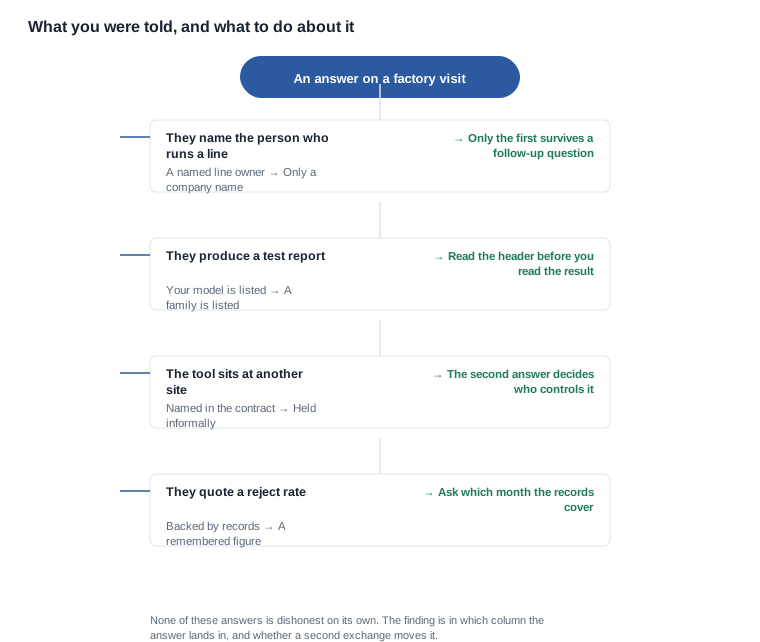
The answer is not a formality, because it tells you where the operating knowledge sits. If the person who schedules your order works for you, then the knowledge is inside the organisation you have contracted with, it is available to you, and it survives the end of the project. If the answer is that production is managed by a partner, then the knowledge is outside, it is not yours to interrogate, and it can be lost when your order ends — which is precisely the moment a repeat order depends on it.
Two follow-ups sharpen the answer considerably. Ask who the buyer would call if a unit failed two months after delivery. In a factory, that call reaches the people who made it, and the call is answered from records rather than from recollection. In an intermediary, the call is relayed, and the answer has to be assembled before it can be given to you.
Then ask the harder version: how many of the people running the line are on your supplier's payroll, and how many belong to a labour provider. This is not an accusation. A factory that uses contracted labour for peak periods is operating normally, and it will tell you so plainly because it is an ordinary cost decision. What separates a real answer from a staged one is whether it comes with a mechanism — a documented peak staffing plan, a stated proportion, an explanation of who trains and supervises.
The final version is the one most buyers never ask, and it is the one that predicts the second order: who owns the process knowledge that is not written down anywhere? Every factory has an informal layer — which batch runs well on which shift, which supplier's parts arrive pre-loaded, which finish standard everyone understands without a document. If that layer belongs to your supplier's organisation, it is an asset you are buying access to. If it belongs to a partner, you are dependent on a relationship your purchase order does not govern.

What a staged answer sounds like
A staged answer is not a lie. It is a description of a process that exists somewhere, delivered by someone who is not accountable for it. Learning to recognise one is a matter of form rather than of suspicion, because the two kinds of answer have different shapes.
Adjectives against facts. "Advanced" and "professional" and "world-class" describe a claim; an asset reference, a date and a named role describe a fact. When you hear the first kind, the questions to ask are what to ask questions about measurement: how many, how often, who records it, and where the record is kept.
Generalisation against specificity. "We work with several partner factories" is a true statement and it is also an evasion, because it declines to say which one makes your order. The follow-up that resolves it is to attach a quantity: and for an order of this size, which one. A site that cannot name the site for your specific quantity is telling you that allocation is somebody else's decision.
Recency. The most reliable single test in the category is to ask for a test report and read the header. Look at the report number, the laboratory name and the model list printed on the document itself. Documents in this category are frequently issued per family or per electrical design rather than per marketing name, so a report covering a different variant tells you about a different product. You are not trying to catch anyone; you are establishing whether the document describes the goods you will receive.
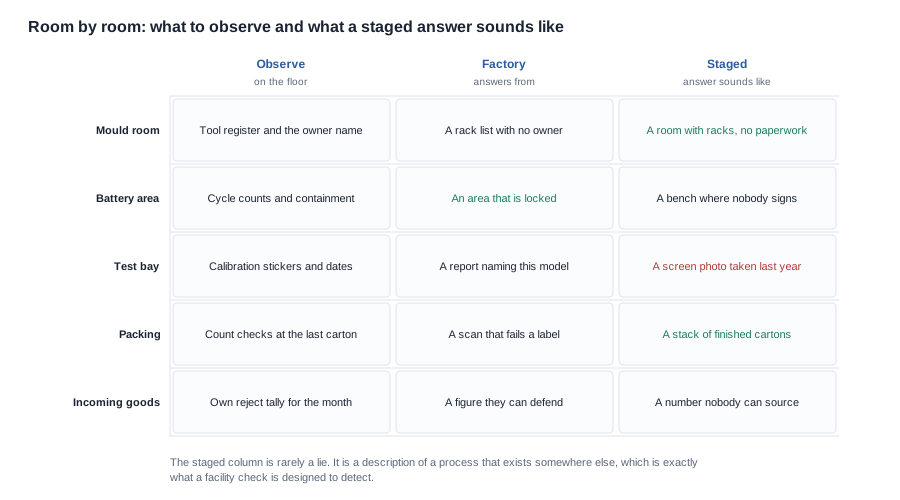
The matrix above pairs each room with the evidence a factory produces and the version a staged answer resembles. Notice that the staged column is not absurd. An empty but locked containment area and a mould room with racks and no paperwork are both plausible buildings. What they lack is the record that the organisation keeps regardless of whether a visitor is present.
A useful discipline here is to separate what you were shown from what you were told, and to write them down separately before you leave. Almost every retrospective disagreement about a factory visit traces back to a visitor who could not later separate a demonstration from a claim. A short note made in the room costs nothing and is worth a great deal three months later.

The remote substitutes when travel is not possible
Travel is not always available, and a remote evaluation is genuinely weaker rather than merely slower. It cannot establish who is employed by whom. It can establish something narrower and still useful: whether the answers are specific, sourced and repeatable, which removes most of the suppliers who cannot be classified before you have spent money on a flight.
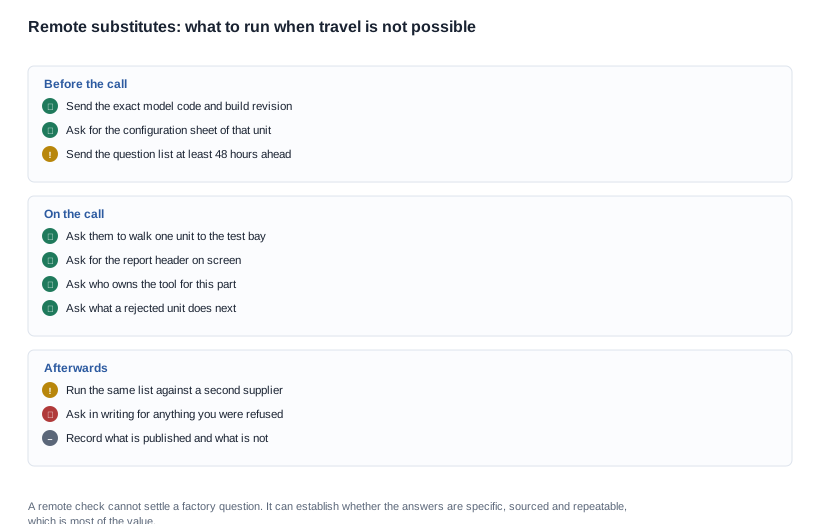
The strongest remote substitute is a live walk rather than a slide show. Ask for a video call in which one person walks from incoming goods to packing with the camera on the floor, and ask three questions during the walk rather than scheduling them for afterwards. The value is not in seeing the building; it is in whether the person on the call can answer a question without leaving the frame. An organisation that controls its process answers at the station.
The second substitute is documentary and requires no call at all. Ask for the configuration sheet of the exact unit that would be built, the bill of materials with part versions, and the non-conformance procedure. These are documents rather than demonstrations, so they can be read rather than staged, and a document that cannot be produced is a fact in itself.
The third is comparative. Run the same short list against two suppliers and compare the specificity of the answers side by side, because a single supplier's vagueness is much harder to detect without a baseline. Questions to ask each of them include the build site, the tool owner, the calibration date and the model list on the most recent report.
The fourth is a third party, and it is the only one that can reach the parts a supplier controls. An independent audit against a named standard, or a customer reference from a brand that has run a production programme rather than a distributor that has bought a container, reaches information the supplier would not otherwise volunteer. Set the agenda yourself rather than accepting the one offered.
What no remote method settles is the workforce question. Employment relationships are verified in person or not at all, and any supplier who offers a remote substitute for that specific question is telling you where to look for the answer.
Being inspected: what we show, and what we will not
We are a manufacturer, and the honest way to present that is to be specific about what it proves rather than to ask a buyer to take our word for it. If you visit, we will show you lines that are idle as well as lines that are running, and we will explain the difference between the two rather than steering you past it. We will let you ask the non-conformance question, and we will tell you where a record exists and where one does not.
We will also say now what a visit will not settle for our range, because the list is the same every time and it is better stated in advance than discovered during the walk:
- battery cell chemistry, cycle life and replaceability — not published for any of our twenty-eight models;
- acoustic measurements and driver details — not published;
- frame weights beyond a single figure, the MT6 at 158 g;
- ingress test basis — an IP54 catalogue marking appears on two sport models with no standard, laboratory or batch behind it;
- every certificate number, issuing body and validity period.
None of those appear in a facility because none of them are in our source material to show. A supplier who produces a certificate number on the day of a visit is producing something they prepared that morning, not something they hold, and you would be relying on it for a year.
We will say plainly that the instinct behind these checks is correct, with one adjustment: check the process rather than the premises. A trading company can present a convincing building. It cannot present a production flow it does not run, and the difference between the two is visible within thirty minutes if you walk the route the product takes rather than the route the tour is designed to take.
The criteria we would propose are simple enough to apply to any supplier: name the site, name the employing party, produce three documents, and answer the failure-path question without pausing. Four red flags remain after those are cleared — an answer that arrives only in adjectives, a report whose header names a different variant, a tool with no owner, and a schedule that no named role controls. Any one of them can be worked around with a clause. Three of them together should stop the evaluation, and the questions to ask about how to evaluate that are worth as much as the answers.
Buyers frequently ask whether this is worth a day of travel against a cheaper screen. The honest trade-off is that a visit cannot shorten a programme and a remote check cannot settle control, so the choice is which risk you prefer to carry into the purchase order. Most buyers who carry a first order remotely and a repeat order after a visit report that the second programme was the cheaper one, because the findings arrived while they were still negotiating rather than after.
The broader commercial distinction is covered under factory vs trading company. The remote version of these checks is in what to check on a video call, and the documents to verify independently are in supplier verification.
Related reading
- Checking before travelling — what to check on a video call
- Where the sourcing boundary sits — what do you outsource
- What a facility visit cannot settle — supplier verification
Tell us the questions you intend to ask and we will tell you which we can answer on the spot.


