

What do you outsource is the question that separates two kinds of supplier faster than anything else in a due diligence file, and the reason it is asked first is that the answer tells a buyer where its own leverage is. A factory buys in commodities and keeps the work that defines the product. A trading company buys in the factory itself and keeps only the customer relationship. Both are legitimate businesses, and the failure mode for a buyer is not choosing one but choosing one without knowing which one had been chosen. This page works through the seven elements that make up a pair of smart glasses, states where the boundary between making and buying usually sits for each of them, and gives the artefact that proves the answer for each one. The value of that artefact is the point: a make-or-buy answer given in words is a claim, and a make-or-buy answer that produces a document, a part number or a piece of equipment on site is evidence.
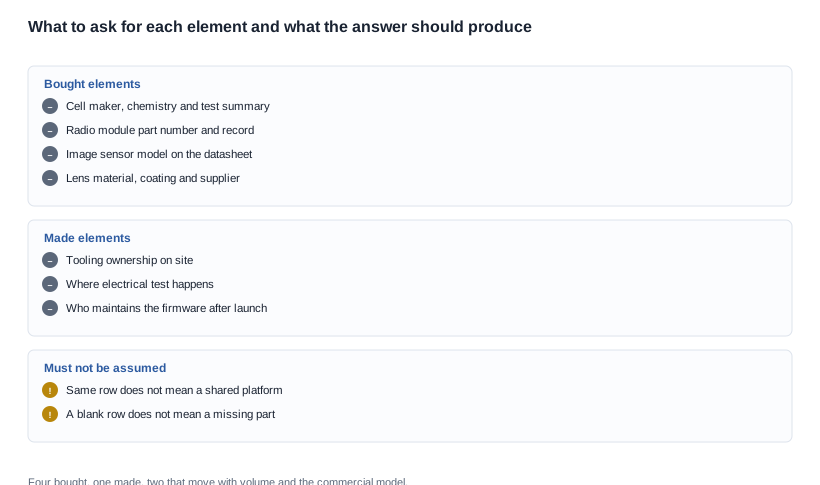
The seven elements are the cell, the radio module, the image sensor, the lens, the frame and temples, the board assembly, and the firmware. That is not a complete bill of materials — it is a decomposition of the product into the decisions that separate a manufacturer from an intermediary, and each of the seven has a different normal answer and a different proof. Four of them are bought in, because they are regulated, specialised or concentrated in the market: the cell, the radio module, the image sensor and the lens. One is normally kept in house, because it is the work that defines the product and the capability that a factory is structurally incentivised to retain: the frame and temples. Two genuinely vary with volume and with the commercial model: the board assembly and the firmware.
What the catalogue publishes supports that decomposition without completing it, and the support is more useful than it first appears. It publishes a charging method for twenty-four of the twenty-eight entries — magnetic on seventeen, Type-C on seven, and nothing for the CY05 and the L1 Pro, and the MT6 and the CY03 — which tells a buyer that the charging circuit is a designed element of those products rather than a commodity. It publishes a removable inner frame on the V06 and the S7 and a removable temple on the G07, which tells a buyer that the frame and temple are manufactured elements with their own tooling and their own fit characteristics. It publishes an IP54 marking on the V06 and the S7 as a catalogue marking with no third-party test report reference attached to it, which tells a buyer that the enclosure and its sealing are elements the manufacturer owns and can be asked about.
The seven elements and where the boundary usually sits
The order below follows the way a product is built, from the cell at the centre of the electronics outwards, and each line carries the artefact a buyer should ask for. The outsourcing question set covers the same seven elements from the audit side, and how factories differ sets out the wider distinction.
| Element | Where it usually sits | Artefact that proves the answer | What to ask for |
|---|---|---|---|
| Cell | Bought in | Test summary for the fitted cell | Cell maker, chemistry, summary |
| Radio module | Bought in | Part number and qualification record | Module part number, qualification ID |
| Image sensor | Bought in | Model named in a datasheet | Sensor model, lot consistency |
| Lens and coating | Bought in | Lens specification and supplier | Material, coating, prescription options |
| Frame and temples | Kept in house | Tooling held on site | Tooling ownership, fit tolerance |
| Board assembly | Either | Where electrical test happens | In-house or partner, test coverage |
| Firmware | Either | Who owns it after launch | Named owner, update commitment |
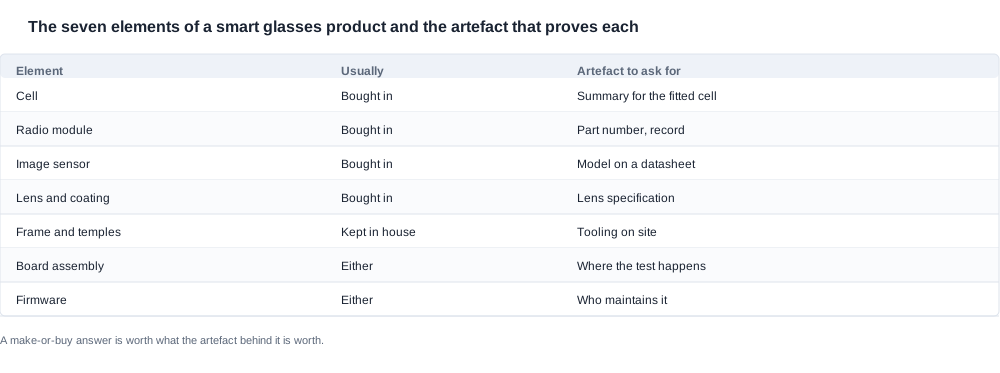
The first four lines share a structure, and that structure is what makes them safe to outsource. Each is a component whose supply is concentrated, whose qualification is expensive and whose quality is set upstream rather than by the manufacturer. A factory that designed its own cell would not have a better cell; it would have a worse one and a longer schedule. The buyer's correct expectation of a factory is therefore not that it makes everything but that it knows what it bought, and the artefact that distinguishes a factory from an intermediary here is specific and checkable: a part number, a qualification record, a test summary, a model designation. An intermediary can produce all four as well, which is exactly why the buyer has to go one step further and confirm that the part is the part in the units — through a bill of materials, a component marking on the product, or a production line check.
The fifth line is the one that separates the two supplier types most reliably, because the frame and temples are where a manufacturer's tooling, its fit tolerances and its repeatability live. A supplier that owns the tooling for a frame can change that frame; a supplier that buys frames from a factory cannot. The question that exposes the difference is not about processes at all, it is about property: whose name is on the tool, and what happens to it if the programme ends. A company that has no tooling to lose cannot lose it, and the answer to that question is a reliable signal that costs a buyer one message to send.
The last two lines are the ones that genuinely vary, and they vary with volume and with commercial model rather than with capability. Board assembly is commonly done outside at low volume and in house at production volume, and neither answer is a warning sign on its own. What matters is where the electrical test happens, because that is where a defect is caught, and a supplier that outsources assembly and keeps the test has kept the part of the process that determines whether defects reach a customer. Firmware is the hardest of the seven to resolve, because the question is not who wrote it but who owns it after the launch, and what happens to units already in the field when the buyer stops ordering. A supplier that answers that question clearly has thought about the long tail of the product.
Where the boundary usually sits, and why the volume matters
The make-or-buy boundary in this category is not a preference, and it is not fixed by the supplier's character. It is driven by three things: how expensive it is to qualify a supplier for that element, whether the element's specification is stable enough to be specified once, and whether the volume ever justifies bringing it in house. Those three drivers explain the seven-line pattern above without needing any assumption about how good the factory is.
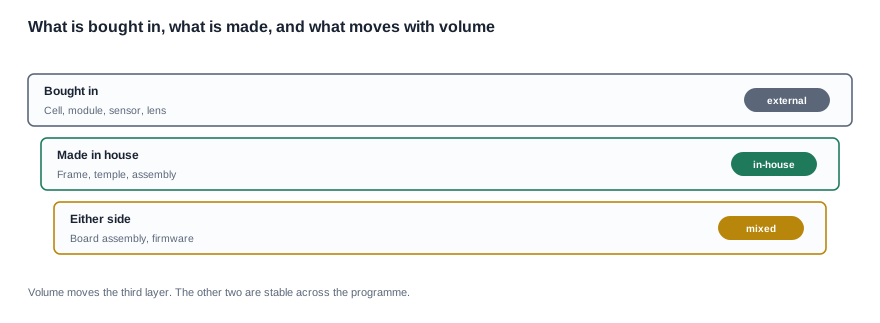
Qualification cost explains the first four. A cell supplier is qualified, a radio module supplier is qualified and the qualification travels with the part rather than with the factory. Buying it in is cheaper than re-qualifying it, and the record of that qualification is a document the buyer can ask for. Specification stability explains the lens: once an optical specification is written, it can be bought from a specialist for the life of the programme. Volume explains the last two, because the fixed cost of an assembly line and a firmware team is only recovered over enough units, and a supplier's answer on both changes with the number quoted rather than with the technology.
The consequence for a buyer is that the two answers which change with volume are the two that have to be pinned to a number in the agreement. If assembly moves in house at a particular volume and firmware moves to the buyer at a particular stage, then the point at which each moves is a commercial term with a cost attached, and it belongs in the contract rather than in a conversation. The four stable answers belong in the technical file, where a change-control rule can reach them.
A second consequence is worth naming, because it is a source of disagreement that has nothing to do with performance. A buyer who assumes the supplier owns the firmware upkeep and a supplier who assumed the buyer would own it can both be acting reasonably and still arrive at a programme where neither party is looking after it. The same is true of a spare-parts arrangement, of a repair path for a returned unit and of the document set for a product that is still in the field. These are not technical failures; they are gaps in an assumption that everybody made and nobody wrote down.
What the catalogue's silence tells a buyer
The published sheet in this range is dense on hardware and empty on everything that runs, and for a make-or-buy question that asymmetry is informative rather than merely disappointing. Where the catalogue publishes a row, the element is a designed part of the product that someone owns a decision about: a charging method, a resolution class, a removable inner frame, a colour set, an ingress marking, a charging-case capacity. Where the catalogue publishes no row, the element is more likely to be a bought-in commodity whose specification the catalogue does not attempt to describe — and a buyer who wants to see it has to ask for it.
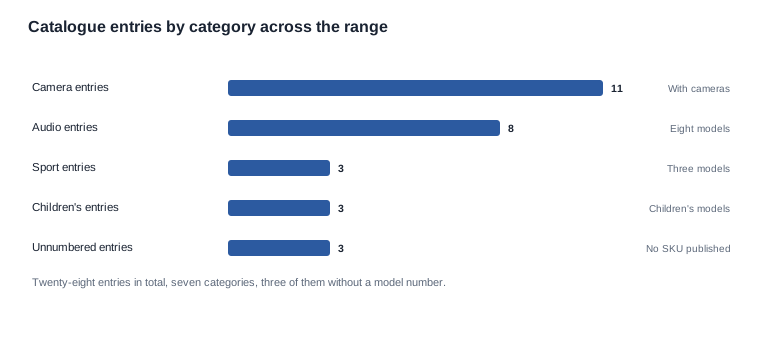
The catalogue's published rows support that reading in a specific way. The Bluetooth version is published for fourteen of the twenty-eight entries — V5.3 on the K01 and the K02, V5.4 on the other twelve — and it is not published for any of the eleven camera models, nor for the A05, the A06, nor for the bone-conduction entry. The resolution class is published for all eleven camera models, eight megapixel across eight of them and thirteen megapixel across the S7 and the L1 Pro, and the L2 Utral, with no sensor model, no field of view, no frame rate and no video format for any of them. The catalogue publishes no touch row for any model. It publishes no material name for any model, and no frame weight for any model other than the 158 g figure for the MT6 assembly.
None of those silences is a defect, and each one is a pointer. A buyer who wants to know whether the radio module is a bought-in part with a qualification record attached has a much better chance of getting a straight answer about a model that publishes a Bluetooth version, because there is a published row to anchor the question to. The same applies to the camera models: the resolution class is published, so the sensor is a named purchased element, and the absence of a sensor model tells the buyer that the sensor's identity is not something the catalogue treats as a product specification.
The one caution attached to this is worth stating, because the inference is tempting and it is wrong. The catalogue publishes no per-model certification row for any entry, and the catalogue text carries no reference to CE, FCC or RoHS; the company page that carries the words export certification shows ten patent certificates as images — eight appearance designs and two utility models. A published row in one area of the catalogue is not evidence of a published row in another. The same applies to the reverse direction, and more sharply: two models that publish identical rows are not thereby running the same platform, and a buyer who treats a shared specification line as a shared firmware branch, a shared application or a shared accessory family has built an assumption that no published row supports.

Verifying a make-or-buy answer with four checks
Four checks turn a make-or-buy answer from a claim into evidence, and all four can be run without visiting a factory. The first asks for the artefact rather than for the story: a part number, a qualification record, a test summary, a tool asset, a test procedure, a named owner. The second checks the artefact against the goods, because a part number that appears in a supplier's file has not thereby been confirmed in the units, and a bill of materials that names one cell while the production line fits another is a defect that will be found by a market surveillance authority rather than by the supplier.
| Check | What it establishes | Cheap way to run it |
|---|---|---|
| Artefact test | The element has an identifiable owner | Ask for the document or part number |
| Consistency test | The artefact matches the ordered unit | Compare against a bill of materials |
| Site test | The claimed process happens on site | Ask for production line questions |
| Continuity test | The element is owned after launch | Ask who owns the update |
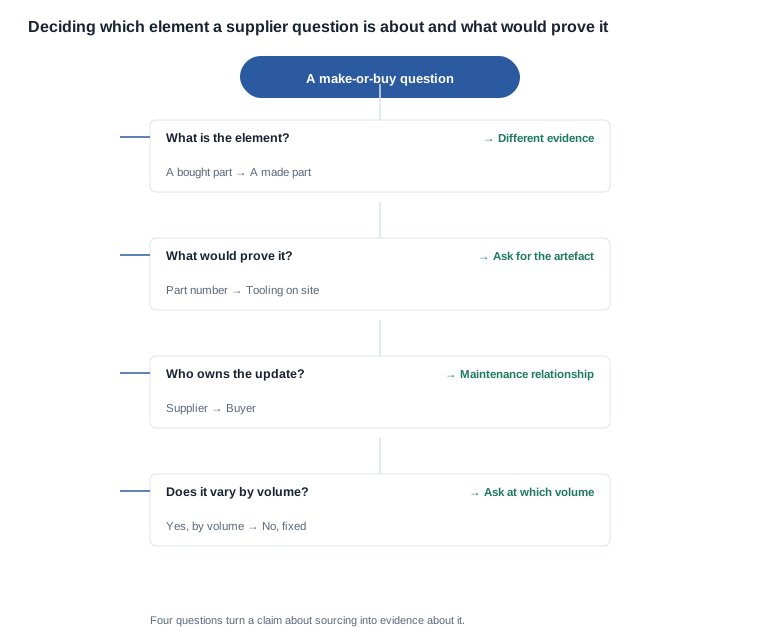
The third check is the one that only a supplier who actually operates can pass, and it is the check that a video walkthrough can begin but not complete. Ask about the production line rather than about the company: where the line starts, where the electrical test happens, what is measured at that test, what happens to a unit that fails it, and where the units that pass are packed. The production line question set and the worker and facility checks cover this in more detail, and the reason the line matters more than the head office is that the head office is where a trading company looks most like a factory.
The fourth check is the one most often skipped and the one with the longest tail. Continuity asks what happens to the firmware, the spare parts, the repair route and the document set for a product that is still in the field after the buyer has stopped ordering. A supplier that answers this in terms of its own obligation has told a buyer something useful about how the relationship will end, and that answer is worth more than any of the seven element answers because it is the only one that describes the whole programme rather than a part of it.
What do you outsource: the three-part answer for a procurement file
Published: twenty-eight entries — eleven camera models, eight audio models, three sport models, three children's entries and three entries published without a model number; a charging method on twenty-four of them, split magnetic and Type-C with the CY03 and the MT6, and the CY05 and the L1 Pro carrying no charging-method row; a charge time and a rated runtime on every entry; a resolution class on the eleven camera models; a Bluetooth version on fourteen; a removable inner frame on the V06 and the S7 and a removable temple on the G07; an IP54 catalogue marking on the V06 and the S7 with no third-party report reference attached; colour on the V03 Pro and the V06; a charging-case capacity on five camera models; and a weight on the MT6 assembly alone. Not published: the cell maker, the cell chemistry and the cycle-life figures; the radio module part number; the image sensor model, field of view, frame rate and video format; any touch row; any lens material, coating or optical measurement; any material composition for a frame; any frame weight other than the MT6 figure; any production capacity, minimum order quantity, unit price or lead time; any per-model certification row, and any reference to CE, FCC or RoHS in the catalogue text. Ask the supplier: the artefact for each of the seven elements, the consistency check against the bill of materials for the exact configuration, the line questions for the claimed in-house steps, and the continuity answer covering firmware, spares, repair and the document set after the programme ends.
The wording rule is narrow, and it is the same rule that applies to every other published row in this range. A procurement file may state that a part is bought in, that a document exists for it and that the document names a particular part number. It may not state that the product is certified, because no published row supports that for any model, and it may not describe an internal platform, a shared application or a shared accessory family, because the catalogue publishes identical specification lines without any published evidence that the underlying platforms are the same. Those two temptations are the same error in different clothes: reading a silence as a positive statement about something the catalogue does not describe.
For a buyer running due diligence on a supplier in this category, our position is that the make-or-buy answer matters less than the artefact behind it, and that the artefact list is the same for every supplier in the industry. A cell maker and a module part number, a test summary for the fitted cell, a sensor model, a lens specification, tooling that belongs to the supplier, a stated place for electrical test, and a named firmware owner: these seven items either appear in a reply or they do not, and the ones that do not are the ones that decide what kind of business the buyer is dealing with.
Related reading
- The same seven elements asked from the audit side — what to ask about outsourcing
- Why some factories outsource more than others — outsourcing and factory type
- The questions that separate a line from a showroom — production line questions
- The checks that only work on site — worker and facility checks
- The wider distinction in full — how factories and trading companies differ
Ask for the artefact behind each of the seven elements, for the exact configuration in the order, and the make-or-buy answer can be checked rather than believed.


