

Most of a pre-ordering checklist for the G07 is the same checklist that applies across the audio range. One question is not, and it decides whether the model is worth stocking at all: is the detachable temple user-replaceable, or factory-only? That single phrase is the reason this model exists in our catalogue. It is the only published detachable temple in the Bluetooth audio range, and it is a service story, a sizing story and a retail story in one word. Both answers are defensible. Only one of them supports the premium the model will otherwise cost you.
The rest of this article is the method for closing the other rows — weight, dimensions, control method, charge behaviour, acoustics and certification — before the quotation becomes a purchase order, and for working out which buyer the G07 serves when the answer to the temple question goes the way it goes.
The order below is deliberate. The temple question goes first because a wrong answer there changes which model you buy; the specification rows go second because they change what you write; the commercial rows go last because they are the ones a supplier can commit to and therefore the ones worth having once the specification is settled. Buyers who work through this in a different order usually end up asking the temple question last, at which point the model has already been priced into their plan.
G07 temple question: the one answer that decides the model
The published row records an ultra-slim detachable temple, and it is recorded in our catalogue as an available configuration for this model. Everything that separates the G07 from the LC-105-1, the LC-105-2 and the YK12 — all of which sit on the same paired-cell platform — is that temple. Ask four things about it.
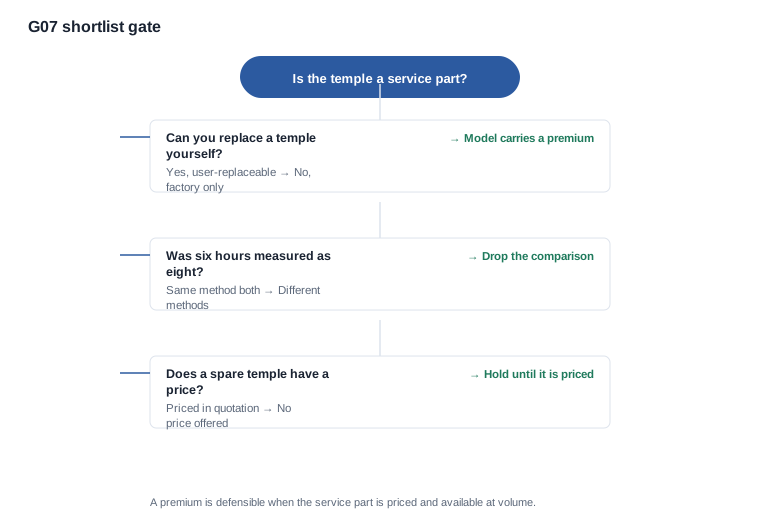
Whether it is user-replaceable or factory-only. This is the question that carries the commercial value, and it needs a yes or a rather than a description. A description in this context is usually a way of avoiding the answer.
What the mechanism actually is. A release catch, a screw, a moulded joint and a bonded assembly are four different products with four different service costs, and the wording on a datasheet rarely distinguishes between them. Ask for the specific mechanism.
What the failure mode is. This is a safety question for a frame carried on the face during movement. A catch that releases under load is a different proposition from a screw that requires a tool, and a bonded assembly is a different proposition again. The failure mode determines whether your channel partner receives a damaged frame or a loose one, and those generate entirely different conversations.
Whether replacement temples are available as a spare part, at what volume, and at what price and lead time. A user-replaceable temple with no priced spare part is not a service feature. It is a description.
Whichever answer arrives, record it in the same words your retailer will read. If the answer is user-replaceable, the sentence that goes into your channel documentation is the one a store colleague can use without asking you, and that means naming the tool, the number of steps and whether two hands are needed. If the answer is factory-only, the sentence is equally specific: a damaged frame becomes a warranty claim with a stated route and a stated allowance. Vague service language is what turns a good feature into a support cost, and it is far cheaper to fix at this stage than after the first hundred units are in the field.
The user-replaceable answer is worth real money, and the reason is arithmetic rather than sentiment. It turns a damage event from a warranty claim — which consumes a unit, a return shipment and a support contact — into a five-minute swap against a spare part you stock. It also turns a fixed-size frame into something a retailer can adjust, which is the difference between a product sold once and a product sold through a channel that has to serve more than one head shape. The factory-only answer makes the detachable temple a manufacturing feature rather than a service feature, and your listing should then say so in those words rather than implying otherwise. Buyers who discover the difference after launch will not treat it as a design decision; they will treat it as a description that did not match the product, and that is a reputation cost rather than a product cost.
Eight rows to close before the quotation is accepted
The published specification for this model is Bluetooth V5.4, paired 55 mAh cells, magnetic charging in up to two hours, a rated runtime of approximately six hours, and the temple configuration. Everything else is an open row, and the order below is the order in which to ask them.
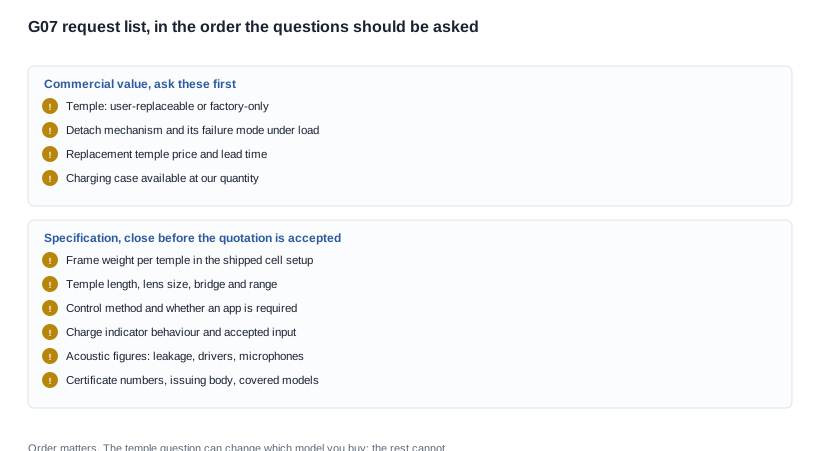
- Frame weight, per temple if they differ, and in the shipped battery configuration. Not published, and it is the row that decides the return rate in a product carried all day.
- Temple length, lens dimensions, bridge width and the adjustment range. Not published, and a detachable temple is only useful if the sizing can be described to a retailer who is fitting the frame for somebody else.
- The control method. No input method is published for this model. The K01 is the only model in the range with capacitive touch published, so if your listing copy says tap to answer, this is not the model to list it against.
- Charge indicator behaviour, and the charging input the device accepts. Not published, and a magnetic interface fails silently when it is misaligned, which means the failure surfaces as a support contact rather than as a fault report.
- Whether a companion application is required, who publishes it, which phone systems it supports, and where any data is held. Not published, and an undocumented app dependency is a support cost that lands on you.
- The acoustic figures — leakage, driver size, frequency response, microphone count and pickup distance. Not published, and the G07 publishes no sound claim of its own, so a competitor comparing two products has nothing to point at except the absence.
- Certificate numbers, issuing body, validity period and the schedule of covered models. Recorded as pending confirmation for this model.
- Minimum order quantity, lead time and price. Not published, and these belong in a quotation where they can be committed to.
The control method row deserves more attention than its position in the list suggests. When no input method is published, the practical consequence is that nobody in your channel can write a usage instruction, because the instruction depends entirely on the method. A buyer who receives a product with undocumented controls will not describe it as undocumented; they will describe it as difficult, and the review that results costs more than the answer would have.
Rows one to six are specification questions and rows seven and eight are commercial questions, but they belong in the same exchange because splitting them produces two slower conversations instead of one. Send them together, with a deadline, during supplier evaluation. The answers that arrive together also tend to be answers that agree with each other, and answers that disagree with each other across two emails are usually the result of two different people answering from memory.
The same cells, a two-hour spread, and what that tells you
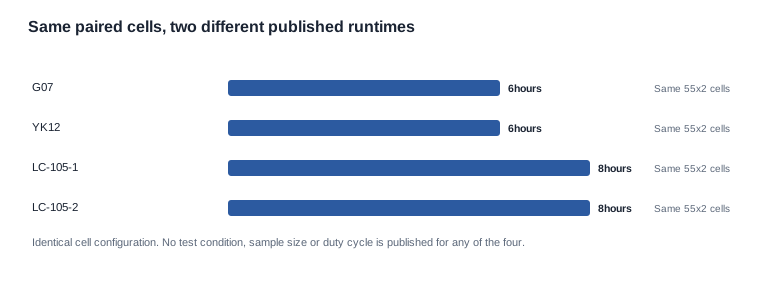
The G07 publishes approximately six hours. The LC-105-1 and the LC-105-2 run on the same paired 55 mAh cells and publish approximately eight hours. The YK12, on those same cells, publishes six. An identical cell configuration is producing a two-hour spread inside one family, and that is not a battery story — it is a measurement story.
The practical consequence is that the four figures cannot sit in the same comparison chart on your site. Not because one of them is wrong, but because none of them carries a stated condition, and a difference that large inside one family tells you the published figures are describing a duty cycle and a test method rather than a cell. The question worth asking is therefore not whether six hours is enough. It is whether the six hours was measured the same way as the eight. If the answer is yes, the difference is a real platform characteristic and a real argument for the LC-105 pair on endurance grounds. If the answer is no, the figures describe different conditions and comparing them will mislead whichever way the comparison runs.
Ask what was active during the measurement, over how many units, and whether the figure is a mean or a best case. Record all three in your order file. A runtime figure with those three fields attached is comparable to another runtime figure with those three fields attached; a bare figure is only comparable to itself.

A useful discipline for your own site is to hold every runtime figure to the same three fields or to none of them. A chart where three models carry a condition and four do not is worse than a chart with no conditions at all, because the reader cannot tell which is which. If you cannot obtain the conditions, publish the figures as bare numbers, label the column accordingly, and let buyers draw their own conclusions. That is defensible. A selectively annotated comparison is not.
There is also a structural question worth putting to a supplier, because it is cheap to ask and expensive to assume. The G07's temple is a mechanical difference from its siblings, and a slimmer temple can mean a slightly different acoustic path or a different radio position relative to the head. Whether that matters is not something we can tell you from the outside. Whether it changes the runtime measurement is something the supplier should be able to answer, and an answer of "we have not measured that combination" is itself a useful answer because it tells you which figure describes which hardware.

Sample order: prove the temple claim in five minutes
Because the model's value rests on one mechanical feature, the sample order for the G07 has a different priority order from the audio models. Spend your test time on the temple, then on the rows that a datasheet cannot settle.
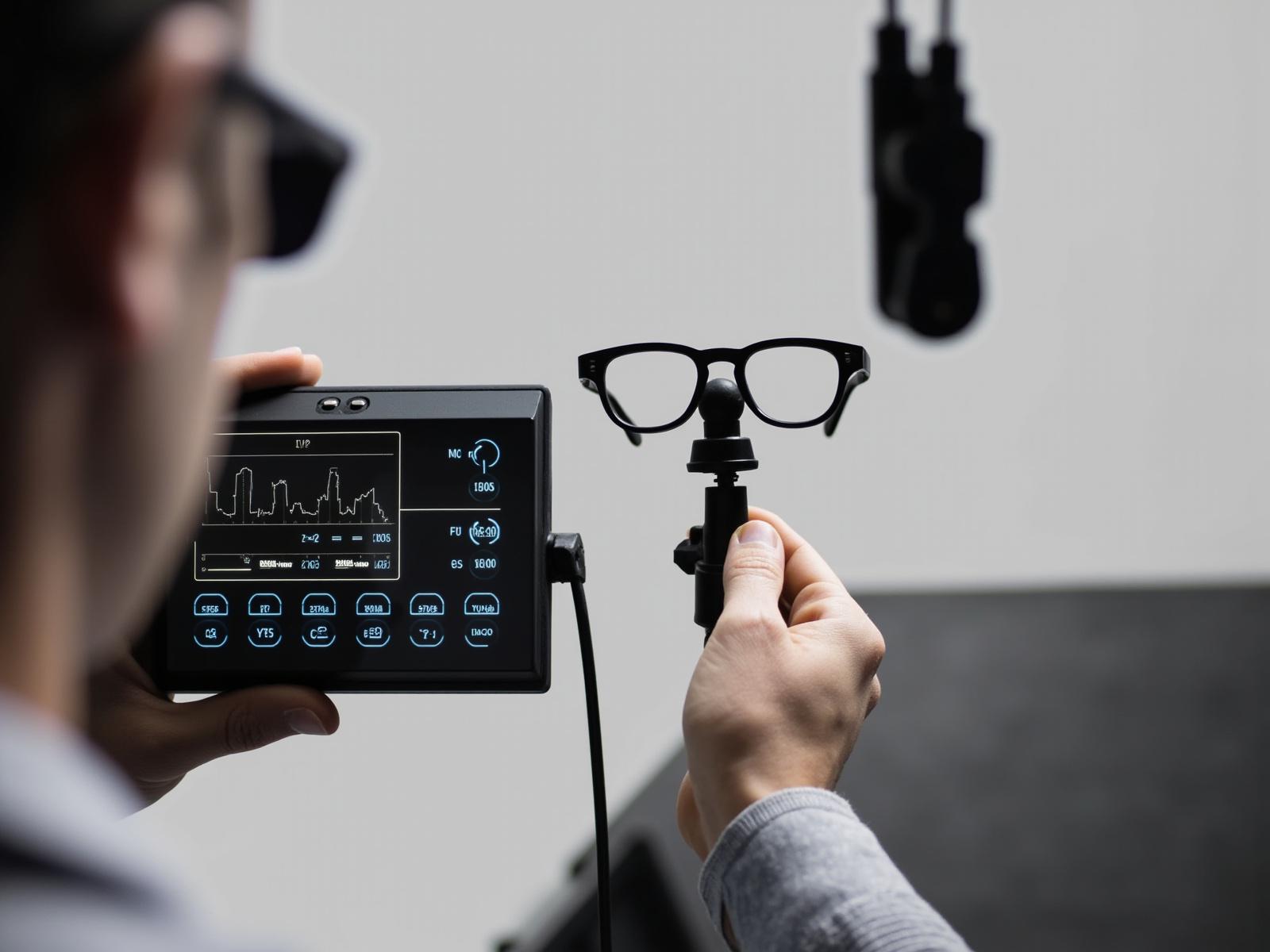
- The temple swap. Attempt the swap yourself, on a desk, with whatever tool the answer says is needed. Time it. Count the steps. Record whether a second person is required. This is the test that either validates the service story or ends it.
- The failure mode. Load the temple deliberately — not to destruction, but firmly enough to show whether it releases, slips or holds. Record what happened rather than what you hoped would happen.
- Weight and balance per temple. Weigh both temples separately with cells fitted, and record the difference. An uneven pair is a return driver in a product whose selling point is that its parts are interchangeable.
- The charging case. Charge a unit in the case and then on the pad, and record whether the indicator behaves the same way in both. Silent misalignment is the failure you are testing for.
- Call test in reproduced background noise. Fixed source, fixed distance, fixed position; record the setup before the result.
- Port, cable and packaging. Confirm the retail contents against the quotation, line by line.
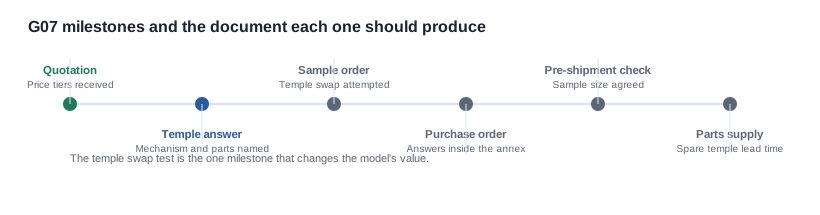
Keep the sample units and the spare temples with them. When the production lot arrives, repeating the swap test on a unit from the packed cartons is the cheapest possible check that the service story survived manufacturing, and it is the check most often skipped because it seems obvious.
Score the sample against the rows you asked to close, not against an impression. Any row where the sample contradicts the written answer is a written question to send back before you commit, with a deadline. Treat a contradiction as due diligence on the supplier rather than as a defect notice, because the second framing produces a concession and the first produces a correction.
Commercial rows that are not published for this model
Minimum order quantity, lead time and price are not published for the G07, and our internal documentation currently holds conflicting minimum order quantity figures that have not been arbitrated. The temptation to plan a volume range on any one of them should be resisted, because a range built on a wrong figure is a range that has to be re-planned, and a re-planned range is usually the one that ships late. Ask for the figure at your quantity in a quotation, ask whether it differs per colourway, and ask what changes if you consolidate colourways into a single run.
The certification position is model-specific and unpublished. Our catalogue carries no CE, FCC or RoHS row for this model and no certificate numbers, so nothing in our own record supports a conformity claim for it. Ask for the numbers, the issuing body, the validity period and the schedule of covered models, and check that your purchase order designation appears on the schedule. A certificate that covers a platform but not the model code on your paperwork is not coverage for your goods, and that is the single most common document failure in this category.
Two clauses are worth negotiating while the conversation is still open. Tie the balance payment to a passed pre-shipment inspection rather than to a shipping date, so the money and the evidence move together. Write the defect allowance and its remedy beside each other, because an allowance without a remedy becomes a negotiation that starts once the container has sailed. Where a supplier resists both, record the resistance against the supplier rather than against the model: it is a reasonable forecast of how a dispute will be handled six months from now.
The spare-parts question follows directly from the temple answer and belongs in the commercial terms rather than in a discovery exercise after the first damaged unit. If the temple is user-replaceable, a replacement temple is a catalogue line with a price, a lead time and a minimum order. If it is factory-only, a damaged frame is a warranty claim with a defined allowance, and the allowance should be written down before the first one happens rather than negotiated during it. Both outcomes cost money; only one of them is predictable, and predictability is the thing you are buying when you close this row.
What the G07 is worth, and who should not shortlist it
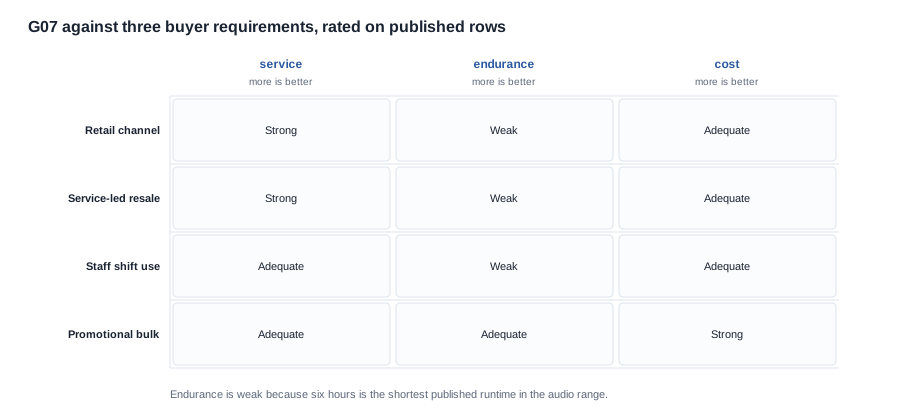
Name the cases, because a shortlist containing only the model you can supply is not a shortlist. If your channel is built around call quality, the G07 has no published microphone pickup figure and you will lose a comparison against a model that publishes a method. If your buyers are on long shifts, six hours is the shortest published runtime in the audio range, and that is a hard number to lead with even though no condition is attached to it. If your channel needs a sealed or rugged product, no ingress rating means the G07 cannot be positioned there at all. If your retail partners cannot adjust a frame in store, the detachable temple buys them nothing and you are paying for a feature their customers never meet.
Where the G07 does earn its place is a channel that can service a frame, that sells on lightness and slimness rather than on specifications, and that has a genuine answer for a customer who has damaged a temple and does not want to replace the whole product. That is a narrower channel than most people assume when they see a detachable temple on a datasheet, and the honest way to size it is to ask how many of your retail partners would actually stock a spare temple before you ask whether the mechanism works.
If you want a starting point rather than a full evaluation, the fastest useful sequence is short: ask the temple question, ask the weight, ask the runtime condition, and stop there. Those three answers are enough to decide whether the model belongs on your shortlist at all. Everything else on the list matters once you have decided to proceed, and none of it changes that decision. Buyers who ask the eight questions at once often spend a week on a model they should have dropped on day one.
The G07 is a range specialist with one published feature, and the feature is worth a premium if the temple is user-replaceable. If it is factory-only, the G07 is a slim-temple open-ear frame at the shortest published runtime in the audio range, and the LC-105-1 or the LC-105-2 may serve a buyer better. We will not assume which of the two the temple is, and we will not fill in the weight, the dimensions, the control method or the certification detail with values we do not hold — a figure we cannot defend becomes your problem the first time a customer returns a unit.
Tell us the model, the quantity and the market, and we will come back with the specification, the gaps and the questions we can settle.
Related reading
- Where this model sits across the range — which Bluetooth audio glasses model to pick
- The document set to request before you commit — Bluetooth SIG certification checklist
- Reading competing runtime figures honestly — battery comparison for Bluetooth audio glasses
- Building a spare-parts line into the order — private label options
Tell us the channel, the volume and the target market, and we will come back with what is available.


