
Three questions arrive in one. Do I strap the camera to the rider's helmet, do I clamp it to the rider's glasses, or do I make the glasses good enough to hold still on a face that is sweating, shouting into the wind and pressed against a helmet strap? Those are not the same product, and the difference shows up in the invoice, in the accessory chain, and in the return rate.
Good frames are held by three things at once: the temples, the bridge, and friction at the skin. The first two are geometry, and geometry is measurable in millimetres. The third is a condition, and on a summer climb it changes four times an hour.
What our catalogue publishes is worth stating precisely, because the honest position is narrow. The V06 and the S7 publish an IP54 marking, an ergonomic frame construction, and a detachable inner frame; the V06 adds four published colour options. The D17 and the ZH12 publish a remote shutter, so a rider never has to touch a temple mid-session. Beyond those rows, the range publishes no temple length, no temple curve, no head-size range, and — with a single exception elsewhere in the range — no weight.
We have not published a retention figure because we do not hold head-shape data, and we would rather tell you how to establish retention on your own riders than hand you a number we cannot defend. This page is written for the buyer who has to decide, before a purchase order, whether a wearable is even the right answer to the brief in front of them.
How do I mount it securely: what holds the frame on during a ride
Retention is not one property. It is the sum of a static geometry and a dynamic condition, and the two fail in different ways. A frame with perfect temple geometry still slides when a rider's temples are wet, and a frame with a rubberised bridge still slides when the rider's head shape falls outside the range the bridge was drawn for. Any retention claim that does not separate the two is incomplete.
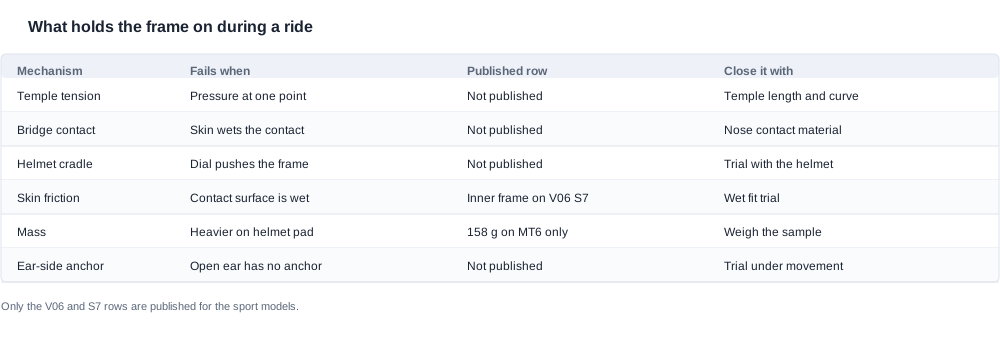
The table below lists the six mechanisms that decide whether a frame stays on, what actually causes each one to fail, what our catalogue publishes about it, and the question that closes the gap.
| Mechanism | How it fails | Published in our catalogue | The question that closes the gap |
|---|---|---|---|
| Temple tension along the head | Pressure concentrates at one point instead of spreading along the temple | No temple length, temple curve or head-size range published for any model | The temple length and curve in millimetres, per model, on a drawing or a measurement sheet |
| Bridge and nose contact | Slides down as the skin wets; the contact material matters more than the shape | Not published | The nose-contact material, and whether it is a replaceable part |
| Helmet retention cradle | The helmet's dial presses on the frame and pushes it down at the sides or holds it away from the head | Nothing published | A fit trial with the exact helmet, on the exact rider |
| Skin friction at the temples | Drops sharply once the contact surface is wet, which is the normal state in sport | The V06 and the S7 publish a detachable inner frame | A wet fit trial with the real rider and the real session length |
| Mass and balance | A heavier frame presses differently against helmet padding over a long ride | 158 g for the MT6 only — no other model in the range publishes a weight | A measured weight per model, on your own scales, in the configuration you will ship |
| Temple position relative to the ear | An open-ear design has no ear-side anchor, so the whole load sits on the temples and the bridge | Not published | Retention behaviour under movement, established on a sample |
There are three physical routes a frame can take to stay on a head, and they are worth separating because they fail differently. An over-ear or rear-retention hook takes the load away from the temples entirely, and its failure mode is the hook losing its grip on a collar or a helmet strap. A temple-and-bridge design takes the load on the head itself, and its failure mode is a pressure point that becomes painful over time. A hybrid design shares the load between the two, and its failure mode is usually an asymmetric fit where one temple sits lower than the other and the frame slowly rotates.
None of our sport models publishes a retention hook as a feature row, which means the route is a question to ask the supplier rather than a row to check. It also means the detachable inner frame published on the V06 and the S7 is doing a specific job: it is the part of the temple that takes the skin contact, and taking it off for cleaning is what keeps the friction term in the table above from degrading across a season.
The single most common failure in this channel is not a product failure at all. It is a fit interaction. A cycling helmet has an adjustable retention cradle with a dial, and that dial presses down on the temples. A frame designed to be worn without a helmet may have temples that sit lower, higher, or at a different angle than the cradle expects. The result is a frame pushed down at the sides, or held slightly away from the head — and both of those are visible in the footage the customer is buying.
That failure looks like a retention problem and is actually a specification problem, and the fix is a single trial with the helmet the customer already owns.
A second observation belongs here because it changes what you sell. The detachable inner frame published on the V06 and the S7 is not a comfort feature in the abstract — it is the published answer to the sweat-and-fit problem. A worn inner frame can be removed, cleaned, and replaced; a frame whose skin-contact surfaces are bonded cannot. In a channel where the ambient condition is a wet forehead, that difference decides whether a fit complaint is a five-minute service event or a whole-unit replacement.
Two further rows from the sport tier are relevant to a ride. The D17 and the ZH12 publish a remote shutter, which means the rider does not have to reach up and touch the temple during a session — reducing both accidental activation and the temptation to adjust a frame that is already sitting correctly. The YKC02 publishes two 70 mAh cells, magnetic charging, and a runtime figure of about eight hours, which is a different energy architecture from the camera models and a different answer to the "does it survive the session" question.
How do you tell a wearable fit apart from a mounted camera
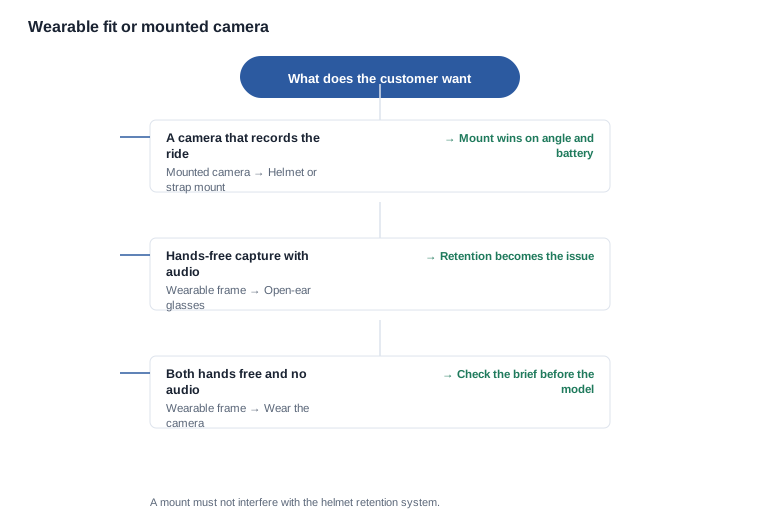
Before any fit discussion is worthwhile, the brief has to be resolved, because a helmet or strap mount solves a different problem from the one a pair of smart glasses solves. If the customer's requirement is a camera that records the ride, a mounted camera is the better product and our range is the wrong answer. If the requirement is first-person capture with both hands on the bars and open-ear audio, wearing is the only option, and the question becomes retention rather than fixation.
The decision tree above is the version we would walk a buyer through on a first call. Read it from the top: the first branch is what the customer actually wants to capture, the second is whether both hands must stay free, and the third is whether open-ear audio is part of the purchase. The two paths terminate in different product categories, and only one of them is ours.
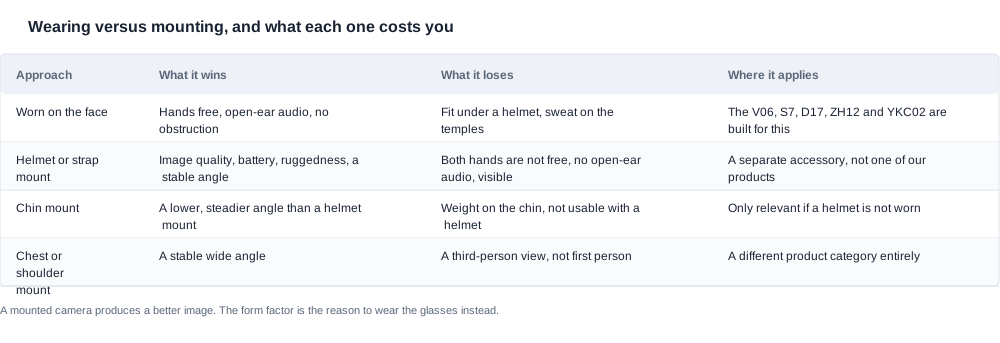
A mounted camera wins on several measurable dimensions. It has a better camera position for the forward view, a bigger battery, a more robust housing, and a completely stable angle because it is rigidly attached to the helmet. It loses on everything the glasses win: the rider's hands are not free, there is no open-ear audio, and the device is visible to everyone in the frame, which changes what a customer can do around other people — and therefore what you can put in the listing.
One safety point belongs in the answer rather than in a footnote. A mount adds an object to the helmet, and it has to sit where it does not interfere with the helmet's retention system or the wearer's field of view. That is a helmet question before it is an accessory question. No accessory we describe should be positioned where it could affect the helmet's function, and we will not describe one that way.
The commercial consequence is bigger than the technical one. A wearable sells a frame and a small box. A mounted camera sells a mount, a battery pack and a second device, and it moves the buyer into a different accessory chain with different minimum order quantities and a different retail story. Which one you are in decides the whole channel shape, so it is worth resolving in one line before anyone looks at a catalogue.

How do you establish the fit before the product is listed
Because the catalogue does not publish retention data, the buyer has to produce it, and the cheapest way to produce it is a written protocol run on a sample with the customer's real riders. The sequence below is the order we recommend, and each step exists to catch a failure mode that the previous step cannot.
- Send the geometry request first. Ask for the temple length, the temple curve, and the measured weight of the frame in the configuration you intend to ship — three items, one message, one model at a time. If a supplier answers with a "fits most people", that is the end of that conversation, because it is not a measurement.
- Run a fit trial with the actual helmet. Not a generic helmet and not the rider who happens to be available. The retention cradle is part of the fit system, and it has to be in the room.
- Ride the real distance. Discomfort appears at forty minutes, not at five. A shop trial never reaches the failing part of the comfort curve, which is why so many "fine in the shop" products come back after one ride.
- Re-check the fit after the session. If the temples ride up, the camera's framing changes and the microphone's position relative to the mouth changes with it. Both of those are commercial problems, not comfort ones — they change what the recorded content looks like.
- Test the wet case. A fit that holds dry and slips wet is a different product, and the wet case is the one that produces the returns. Run the session with the rider's own sweat, not a sprayed bottle.
- Record the outcome in writing. What you measured, on whom, in which helmet, for how long, and what you concluded. That record is the only way to compare a production unit against the sample later.
The order matters. Asking for geometry after the trial wastes the trial; running the ride before the geometry request means you are testing a frame whose temple position you do not know, so you cannot tell whether a failure is a fit problem or a geometry problem.
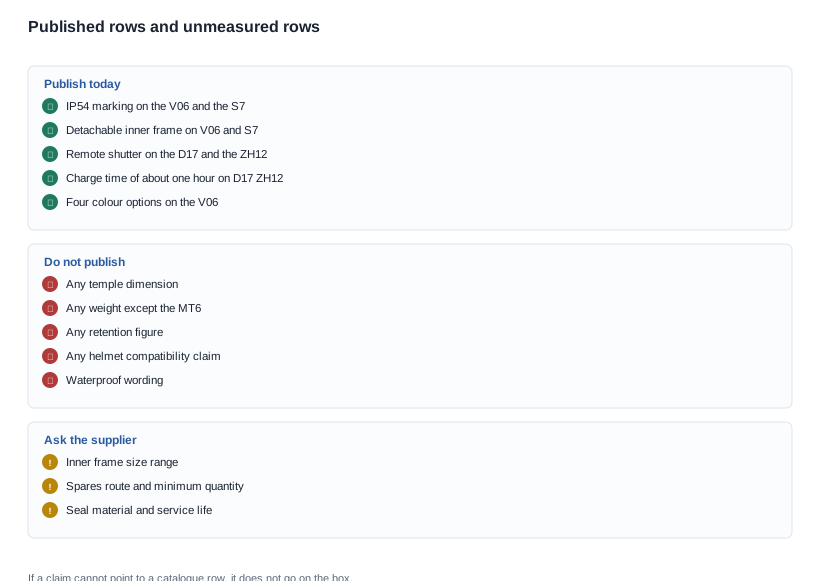
How do the published rows and the unmeasured rows divide
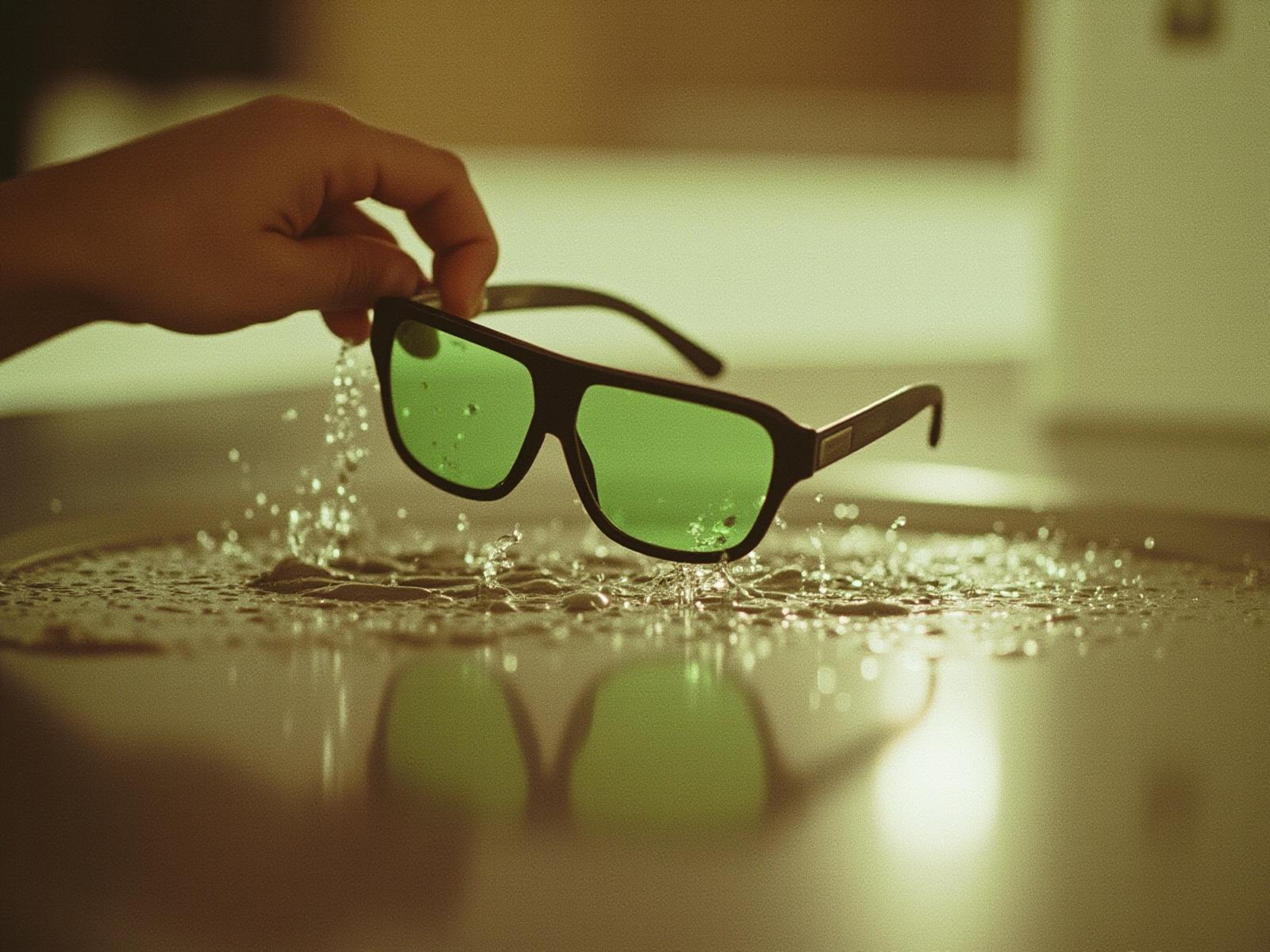
Every listing claim has to sit on one side of a line, and the line is simple: can you point to the row it came from? The checklist above is the version we suggest running against your copy before it is published.
Rows you can publish today, because the catalogue states them:
- The V06 and the S7 carry an IP54 marking.
- The V06 publishes four colour options; the S7's colour rows are separate from the V06's.
- The V06 and the S7 publish a detachable inner frame and an ergonomic frame construction.
- The D17 and the ZH12 publish a remote shutter.
- The D17 and the ZH12 publish a charge time of about one hour; the rest of the range publishes two hours or less as the ceiling.
- The YKC02 publishes two 70 mAh cells, magnetic charging, and a runtime figure of about eight hours.
- The YK12 and the G07 publish slim and ultra-slim temple constructions, which are audio-seal geometry rather than a sport retention feature — a distinction worth keeping straight in the copy.
- The full range is on the sport smart glasses page, and the scenario context is under smart glasses for cycling.
Rows you cannot publish, because they are not published:
- Any temple length, temple curve, or head-size range, for any model.
- Any weight, with the single exception of the MT6's 158 g, which is published for the glasses only and excludes its 1200 mAh foldable case.
- Any retention figure, any "stays put", any "no slip", any helmet compatibility claim.
- Any ingress claim on a model that does not carry the IP54 marking, and any claim that a model is waterproof.
- Any seal material, any seal life, any drop rating.
Two of these deserve particular attention because they are the ones that get written anyway. The first is helmet compatibility. There is no published data linking any model to any helmet, so a listing that names a helmet model is making an unsupported statement about a third party's product and about our own. The second is waterproof language. The V06 and the S7 carry an IP54 marking, which describes protection against water splashing in any direction — not immersion, not a shower, not a downpour, and not sweat. Writing "waterproof" beside that marking is a claim the marking cannot carry.
A worked comparison helps more than the rule does. Take a cycling brand building a first sport line with two candidate models. The V06 and the S7 are the two camera models that carry an IP54 marking, both publish a detachable inner frame and an ergonomic frame construction, and both are the models in the range for which a splash claim is defensible. Between them, the V06 publishes four colour options and the S7 does not publish the same set, so the S7 becomes the volume model and the V06 the colour model for a retail listing. The YKC02 is a different proposition entirely: it is a sport model with two 70 mAh cells, magnetic charging, surround audio and a runtime figure of about eight hours, which makes it the audio-led option for a customer who wants a long session and no camera at all.
What that comparison does not tell you is which of the three holds up on a fifty-kilometre ride in July. Nothing in the catalogue answers it, and no amount of reading the specification sheet will change that. It has to come from the fit trial, which is why the sequence above is the section a buyer should read twice before writing the purchase order.
The same comparison run in the wrong order produces a familiar commercial mistake. A buyer who shortlists on the published rows alone will conclude that the two camera models with IP54 markings are the sport answer, ship them, and discover the fit problem in the first season — at which point the cost of a fit trial is a rounding error against the cost of a returned pallet. Which model you pick on the published rows and which model survives the season are two different decisions, and the second one is the expensive one.
The broader framing is that your listing copy and your technical file should describe the same thing. When a customer reads the box, asks a question, and gets an answer that contradicts the box, the cost lands on your support desk for the life of the channel.
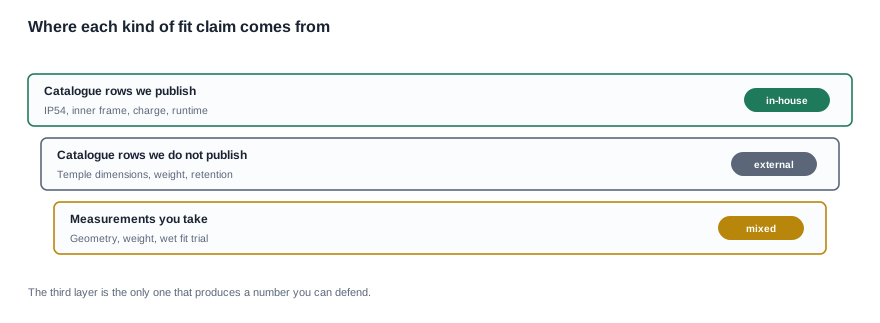
How do the commercial terms follow from the fit decision
The retention decision is worth money, and the money sits in the terms rather than in the unit price. A fit failure in a sport channel is expensive because it is discovered late, in bulk, in a season you cannot repeat. The terms that protect against that are the ones worth spending negotiation time on.
Negotiable, and worth asking for explicitly:
- Unit price and volume tiers, with the tier breaks written down. Ask which tier your actual volume lands in rather than accepting the band that happens to contain it.
- The spare-parts set and its minimum order quantities. The contact, the seal, the inner frame, the temple. This single line decides whether a fit complaint costs you a service kit or a whole replacement unit, and it is usually the cheapest line on the quotation with the largest effect on your return rate.
- Packaging specification, including whether the inner frame and its spares ship in the box, in the carton, or separately.
- Delivery splitting, so that a first pilot can be split from the main order rather than locked to the same dispatch.
- Payment nodes against inspection, not simply a deposit and a balance.
- The warranty period and a stated response time, which is a different thing from the warranty period.
- Return terms for a cycling channel, including what the buyer must do with a returned unit and in what condition.
- The terms of a pilot order, so that a first run is a smaller commitment than the annual forecast.
Quotable rather than negotiable, because they follow a process rather than a conversation: certification cost and certification lead time, which belong to the testing body rather than to either party; and tooling, which is frequently amortised across a first order while certification is charged per product family. Ask which of the two you are being quoted, because the two are often bundled into one line that hides which is which.
The trade-off worth naming explicitly: a tighter lead time usually costs more per unit, and a longer lead time usually costs more in working capital and in seasonal risk. A buyer who negotiates unit price to the last cent and then accepts a vague delivery schedule has optimised the wrong end of the quotation. Set the schedule first, then negotiate the price inside it.
The delivery terms deserve the same attention as the unit price. FOB and DDP are not variants of one another — they place the risk of loss, the cost of insurance and the cost of import clearance in different places, and a buyer who treats the difference as a rounding difference is negotiating the wrong variable. In a sport channel with a seasonal deadline, the useful question is not which term is cheaper on paper but which term leaves you able to react when a shipment is delayed. Whichever you choose, write the delivery window into the order rather than leaving it as a supplier commitment in a conversation.
A negotiation sequence that works on this kind of order is short. Fix the configuration and the quantity before the first call, because both change the price and neither can be negotiated in the abstract. Fix the delivery window before the unit price, because the window is what makes the quantity meaningful. Then negotiate price, then spares, then warranty and returns, then the pilot terms. Reversing that order — starting with unit price and discovering the delivery window late — is what produces a cheap order that cannot be planned around.
Before a shortlist goes to scoring, run one pass of due diligence on the terms above. Which model, which configuration, which spares, which schedule, which return terms — five answers, and any blank is a gap that will surface during a season rather than during a negotiation.
How do we decide what we publish and what we will not claim
The position is deliberately narrow, and it is narrow on purpose. We publish the sport models' published configuration — the IP54 markings on the V06 and the S7, the detachable inner frames, the ergonomic frame construction, the colour rows, the cell configurations, the charge times, the runtimes and the charging interfaces — because those are the rows the catalogue actually holds.
We do not publish temple dimensions, because we do not hold head-shape data. We do not publish weights for the sport models, because we have not measured them. We do not publish retention figures, because a retention figure without a rider population, a helmet, a session length and a wet condition is a marketing sentence rather than a measurement. And we will not describe a splash-protected product as waterproof, or a product as sweat-proof, because the marking we hold does not say that.
What we can do is tell you which models in the range were built for the sport scenario, which of them publish a detachable inner frame, and which questions a sample settles that a specification cannot. The weather side of the same scenario is in smart glasses for sports and outdoor weather considerations, the selection criteria are in sport smart glasses buying guide, and the frame properties behind a secure fit are in smart glasses frame materials for different use cases.
What to do next.
- Resolve the brief in one line — a camera on the ride, or first-person capture with the hands free.
- Send the temple length, the temple curve and the weight request as a single message, per model.
- Run a fit trial with the actual helmet, for a real ride length, and re-check the fit afterwards.
- Ask for the inner frame size range and the spares route, and price them into the order.
- Put the measured fit rows, the spares route and the return terms into the agreement.
Related reading
- The sport range and its published configuration — sport smart glasses buying guide
- The frame properties behind a secure fit — frame materials for different use cases
- The weather side of the same scenario — sports and outdoor weather considerations
Tell us the helmet, the head-size range and the ride length, and we will say which published features address the fit and which have to be established on a sample.


