

Smart glasses frame materials smart glasses for different use cases is best approached by asking which property of the frame decides the outcome in each scenario, because the property that dominates in a cycling product is not the one that dominates in a prescription product. Once the property is identified, the models that serve it become obvious, and the questions to put to a supplier narrow to two or three.
We publish one mass figure across the whole range, and that figure needs its exact terms: the MT6 glasses unit at 158 g including its 265mAh cell and its camera, excluding the foldable charging case, whose capacity is 1200mAh and whose weight is not published. The weight of a bare frame is not published for any model. No material name, temple dimension or hinge detail is published for any model in the range. So this is a framework for asking rather than a table of answers.
Smart glasses frame materials: office mass, temple pressure
For a product used at a desk for a full working day, the dominating property is not total mass. It is the distribution of mass along the temple, because the device is on the head for eight hours and the ear is where the pressure concentrates.
The failure mode is pressure at the temple after two hours, and it is the complaint that appears most often in this category. It is also a complaint that a total-mass figure does not predict, which is the practical reason the mass number alone is not enough.
What to check. The whole-unit mass first, and then, separately, where the mass sits along the temple and how close to the ear the heaviest point is. A model whose mass is concentrated in the front of the frame will feel heavier than a heavier model with a balanced temple.
The cell configuration is where this shows up most clearly. The audio models with paired cells — the LC-105-1 and the LC-105-2 at 55mAh×2, and the K01 and the K02 at 90mAh×2 — carry two cells, and a paired arrangement is a different mass distribution from a single cell in one temple. A supplier who quotes the mass of a single-cell build is not quoting the number that decides an eight-hour programme.
There is a second office-specific property that is easy to miss: how the frame behaves when it is put on and taken off repeatedly. A product that is removed several times an hour will have its temple geometry handled several times an hour as well, and a temple that slowly shifts is a problem in this scenario that does not appear in a sport product at all.
The measurement that settles an eight-hour programme
There is one measurement that predicts an eight-hour office programme better than any published figure, and it takes an afternoon.
Take the unit. Sit with it for the length of a working session, then a second session. At the end of each, note two things: whether you removed the frame to take a call, and where you feel it first. Not where you think you should feel it — where you feel it.
Then repeat with a second unit from the same batch, because a single unit tells you about a unit. If two units give the same answer, the programme has a stable characteristic. If they do not, the batch variation is now a factor in your programme and it belongs in your quality control request rather than in a hope that the customer will not notice.
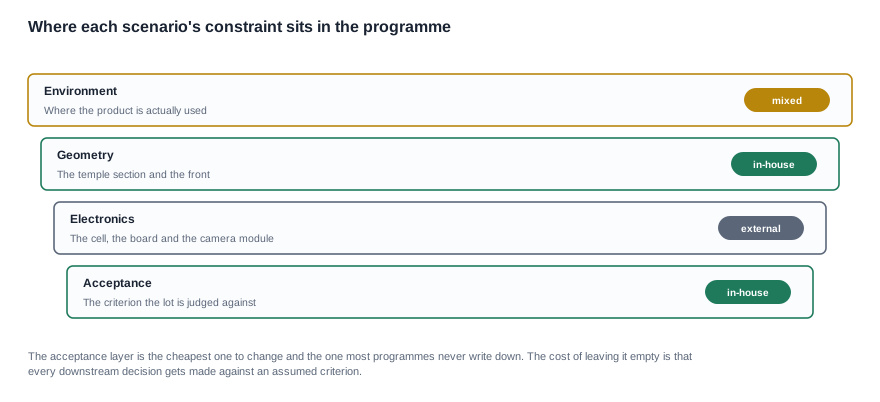
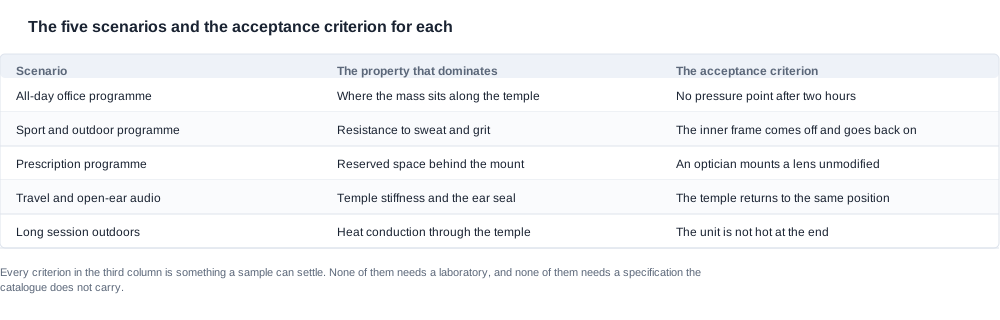
The result is not a specification, and it is not a number you can put in a contract. What it is worth is more than that: it is the acceptance criterion for the one property that decides this scenario, and an acceptance criterion is exactly what a purchase order needs. A frame that is used for eight hours a day is a frame whose mass distribution has been evaluated against a full working day, and the evaluation is something a supplier's factory can repeat on a sample before they build your run.
From a procurement point of view this is the cheapest test in the whole scenario list and the one most often skipped, because it produces no document. It produces a note with a date and a unit, which is exactly what a purchase-order criterion needs and exactly what most programmes never write down.
Sport programmes: sweat and grit, not mass
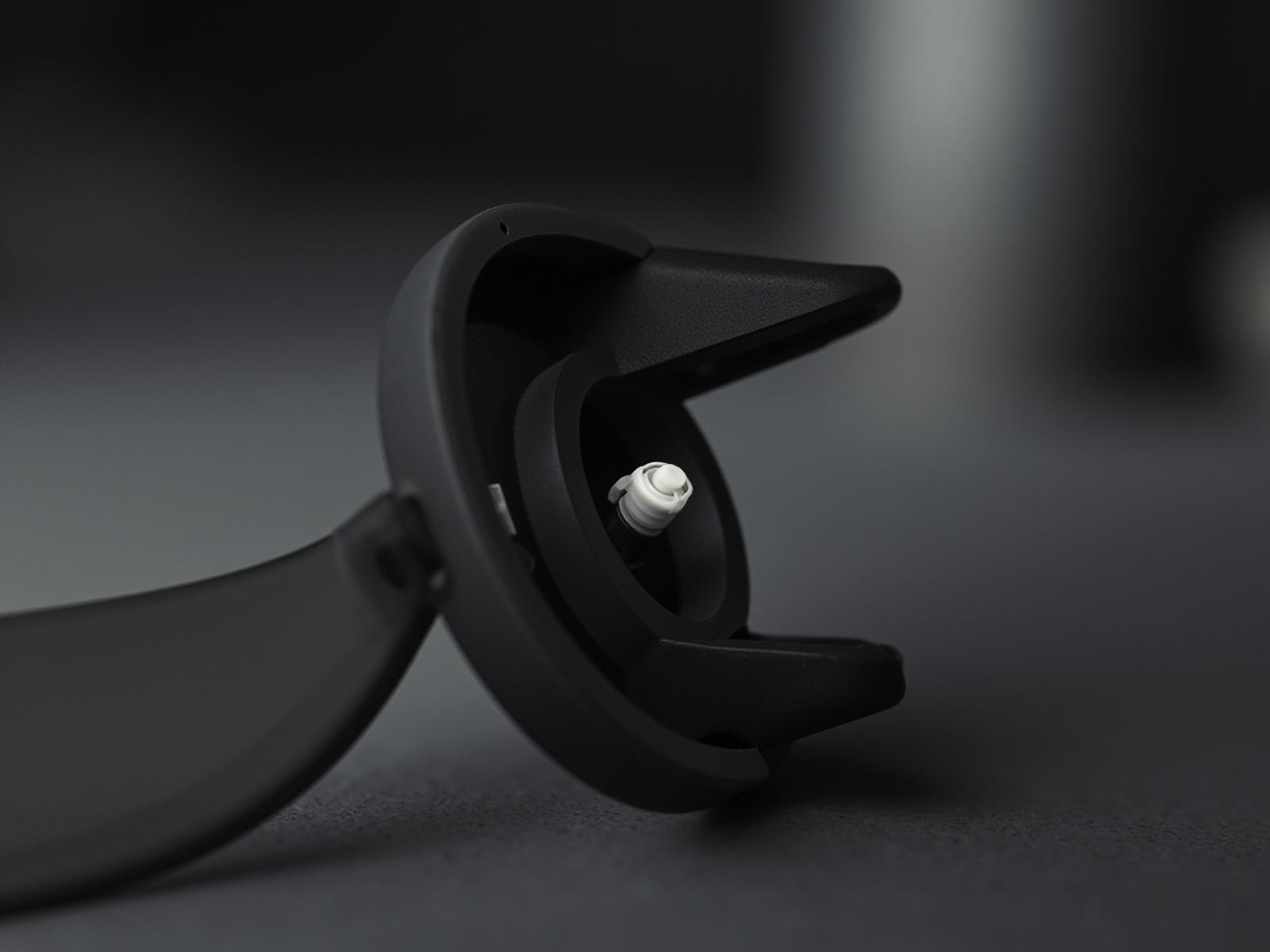
For sport and outdoor, the dominating property is resistance to sweat and grit, and the practical answer in our range is the detachable inner frame on the V06 and the S7. It exists because a frame that touches the skin every session eventually accumulates contamination, and a removable inner frame turns a product failure into a maintenance task.
What to check. Whether an inner frame comes off, and whether it is a published feature or a conversation. The D17, the ZH12 and the YKC02 do not publish one, which makes the answer to this scenario different rather than a smaller version of the same answer. A brand that needs the removable inner frame and assumes it exists across the sport tier will discover the gap at the sample stage.
The ingress marking is relevant here and bounded. In our catalogue the IP54 marking appears on the V06 and on the S7 — those two models only, and no third model in the range carries a published ingress marking. It covers splashing water, not immersion and not a downpour, and it is published as a catalogue marking with no third-party test report number behind it. A buyer who is going to put that claim on a product page needs the document behind it, and the document has to name the exact configuration, because the inner frame and the temple profile are part of what was marked.
That last point is the one that catches sport programmes. A colour change or a temple change in a sealed product is a change to the configuration the marking was about, and the marking does not travel with the new build.
What the removable inner frame actually changes
It is worth being precise about what a detachable inner frame buys, because the name suggests more than it delivers and a buyer who assumes more will be disappointed.
It changes the service model, not the product. The frame that accumulates contamination is removed and cleaned, and the cleaning becomes a maintenance task instead of a reason to return the product. The benefit shows up in the returns rate, in the warranty line and in the support cost — and it takes a season of field data to prove, which is why it is worth pricing as a warranty position rather than as a quality improvement in the launch quarter.
It changes the tooling. A removable inner frame means a second mould and a second process, and for a supplier it means a second set of inspection criteria. That cost is in the quotation, and it is worth asking for it separately so that the buyer can compare a removable-frame programme with a fixed-frame programme on unit cost rather than on feature count.
It changes the conformity position. A joint in the structure is a joint in the enclosure, and where an ingress marking exists the inner frame is part of the configuration that was marked. This is the point at which a sport programme's documentation burden goes up rather than down, and it should be priced into the compliance work rather than discovered during it.
It changes what the customer has to do. The customer has to know that the part comes off, and that removing it is the intended maintenance step. A product that ships with a removable frame and no instruction is a support cost instead of a feature, which is a packaging and artwork problem rather than a product problem — and it is the cheapest thing on this list to fix.
The three questions an optical partner will ask
For a prescription programme, there is a conversation worth having before the range is frozen, and it is one most buyers have too late.
Can a lens of this shape be edged into this front without the technician touching the frame? A yes establishes that the programme is servable. A qualified yes establishes that it is servable with a modification, and the qualification needs to be understood before the artwork is final.
Where on the temple do the technician's hands go, and where are the controls? The answer decides whether a capacitive control is usable in a prescription build. No model in the catalogue publishes a touch row, so this is a live question for every platform with a temple control, and it has to be put to the supplier rather than read off the page.
What does the technician do when the customer brings the frame back because the temple moved after fitting? This is a service-cost question rather than a technical one. The answer changes the warranty position, the spare-parts position and the negotiation with the optical partner, and it is the answer that a person who does this work every day will give you in one sentence.
What to take away is a short list of the frames an optician would decline to work on and why. That list is a shortlist filter, and it applies to any supplier's range without asking that supplier anything at all.
The third property for this scenario is thermal, and it comes up in any programme sold into a hot climate or used near a heat source. Our range publishes no thermal data for any model, so this is a sample observation rather than a specification — and it is worth making the observation deliberately, because a frame that is merely warm at the end of a session and one that is hot are different products.

Prescription programmes: the lens decides, not the material
For a prescription programme, the dominating property is reserved lens space, and it overrides every other consideration, including mass.
A frame that cannot take an insert lens is not a frame with a weakness. It is a product that excludes the customer who needs it, and that is a commercial exclusion rather than an engineering one — it removes a segment of the market rather than a fraction of the satisfaction.
What to check. Whether the frame reserves space for an insert and carries the fitting positions. Our general guidance is that the AI camera and audio models generally do, while electronically tinted and display-equipped designs can be constrained by where the module sits, and it has to be confirmed model by model. Because our catalogue publishes no frame dimension for any model, this is a question for the factory rather than for a document.
The second question in this scenario is about the hands, not the lens. A capacitive control sits on the temple, and because no model in the catalogue publishes a touch row, whether the K01 or any other entry carries one has to come from the supplier. An optician mounting a lens works on the temple. If the control is in the working area, the two interfere, and the interference appears as a product that stopped responding after the customer's glasses were fitted.
The third question is about the modification, and it is the one that separates an optical partner from an electronics supplier. A lens can be edged into a front in several ways, and one of them involves touching the frame. In optics that is routine. In a product that carries electronics, a modification can change the geometry, the seal and the alignment of the speaker to the ear.
Travel and open-ear audio: the temple is the acoustic path
Two related properties dominate this scenario, and the second follows from the first.
Temple stiffness leads in travel and commuting. The device is moved around and taken off repeatedly, and a soft temple changes the speaker alignment over the course of a day. The failure mode is the speaker drifting out of the position the design intended, which changes both the audio level and the leakage. Flex the temple and release it, and see whether it returns to the same position. Then listen to a fixed source at the start of the day and again in the evening.
The YK12 publishes a slim temple and the G07 publishes ultra-slim and detachable temples, and those constructions are the ones where this question is worth asking rather than assuming.
The temple-to-head seal is the second property, because it decides both how much sound reaches the ear and how much escapes into the room. The failure mode is a customer in a quiet office hearing their own audio, which becomes a return and a review.
Check the temple geometry and its finish, and the effect of the seating on the seal. No model in the catalogue publishes a touch row, so whether a control sits on the temple — and therefore puts a physical feature into the surface that forms the seal — is a question for the supplier rather than a specification. A touch version and a non-touch version of the same frame do not seal identically, and a specification that treats them as one product is wrong in a way that is audible.
Why leakage is a supplier conversation and not a sample measurement
Leakage is the one property in this article that a buyer cannot settle with a ruler, and it is worth saying why rather than leaving it as an unanswered row.
The acoustic path runs through the temple and depends on the geometry of the port, the finish on the temple surface, the shape of the ear and the position of the unit on the head. Four of those five are properties of the head rather than of the product, which means a measurement taken on one head is a measurement of that head. There is no single number that describes leakage for a product, and a supplier who quotes one is quoting a test condition.
What a supplier can do instead is describe the design in terms you can check. How the port is sealed. Whether the temple carries a control surface at all, and whether that surface interrupts the sealing surface. Whether the temple profile is the same across the range. Whether the finish on the sealing surface changes between the matte and gloss options, and if it does, which one was evaluated.
Those are answerable questions, they are the ones a sample then confirms, and they are what a buyer should put in the purchase order. The acceptance criterion that follows from them is not "leakage below a level", which cannot be measured without a defined measurement, but the geometry and the finish that produce the leakage, held as fixed configuration. That is a criterion a quality control function can actually apply to a lot.
The commercial reason to care is a warranty line. A customer in a quiet office hearing their own audio is a return, a refund and a review, and the fix is never a refund — it is a frame that does not leak. Getting the configuration right before the first article is the difference between a warranty provision and a warranty cost.
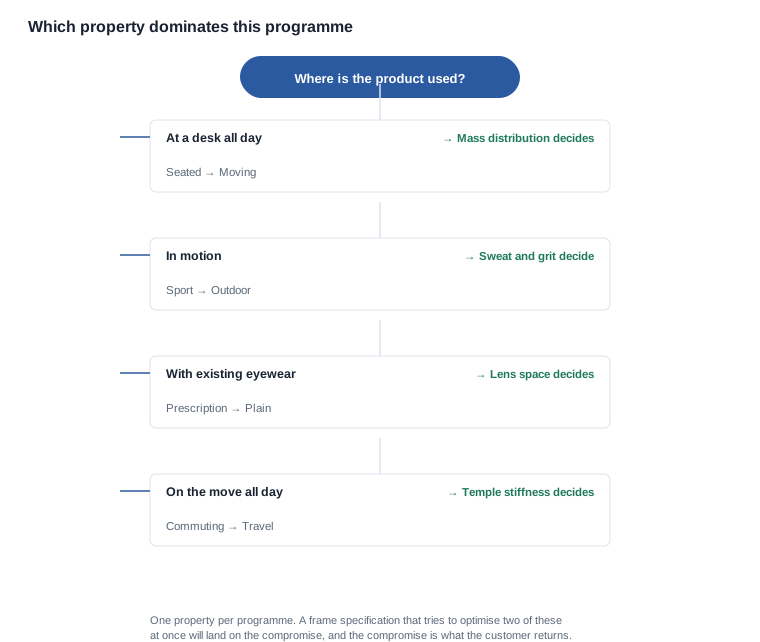
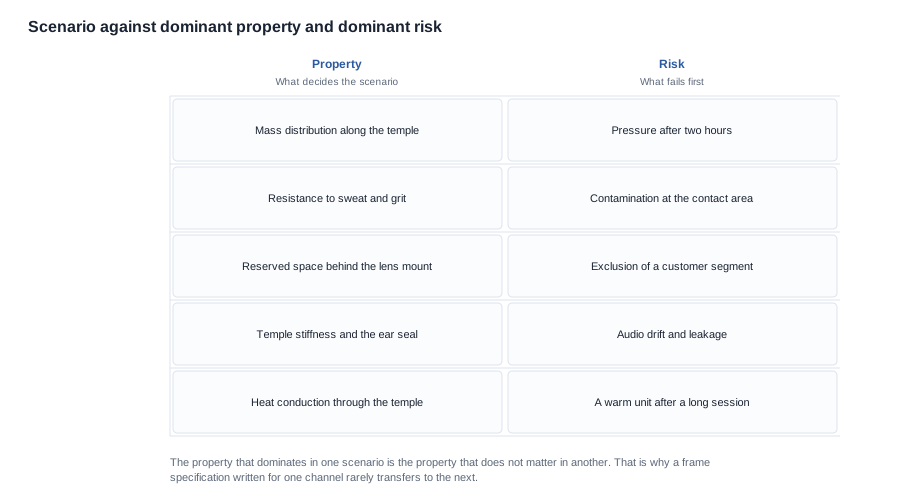
Each scenario selects one dominant property and one dominant risk
The value of this framework is that it stops a specification from optimising everything at once. One property per programme, and one risk that follows from it, is a shortlist criterion you can apply to any supplier's range without asking them for anything.

The acceptance checks are the second half of the method, and they are the part that actually closes a programme. Each one is a half-hour on a sample, each one produces a number or an observation that can be written down, and each one can be turned into a purchase-order criterion before the first article. The point of writing them per scenario is that the same programme often serves more than one channel, and the checks conflict — a prescription programme needs the lens space that a sport programme needs for the sealed electronics bay.
There is a commercial step that belongs before the sample, and it is the one that gets skipped. Before a sample order goes out, the scenario has to be translated into a configuration the factory can quote: which models, which cell configurations, which colourways, which markets, and which of the acceptance checks will become purchase-order criteria. A sample order without that translation produces a sample and no criteria, and the programme then has to go round again with a second sample because nothing was written down the first time. Our range publishes twenty-eight product entries and eleven of them carry a camera — eight at 8 MP and three at 13 MP — and the cell configurations run across twelve different values from 40mAh single cells through 55mAh×2, 70mAh×2 and 90mAh×2 to single cells at 290mAh. That spread is why the translation step is worth doing: the same model name can carry a materially different frame depending on the configuration named in the order.
The short answer: the frame is an engineering component, and the right question in each scenario is the property that dominates it. We publish the figures we hold, which is one mass figure for one model, and we will not fill the rest with typical values from the industry, because a material name copied from a competitor's specification sheet tells a buyer nothing about the frame in the box.
What we can do is identify, for a given scenario, which property dominates, which models in the range are built around it, and which questions have to go to the factory. The material and fit context is under materials and ergonomics, the sport range is on the sport smart glasses page, and the audio range is on the bluetooth audio glasses page.
For the selection method itself, the deeper treatment is under how to choose frame materials, the structural argument is under why frame materials matter, and the direct question is under what frame material is best.
Related reading
- Why the frame is a structural part — why frame materials matter
- The selection method — how to choose frame materials
- The direct question — what frame material is best
Tell us the scenario and we will tell you which property dominates it, which models serve it, and what has to go to the factory.


