

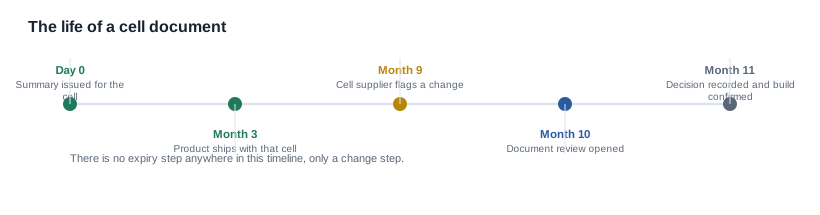
A buyer asks this question because they expect a date. There is no date. The lithium battery test summary is not a certificate with a renewal cycle or a shelf life — it is a document issued against one specific cell, and it keeps its standing for exactly as long as that cell remains the cell inside the product. The question that usually follows is the harder one: if it never expires, what actually invalidates it? The answer is a substitution, a supplier change, a manufacturing-site change or a change in how the product is assembled, and each of those is a decision somebody has to make and somebody has to document.
That distinction matters more in this category than it sounds. A buyer who assumes "no expiry date" means "always fine" will hold a compliant summary and a product that no longer matches it, and the mismatch surfaces at a border, in a claim file, or during a due diligence audit rather than at the factory. So the useful answer to how long is the test summary valid is a description of what it covers, what breaks it, how long the paperwork has to be kept, and which questions to put in front of a supplier.
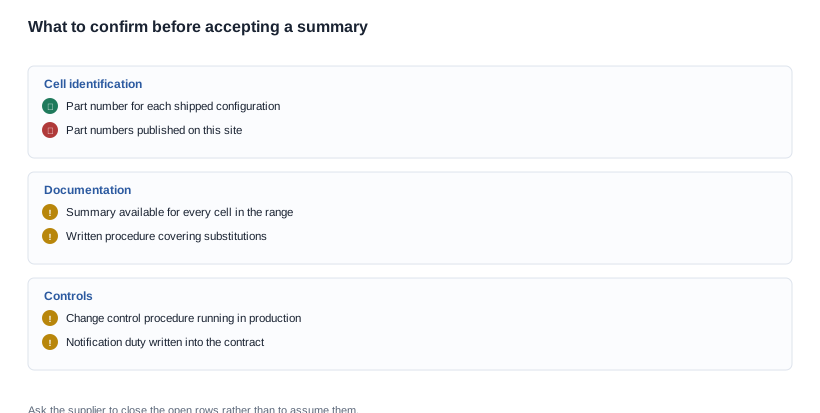
Here is what our own published material does and does not settle. The cell configurations across the catalogue are published: 40 mAh cells in the A05 and A06 children's models, 55 mAh in the LC-105 pair, the G07 and the YK12, a single 70 mAh in the A07, two 70 mAh cells in the sport YKC02, two 90 mAh cells in the audio-tier K01 and K02, a single 100 mAh in the D11, the D12, the ZH12 and in the electrochromic and AR entries, 115 mAh in the D17, 200 mAh in the bone conduction model, and 220 mAh up to 290 mAh across the camera family. The cell part numbers behind those figures are not published. The transport documentation itself is not published here. And there is no per-model certification row anywhere in the catalogue — the export-certification page is a picture page carrying ten patent certificate images, eight design patents and two utility models, which is a completely different category of document.
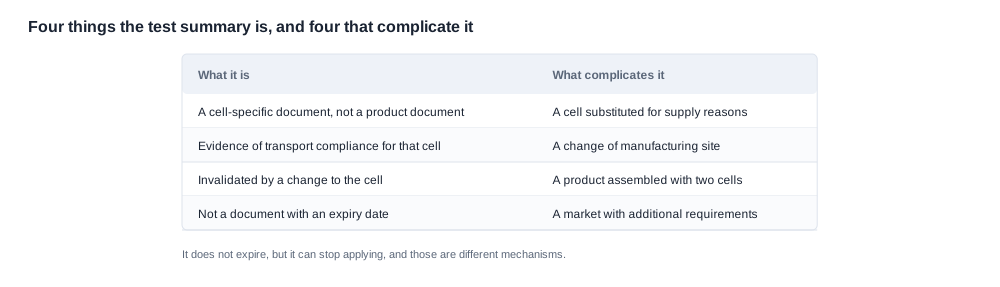
How long is the test summary valid: the four things it actually is
Strip away the phrase "validity period" and the document is four specific things. None of them has a date attached.
1. A cell-specific document. It covers a specific cell, identified by a manufacturer part number, and it is issued against that cell's design and that cell's test results. It is not a product document. It does not cover the finished glasses, the firmware, the enclosure, the packaging or the brand. A test summary for a 220 mAh cell says nothing about a product that ships with a 290 mAh cell, even if both cells come from the same maker and look identical on the datasheet.
2. Evidence that this cell may be transported. Its purpose is to let the cell move. Once the documentation is in place, a product containing that cell inherits the ability to be shipped, because the shipping problem is the cell, not the frame. This is why a buyer should be relaxed about the product-level implications and strict about the cell-level ones.
3. A document that a change to the cell breaks. A substitution of a different cell, a change of cell supplier, or a change in the cell's design or its manufacturing site each affects it. A "formally equivalent" cell is a judgement, not a fact, and somebody has to make that judgement and record the reasoning behind it. If no one in the chain is authorised to make it, the safe answer is that the substitution is not acceptable until it is.
4. Not a document with an expiry. There is no date after which it stops being true. It stops being true when the cell it covers is no longer the cell in the product, which is a change event rather than a calendar event.
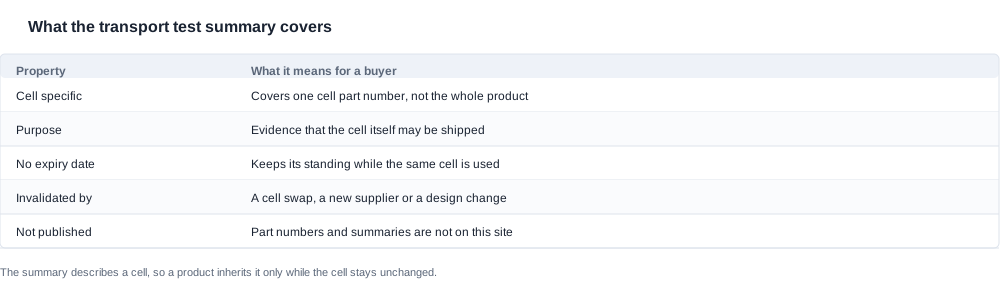
What it is not worth treating as, in a due diligence file: a product certificate, a quality mark, an approval, a statement that the finished glasses are safe, or a proxy for anything the brand will later write on a carton.
Telling a cell document apart from a product document
This distinction is worth making explicit because the two get filed together and then cited interchangeably. A practical way to sort any document you are handed is to ask three questions of it.
- Who is the subject? A cell document names a cell part number and its maker. A product document names a model, a configuration or a finished unit. If the subject line names neither, it is probably a test report or an internal quality record, which is a third category with its own retention rules and its own commercial status.
- What change would break it? For a cell document the answer is a cell change. For a product document the answer is a design, firmware or supplier change. These overlap in practice, which is exactly why a programme that files them together tends to lose track of which one has been reviewed.
- Who is permitted to rely on it? A cell document is relied on by the shipper, the forwarder and the carrier. A product document is relied on by the brand, the authority and the customer. A buyer who relies on a cell document to support a customer-facing claim has made a category error, and a buyer who relies on a product document to get a shipment through the border has made the same error in the opposite direction.
The neat thing about asking these three questions is that they are answerable from the document itself. You do not need the supplier to explain anything, which means you can apply them to a due diligence file that arrived without a briefing, and you can apply them to the sample documentation that travels with an evaluation unit. That is a faster and more reliable screen than asking a salesperson for a summary of the documentation.

How long the document survives a cell substitution
Substitution is the normal event in this industry, not the exceptional one. Cells get re-costed, a supplier's line gets allocated elsewhere, a part number gets consolidated, a purchase order gets rebalanced. The commercial pressure to accept an alternative is real and usually arrives with a good reason attached.
The supply-driven substitution. The most common case, and the one with the widest blast radius. The consequence is not only a paperwork gap: the transport documentation no longer covers the product, so the risk sits with whoever ships it, and in a DDP arrangement that risk ultimately sits with you.
The supplier and manufacturing-site change. The same part number sourced from a different site is a question for the cell maker, not for the factory. The answer is not always immediately available, and "not always immediately available" is not the same as "no". A buyer who wants a durable answer needs the notification obligation in the contract rather than in a relationship.
The assembly configuration change. A product built with two cells rather than one, or with a cell in a different physical position, raises a question for the transport regime that the cell's own document cannot answer, because the document was written about the cell.
The destination market. Some jurisdictions ask for transport documentation beyond the summary, and the requirement is per market and per shipping mode. A document that satisfies one lane does not automatically satisfy another.
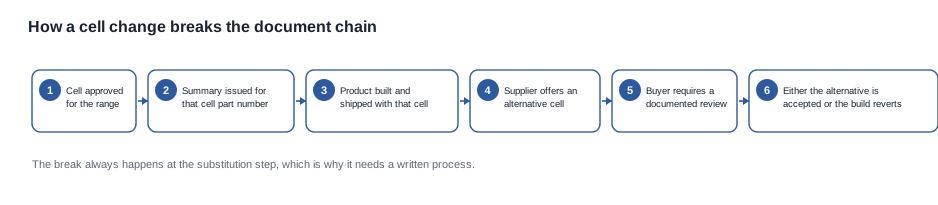
The practical consequence for a buyer is about when you find out. With a change control procedure, you find out at the point of change: someone raises it, someone reviews it, someone records the decision, and either the alternative cell is accepted with its own documentation in place or the build reverts to the approved cell. Without one, the discovery usually happens much later, on a shipment that is held, during an audit that asks for the cell part number behind a shipped serial, or in the middle of a claim investigation.
That is the difference between a five-day question and a five-month question, and it has nothing to do with the document's age.
Working the scenarios through
Each of the four situations ends differently, and it is worth being concrete about how, because "it depends" is not an answer you can put in a process.
A supply-driven substitution to a cell from the same maker. The cleanest case. If the alternative is the same maker, a like-for-like cell with its own transport documentation, then the work is to obtain that documentation, attach it to the configuration map, and tell the forwarder that the cell reference on the shipping papers has changed. The configuration map in your file is what makes this a ten-minute job instead of a week, because you already know which document covered the old cell.
A substitution to a cell from a different maker. A harder case, because you are no longer extending a document chain, you are starting a new one. The new maker may not have an existing summary for the part, and if they do, you still need to know that the new cell behaves the same in the product — the runtime figures, the thermal behaviour and the charge profile you have published for the model were all built around the original cell. This is where a buyer should resist the temptation to accept a purely commercial argument.
A manufacturing-site change at the same maker. The cell part number may be identical and the cell may be electrically identical, and the transport position may still be a question for the maker. In practice this is the scenario most often waved through, because everything looks the same on the datasheet. The correct response is to ask, in writing, and to keep the answer.
A change in the assembly configuration. Say the design moves from one 220 mAh cell to two smaller cells, or from a 260 mAh cell to a 265 mAh cell in a different holder. The cell documents are fine; what is affected is the product-level position, and possibly the runtime row you have published. The battery life and power page carries the published runtime figures, and a configuration change like this is exactly the event that should trigger a review of them.
A new destination market. The document does not change; the requirements around it do. This is a question for the certification route rather than for the cell maker, and the certification checklist is the natural place to open it — although note that no per-model certification row is published in our catalogue, so that checklist has to be run as a requirement list rather than as a lookup.
If your shortlist contains two suppliers whose answers to these scenarios differ, that difference is more informative than any published specification. One of them has a process and the other has a habit.
How long the paperwork has to live, and who has to be able to read it
Retention is not a formality here, because the document is the only evidence tying a shipped unit to a compliant cell. If the file holds the cell part number for each configuration, the claim or recall scenario has somewhere to start. If it does not, the exercise becomes archaeology.
Three files are worth keeping, and they answer different questions.
The configuration-to-cell map. One row per shipped configuration, listing the model, the cell or cells fitted, the cell part number and the summary reference that covers it. This is the document that turns "the glasses" into a specific cell, and it is the one a recall, a customs query or an insurer will ask for. Keeping it current is a monthly task, not a one-off, because configurations get added.
The change control record. Every substitution, the reviewer, the date, the reasoning, and the outcome. The development process documentation page is where this procedure belongs in a real programme, and a programme that has no change control route for components has an open path to an invalid document.
The per-configuration document set. For each model in the range, the documentation that supports shipping it. The wider set of what a programme needs to collect is set out under OEM documentation needed, and the transport-specific material is on battery transport compliance.
Who has to be able to read it is the second question, and the answer is broader than the buyer's own compliance team. The freight forwarder reads it. The carrier reads it. In a recall or an incident investigation, whoever is handling the file reads it, and that person may be a legal adviser, an insurer or an authority who has never heard of your brand. A file that only one person in your organisation understands is effectively a file that does not exist.
A review cadence that survives contact with a growing range
Retirement is the part of document control that quietly fails. A configuration map built for four models does not stay correct when the range becomes nine, and the failure mode is not that the map is visibly wrong — it is that a new model is added, the map is not extended, and the map now describes a subset of what you ship without saying so.
Three habits keep it usable. The first is to give the map an owner with a recurring slot in the calendar, because a document owned by a committee is updated by nobody. The second is to make the map the place where a new configuration is created, so that adding a model and documenting its cell are the same action rather than two actions that can drift apart. The third is to re-verify the map against what actually shipped at a fixed interval, using the same kind of evidence you would accept in a due diligence audit, so the file describes reality rather than intention.
There is a negotiation point buried in that third habit. A buyer who wants the supplier to maintain a configuration-to-cell map is asking for work, and that work should be priced and scheduled rather than requested as a favour. Ask which part of it is included in the order, which part is charged as engineering time, and who updates it when the cell situation changes. The same conversation usually produces the change control procedure as a side effect, because both depend on the same underlying fact: somebody upstream knows about the cell before the build reaches the line.
The reason to insist on this is the shape of the failure. A missing configuration row is invisible until the moment it is needed, and the moment it is needed is nearly always the moment something has already gone wrong.
One point deserves emphasis because it is routinely confused. The patent certificates published on our export-certification page are not transport documentation, and they do not substitute for it. Ten certificate images — eight design patents and two utility models — describe the appearance and the utility of designs. They tell a buyer that the product is a novel shape. They tell a buyer nothing about whether the cell inside it may be shipped.

How long a buyer's due diligence should take
The due diligence question here is not primarily a document question. It is a process question: can this supplier demonstrate that a change to the bill of materials triggers a document review? A supplier that answers confidently about the cell's transport documentation and has no change procedure is describing a controlled product and an uncontrolled supply chain, and the gap between those two things is where your programme breaks.
Some practical criteria for a shortlist, in the order they tend to matter.
Ask for the cell part number behind each configuration you plan to buy. This is the single question that sorts a serious supplier from a comfortable one. A supplier who publishes cell configurations but treats the part number as commercial information is telling you that the document chain is not under formal control.
Ask what triggers a document review. The answer should name a process and a role. "We would inform you" is not a process; "engineering raises a change request, compliance reviews the cell, procurement updates the file" is.
Ask what the position is on a product assembled with two cells, and on a spare cell shipped separately as an accessory. These are specific configurations that some suppliers have never been asked about, which is precisely why the answer is informative.
Ask the carrier or the freight forwarder what they require. Their requirements and the regulatory requirement are related but not identical, and the gap between them shows up at the border rather than in the office.
Ask for the sample documentation set to travel with an evaluation unit. Whether that happens, and how current it is, tells you more about document control than any description of it will.
There is a commercial dimension here that is worth negotiating directly rather than accepting by default. Where a supplier charges for custom cells, custom cell configurations or customer-specific cell sourcing, the treatment of that work under a substitution is a contract question, not a courtesy question. If your brand's specification depends on a particular cell — because the runtime, the case behaviour or the certification evidence was built around it — then the contract should say that a substitution requires notice, a document review and a written decision before the change is implemented. That clause is the cheapest insurance in the whole programme, and it costs nothing to ask for during negotiation because the cost is a paragraph rather than a discount.
The trade-off is that a strict clause slows the factory down, and the factory will point out that supply continuity matters. The answer is to make the clause about documented substitution rather than about prohibited substitution. A substitution that is reviewed and recorded is fine. A substitution nobody sees is the thing you are actually paying to avoid.
A sequence you can run on a shortlist
If you are comparing three or four suppliers and want a comparable answer rather than three different stories, run the same sequence against each one and record the answers in the same format. This is the due diligence method applied to a single document type, and it takes less time than people expect because the questions are narrow.
- Model and configuration first. Name the exact model and the exact configuration, and ask for the cell behind it. A supplier who answers at range level has not answered.
- The document question. Ask whether transport documentation for that cell exists and can be provided. Record the answer as a yes, a no, or a promise, because those are three different things and only the first one closes the row.
- The process question. Ask what triggers a document review when a component changes. Record the named trigger and the role, not the sentiment.
- The edge case. Ask about a spare cell shipped separately, or about a two-cell assembly, whichever is closer to your own roadmap. The answer to an edge case reveals the process more honestly than the answer to a standard case.
- The verification route. Ask how a buyer can independently confirm the cell in a delivered unit. The honest answer is that you cannot open the product and read a label, so what you can check is the model number on the device, the runtime behaviour, and the paperwork that arrived with the unit.
The fifth point deserves a short note, because it is where buyer expectations and supplier capability diverge. There is no published procedure in our catalogue for reading a cell part number off a finished unit, and it would be dishonest to imply that a teardown is a normal buyer activity. What a buyer can realistically do is check that the paperwork travelling with the unit names the same model as the unit, check that the runtime roughly matches the published figure for that model, and check that the configuration on the label corresponds to a row in the configuration map. Those three checks will not detect a substituted cell in every case, and nobody should pretend otherwise — but they will detect the gross errors, and they cost nothing.
A shortlist scored this way tends to separate itself quickly, because the differentiators are behavioural rather than technical: does the supplier name a trigger, do they answer the edge case, and do they tell you what they cannot verify. The third of those is the most telling, and it is the one a buyer can check against anything else the supplier has said.
How long we can answer this, and what has to come from the cell maker
We are explicit about the boundary of our published material, because it is where the risk sits.
Our catalogue publishes the cell configurations across the range, the charge time, the rated runtime, the charging method and interface, and charging case capacities for the models that carry one. It publishes no cell part numbers, no transport documentation, no validity period for a test summary, and no per-model certification row. The certificate page is a picture page, and it is about patents.
We will not estimate a validity period, because there is not one to estimate, and we will not quote a cell maker's typical cycle figure as if it applied to a cell we have not specified. A number like that is exactly the kind of value that ends up in a tender document and then in a warranty dispute, and it is worse than an open row because it looks closed.
What we can do, for a specific model, is tell you which cell sits in it, what we can confirm about that cell, and which of the questions below has to be answered by the cell maker or by the supplier before the number or the document belongs in your file.
- Which cell part number is fitted in each configuration of this model, and can we have the transport documentation for it?
- Who is the cell maker, and what notification exists for a supply or manufacturing-site change?
- What is the change control procedure, and does a cell substitution trigger a document review before it is implemented?
- What is the position on a product assembled with two cells, and on a spare cell shipped separately?
- Which cell capacities, charge methods and case configurations are published for this model, and which are not? The battery rows behind them are on battery life and power.
Ask the fifth one with the other four, because the published rows are the ones you can put in a specification today, and the unpublished ones are the ones you will be asked about by your own customers and your own customers' auditors.
What you can write in a specification this week
It is worth separating what a buyer can commit to today from what has to be conditional, because a tender document that mixes the two is a document nobody can sign.
Committable now, from the published catalogue. The cell configuration for the model. The charging method — magnetic on seventeen models and Type-C on seven, with the charging method not published for the CY03 and the MT6, and the CY05 and the L1 Pro. The charge time ceiling, where twenty-six models publish two hours or less, with about one hour published only by the D17 and the ZH12. The charging case capacity where it exists: 1400 mAh on the L1 Pro and the CY03, and the CY05, 900 or 1400 mAh on the L2 Utral, and 1200 mAh foldable on the MT6, with the case existing but the capacity not published for the KY06 and the MT5, and no case at all for the V03 and the S7, and the V06, with the V03 Pro explicitly excluded. The rated runtime, on every one of the eleven camera models.
Conditional, pending a cell-level answer. The cell part number for each configuration. The transport documentation and its current standing. The end-of-life criterion for the cell. The recommended storage charge level and storage temperature. The cycle behaviour of the cell in the product, which nobody publishes for any model in this range.
Not a specification at all, and never has been. The validity period of a test summary, because there is not one. A warranty period, which is not published for any model here and is a commercial term to be negotiated rather than a technical fact to be looked up. A certificate number, because no per-model certification row exists in the catalogue to carry one. A price, a minimum order quantity or a lead time, none of which are published and all of which belong in a quotation.
That last group is worth dwelling on for a moment, because buyers occasionally ask a supplier to put these into a specification sheet as though they were technical rows, and the effect is to move a negotiation into a document that is supposed to be factual. A price belongs in a quotation with a validity date. A minimum order quantity belongs in the commercial terms and is negotiable. A warranty period is a negotiation between two parties with different risk positions. A test summary validity period belongs in no document at all, because it does not exist.
The discipline that keeps a specification honest is simple: every row states either a published fact, a condition that will be supplied by a named party, or a commercial term with a date. A row that is none of those three is a row nobody will be able to defend when the file is opened in eighteen months.
Related reading
- Battery transport compliance — the transport side of the file
- OEM documentation needed — the wider document set
- Development process documentation — where change control belongs
- Battery life and power — the published power rows
Send us the configurations you are shipping and the destination markets, and we will tell you which cell each one uses and what that means for the documentation.


