

There is no single storage number, and the reason is that the two inputs that determine it — the video bitrate and the retention behaviour — are exactly the two things a camera glasses catalogue does not publish. So a question about how much storage is needed has to be answered from your own use case rather than from a supplier's table. The good news is that you can derive it, and the branch structure below is how.
Our range is explicit about this. We publish the camera platforms, their pixel counts, their cell capacities, their rated runtimes, their charge times and their charging interfaces. We do not publish, for any model, the storage capacity, the video resolution in frames, the frame rate, the bitrate, the file format, the overwrite behaviour or the export method. There is no published file-size figure anywhere in the catalogue, which means a buyer who wants a storage number has to derive it or obtain it on a sample.
That is a bigger gap than it sounds for one category of product, because for camera glasses the storage behaviour determines the user experience more directly than for most other devices. The question is not academic — it decides whether a customer who buys the product for recording finds a camera that works or a camera that fills up after nine minutes.
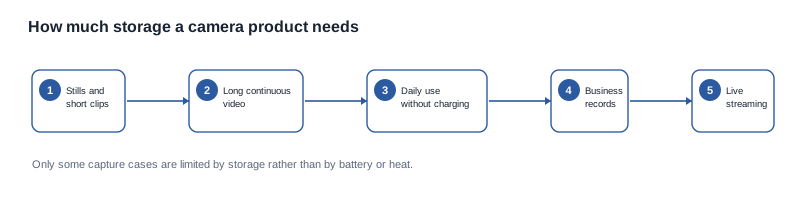
How much storage is needed: start from what the product captures
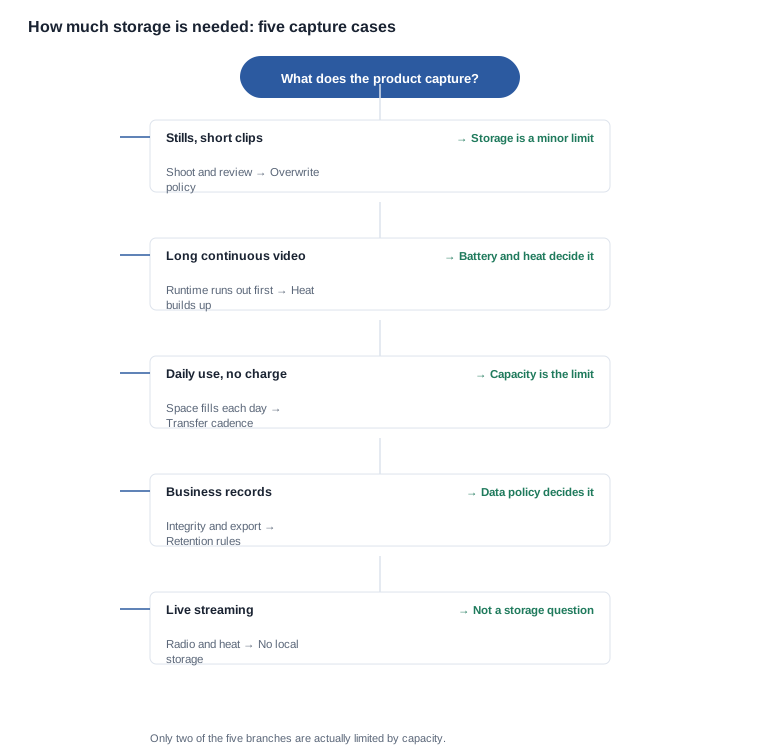
The branching logic matters more than the number, because the number is a consequence of the use case. There are five distinct cases, and only some of them are actually constrained by storage.
Stills only, in short sessions. Storage demand is modest here, and the question that matters is not capacity but overwrite behaviour: when storage fills, does the device stop, overwrite the oldest, or refuse? Silent overwrite loses a recording the user believed was safe, and that generates complaints that present as hardware faults rather than as a design decision. Our catalogue publishes no overwrite behaviour for any camera model.
Long continuous video. Here the limiting factor is rarely storage. It is the combination of bitrate, thermal behaviour and battery. A device recording continuously from a camera platform will exhaust the published runtime — roughly five to eight hours on the 8 MP models and roughly seven on the 13 MP models — long before a reasonable storage capacity runs out. If your use case is continuous recording, the question to ask your supplier is about heat and about the recording-duration limit, not about capacity.
Daily use with no charging opportunity. This is where capacity becomes the primary constraint, and where retention policy becomes the product question. Does the user choose what to keep, or does the device decide? The second answer is cheaper to implement and more likely to lose data.
Business records and evidence. Here capacity and integrity both matter. Timestamp behaviour, export integrity, and whether a file can be recovered after deletion are all questions with consequences when the answer is bad. None of them is published for our range.
Live streaming. Not a storage question at all. It is a radio and thermal question, and it belongs in a different conversation with a different supplier.

What our catalogue publishes for how much storage is needed, and the gap it leaves
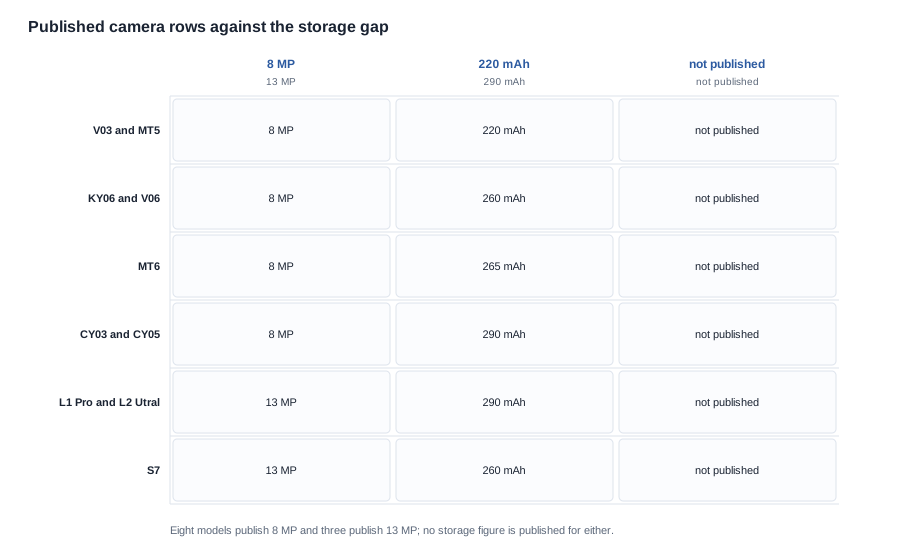
The camera range is eleven models: the MT5 and the V03, the CY03 and the CY05, the V06 and the S7, the MT6 and the V03 Pro, the KY06 and the L1 Pro, and the L2 Utral. All eleven publish a rated runtime. Eight publish an 8 MP pixel count, and three — the S7 and the L2 Utral, and the L1 Pro — publish 13 MP.
What accompanies that: cell capacities from 220 mAh on the V03 and the MT5, and the V03 Pro, through 260 mAh on the S7 and the V06, and the KY06 and 265 mAh on the MT6, to 290 mAh on the CY05 and the CY03, and the L2 Utral and the L1 Pro. Charge times of two hours or less across the range. Charging cases with published capacity for five models: 1400 mAh on the CY05 and the L1 Pro, and the CY03, 900 or 1400 mAh on the L2 Utral, and 1200 mAh foldable on the MT6. A case exists but its capacity is not published for the KY06 and the MT5, and there is no case row for the V03 and the V06, and the S7, with the V03 Pro explicitly excluded.
What is missing is the entire storage column. No capacity, no resolution in frames, no frame rate, no bitrate, no file format, no overwrite behaviour, no export method, no maximum recording duration, and no storage type.
That is a substantial gap for this particular question. Without bitrate you cannot derive storage demand at all. Without overwrite behaviour you cannot describe the user experience. Without export method you cannot answer the business-records branch. And without maximum recording duration you cannot tell a customer how long a session runs before the next transfer.
One clarification worth making, because it comes up repeatedly in this category: the pixel count is not the video resolution. Eight megapixels describes the still-image sensor. It does not tell you the video frame size, the frame rate or the resulting bitrate, and it is not legitimate to derive a storage requirement from it. What it does tell you is which tier the platform sits in, and therefore which of two sample-tested behaviours to expect.
How much storage is needed: deriving the number yourself
If you have a bitrate from a sample, the arithmetic is straightforward. Storage per hour in bytes is the bitrate multiplied by 3600 seconds, divided by eight. A product capturing ten minutes in each hour needs roughly a sixth of that. Once you have tested one sample and know its actual file sizes, you can size the rest of your range.
The critical dependency is that measurement, and it has to come from a sample in the configuration you intend to ship. Storage behaviour is one of the few things that genuinely varies between firmware revisions, which makes a datasheet figure from an earlier build close to worthless.
Measure the file size, not the bitrate. A file produced by a typical encoder has a header and container overhead, and the overhead is not constant across durations. The practical approach is to record a fixed short clip, measure the file, and record a longer one, measure that, and use the difference to get the per-second rate. Two measurements are enough to remove the container overhead from the calculation.
Measure the actual bitrate at the setting the product will use. Camera platforms commonly offer a quality setting. The bitrate at the highest setting is not the bitrate at the setting a customer will actually leave it on, and the difference is often large enough to change the answer from "fits in the case" to "needs a daily transfer".
Test the overwrite behaviour explicitly. Fill the storage deliberately — or near to it — and record what happens. Whether it stops, overwrites the oldest, or refuses is a fact about the product that no catalogue in this category publishes, and it is the fact that most affects whether customers complain.
Then check what happens to the files after transfer. Whether a file can be opened by a desktop tool, whether the export preserves the timestamp, and whether a deleted file can be recovered are all observable on a sample in a few minutes, and all three change the answer for the business-records branch.

Two practical points that save a lot of rework. First, measure with the charging case in the loop if the model ships with one, because a case changes how often a session runs and therefore how much accumulates between transfers. Second, note that the 13 MP tier behaves differently from the 8 MP tier in terms of file size even when the still-image resolution is not the limiting factor, which is exactly why you should sample-test the tier you are buying rather than extrapolating from the other one.
A worked example, from an unmeasured sample
The derivation is easier to trust with a concrete case, so here is one built on the published rows plus two file measurements. The figures below are an illustration of the arithmetic, not a specification of any model in our range — the storage capacity of every camera model is not published, and the sample measurements here are hypothetical inputs used to show how the method works.
Suppose a brand is evaluating a camera platform for a content-creation channel, where a typical user records in short sessions across a working day and transfers the day's clips to a laptop in the evening. The published rows for the candidate give an 8 MP sensor tier and a rated runtime of five to eight hours, and the cell is 220 mAh on one of the models that carries that tier. That runtime figure is a bound, not a working assumption, and the first thing worth noticing is that it does not constrain the storage question at all: the user records in short sessions, so the device is never near its runtime limit.
Two measurements on the sample then settle the question. Suppose the first recording is two minutes of ordinary video and produces a file of 31 MB. Suppose the second is ten minutes and produces a file of 152 MB. The difference between them is 121 MB for eight extra minutes, which works out at roughly 15 MB per minute, or about 0.25 MB per second. On those hypothetical numbers, a user recording a total of forty minutes across a working day would accumulate roughly 600 MB, and a user recording two hours would accumulate roughly 1.8 GB.
Those two numbers are enough to make the commercial decisions. Whether the platform's storage holds a comfortable margin above that accumulated figure determines the transfer cadence — whether it is a daily evening transfer or a twice-daily one. Whether the storage is expandable determines whether a user with a heavy week can be given a remedy. And because the measured per-minute rate was taken at the quality setting the sample shipped with, the whole calculation has to be redone if that setting changes for the private-label build, which is exactly the kind of thing that has to be caught on a sample rather than in production.
What the derivation does not settle, and what the third and fourth questions exist for, is what happens at the limit. If the storage fills and the device overwrites silently, the user's evening transfer has to be a habit rather than a routine, and a customer who forgets once loses a clip. If the device refuses to record and shows a clear message, the failure is visible and the customer knows to transfer. Same measurement, same capacity, entirely different product experience — and the difference is not knowable from the storage figure, only from the behaviour.
The same calculation for a business-records deployment
Now take the branch where the recordings are evidence rather than content, and the arithmetic is the easy part. On the same hypothetical per-minute rate, a field team recording two hours per shift across five working days accumulates roughly 4.5 GB per week per user. At that rate the transfer has to happen weekly at minimum, and a device that cannot be wiped between users becomes a data-handling problem rather than a convenience problem — which is why the erase function and the confirm-erase behaviour are on the list of what a buyer should require, and why the export integrity question carries more weight in this branch than in the content branch.
For a business-records deployment the storage number is genuinely secondary. What matters is whether a file that has been exported is intact, whether the timestamp survives the export, and whether a deleted file can still be recovered if it turns out to be needed. Those three answers come from a sample in an afternoon.

Four questions to ask a supplier about how much storage is needed
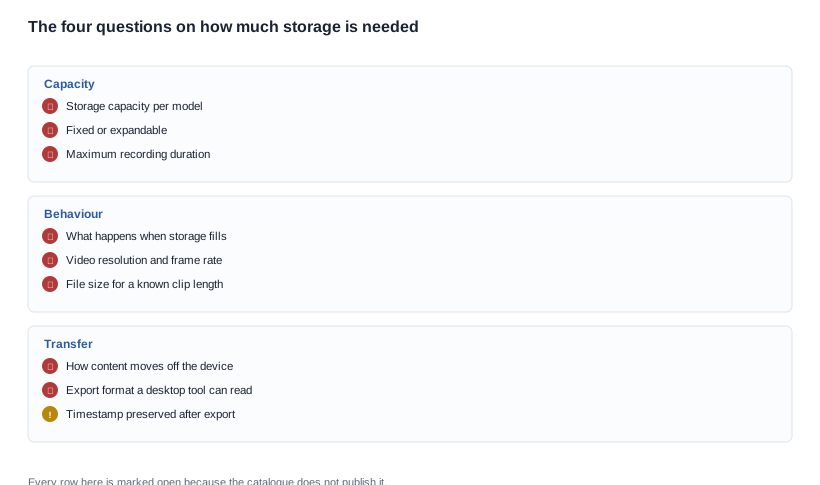
- What is the storage capacity on each model, and is it fixed or expandable? Not published for any of our models.
- What happens when storage is full? Stop, overwrite, or refuse. This is the single most useful answer a supplier can give on this topic.
- What is the video resolution, frame rate and resulting file size? Not published.
- How does content move off the device, and is there an export format a desktop tool can read? Not published.
A supplier who answers question two well has probably thought about the product. It is the question most often skipped, and the one that produces the most user complaints after launch, because it is the one that determines whether a customer's recording survives.
There is a fifth question that matters commercially rather than technically, and it is worth adding to the request for quotation. What is the position on the storage row when the product is private-labelled? A brand that changes the firmware, the app or the packaging needs to know whether the storage configuration is fixed at the platform level, whether it can be adjusted, and whether a change to it would affect the platform's certification. Since no per-model certification row is published in our catalogue, that question cannot be answered from this site and has to be asked.
And a sixth: how is the storage row presented in the user guide? A product with a modest storage capacity that silently overwrites will frustrate customers who assume the device behaves like a phone. If the supplier can supply wording for the guide that describes the behaviour accurately, that removes a category of complaint that has nothing to do with the hardware.
The commercial consequence of an open how much storage is needed row
Where a specification row is missing, the exposure does not sit still — it moves into returns and into the listing copy, and it lands there as a customer expectation that the product never met.
The listing is where the risk is highest. A page that shows a camera and a runtime but says nothing about recording duration invites a customer to assume a full day of capture. If the actual behaviour is a much shorter session with silent overwrite, the returns arrive with the reason "it stopped recording", which is indistinguishable from a fault from the customer's point of view.
The return terms matter more here than the battery terms do. A product whose complaint is "it ran out of space" is a product whose return rate is a function of how clearly the storage behaviour was described before purchase. Where the return terms are negotiable, this is the category where negotiating them is worth the time.
The negotiation agenda is long and mostly not about storage. Unit price and volume tiers, the accessory set and its minimum order quantities, packaging specification, delivery splitting, payment nodes tied to inspection, the warranty period with a stated response, the return terms, and the terms of a pilot order are all negotiable. Certification cost and lead time follow the testing body rather than the relationship, and tooling is usually amortised across a first order while certification cost is a per-family charge, so ask which one you are being quoted rather than accepting a bundled line. Where storage behaviour cannot be specified, the sensible trade-off is a documented behaviour rather than a number: overwrite policy, a stated maximum session length, and an export path that a customer's editor can read are all things you can negotiate for and none of them requires a datasheet.
And for a reseller, the storage row affects the sell-through story rather than the invoice. A channel partner needs to know whether the product can be sold on "records your day" or only on "captures short clips", because that determines which customers to sell it to. A clear answer about the branch is worth more than a capacity figure.
And for an e-commerce seller, the storage row interacts with the return window. A product that runs out of space quickly returns more often, and because the return reason reads as a fault rather than as a design limit, it lands in the fault category in a seller's reporting. That distorts the seller's own view of which products are reliable, and the distortion compounds over a season. Getting the branch right before the listing is written is cheaper than correcting the return data afterwards.
One negotiation item worth raising directly. Where the storage row is unpublished, ask the supplier what they will commit to in writing about the behaviour: a stated maximum session length, a defined overwrite policy, an export format name, and a documented erase function. None of those is a number, and each one is a specification that protects the buyer's listing copy. A supplier who agrees to describe the behaviour precisely has done most of the work that the missing number would have done, and has done it without inventing a figure that a customer could contradict.
And a trade-off to hold in view. The platform with more storage is usually the heavier and more expensive one, and if your use case is short clips you are paying for capacity you will not use. Working out which branch you are actually in before the shortlist is drawn is the cheapest way to avoid over-specifying, and it is the same question as which model is right for the channel.
Where the published boundary sits on how much storage is needed
We cannot tell you how much storage any of our models has, because that figure is not in our source material, and neither is the overwrite behaviour that would determine whether it mattered. Where your product depends on storage capacity or on content retention, that makes a sample the only route to an answer, and we would rather tell you that now than quote a figure and have it change when the firmware is finalised.
The camera platforms themselves are on the ai camera glasses range page. The imaging specification gaps are set out under camera and imaging, and the protocol for extracting answers from a sample is in sample evaluation. The questions a buyer should put to a supplier about imaging claims are in camera technology supplier verification, the manufacturer claims that need independent support are in camera imaging claims we can support, and the way storage demand interacts with the battery constraint is covered in battery cost versus performance.
One practical note before you order. Because the storage row cannot be confirmed from published material, the sample is doing real work in this category rather than confirming something you already know. That makes the sample's configuration important. A sample in a published configuration tells you the platform behaviour. A sample in your own configuration tells you the platform behaviour and your firmware's behaviour, which is the thing you actually need. Where the two differ, and where the difference is going to cost you a firmware cycle to fix, that is cheaper to discover on a sample than in production.
The checklist that follows from this article is short: what is the capacity, what happens when it fills, what is the video format, and how does the content get off the device. Four answers, obtained on a sample in your configuration, replace the missing column entirely.
Related reading
- Which camera tier fits your pipeline — camera technology supplier verification
- What the imaging rows do not state — camera imaging claims we can support
- Battery limits on continuous capture — battery cost versus performance
Tell us what your product captures and we will tell you which of these rows we can answer for that configuration.


