

Accelerating a product development programme is possible in four specific ways and impossible in one commonly attempted way, and knowing which is which saves a buyer weeks that would otherwise be spent working on a constraint nobody can move. The impossible way is parallelising more work.
The reasoning is straightforward once it is stated. The constraint in this category is rarely engineering effort. It is a laboratory queue, a tooling lead time, and an artwork approval cycle — three dependencies that do not compress when a team applies more pressure to them. Adding engineers to a programme that is waiting for a laboratory result changes nothing except the payroll. So development process how to accelerate is best understood as a question about which decisions can be taken faster, not about which tasks can be assigned to more people.
Our published configuration space is what makes the honest answer available. Cell configurations run from 40 mAh up to 290 mAh; charging is magnetic or Type-C; case capacities are published at 900, 1200 and 1400 mAh; camera resolution comes in 8 MP and 13 MP tiers; Bluetooth 5.3 appears on two models and 5.4 across the rest; and colour options are published for two models only. Any one of those is a decision that can be made in a day rather than developed in a quarter.
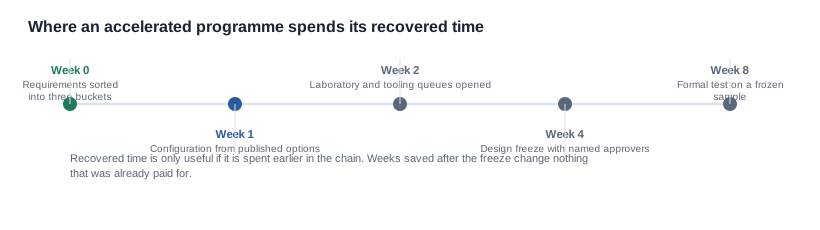
The timing point matters as much as the lever. Recovered time is only useful when it is spent earlier in the chain, because weeks saved after the design freeze change nothing that has already been paid for in tooling, in laboratory fees and in a queue position.
Development process: what can be compressed and what only moves
It helps to sort every step into one of three categories, because the categories behave differently and buyers routinely treat them as one.
Steps that can be compressed. These are decisions, not queues. Choosing a cell configuration from the published options, agreeing a colour, approving an artwork file and settling a device name are all decisions that can be taken in hours. None of them requires a supplier to do anything, which is precisely why they are the most under-used accelerators in this category.
Steps that can only be moved earlier. These are external queues that cannot be shortened but can be joined sooner. A laboratory assessment, a tooling order and a print run are all like this. The action is not effort; it is issuing the instruction before the decision is finished, or issuing it conditionally so the queue starts while the review completes.
Steps that cannot be moved at all. A design freeze has to follow enough evidence to be defensible, and an artwork cycle takes the time the printer takes. The only honest lever on these is to make fewer of them, which means not changing the product after the freeze.
A buyer who asks a supplier to compress something in the third category will receive a date that slips, and it will slip at the worst possible moment because the schedule was built on an assumption rather than on a constraint.
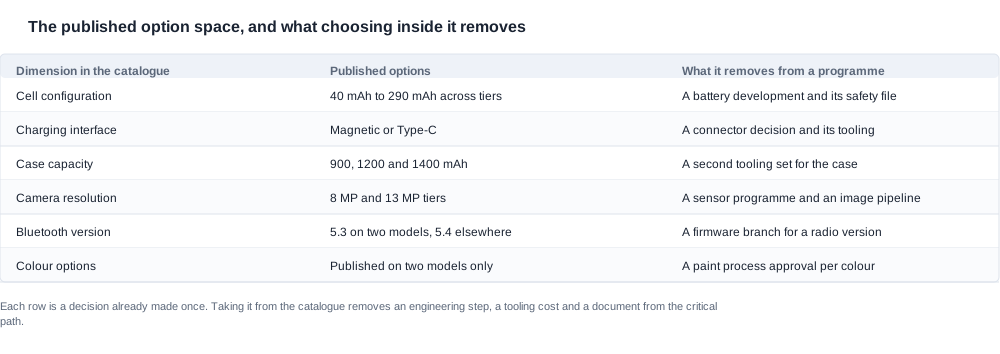
Read that table as an acceleration instrument rather than as a catalogue. Each row is a decision that somebody has already made once, at somebody else's cost. Taking it from the published set removes an engineering phase, a tooling cost and a document from the critical path of your programme — and, more importantly, removes the queue that sits behind that phase.
The two models in the range with published colour options are worth noting for a specific reason. Colour is one of the few customisations that appears cheap and is not, because each colour carries a paint process approval and sometimes a distinct housing batch. Choosing a model where colour is already published, rather than requesting a new one, is the difference between a configuration choice and a development project.

The four accelerators that remove work
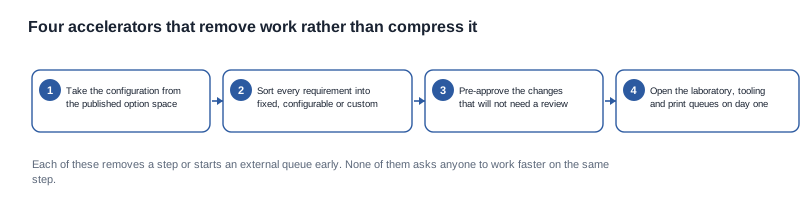
1. Take the configuration from the published option space. This is the largest single lever and it is available before the first meeting, because the space is published. Choosing among existing configurations removes development, removes tooling and removes a new conformity document. If your requirement can be met inside this space, the programme can start several phases further along than a buyer typically expects.
2. Sort the requirements before the quotation. Every requirement goes into one of three buckets: fixed by the platform, configurable within it, or genuinely custom. The design phase discussion sets out the method. The cost of skipping this step is not abstract — it is a development discovered at the pre-production sample, which is the single most expensive moment to discover one.
3. Pre-approve the customisations that will not need a review. A short list — the logo process, the colour, the packaging artwork, the device name — agreed in advance, so the programme does not run a separate conformity review for each. The certification impact discussion sets out what a review involves, and the reason to pre-approve is that each review is a queue with a duration.
4. Start the external queues on day one. The laboratory, the tooling shop and the print run are the actual constraints in most programmes. If they are waiting on a decision, the queue is idle and the recovered weeks are being spent standing still. Our published position is that our catalogue publishes no CE, FCC or RoHS text and no per-model certification row for the adult models, with any certificate numbers awaiting confirmation; the model-list question can be asked immediately, and asking it in week one rather than week six is worth real schedule.
There is a fifth accelerator that is not on this list because it is not really an acceleration: deciding to do less. A programme that launches one market with one platform and adds the second market after the first shipment is faster than one that attempts both in parallel, and it produces a smaller risk surface while it is running.
Before the first meeting, the highest-value hour available to a buyer is an audit of their own requirement list against the published option space. Take each requirement in turn and mark it against one of the published dimensions — cell, charging interface, case capacity, camera tier, radio version, colour, runtime. Where a requirement maps to a published option, it is a configuration choice that can be made in a day. Where it does not, it is a development, and it needs to be visible as one before it is quoted rather than after.
That audit changes the character of the first conversation entirely. Instead of describing a product and waiting for a supplier to say which parts are difficult, a buyer arrives with a shortlist of configurations and a short list of genuine developments, and the meeting is spent on the second list rather than the first. The questions to ask are short: which of these published configurations is closest to our requirement, what is different about it, and what would closing that difference involve.
It also protects the programme against a common failure mode, where a requirement is described loosely enough that both parties assume it is inside the published space. A vague phrase such as "long battery life" maps to no published row at all, and the disagreement about it surfaces weeks later as an expectation that was never stated. The discipline is to replace adjectives with the specific figure, and where no figure exists, to write the criterion the buyer would actually accept.
The four things that do not accelerate a programme
1. Working harder on the late phases. The dependency chain is fixed: the requirement has to be sorted before the configuration can be selected, the configuration before the frame, the frame before the first article, and the first article before the production run. Compression at the end of the chain moves work rather than removing it, and the work returns as a change request.
2. Skipping the first article. It appears to be a saving and it is a postponement. The first article is the cheapest place to discover that a finish standard was never written down, that an assembly sequence depends on a jig nobody has, or that a label will not fit the packaging it is printed on. Each of those is expensive to find during a production run and inexpensive to find on one unit.
3. Assuming the compliance track follows the design track. It usually runs alongside the design track and it usually runs longer, because it waits on a laboratory rather than on an engineer. Programmes that plan one critical path and discover a second one late are the most common cause of a certification date that slips past a launch commitment.
4. Rushing the artwork approval. The artwork cycle is external and does not compress, and an internal approval chain compresses badly at the end of a quarter, when the people who have to sign it are closing other work. Sending artwork late is the single most reliable way to lose four weeks at the end of a programme that was otherwise on time.
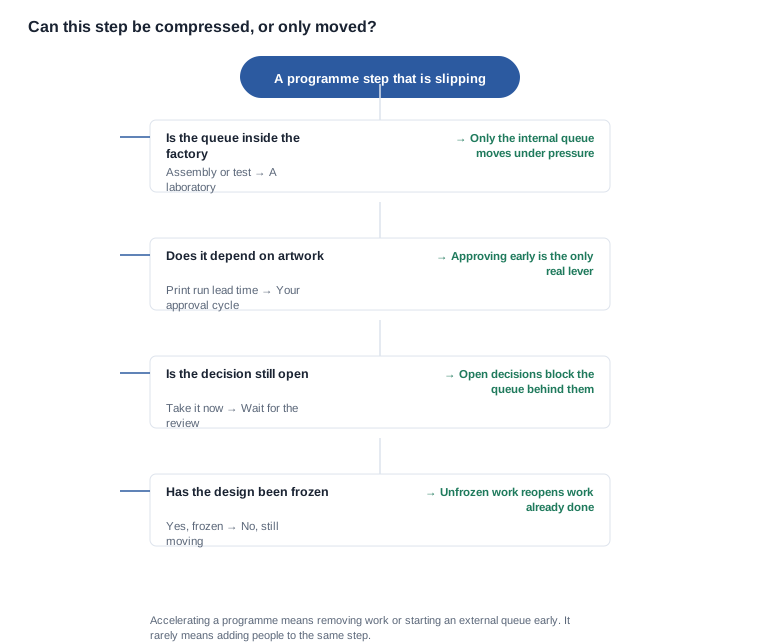
A fifth item deserves naming because it is the most common of all: adding people. Adding people to a step that is waiting on an external dependency produces a larger team waiting on the same dependency. The question to ask before any resourcing decision is whether the step's constraint is inside the organisation or outside it, and that single question prevents most of the wasted acceleration effort in this category.

Naming the constraint before promising a date
Most schedule disputes in this category are not disputes about facts. They are disputes about which constraint was assumed, because the two parties were each modelling a different one. The buyer's model assumes the supplier's engineering capacity is the limit; the supplier's model assumes an external queue is the limit. Both are usually wrong in the same direction, and the conversation resolves quickly once the constraint is named.
Before anyone commits to a date, four questions have to be answered.
- Which phase is the constraint, and what is the queue length at each external step? A date without a named constraint is a guess, and it is a guess that feels like a commitment because it appears in a quotation.
- What has to be frozen for that date to hold? A date is only as firm as the last open decision, and an open decision after the freeze is a change request.
- What is the fallback if that phase slips, and is the fallback a different configuration, a different market or a later date? Each fallback has a different cost, and a buyer who has not chosen one will choose it under pressure.
- Which requirements are still unsorted? Every unsorted requirement is a potential new development, and this is the question most often left unanswered because it requires someone to admit that a list is incomplete.
The trade-off worth naming explicitly is the one between breadth and date. A programme that covers three markets and two platforms carries three documentation tracks and two characterisation exercises. A programme that covers one market and one platform carries one. Most buyers discover that they wanted the first thing and were quoted the second, and the resolution is to state the priority order before the quotation rather than after it.
There is a related negotiation point: the date a supplier quotes is usually a date conditional on something the buyer has not yet decided. Asking what the date assumes is a legitimate and productive question, and a supplier who cannot answer it is telling you the date was not built from a constraint analysis.
The quotation itself carries the same ambiguity, and it is worth decomposing rather than reading as a single number. A quotation should distinguish the unit price from the tooling charge, from the one-off development cost, from the certification cost and from the cost of anything that has to be repeated per market. A programme accelerated by choosing inside the published space typically shows lower development and tooling lines than one built from scratch, and a buyer who cannot see the breakdown cannot tell whether the saving is real or has been moved into a different line.
The terms attached to the quotation matter as much as the figure. A price with no stated defect definition, no inspection scope and no remedy is not a price that can be acted on, because every one of those three becomes a negotiation later and each negotiation costs more than the original conversation. Asking questions to ask about terms before you commit to a quantity is cheap; renegotiating them during a production run is not.
A final point on dates worth making, because it is the one buyers most often leave alone: a date with no named assumption attached will be defended as though it were contractual. Suppliers generally do not intend that, and stating the assumption in writing at the quotation stage is enough to prevent it. It costs one sentence and removes a dispute that otherwise arrives at the worst time.

What to do in the weeks when the programme is waiting
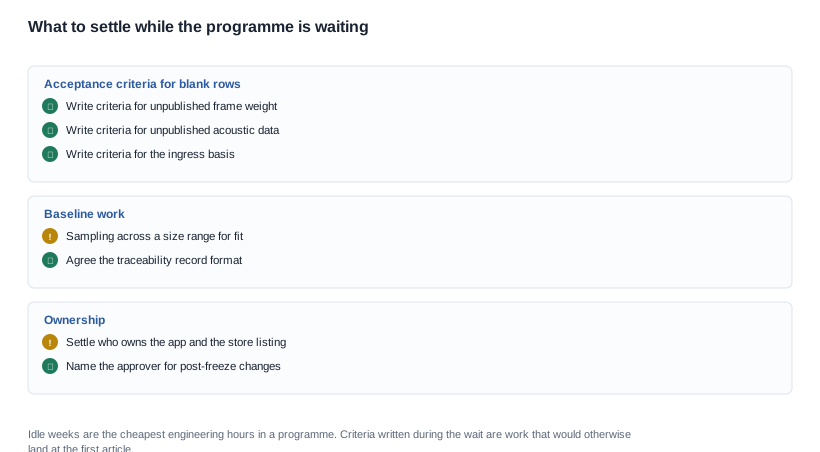
Idle weeks are the cheapest engineering hours in any programme, and they are usually spent waiting rather than working. Four things are worth doing in them.
1. Write acceptance criteria for the rows that are published as Not published. Our range leaves the frame weight, the camera specification, the acoustic performance, the lens performance and the ingress evidence blank for nearly every model — the single published weight figure in the entire range is the MT6 at 158 g. Writing the criteria during the wait is work that would otherwise happen under pressure at the first article, when a criterion written late is a criterion negotiated in a hurry.
2. Establish a fit baseline across a size range. Sizing is the largest driver of returns in this category and the published data cannot help, because the per-model detail is absent. A structured sampling exercise during the wait produces the baseline that the later field data will be measured against, and doing it once rather than twice saves a pilot.
3. Agree the traceability record format. The record is what makes a claim work in year two, when the people who made the original decision have moved on. Designing the format during the wait costs nothing, and retrofitting it across a production run is one of the more expensive administrative tasks in this industry.
4. Settle the app ownership and the firmware policy. The app branding discussion covers the ownership levels, and a decision deferred to month six arrives with a schedule attached. Early ownership decisions also determine who signs a post-freeze firmware change, which is the decision that most often invalidates a technical file.
Two smaller items belong on the same list. Agree in advance what counts as a change requiring approval and what does not, because an undefined change process converts every small request into a negotiation. And write down what the programme is explicitly not doing in its first six months, because scope that is never excluded has never been agreed.
There is a further category of work that only becomes possible while a programme waits, and it is the one most often missed. Several of the rows in our published data are blank, and a blank row that is never converted into a criterion simply stays blank until the programme is under pressure. Each blank row is an opportunity to define, in advance and without a supplier in the room, what evidence would satisfy the requirement. A frame weight acceptance criterion, an acoustic floor for a call, a runtime measured under a stated charge method, an ingress requirement with a named standard behind it — each of these takes an hour to write during the wait and saves a week of argument during the first article.
Writing them alone is not sufficient, because a criterion nobody has agreed is a criterion somebody will renegotiate. The useful version names the method as well as the threshold, because most disagreements in this category are actually disagreements about how a figure was obtained rather than about whether it is acceptable.
Being direct about what we do not publish
We will say plainly that the honest accelerators are the ones that remove work rather than the ones that compress it, and that the published configuration space in our range is wide enough that a programme can often begin three phases further along than a buyer expects.
We will also be direct that production lead times, production capacity and minimum order quantities are Not published on this site and are confirmed per enquiry, because each depends on configuration, quantity, documentation scope and the current schedule. The published figures that do exist — cell configurations, case capacities, charging interfaces, camera tiers, radio versions, runtimes and the two models with published colour options — are published precisely because they are stable enough to plan against. The commercial figures vary per enquiry because they are not.
The one number a buyer should never accept from any supplier without a basis is a date. Ask what it assumes, name the constraint it was built from, and state what has to be frozen for it to hold. A date that survives those three questions is a plan. A date that does not is a number, and it will move when the programme meets the constraint.
It is worth being clear about one trade-off that buyers sometimes try to avoid entirely. Accelerating a programme by choosing inside a published option space means accepting some of the boundaries of that space — a cell configuration that is close to your requirement rather than exactly on it, a colour from a smaller set, a runtime measured under conditions you did not choose. That is a real concession, and a buyer who will not make it should say so rather than accepting it quietly and reopening it at the first article. The alternative is a genuine development, which is a legitimate programme, provided it is funded and scheduled as one.
What is not legitimate is a programme that pays for the development without scheduling it, or that schedules it as though it were a configuration change. That mismatch is the most common single cause of a date that was never achievable, and it is visible early to anyone who asks where the requirement sits in the published space.
If you tell us the configuration, the quantity, the destination markets and the date you are working back from, we will tell you which phase binds and what can be taken off the critical path. The stage structure itself is set out in development process cost drivers, and the cost of each customisation point is covered in customisation lead time impact.
Related reading
- Development process
- Development process cost drivers
- ODM design phase
- Customisation lead time impact
Send the configuration, quantity, markets and date and we will name the binding phase.


