

The honest answer to the question is that there is no typical smart glasses shipping cost range, and any figure presented as one is either the cost of a very specific shipment or an estimate built on assumptions the buyer has not been shown. The useful answer is different: a range is not a market fact, it is the residual left over after you have closed the variables, and the width of your range is a measurement of how much of your own specification is still missing.
That reframes the question in a way that changes what a buyer does. Instead of looking for a number to accept, you can look at the range, identify which of its seven variables are open, and close them in order of how much each one moves the spread. A range that narrows from a wide band to a narrow one is a specification improving. A range that stays wide however many quotations you collect is telling you that the thing you are comparing is not a shipment.
Smart glasses shipping cost ranges: what the width does not prove
Every range a buyer is shown in this category is produced the same way, whether it came from a supplier, a forwarder or a colleague's last order. Somebody took a shipment with a specific configuration, a specific volume, a specific route, a specific mode, a specific carton and a specific incoterm, and generalised from it. The generalisation is where the width comes from, and the width is not a property of the freight market. It is a property of how many of those six inputs the person producing the range actually knew.
The practical consequence is that a wide range is not a signal that freight is volatile. It is a signal that the range was built from a shipment that is not yours. A narrow range built on a stated basis is worth more than a wide range built on an unstated one, even when the wide one happens to contain the right number — because a range you cannot reconstruct cannot be defended to a supplier, and a number you cannot defend is a number you cannot repeat.
There is a second reason a typical range is hard to publish in this category, and it is a data reason rather than a market one. The inputs a freight rate is built from are mostly not published by anyone in the supply chain for this product. The catalogue publishes no packed carton dimensions, no gross packed weight and no unit count per master carton for any of the twenty-eight models, and those three figures are exactly what a chargeable weight is calculated from. It publishes one unit weight — the MT6 glasses body at 158 g, which includes its 265 mAh cell and its camera and excludes the foldable charging case, with the case weight itself unstated — and that is a body weight, not a packed weight. It publishes no freight rate, no minimum order quantity, no lead time and no production capacity.
So even a manufacturer who wanted to publish a typical range would be publishing it without its own inputs. That is not a reason to keep the figure secret; it is a reason to publish the method instead. Which is what this article does: the seven variables, the order in which to close them, and the catalogue rows that set the volume.
What a defensible range actually looks like
A range becomes defensible at the point where it carries three things: the configuration it was built for, the date it was built on, and the basis of every cost line inside it. Those three are what let a buyer take a number from a previous shipment and reuse it, and they are also what let a supplier confirm or dispute it. A range without them can still be a good estimate; it simply cannot be argued with, and a cost conversation that cannot be argued with is a cost conversation that ends with whoever quoted last.
The criteria for a usable range are better stated as a shortlist than as a formula, because no formula exists in this category. A usable range names the model and the variant; it names the volume in units and in cartons; it names the route and the mode; it names the incoterm with a named place; it names the carton; and it names the date it was built on. Miss any one of the six and the range is a number with a gap in it, and the gap is where the disagreement will arrive from.

The seven variables that decide the width of your range
Each of the seven below moves the range differently, and the difference matters more than the size of the move. A variable that moves the range and a variable that moves the centre of the range are different problems, and only one of them can be closed by asking a supplier a question.
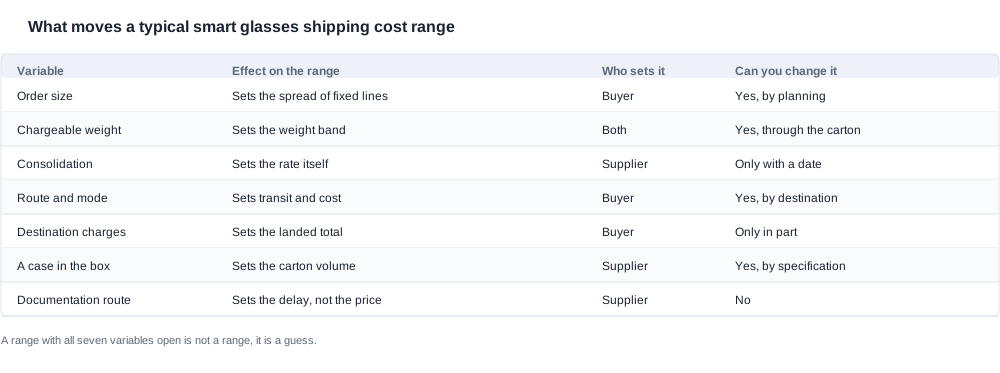
Order size sets the spread of the fixed lines rather than the centre of the range, and it is the only variable the buyer controls outright. The per-consignment costs — transport documentation for a lithium-equipped product, clearance, terminal handling, the booking and the release work — are charged once per consignment and divided across the units. That is the entire arithmetic behind the difference between a first order and a fifth order, and it is why a range produced from a large shipment does not describe a small one at all. It is also the reason splitting an order is rarely a saving: a second consignment adds a second set of fixed lines rather than dividing the first set further.
Chargeable weight sets the weight band, and for a boxed product it is normally the greater of actual and volumetric weight, which makes the carton the dominant term. This is the variable most often left open in a range, because it requires a packed carton dimension that nobody publishes. It is also the one where the buyer has the most leverage, since the carton is a specification decision rather than a market condition.
Consolidation sets the rate itself, and it is controlled by the supplier's production and packing calendar rather than by the buyer. It cannot be assumed without a date, and a rate quoted for a consolidated movement without the window attached is a rate for a shipment that may not happen.
Route and mode set both transit and cost, and they are constrained rather than free: the transport document set applies to every consignment of this category, because every model in the range ships with a lithium cell, and what actually varies by lane is which documents are required and how long they take to prepare.
Destination charges set the landed total, and the incoterm decides which side carries them. Two suppliers quoting the same number on different terms are not quoting the same product, and this is the variable most often folded into a blended figure that cannot be rebuilt.
A case in the box sets the carton volume, and in this catalogue it is the variable with the most published variation behind it. Whether a charging case travels with a camera unit is not one question with two answers: seven camera models ship with a case, the V03 Pro has no charging-case row, and the catalogue publishes no charging case row at all for the V03, the V06 or the S7. Where a capacity is published it is a specific number, and the L2 Utral is published at either 900 mAh or 1400 mAh, so even a published case can be two cartons.
The documentation route sets the delay rather than the price, and it is the variable most often left out of a range entirely — including out of the cost, because the cost of a hold at the origin is charged per day and appears as storage rather than as freight.

Which variable closes the range fastest
Closing seven variables in the wrong order is a common way to spend a month and end up no closer to a number. The order that works is the order in which each variable stops other variables from being estimated.
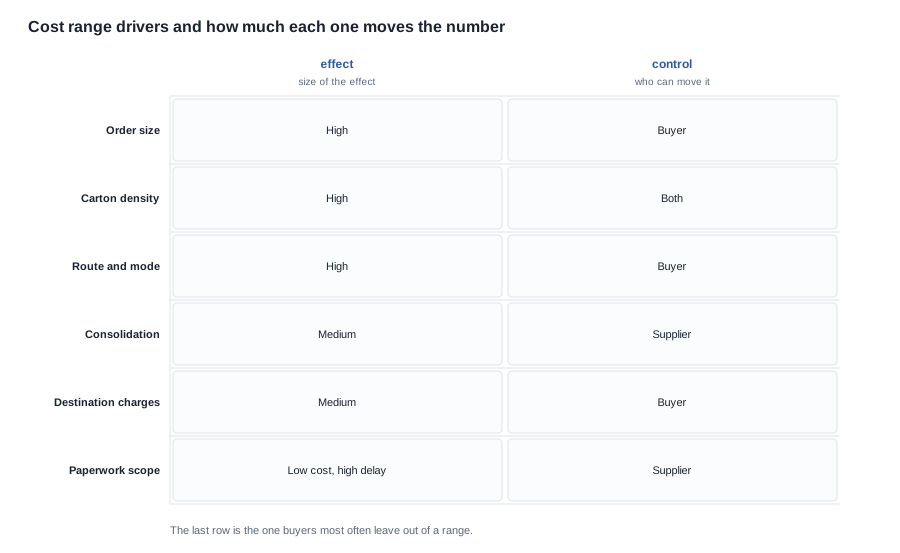
Read the matrix by column rather than by row. The three high-effect variables are order size, carton density and the route — and they are high-effect for different reasons. Order size moves the fixed lines. Carton density moves the weight band. The route moves both the transit and the cost, which is why it sits above the rest.
Consolidation and destination charges sit in the middle. Consolidation is a medium effect on cost but a large effect on schedule, and destination charges are medium only because the incoterm decides how much of them the buyer carries. The last row is the one most buyers omit: the documentation scope has a low cost and a high delay, and it is the variable that produces the cost surprises rather than the price surprises.
The practical ordering follows from this. Order size comes first because it is free — it is a decision the buyer has already made, and it costs nothing to write down. The route and the incoterm come next, because they are also buyer decisions and because a freight rate is meaningless without them. The carton comes third, because it cannot be specified until the case status is known, and the case status depends on the configuration. Consolidation comes fourth, because it is a question for the supplier and it will not be answered accurately until the first three are written down. The documentation scope comes last, and it is the one most likely to be a surprise.
The questions to ask, in the order that closes the range
Five questions, asked in this order, close most of the range. Each one has a completion test, because a question without one comes back as a paragraph rather than as a number.
- How many units go into a master carton, and what are the packed dimensions of that carton? Completion test: a number and a dimension, in writing. This is first because the answer sets the weight band, and the band is a step rather than a slope.
- What chargeable weight will be declared, and is it the actual weight or the volumetric weight? Completion test: a number and a label. If the answer is volumetric, the carton question above has not really been answered yet.
- What rate applies at my quantity, and what rate applies if the goods travel alone? Completion test: two numbers. This separates the fixed lines from the variable ones, and it is the only way to see how much of the range is volume-driven.
- Which destination charges are inside the rate and which are mine? Completion test: an itemised list, or a written statement that they are bundled — because bundled is also an answer, as long as it is labelled as one.
- When will the goods be ready, and what has to be ready before they can be booked? Completion test: a date and a list of conditions.
Asked before you order, these five questions take an afternoon. Asked after the goods are packed, the same five take a fortnight and produce a number that cannot be acted on.

Narrowing the range into a single number
A range narrows by closing fields, not by pressing for a discount. Pressing for a discount on a range that still has open variables produces a lower number on a shipment nobody defined, and it is the cheapest possible way to buy a future dispute.
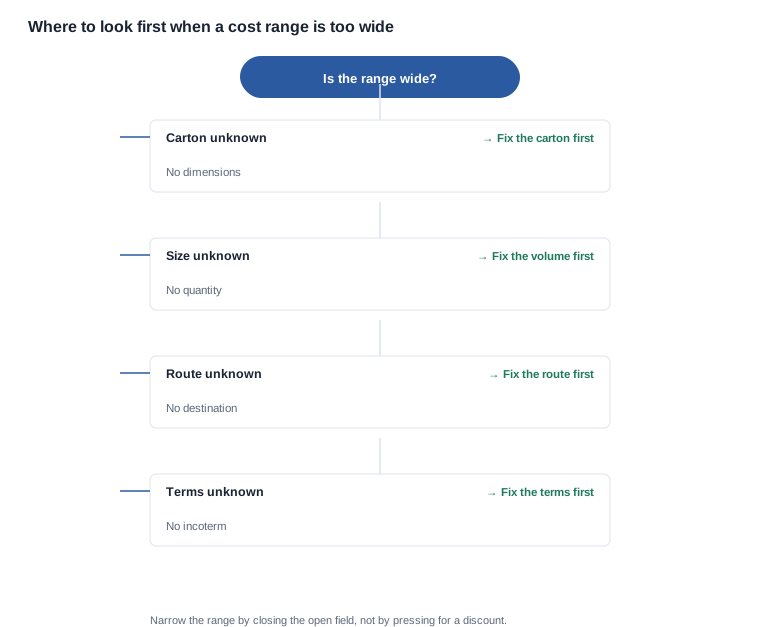
The decision chart is a diagnostic for a range that is wider than it should be. If the carton is unknown, fixing the carton will move the range more than any negotiation on the rate, because the carton sets the weight band and the band is a step function rather than a percentage. If the order size is unknown, fixing it removes the fixed-line spread. If the route is unknown, there is no range to narrow at all — the rate depends on it more than on anything else in the document. If the terms are unknown, the destination charges are outside the range, and the range you are looking at is a carriage cost rather than a landed cost.
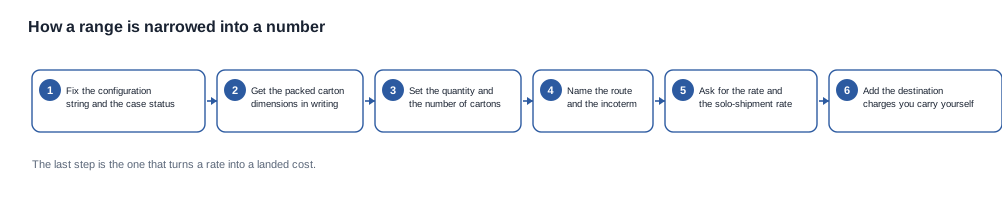
The six steps in the flow are in dependency order, not in preference order. The configuration string and the case status come first because the carton follows from them. The carton dimensions come second because the weight band follows from them. The quantity and the carton count come third because the fixed lines divide by them. The route and the incoterm come fourth because the rate and the destination charges follow from them. The rate and the solo-shipment rate come fifth, and the destination charges the buyer carries come sixth — which is the step that turns a rate into a landed cost.
That last step is the one most ranges never reach, and it is the step that decides whether the range was worth building. A range that stops at the rate is a carriage cost with a tolerance; a range that reaches the destination charges is a landed cost, and a landed cost can be set against a margin, quoted to a channel, and used to decide whether the order is worth placing at the volume it was placed at.
The trade-off worth making deliberately
There is one trade-off in this category that buyers regularly make by accident rather than by decision, and it is worth naming. It is narrowing the range by accepting a simpler carton rather than by asking for a better rate.
A denser carton reduces the freight band on every future order and reduces the number of units exposed to a single handling event, and it does both at once. A negotiated rate is smaller, and it reverts at the next surcharge or the next market move. Which one to choose depends on the order profile, and the question to ask is how many times this shipment will recur, set against how much the order is worth right now. For a programme with a stable annual volume and retail packaging that is not about to change, the carton is the better investment and the rate is the smaller prize. For a one-off launch whose packaging is still moving, the rate deserves more attention than the carton, because the carton will be redesigned anyway.
The trap is treating the two as alternatives on a single negotiation. They are not, because they sit on different sides of the paperwork: the carton is a specification the buyer owns and controls, and the rate is a commercial term that will be re-quoted whatever the buyer does.
The catalogue rows that set the volume, and where our position sits
The bars below are the published catalogue rows that determine how much room the unit occupies in a carton, and therefore which part of the range a given model pushes on.
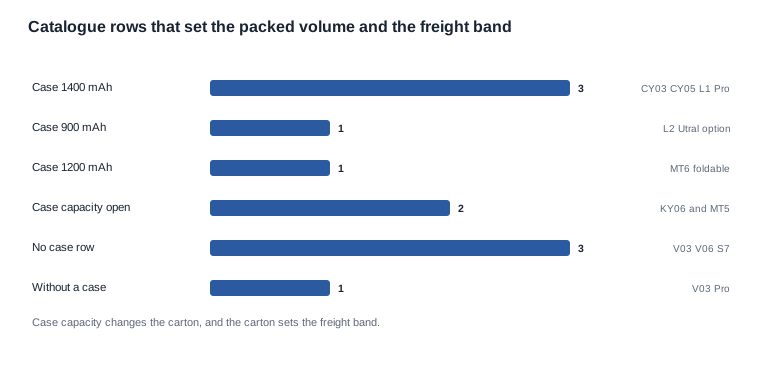
Five camera models publish a case capacity — the CY05 and the CY03, and the L1 Pro — each at 1400 mAh, the L2 Utral at either 900 mAh or 1400 mAh, and the MT6 at 1200 mAh in a foldable case — two publish a case with no capacity stated, three publish no charging case row at all, and one has no charging-case row. That spread is why the carton volume has to be established per model rather than per category, and it is the reason a range built on one camera model will not transfer to another.
The charging method moves the same variable from a different direction. It is published for twenty-four of the twenty-eight models, and not published for the L1 Pro and the CY03, and the CY05 or the MT6. For those four, the packing list cannot be finalised until the method is confirmed, because the method decides which power accessories travel in the box.
One figure is often offered as a shortcut and cannot be used as one. Every model in the range publishes a charge time — twenty-six at two hours or less, the D17 and the ZH12 at around one hour — and it is tempting to treat that as the turnaround time for a mid-shift swap. It is not, because no starting state of charge and no end criterion is published with it, and without both of those the figure cannot be turned into a window in which the unit is actually usable. It also cannot be used as a charging-case turnaround time, for the same reason.
Concretely, we will not publish a typical shipping cost range, because a range published without its inputs is a number a buyer cannot rebuild and a supplier cannot be held to. We will not quote a rate against a retail carton, and we will not supply a chargeable weight derived from a packed figure we have not been given. We do not publish unit prices, minimum order quantities, lead times or production capacity, and we will not substitute a typical figure for any of them.
What we will do is close the fields that close the range, and they are not all ours to close. Send the model, the quantity, the destination and the intended incoterm, and we will tell you which of the seven variables the published configuration settles for you — the configuration, the case status, the charging method and the battery detail — and which three have to be agreed with the factory and the forwarder before the range can become a landed cost you can quote.
The cost breakdown article sets out the six lines a landed cost is rebuilt from, and the industry benchmarks article covers which reference points survive a like-for-like comparison.
Related reading
- Smart glasses shipping cost breakdown
- Smart glasses shipping industry benchmarks
- Smart glasses shipping hidden costs
- Smart glasses shipping request template
- Battery transport compliance
- Logistics and shipping
Send the model, the quantity, the destination and the incoterm, and we will tell you which parts of the range the published configuration closes and which three remain open — and that is usually the difference between a range and a price.


