

Shipping is not the last step of an order; it is a cost block that decides the unit economics of the programme and a compliance step that decides whether the goods are allowed to move. The right question is not which courier is cheapest but which shipment rule your price depends on, and what happens to the cost and the schedule when that rule does not hold.
The reason shipping has its own document list, separate from the quality documents and the compliance documents, is that the documents that move goods are not the documents that describe goods. A packing list tells a forwarder how many cartons there are. It does not tell you whether the case inside them is the one you ordered. Both questions matter, but they are answered by different documents and they are requested at different times, and conflating them is what produces a consignment that arrives with the paperwork for a different build.
What follows is the working version: which document settles what, in what order they arrive, how to verify them, and what happens to the landed cost when one of them is missing.
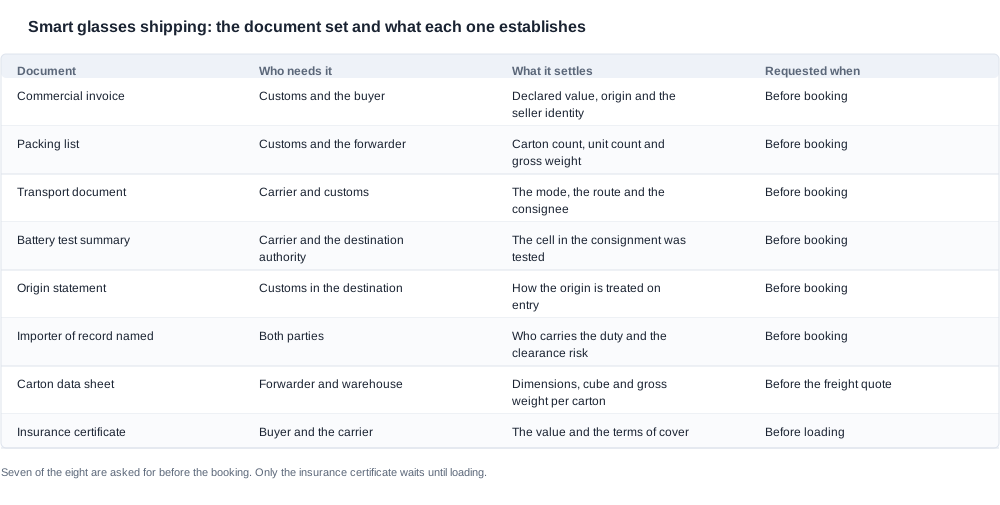
Smart glasses shipping: who has to hold the four release documents
Four of the eight documents in the set below have a property the others do not: a consignment without them does not arrive late, it does not arrive. They are the release documents, and they are all requested before the booking rather than before the loading, because the booking is the point at which the carrier commits and the documents are the point at which the carrier checks.
The commercial invoice establishes the declared value, the origin and the identity of the seller. It is the document the destination authority reads first, and it is the document that determines whether the consignment is treated as what it is.
The packing list establishes the carton count, the unit count and the gross weight. In practice this is the document the forwarder reconciles against the physical cartons, and the reconciliation is where the first discrepancy appears: a carton count that does not match the physical load is a question that gets answered at the port rather than at the warehouse.
The transport document establishes the mode, the route and the consignee, and it is what the carrier uses to construct the movement. For a battery-equipped product it is also where the handling declaration sits, which means the document has to agree with the cell documentation or the carrier will hold the shipment.
The battery test summary establishes that the specific cell in the consignment was tested for transport. This is the document that is asked for most often and provided least often in a usable form, and the reason is worth understanding: a summary that covers a cell type is not a summary that covers your cell, and in this category there is more than one cell type in a single consignment.
That last point is the one specific to this product category and it deserves stating with the published figures. Device batteries across this catalogue run from 40 mAh on the A05 and the A06, through 70 mAh on the A07, 100 mAh on the D11 and the D12, 115 mAh on the D17, 200 mAh on the bone-conduction model, and 220 mAh, 260 mAh, 265 mAh and 290 mAh on the camera models. Charging cases appear separately at 900 mAh and 1400 mAh on the L2 Utral, 1400 mAh on the CY05 and the L1 Pro, and the CY03, and 1200 mAh in the MT6's foldable case. A camera model with a case therefore carries two distinct cell types, and the transport paperwork has to cover both.
The reader, and what the shipping documents actually decide
The reader is a brand-side buyer, a channel buyer or an importer. The situation is one of three: a freight quotation has arrived and the landed cost cannot be checked against anything, because the carton data behind it is missing; a first shipment is being planned and nobody has established who carries the duty; or a programme is already shipping and a consignment has been stopped, and the cost of that stop is landing in the buyer's margin.
Shipping sits at the point in a programme where several people's assumptions meet. The factory assumes the freight forwarder handles the paperwork. The forwarder assumes the buyer provides the commercial documents. The buyer's logistics team assumes the factory has declared the classification correctly. In the absence of a document list, each of these assumptions is reasonable and the gap between them is where the shipment stops.
The two commercial questions that follow from the document set are worth stating separately, because they are frequently confused with each other. The first is which shipment rule the price assumes: whether the goods travel consolidated with other orders, alone, or by a mode that has its own constraints. The second is who carries the risk between the two points in the contract: where responsibility for customs treatment, duty and clearance sits. Both belong in the purchase order rather than in a quotation footnote, and the second one in particular has consequences that reach all the way back to the unit price.


The eight documents, and the order they should be requested in
| Document | Who needs it | What it settles | Requested when |
|---|---|---|---|
| Commercial invoice | Customs and the buyer | Declared value, origin and the seller identity | Before booking |
| Packing list | Customs and the forwarder | Carton count, unit count and gross weight | Before booking |
| Transport document | Carrier and customs | The mode, the route and the consignee | Before booking |
| Battery test summary | Carrier and the destination authority | The cell in the consignment was tested | Before booking |
| Origin statement | Customs in the destination | How the origin is treated on entry | Before booking |
| Importer of record named | Both parties | Who carries the duty and the clearance risk | Before booking |
| Carton data sheet | Forwarder and warehouse | Dimensions, cube and gross weight per carton | Before the freight quote |
| Insurance certificate | Buyer and the carrier | The value and the terms of cover | Before loading |
The ordering has a logic that is worth understanding, because it explains why the release documents are requested first. The carton data sheet has to come before the freight quote, because the freight quote is calculated from the carton data and a quote built on estimated dimensions is not a quotation at all — it is a guess with a currency symbol on it. The release documents have to come before the booking, because the booking commits the carrier and the carrier will not accept a movement it cannot document. The insurance certificate comes last because it is the only one of the eight that describes an event rather than a state.
What this sequence means in practice is that the cheapest moment to get the shipping document set right is before the production run is confirmed, not before the goods leave. Every one of these documents can be produced in days; none of them can be produced in hours once a container is booked.
Where the shipped case changes the paperwork
Three rows in the set above behave differently depending on what is in the box, and they are worth walking through because they are the ones that catch out a first shipment.
The battery test summary depends on the device cell and, where a case is included, on the case cell as well. A camera model with the 1400 mAh case and one with the 900 mAh case are the same product with a different transport profile, and the difference is visible in the paperwork rather than in the product listing.
The packing list and the declared weight depend on the case in the same way. A unit in a 1400 mAh case and a unit without a case are not the same parcel, and a packing list that does not reflect the case is the most common reclassification trigger in this category.
The classification depends on the configuration in a way that is easier to get wrong than it looks. The catalogue publishes three charging methods across the range — magnetic charging on seventeen of the twenty-eight rows, Type-C charging on seven, and a charging method that is not published at all on the L1 Pro, the CY05 and the CY03, and the MT6 — and a case configuration is published for a subset of the camera models. Each of those is a packaging and declaration decision made at the point where the configuration is chosen.
This is where the shipping document set intersects with the sample document set, and it is why the configuration has to be settled before either document set is complete. A buyer who requests shipping documents against a configuration that is still open is asking for documents that will be reissued.
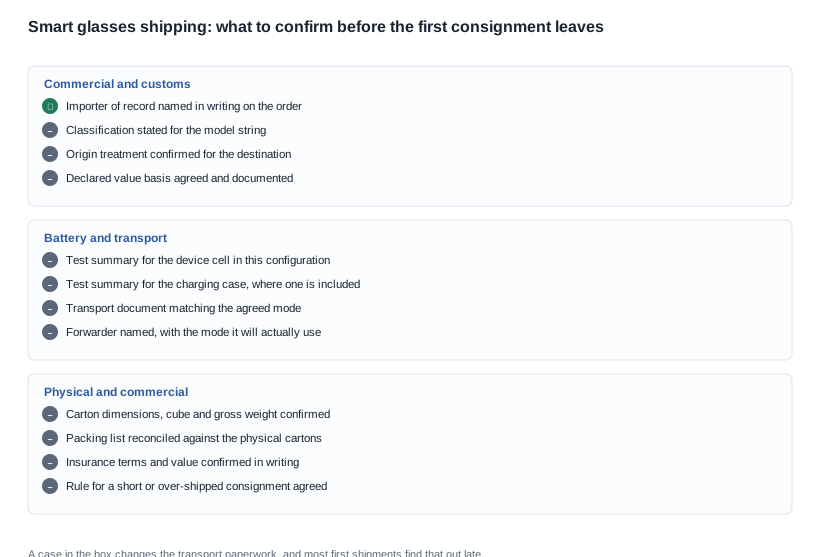

Checking a shipping document set rather than accepting it
A shipping document set is verified against physical things, which makes it easier to check than most document sets and easier to fake. Six steps will settle it.
-
Reconcile the packing list against the cartons yourself. Count the cartons, count the units in one carton, and check the gross weight against what the forwarder has. A packing list that is one carton out is the cheapest possible catch and it costs a minute.
-
Ask the forwarder which mode they will actually use. Not the mode the supplier quoted and not the mode the label suggests, but the mode on the booking. A forwarder consolidating an air shipment into a sea booking changes the transit time by weeks and the cost by a different order of magnitude, and both facts belong in the landed-cost model.
-
Check the transport document against the battery documentation. The cell on the paperwork should be the cell in the box. This is a two-minute check that prevents a hold, and it is the check most often skipped because the two documents are assumed to agree.
-
Confirm the declared value basis in writing. A declared value that is the ex-works price rather than the landed value is a common shortcut, and it is a decision with consequences at clearance rather than a clerical detail.
-
Establish who the importer of record is, and get it on the order. Where the importer of record is not named, the clearance risk sits somewhere undefined, and undefined risk is the most expensive kind to carry.
-
Ask what happens to a short or over-shipped consignment. The rule for a discrepancy is worth settling before it happens, because the alternative is a per-shipment conversation with a forwarder who is not a party to your contract.
Run those checks before the first shipment rather than after it, because the first shipment is the cheapest one on which to learn them. After that, the same check is a dispute.
Where the cost and the delay actually sit
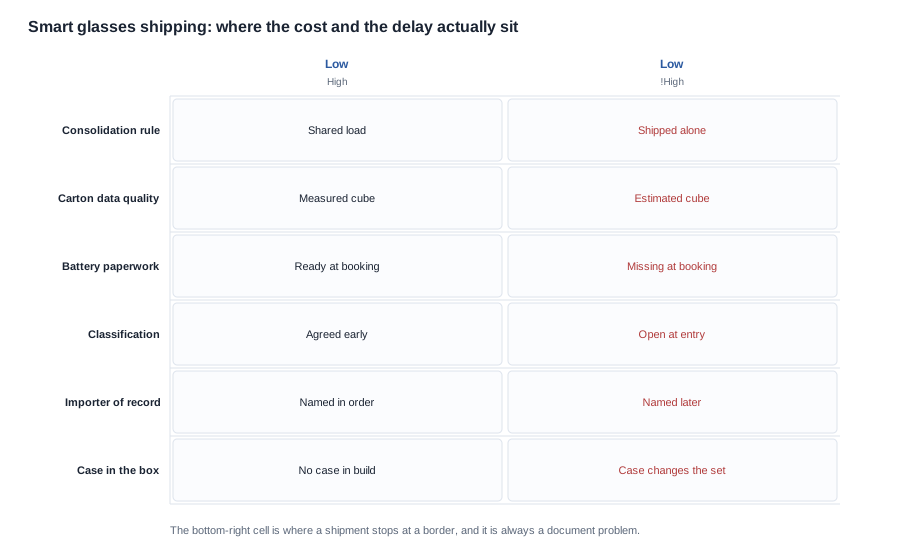
The matrix sets two outcomes against each other for six factors. The bottom-right cell — high cost pressure and high delay risk — is where a shipment stops at a border, and in every case in this category the cause is a document rather than a product.
The cheapest lever in the whole matrix is the top-left one, and it is a commercial term rather than an operational one. The consolidation rule decides whether a shipment travels with other orders or alone, and the price difference between those two is frequently larger than every other line in the freight comparison combined. A supplier who will write down the consolidation window, the solo-shipment rate and the split between their forwarder and yours gives you a cost you can model. A supplier who offers only a blended figure gives you a number you cannot plan against, because you do not know which rule you are inside.
The second cheapest lever is the carton data. An estimated cube overstates or understates the freight charge, and it does so silently, because the quotation looks identical either way. The buyer who asks for the carton data sheet gets a quote that can be checked against the buyer's own warehouse assumptions.

The failures that reach a buyer as a surprise
Each of the following is a symptom, a root cause and the control that stops it.
The shipment that went alone. The order missed a consolidation window and shipped individually at a higher rate, and the freight cost arrived as an overage against a plan that assumed consolidation. The control is the consolidation rule and the solo rate in the quotation, with the solo rate treated as the budgeted cost rather than as a penalty.
The packaging that was chosen for the shelf. Retail packaging was used for a freight route with different conditions, and the damage showed up at the customer's warehouse rather than at the port. The control is to specify packaging against the shipping route and to confirm who approved it against that route rather than against the product.
The consignment that was stopped in transit. The transport documents for the battery were not ready when the goods were collected, and the release was held while a summary was chased. The control is to confirm the document set and its owner before the production slot is confirmed, because at that point a document problem is a paperwork problem and after collection it is a storage charge.
The duty that was never in the model. Clearance and import handling were excluded from the cost model and arrived as an overage. The control is to name the importer of record, the classification and the destination treatment in the quotation rather than treating them as somebody else's department.
The classification that was opened at the border. The treatment was never agreed, and the destination authority made the decision. The control is to agree the classification before the goods are made, and to write into the agreement that a classification dispute is assigned to the party with the technical file to win it.
None of these is a reason to change supplier. They are reasons to put a line in the order.
The commercial terms worth taking, and the ones to resist
The negotiable part of a shipping arrangement is the shipment rule, not the rate card. A supplier who will confirm the consolidation window, the solo-shipment rate and the split between the supplier's forwarder and your own gives you the ability to plan; one who offers only a blended figure does not. Incoterms should appear in the purchase order rather than in a side letter, because a change of term changes the insurance obligation, the customs paperwork and the point at which risk passes, and the three have to move together.
The contract lines worth having are the shipment method, the packaging specification reference, the transport document set, the importer of record and the duty treatment, the consequence of a consignment that arrives late or damaged, and the rule for a short or over-shipped consignment. Where the destination is a customs risk, the most valuable clause is the one that assigns the classification dispute to the party with the data to win it, which is usually the party that wrote the technical file.
Two terms are worth resisting. An open-ended obligation to "provide reasonable documentation" has no owner and no completeness definition, which means the missing document is discovered at the port. And an indemnity that covers clearance and duty costs but not the delay they cause leaves the schedule risk with you while the cost risk has moved.
The questions worth putting in the enquiry, because each one changes the price or the schedule:
-
What shipment method does this price assume, and what is the rate if the goods ship alone?
-
Is the packaging specified against this shipping route, and who approved it?
-
Which transport documents will accompany a battery-equipped consignment, and for which cell types?
-
Who is the importer of record, and how are duty and clearance treated in this price?
-
What are the carton dimensions, cube and gross weight for this configuration, and when will they be final?
A buyer who asks all five in the first round is establishing which quotation is complete. The comparison only works between quotations that answer the same questions.
How to choose between two shipping quotes you cannot yet compare
Two freight quotations for the same configuration are frequently not comparable, and the reasons are usually three: one is priced on measured carton data and the other on an estimate, one assumes consolidation and the other does not, and one includes the duty and clearance treatment while the other treats it as an unbilled contingency. A buyer who compares the two headline numbers is comparing two different scopes.
The method that works is to put both quotations into a single model before comparing anything, and the model has four lines.
The first line is the freight rate at the shipment rule your volume actually supports. This is not the rate on the quotation if the quotation assumes consolidation you will not reach; it is the solo rate, which is what your first three or four consignments will be. Ask for both and use the one that applies to the shipment you are actually placing.
The second line is duty and clearance, included or excluded. If the quote excludes them, they are not zero, they are an estimate, and the estimate belongs in your model because the cost lands in your margin. A quotation that names the importer of record and the classification can be evaluated; one that does not can only be accepted on trust.
The third line is the packaging and carton data cost, which is where the configuration decision shows up. A build with a charging case and a build without one do not produce the same carton, and if the two quotations cover different builds then the freight difference is not a freight difference at all.
The fourth line is the delay cost, which is usually absent from the quotation and always present in the margin. A consignment held at a border costs storage, and the storage period is a function of how long it takes to assemble a document that should have been assembled before the booking.
With the four lines filled in for both quotations, the comparison becomes a total cost comparison rather than a rate comparison, and the criteria for choosing are explicit: lower total cost, or an equal total cost with a shorter documented release path. The trade-off worth naming is between cost and control. A quote that consolidates at a lower rate ties your schedule to a window you do not control, and for a first shipment that dependency is worth paying more to remove.
Before you order, the checklist is short: ask for the shipment rule, ask for the carton data, ask who the importer of record is, and ask which documents travel with the consignment. How to evaluate a document set is to check it against the physical consignment rather than against the other quotation, and how to compare two quotations is to normalise them into the four lines first. The red flags are the ones named above — an unstated consolidation rule, an estimated carton, an unnamed importer of record — and the pitfalls behind them are the same in every programme: a figure with no condition and a cost that appears later.
Where the total cost of a shipment is decided
The total cost of moving goods is not the freight rate, and a buyer who models it as the freight rate will be surprised by the difference. The rate is one line in a model that also carries the duty and clearance treatment, the packaging cost, the storage and demurrage exposure, the insurance, and the cost of the delay when any of these goes wrong.
Two of those lines are controlled by documents and two are controlled by decisions, and the split matters for where you put your effort. The documentation effort — collecting the summaries, agreeing the classification, naming the importer of record — removes the exposure that appears at the border. The decision effort — the shipment rule, the packaging specification, the mode — removes the exposure that appears in the margin.
The red flags for each are the same in kind. A cost model with a single freight line has two lines missing. A quote that names the consolidation window but not the solo rate has one of them. And a quote that treats duty and clearance as an unbilled contingency has moved a cost onto the buyer's model without moving the responsibility, which is the arrangement most likely to end in an argument about who received the bill.
None of this is exotic, and none of it requires a site visit. It requires the eight documents and a model with four lines, and a buyer who asks for both before the order rather than reconciling them after the first invoice.
Our position, and what we publish about shipping
The working rule we apply: the published material on shipping is the part of the specification we can stand behind, and the rest is a question for the supplier's own file. We publish what our documentation states, we mark the rows that are open, and we will not fill an open row with a typical figure from a supplier's general data.
The rows we do not publish for this configuration are these:
- We mark as Not published the packed carton dimensions, the gross weights, the units per carton and the freight weights, because they depend on the final retail packaging rather than on the device.
The rows our published data does settle are these:
-
The UN 38.3 test summary information for the cell is what the forwarder asks for, and the transport classification for the configuration determines the packing rules, the paperwork and the mode options.
-
A configuration that ships with a 1400 mAh charging case and one whose catalogue page prints no charging-case line do not have the same classification, and a packing list that does not reflect the case is the most common reclassification trigger in this category.
-
In the European Union the framework is the General Product Safety Regulation (EU) 2023/988, applicable since 13 December 2024, together with the Radio Equipment Directive (EU) 2014/53/EU and the EN 18031 series of harmonised cybersecurity standards, a mandatory part of the CE mark since 1 August 2025.
We will also tell you when the answer to a shipping question is that it depends on the packaging artwork, because in this category that is often the honest answer and it is a decision that belongs to you.
A hypothetical order, worked through
Consider the worked scenario below rather than a client project. It shows the order of decisions. A channel buyer is importing a camera model with a charging case into the European Union for a retailer, and has a freight quotation that is roughly half the landed cost of the goods.
The first step is to establish what the freight price assumes, and the answer is a consolidation window that the buyer's volume will not support. The quotation is a consolidated rate, and a first shipment of this size travels alone. So the budgeted cost is not the quoted cost, and the buyer's margin model is wrong by a factor that has to be corrected before the order rather than after the first invoice.
The second step is the carton data. The supplier produces dimensions, cube and gross weight for the configuration including the case, and the difference between the estimate in the original quotation and the measured carton is enough to change the freight rate again. Neither number was wrong; the first was never a measurement.
The third step is the compliance document set. The battery test summary for the device cell and the summary for the case cell are both obtained before the booking, the importer of record is named on the purchase order, and the classification is agreed rather than left open. The origin statement is settled at the same time.
The decision at the end is that the programme proceeds with the higher budgeted freight and a landed-cost model that matches it, because the alternative is a first consignment that travels alone at an unbudgeted rate and stops at the border for a document that was never requested. The commercial judgement was not the freight quote; it was that a cost model built on an unstated consolidation assumption is not a cost model.
Send the models, the configurations, the quantities and the destination, and we will tell you which configurations exist and which parts of the shipping question are settled by the published data and which are the forwarder's and yours to answer.
Related reading


