

Smart glasses shipping is a category where a buyer can hold a completely reasonable belief and still lose money on the first consignment, because the belief is invisible in the quotation. The beliefs in this article are not stupid and they are not rare — they are the ones a procurement manager arrives with after a decade in a different product category, where the catalogue weight was the shipping weight and where a delivered price really did include duty. Each one is set out here with the published catalogue fact that contradicts it and the check that settles it.
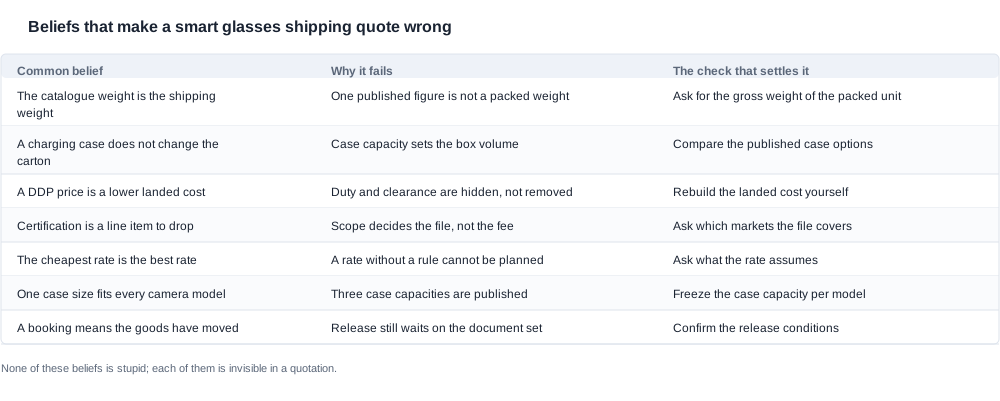
Smart glasses shipping: the beliefs that make a quotation wrong
The short answer on these mistakes
The mistake is never the belief itself. It is allowing a belief to substitute for a question that a supplier should have answered in writing. A buyer who believes the catalogue weight is the shipping weight and who then asks the factory for the gross weight of the packed unit has lost nothing. A buyer who believes it and does not ask has made a decision by default, and the decision is being made again on every order.
Three of the beliefs in this list cost freight. The rest cost schedule, cash or channel trust, and those are the more expensive ones. The practical summary is this: a belief is a hypothesis, and a hypothesis has to be tested against a document before it is priced into a programme. The checks in the last column of the table below are the tests, and all of them are answerable by a supplier in a single email.
The buying task behind the belief list
The reader here is someone buying on the brand side, a channel buyer or an importer, and in every case the belief is doing the same job: it is closing a question so that the buyer can move on to the next one. That is what beliefs are for, and it is why they are dangerous here, because the question they close is the one that decides whether the programme is planned or discovered.
Three situations produce most of them. The first is a quotation comparison, where a buyer needs the numbers to line up and reaches for a rule of thumb to make them line up. The second is a margin model, where a line has to be filled in and the catalogue number is the nearest available number. The third is a re-order, where the arrangement that worked for the first shipment is assumed to work for the fifth, and nobody re-opens the file.
What the reader is actually managing is a set of unanswered questions wearing the shape of a number. Each belief in this article closes one of those questions, and each closed question is one a supplier should have answered in writing before the order was placed. The consequence is not a bad price; it is a programme that is discovered rather than planned, a schedule that slips for a reason nobody can reconstruct, and a second order that repeats the first one exactly.
The eight beliefs, and the published fact that contradicts each one
| Common belief | Why it fails | The check that settles it |
|---|---|---|
| The catalogue weight is the shipping weight | One published figure is not a packed weight | Ask for the gross weight of the packed unit |
| A charging case does not change the carton | Case capacity sets the box volume | Compare the published case options |
| A DDP price is a lower landed cost | Duty and clearance are hidden, not removed | Rebuild the landed cost yourself |
| Certification is a line item to drop | Scope decides the file, not the fee | Ask which markets the file covers |
| The cheapest rate is the best rate | A rate without a rule cannot be planned | Ask what the rate assumes |
| One case size fits every camera model | Three case capacities are published | Freeze the case capacity per model |
| A booking means the goods have moved | Release still waits on the document set | Confirm the release conditions |
| IP54 means the product survives the route | It marks the unit, not the packed unit | Specify packaging against the route |

What the published catalogue data actually settles
The point of the table above is not that the beliefs are foolish. It is that this category has more published data than most, and the data settles most of the questions that the beliefs are being used to answer. A buyer who reads the catalogue properly does not need a rule of thumb, because the numbers that matter are on the page.
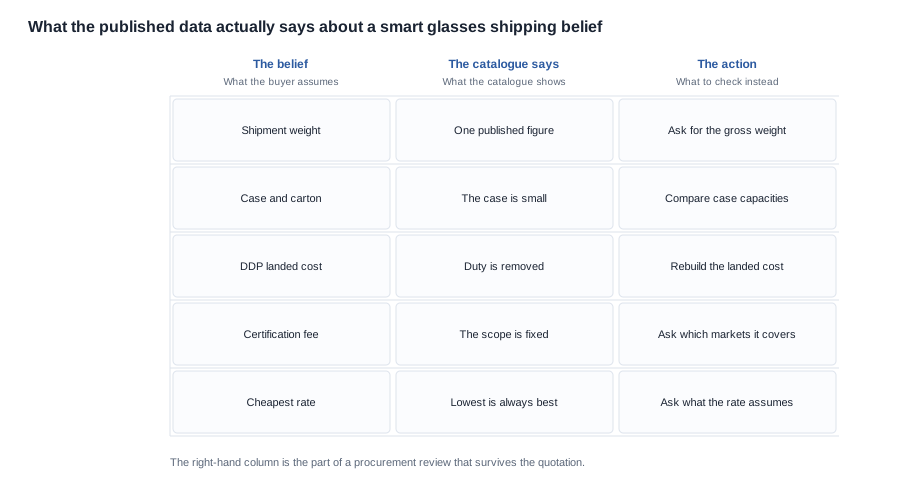
The one published weight, and what it is not
The catalogue publishes the MT6 glasses body weight at 158 g. That figure is the weight of the glasses themselves, including the 265 mAh battery and the camera, and it explicitly excludes the foldable charging case. The case capacity is published separately at 1200 mAh; the case weight is not published at all. No other model in the range has a published weight.
The consequence for a shipping belief is direct. A buyer who takes 158 g and multiplies it by a unit count gets a number that has nothing to do with what a carrier will bill, because a carrier bills on the packed unit and a packed unit is a glasses body, a case, a retail carton, a cable and a moulded insert. The published weight is useful for one thing only: it tells you that the catalogue is willing to publish a weight when it is meaningful, which means the absence of a weight on any other model is a deliberate signal rather than an oversight. Write to the supplier and ask for the gross weight of the packed unit; that is a normal request and the answer is a number.
Three published case capacities, and therefore three cartons
The camera models in the range carry a charging case, and the published case capacities are 900 mAh, 1200 mAh and 1400 mAh. The L1 Pro and the CY03, and the CY05 are published with a 1400 mAh case. The L2 Utral is published at either 900 mAh or 1400 mAh, which means one model in the range has two possible cartons. The MT6 carries a 1200 mAh foldable case. The KY06 and the MT5 have a case with magnetic charging, and the case capacity is not published for either. The V03 Pro has no charging case at all.
That is the whole basis of the belief that one case size fits every camera model, and it is wrong in three ways at once: there are three capacities rather than one, one model has two of them, and one model has none. A case is a moulded object that occupies volume, and volume is what a forwarder bills on for a dense product. The case is therefore a freight decision as much as a product decision, and the buyer who treats it as a product attribute is making a freight decision by accident.
Published cell capacity, and what it actually decides
The camera models publish cell capacities of 220 mAh, 260 mAh, 265 mAh and 290 mAh across the range, and the audio models publish 55 mAh times two, 90 mAh times two, 100 mAh and 115 mAh, while the children's protection and audio models publish 40 mAh and 70 mAh.
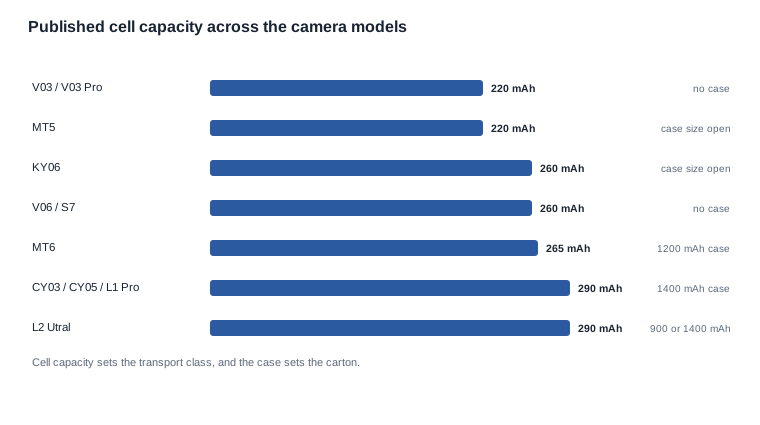
What cell capacity decides is the transport class and the paperwork that follows from it. What it does not decide is the freight rate, which is set by the packed dimensions and the chargeable weight. Conflating the two is a common error and it is expensive in a specific way: a buyer who assumes a bigger cell means a heavier consignment will have modelled the wrong line, and the line they should have modelled is the volumetric one, which depends on the carton and on how many retail units go into a master carton.
What the catalogue does not publish, and why that is useful
The catalogue carries a company-level export certification page. It does not carry a per-model certification row, and it does not name certificate numbers, issuing bodies or validity dates. The IP54 marking appears on two models only, the V06 and the S7, as a catalogue marking with no third-party report number attached to it.
For a buyer, that is an advantage rather than a gap, because it tells you exactly what to ask for. Buyers will ask about CE, FCC and RoHS evidence, about UN 38.3 test summaries, and about the responsible economic operator and traceability data that the EU General Product Safety Regulation, Regulation (EU) 2023/988, requires for goods sold in that market. The honest answer from any supplier who publishes a company-level page and no per-model row is that the per-model file has to be requested in writing for the configuration being ordered. If the answer arrives within hours, it is a routine question. If it does not arrive at all, that is the finding.
How a wrong belief turns into a line in the landed cost
The reason a belief survives is that the consequence arrives later than the decision. A belief formed at quotation stage does not produce a cost at quotation stage. It produces a cost three stages later, in a document that the buyer sees as an invoice and reads as a surprise rather than as the bill for a decision they made in week one.

The sequence, step by step
The belief is adopted. It is usually adopted silently. Nobody writes "we are assuming the catalogue weight is the shipping weight"; they simply do not ask for the packed weight, and the quotation moves on.
The first consignment is fine. This is the part that makes the belief durable. A small order, shipped quickly, arrives intact, and the invoice is close enough to the quotation that nothing reads wrong. The belief is not disproved, so it survives into the second order at a larger volume.
The second consignment is not fine. Either the freight is billed on a volumetric basis that the first order was too small to trigger, or the cartons were counted rather than measured, or a consolidation window closed and the goods travelled alone. The invoice is larger than the model predicts, and the buyer is searching for a cause in the wrong place — usually in the freight rate.
The correction is made in the wrong place. A buyer who believes the rate is the problem will negotiate the rate. A buyer who understands that the chargeable weight basis is the problem will ask for the packed dimensions and the divisor and rebuild the number. The first negotiation gets a slightly better rate and the same problem in the next quarter. The second one ends it.
The model is rebuilt with a correction nobody planned. The margin model now carries a line that was not there before, and it carries it for the rest of the programme. This is the real cost of a belief, and it is the reason the checks in this article are worth ten minutes of supplier correspondence.
Why the small order is the dangerous one
There is a specific trap here for procurement managers, and it is worth naming: the first order is the least informative order a buyer will ever ship. It is small enough that it travels alone, fast enough that it clears without a hold, and light enough that volumetric weighting does not bite. Every belief in the list above survives that order intact and only becomes expensive at the volume where the programme is actually worth running.
The practical response is to make the first order deliberately informative rather than deliberately quick. Ship it in the packaging you intend to use at volume, ask for the rate at two volumes, and open the document route for the market you intend to sell into rather than the market that is easiest to ship into. The cross-border logistics planning article covers how to open that route before the production slot, and the shipping cost reduction article covers what can be changed in the freight arrangement itself once the volume is there.

Beliefs worth challenging before the order is placed
The list above is a catalogue of beliefs. The set below is the working version — a shortlist a buyer can run against a quotation in one sitting, with a document requested for each open item.
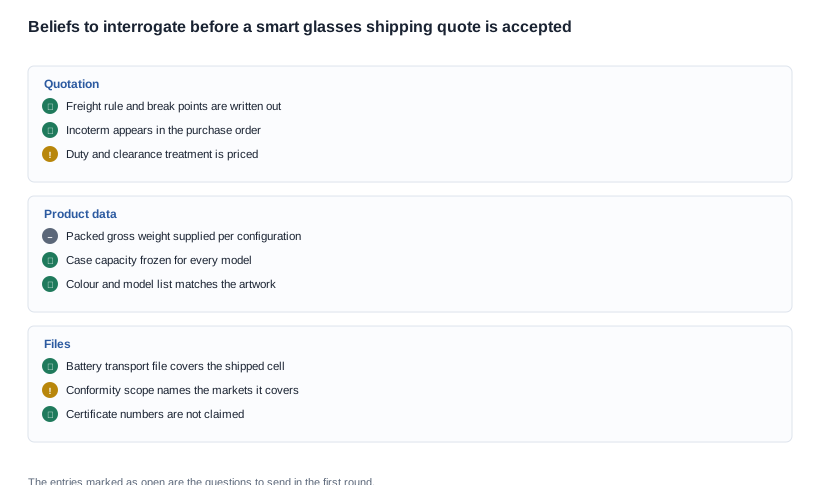
Seven challenges worth making, in this order
- The freight rule. Ask what shipment rule the price assumes and what the rate is if the goods travel alone. Completion test: two numbers in writing. A single blended figure cannot be scaled into a programme.
- The billable unit. Ask whether the rate is per shipment, per kilogram, per unit or per pallet, and what the volume thresholds are. Completion test: a cost basis with break points.
- The chargeable basis. Ask for the packed dimensions, the gross weight and the volumetric divisor. Completion test: three numbers that can be multiplied together by the buyer.
- The case and the carton. Ask which case capacity is included for each model, and how many retail units go into a master carton. Completion test: a case capacity and a density figure.
- The classification. Ask what the declared classification is, who the importer of record is, and how duty is treated in the price. Completion test: a named party and a stated basis.
- The file scope. Ask which destination markets the documentation covers, and which cell configurations it names. Completion test: a list, and an answer on how long it takes to produce.
- The release conditions. Ask what the carrier will check before the goods are released. Completion test: the list, and confirmation that it can be met by the date the goods are ready.
The three red flags that mean the quotation is not comparable
Three patterns in a quotation tell you that it cannot be compared with another quotation, no matter how the numbers line up. A freight figure with no rule attached to it. A landed cost that stops at the port, with destination charges described as a contingency. And a certification or compliance line with no markets attached to it, which is the line most often to be dropped and the line whose scope most often decides whether the goods can be sold.
A fourth pattern belongs with them: a total cost that cannot be rebuilt. If the buyer cannot take the packed dimensions and the weights and reproduce the freight line, then the buyer cannot tell whether a cheaper quotation is cheaper or simply less complete, and a total cost comparison between the two is a comparison of two different scopes rather than two different prices.

The commercial questions a wrong belief makes expensive
Beliefs are cheapest to correct at the point where they turn into commercial terms. The clauses below are the ones that carry the seven challenges from the previous section, and they are written so that a buyer can send them to a supplier for comment without redrafting.
The clauses that close the belief
The packed weight clause requires the gross weight of the packed unit, the master carton dimensions and the number of retail units per master carton to be stated on the quotation, and requires any change to them to be notified before the order is cut. This clause alone prevents the volumetric surprise, because it converts the chargeable weight from something a third party calculates to something two parties have agreed.
The consolidation clause states the shipment rule, the consolidation window, the rate for a consignment that travels alone, and the notice period required to change the arrangement. The trade-off here is a real one: a committed consolidation window gives a better rate and a worse schedule if the goods are late, so the clause should pair the window with a notice period rather than leave the buffer unallocated.
The duty and importer clause names the importer of record, the declared classification, the basis on which value is declared, and what happens to the parties if the classification is challenged. This is the clause that stops a comparison between a DDP price and an FOB price from being meaningless, and it is worth having even when the two quotations appear to be in the same terms.
The documentation clause names the document set, the party responsible for each item, the date by which each must exist relative to the production slot, and the destination markets the file covers. The clause that matters most inside it is the market list, because a file that covers two markets and a file that covers six have very different values and the same line in the quotation.
The trade-offs worth pricing deliberately
Three of these clauses involve a genuine trade-off rather than a free improvement, and a buyer who does not price them will be surprised by which one they gave away.
Consolidation against schedule. A committed window costs schedule resilience. The right answer depends on whether the launch date is fixed or negotiable, and a buyer who has not decided that cannot price the clause.
Scope against price. A file covering more markets costs more to produce and is worth more to reuse. The useful question to ask a supplier is not whether the compliance work can come down, but whether the scope is right, because an unnecessary market in the quotation is a cost the buyer chose.
Term against rate. A longer commitment in exchange for a rate is a working-capital trade-off, not a freight trade-off, and it belongs in the margin model rather than in the freight comparison. The seven mistakes article sets out the same controls from the operational side.
What is not negotiable
The cost and cycle of certification itself is not negotiable, and the reason is structural rather than commercial. Testing and registration are per product family and per market. They do not fall with volume, they do not fall with a longer contract, and they cannot be amortised across orders that use a different configuration. The same is true of the battery transport file for a given cell: it is a per-configuration document with a per-configuration validity, and asking for it "in a general way" produces a general answer that covers nothing.
The remaining non-negotiable item is the declared value. Under-declaring to reduce duty is a decision that costs everything if the goods are lost, and it is the one term in this category where a supplier who offers it is telling you something about the rest of the file.
Our catalogue position, and the boundaries of it
The short answer: the published catalogue is the part of the specification we can stand behind, and the rest is a question for a supplier's own file. We publish what the documentation states, we mark the rows that are open, and we will not fill an open row with a typical figure taken from a general data set. A buyer who builds a claim on an estimated figure finds the error in the field rather than in the quotation, and the correction costs more than the question would have.
The rows we do not publish for this category are these:
- Packed carton dimensions, gross weights, units per master carton, freight weights and the transport classification for a given configuration, because they follow the final retail packaging and the destination rather than the device.
- Our shipping terms, freight cost, transit times and customs handling arrangements, because they depend on the destination, the incoterm and the composition of the order.
- Minimum order quantities, production lead times and production capacity, because they are a commercial position rather than a specification.
- Certificate numbers, issuing bodies and validity dates, and any per-model certification line. The catalogue carries a company-level export certification page; it does not carry a per-model row, and we will not infer one from a company-level capability. For CE, FCC and RoHS, the honest position is that a per-model answer has to be requested in writing for the configuration being ordered.
- Per-model weight for all but one model. The MT6 glasses body weight is published at 158 g, including the battery and the camera and excluding the foldable charging case, and the case weight is not published.
What we will do is take a configuration, a quantity and a destination market and tell you which parts of the shipping arrangement are settled, which are open, and which have to come from a forwarder. We will itemise freight against a given configuration rather than quote a standard rate per unit, because a rate without a carton, a destination and a mode is not a rate.
Related reading
- Seven shipping mistakes and their controls — the same controls from the operational side
- Preparing a shipment for a cross-border sale — opening the route before the slot
- How to reduce shipping costs — what changes once the volume is there
- Camera and audio smart glasses range — the published configurations
- Logistics and shipping — the wider framework
Send the configuration, the quantity and the market, and we will say which of these beliefs the published data already settles for you.


