
Smart glasses for content creation have a charging problem that office products do not, and it is not the size of the battery — it is that the only chargeable minutes are the gaps between shooting blocks and that a flat battery during a block can cost the take rather than the call. The catalogue publishes everything a buyer needs to plan those gaps on paper, and it publishes nothing at all about the one question that decides whether a creator loses footage or only loses time.
This is written for the buyer specifying a creator product, for the brand writing the quick-start card, and for the channel operator deciding which model goes into which creator's bag. The plan that follows is built from recording blocks and from the material the catalogue actually publishes.
Smart glasses for content creation: the block schedule, not the day
Why a shoot day and a work day are different problems
A work day is long and mostly idle. A shoot day is long and mostly recording, and the difference is not academic: it decides whether the unit spends its charge in the camera or in standby, and the catalogue's rated runtime figures do not say which they were measured under.
That produces three consequences a buyer has to plan around.
- The charge window is the gap between blocks, not the length of the day. A creator with six shooting blocks has five gaps. Whether the plan works is decided by the shortest gap, because one gap shorter than the published charge time breaks the whole chain.
- The published charge time is an upper bound, not a typical duration. Every model in the catalogue publishes a charge time, and twenty-six of the twenty-eight publish two hours or less while the D17 and the ZH12 publish about one hour. None of those rows states the state of charge at which the clock starts or the criterion at which charging is judged complete, so "two hours or less" is the ceiling of a curve whose two ends are not published. Planning a block gap against that ceiling means planning every gap against the worst case.
- A flat battery during a block is a material loss, not a scheduling inconvenience. This is the part that separates the creator scenario from every other charging scenario in this catalogue, and it is addressed in the next section because the catalogue's silence on it is the single most important published fact for a buyer specifying this product.
Who is buying, and which decision is actually on the table
Three buyers arrive at this page with three different decisions, and they do not need the same answer.
The brand owner is deciding whether the product's charging rows support a full shooting day for the creators they put on camera, and needs to know what to write in the quick-start card without overstating it.
The procurement manager is specifying the accessory set for a channel and needs to know which accessory carries the day and what it does to the unit cost, the freight weight and the packaging.
The channel operator is deciding which model goes into which bag, and needs the model-level rows rather than a brand-level promise.
The common decision underneath all three is the same: which configuration can survive the longest recording block without a charge, and what is the between-block spare.
The published rows that decide a shoot day, and the one that does not exist
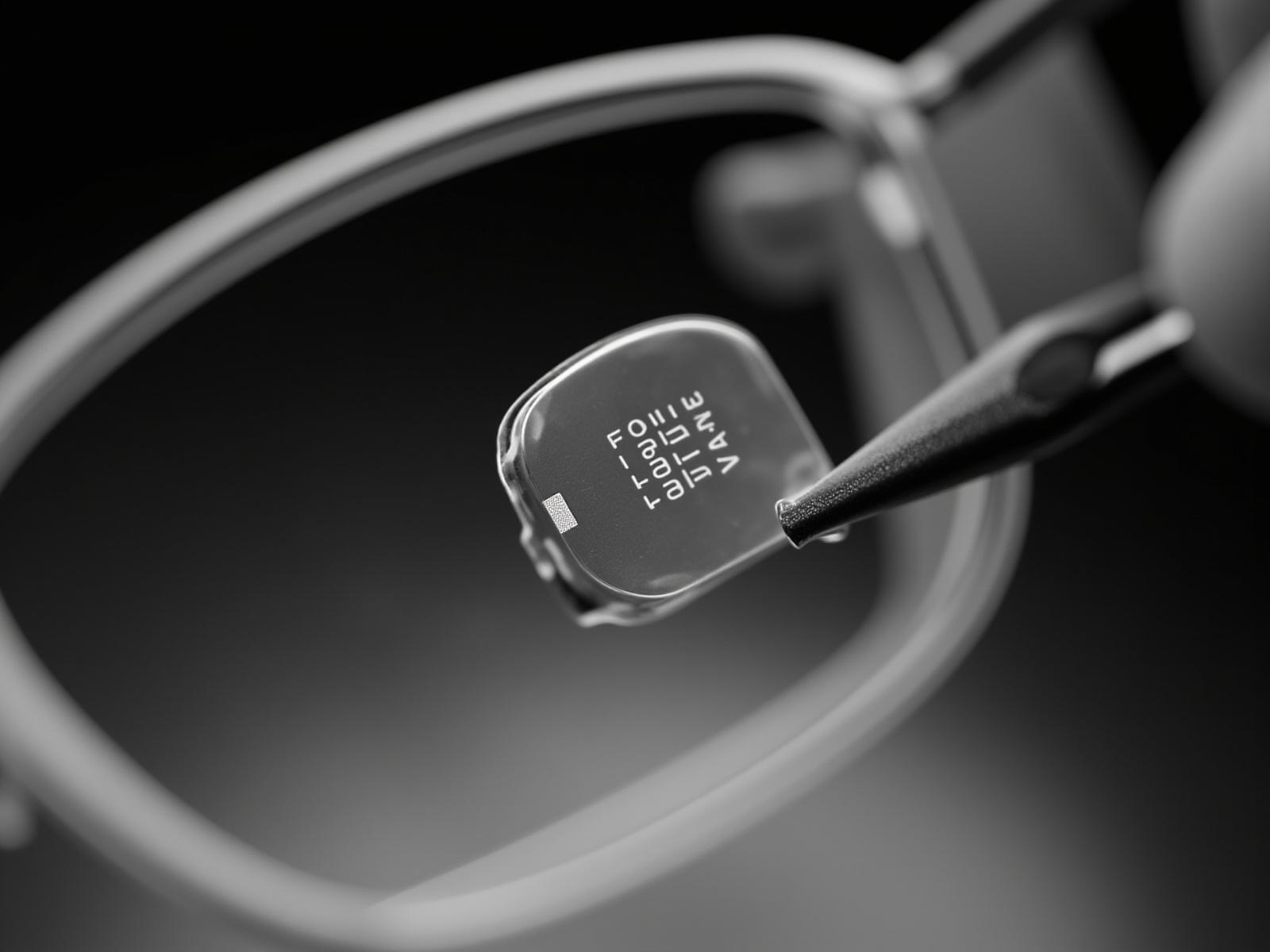
The camera range, model by model
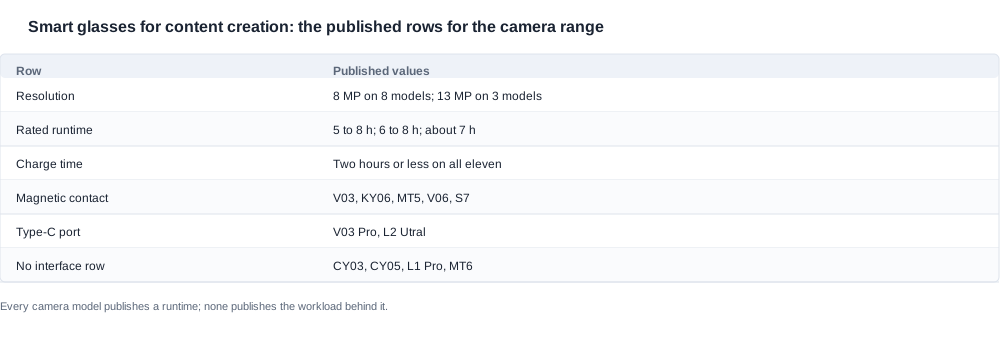
Everything a creator product is specified on is published for the eleven camera models, and nothing has to be estimated.
- Resolution. Eight MP on the CY05 and the V03, the V06 and the KY06, and the CY03 and the MT6, and the V03 Pro and the MT5; thirteen MP on the S7 and the L1 Pro, and the L2 Utral. That is the capture tier decision and it is settled before any conversation about power.
- Rated runtime. Five to eight hours on the V06 and the S7, and the V03 Pro and the V03; six to eight hours on the KY06 and the MT5; about seven hours on the L1 Pro and the L2 Utral, and the CY05 and the CY03, and the MT6. Every camera model publishes a runtime and not one of them publishes the workload behind the figure.
- Charging interface. Five camera models publish a magnetic charging contact, on the V03 and the V06, and the KY06 and the MT5, and the S7. Two publish a Type-C port, on the V03 Pro and on the L2 Utral. Four publish no interface row at all, the CY05 and the CY03, and the L1 Pro and the MT6.
- Charge time. Every one of the eleven publishes one, and all of them publish two hours or less.
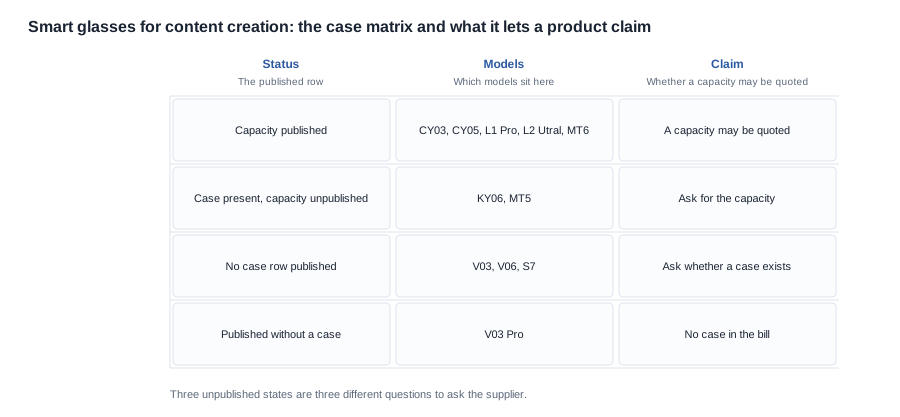
- Case. Five publish a capacity — 1400 milliamp-hours on the L1 Pro and the CY05, and the CY03, 900 or 1400 as a configuration choice on the L2 Utral, and 1200 in the folding case on the MT6. Two more, the KY06 and the MT5, ship with a case whose capacity is not published. Four publish no case row at all — the S7 and the V03 Pro, and the V03 and the V06 — and nothing in the catalogue states whether those four carry a case.
The gap that decides whether a creator loses footage
The catalogue publishes nothing about the storage path for any model in the range. There is no row for how recorded files move off the device, no row for where they are held before they are transferred, and no row for whether anything survives a power loss.
For most buyers that gap is a technical curiosity. For a creator it is the whole scenario, because the consequence of a flat battery depends entirely on what the device does with the files it has not yet moved. If the device transfers continuously, a flat battery costs a block. If the device holds files until a transfer, a flat battery at the wrong moment costs the take — and a take cannot be re-shot.
This is the point where the published runtime stops being the relevant number and the published storage behaviour starts. Because the behaviour is not published, it has to be established on a sample before a channel is specified, and it has to be answered for one specific question: does this unit hold untransferred files at the moment the battery reaches its end of charge? A single sentence in the supplier's answer, or a single measurement on a sample, resolves it.
Two further rows sit in the same category. The operating temperature range is not published for any model, so the behaviour of a unit that has been recording for an hour and is then put on a charger cannot be derived from the catalogue — it has to be measured on a sample. And exactly one weight figure exists anywhere in the catalogue, 158 grams for the MT6 eyewear body including the battery and the camera and excluding the folding case, which means a bag plan built from published numbers has one number to work with.
Why the plan has to be built from recording hours
The most common way a creator charging plan fails is that somebody planned against the shoot length. A nine-hour day planned as nine hours of recording will not work against a five-to-eight-hour rating, and it will not work against an about-seven-hour rating either, because the rated figure does not describe continuous capture.
The plan that works is built in the other direction: count the recording hours in the longest block, compare them against the runtime of the chosen model, and then build the gap schedule from the charge time as a ceiling. If the longest block is four hours and the model is rated at five to eight, the unit survives the block on paper — and "on paper" is doing real work in that sentence, because no test condition is published. The measurement that settles it is on the how to test protocol.

Choosing the model: runtime per recording block beats runtime per day
The four questions a creator product has to answer
- Does the longest recording block fit inside the published runtime of the model, with margin? This is a shortlist question and it is answerable from the catalogue alone. A creator whose blocks are six hours long has a shortlist problem: the models rated five to eight hours are the candidates and the models rated about seven hours are the safer ones, because a rating expressed as a range leaves a lower bound of five and a rating expressed as a single figure leaves seven.
- Is the charging interface the one the creator's bag can carry? The magnetic group needs its own contact, and the four camera models that publish no interface row at all are a bag-composition problem, not a specification problem: nobody can write a cable list for a model whose connector is not published. That is a request to make before the model reaches a shortlist, not a discovery to make on a shoot day.
- Is there a case, and does the creator carry it? A case is the only spare that helps between blocks, because a power bank at the bottom of a bag in a warm vehicle is not a reliable spare. The published case capacities — 900, 1200 and 1400 milliamp-hours — are what make a case a second battery rather than a storage box.
- What is the unit's weight in the bag? The catalogue publishes one weight, and the honest answer for a creator product is that the weight has to be requested per configuration alongside the other rows.
The accessory set a creator product implies
| Item | What it prevents | Per-unit cost | Why it belongs in the box |
|---|---|---|---|
| Charging case | A block that ends with a flat unit | Configuration line, plus a second cell | The only spare that recharges in the gap |
| Spare cable or spare contact | The morning the primary cable has failed | Consumable | Cables fail more often than units and cost nothing |
| Case charging cable | The case that is flat at the start of the day | Consumable | The case is the spare; a flat case is no spare |
| Heat management accessory | The warm unit on the charger | Optional, model-dependent | The operating temperature range is not published |
The accessory set is also the commercial line. A case-led proposition is a second lithium cell per unit, a freight class, a packaging change and a minimum order quantity, and it has to be priced before the channel plan is signed rather than discovered afterwards.
The accessory decision is a procurement decision
The case is usually chosen in the studio and paid for in the procurement meeting, and those are two different conversations. A case-led proposition for a creator channel changes four commercial inputs at once, and each of them carries its own minimum order quantity.
The unit cost. The case is a per-unit addition, and on a creator product it is often the difference between a proposition that sits inside a retail price band and one that does not. Ask for the case at each volume tier rather than at the top tier, because the gap between tiers is usually wider for the accessory than for the device.
The second cell. A case with its own cell means two lithium cells in one package, which changes the battery transport documentation, the freight class and the carton specification at the same time. The published case capacities — 1400 milliamp-hours on the CY03 and the CY05, and the L1 Pro, 900 or 1400 as a configuration choice on the L2 Utral, and 1200 in the folding case on the MT6 — all carry that consequence, and the L2 Utral's two capacities are a configuration choice rather than a variant.
The packaging artwork. The case changes what the customer opens, which means the insert, the carton and the printed materials all change, and artwork is a one-off cost with a lead time attached to it. Drawing it after the configuration is settled is what makes it expensive.
The returns and the warranty. A case is a second object that can arrive damaged, and a creator product shipped with a case has a different returns profile from one shipped without. The warranty period and the response time belong in the agreement, and the accessory set belongs in the bill of materials with the same seriousness as the device.
The case as the between-block spare, and what a case-led proposition costs
The case is the answer to the gap problem, and it is also where the catalogue's coverage is uneven in a way a buyer has to plan around.
Five camera models publish a case capacity. The CY05 and the L1 Pro, and the CY03 publish 1400 milliamp-hours; the L2 Utral publishes 900 or 1400 as a configuration choice; the MT6 publishes 1200 in a folding case. The L2 Utral is the one to watch, because a configuration choice changes the freight weight, the packaging artwork and the cell declaration at the same time, which makes it a decision that has to be made before the artwork is drawn rather than after.
Two camera models ship with a case whose capacity is not published, the KY06 and the MT5. The case is therefore real for these two and its size is not, which means it cannot be priced into a freight calculation from published rows.
Four camera models publish no case row at all, the V06 and the S7, and the V03 and the V03 Pro. The correct reading is that the catalogue publishes no case row for them, not that they have no case. The practical consequence is that a creator product built on one of those four cannot be quoted with a case capacity until the question is asked in writing.
Nothing in the catalogue states what those four carry. That is a different statement from the seven above, and a buyer should not treat the two groups as interchangeable when building a bill of materials.
Two further rows about the case are not published for any model and both change the evening routine: the case's own charge time, and whether a plugged-in case can charge the unit while it is charging itself. A case that cannot pass through is a case that has to be charged overnight and then used, and a case that can pass through is a case that can be topped up during a long block. The difference between those two evenings is the difference between a working plan and an expensive one, and it is a question rather than an assumption.
What to put in writing before a creator channel goes live
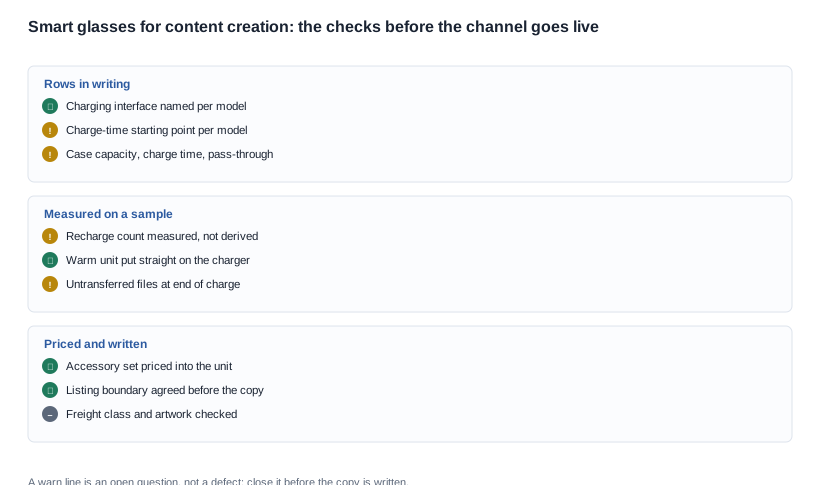
- Request the three rows per model and per accessory in one document: the charging interface, the charge-time starting point, and the case's own charge time with its pass-through behaviour. Ask for the case row for the models whose cases the catalogue does not describe.
- Establish the storage behaviour on a sample, with one question: does the unit hold untransferred files when the battery reaches its end of charge? Record the answer, because it is the single fact that separates a lost block from a lost take.
- Measure the recharge count on a sample rather than deriving it from the case capacity and the cell capacity. The arithmetic is straightforward and the real number depends on where you stop and at what level, and the real number is the one a creator experiences.
- Run the warm-unit test: record for an hour, put the unit straight on the charger, and record whether it reaches a stable state and stays there. The operating temperature range is not published, so this behaviour cannot be read off any row.
- Time a charge from a stated starting point and write the starting point into the record. Without it, the measurement cannot be compared with the published ceiling or with the next unit.
- Write the listing boundary before the copy exists. The charge times, the interfaces, the case capacities, the cell configurations and the runtimes are published rows. The starting states, the indicator behaviours, the case charge times, the pass-through behaviours and the storage path are not, and a quick-start card that blurs the two is the artefact that generates the complaint.
- Price the accessory set as part of the unit, not as a later addition. A case-led proposition changes the unit cost, the freight class and the packaging, and each of those three is easier to change before the artwork is locked than after.
Where the content-creation charging plan stops, and who owns the rest
Concretely, a creator's charging problem is solved by a schedule and an accessory set rather than by a bigger cell, and the schedule can only be written accurately where the published rows and the measured rows are kept apart. We will not publish a charging input, a charge-time starting point, an indicator behaviour, a case charge time, a pass-through behaviour or a storage path for a model where we have not been given one, and we will not present a rated runtime as a promise of continuous recording.
What we will do is take the models, the configuration, the number of blocks and the longest block, and tell you which published rows apply, which of your questions we can close from our own material, and which have to be measured on a sample. The content creation section page covers the channel positioning, the content creation checklist page covers the wider plan, and the outdoor charging page covers the case-led variant where the environment does the damage.
What to do next, in order:
- Build the schedule from the longest recording block and the shortest gap between blocks.
- Request the interface, starting-point and case rows for the models on the shortlist.
- Put one question about untransferred files to the supplier, and measure it if the answer is vague.
- Decide the accessory set, and price it into the unit before the artwork is locked.
- Write the routine into the quick-start card, with the conditions attached to the numbers.


