
First-person camera glasses look like an obvious choice for content creation until the first four-hour shoot. The failures that follow are predictable, and every one of them can be checked before an order rather than after it. This checklist is organised by the constraint that causes the failure rather than by the specification that might prevent it, because in this category the specification rows that would settle these questions are not published for any model, and a checklist built on published rows alone would be a checklist of things that are already fine.
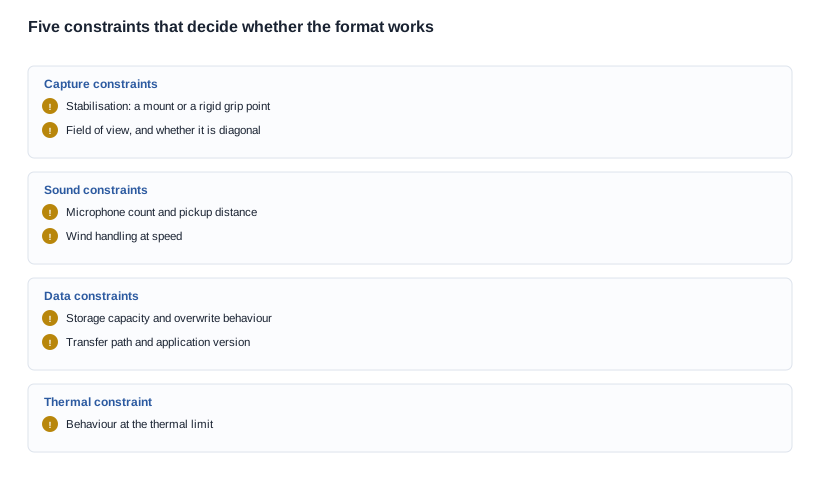
Smart glasses for content creation: five constraints that decide the format
The short answer. Five constraints decide whether a first-person camera can carry a content programme, and they are: framing, stabilisation, sound, continuity and heat. Only the first and the last are visible in a demonstration. The framing constraint shows up as a shot that cannot be composed, the stabilisation constraint as footage that reads as shake rather than as a pan, the sound constraint as narration lost to wind, the continuity constraint as a take that never reached the editor, and the heat constraint as a picture that changes after ninety minutes of continuous recording. None of the five has a published row in this category, which is why this checklist is a set of tests and requests rather than a comparison of published specifications.
Who this checklist is for and what it decides. A brand-side product manager is deciding which models enter a range for a creator segment, and needs the constraints that will produce returns identified before the SKU list is fixed. A channel procurement buyer is placing an order against a segment profile, and needs a document that travels with the purchase order so the factory is building the same thing the buyer tested. An e-commerce operator is deciding whether the product suits the creator audience the listing addresses, and needs the shortlist cut on something other than the specification table, because the specification table does not separate these models.
What is published, so the checklist can start from the right place. The eleven camera models publish a camera tier of 8 or 13 megapixels, a cell capacity from 220 mAh to 290 mAh, a charge time of two hours or less, a rated use between five and eight hours and, on seven of them, a charging method. Published case capacities are 900 mAh, 1200 mAh and 1400 mAh on five models, present but unquantified on two, absent as a row on three and explicitly published as not included on one. A unit weight is published for a single model, the MT6 at 158 g, which is the glasses body including its cell and camera and excluding the foldable case. Everything else the checklist needs to test is not published.
Why the framing constraint comes before the sensor question
Field of view decides whether a shot can be composed or only recorded and cropped afterwards. It is one of the rows most often left unpublished, and for our range it is not published at all. We will not substitute a figure from a comparable model, because a field of view that is close is not the same as a field of view that is right, and the difference shows up in the edit rather than in the specification.
Ask for it per model, and ask how it is measured. A vendor may quote a diagonal, a horizontal or a vertical angle, and will rarely label which one, so a bare number in a quotation is not usable. The request should name the model, the configuration and the convention in one line, and it should be asked for the same day as the frame rate, because the two together decide whether a shot is possible.
The consequence of getting it wrong is not a soft image, it is an unusable format. A narrow angle produces a shot with the subject pushed to the edge and no room to move, which is a crop problem rather than a quality problem, and a crop problem is not fixed by a better sensor. This is why a camera tier of 13 megapixels does not answer the framing question at all, and why a listing that leads on the tier is leading on the one row that cannot be converted into an output claim.
Stabilisation is the constraint nobody asks about, because the footage looks acceptable in a short clip. Handheld footage from a head-mounted camera is worse than footage from a handheld phone, because the movement is smaller in amplitude and higher in frequency. It reads as shake rather than as a pan. The check is straightforward: confirm whether the unit accepts a mount or provides a rigid grip point. Without one, the achievable result is short clips of walking, which is a real format and a narrower one than most buyers are expecting when they write the brief.
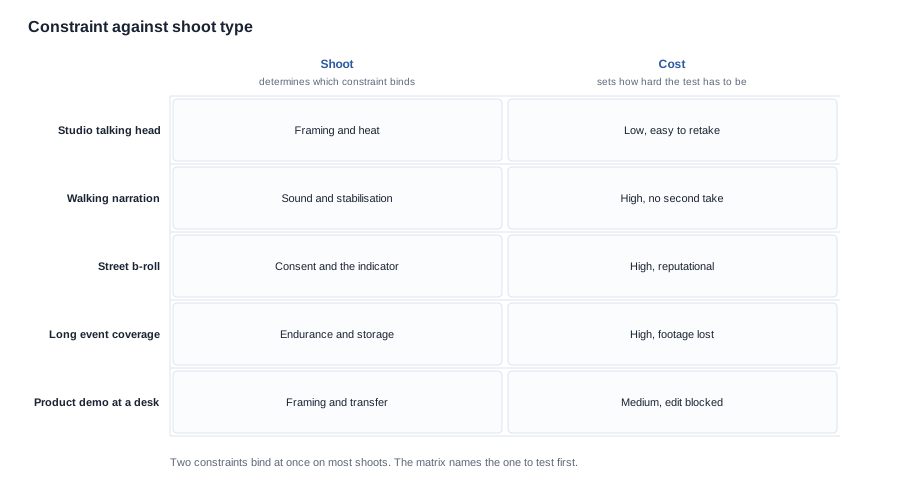
Why the matrix decides which constraint to test first. Two constraints bind at once on most shoots, and the cost of getting one wrong differs by shoot type. A studio talking head can be retaken, so framing and heat are the ones to settle and the effort can be modest. A walking narration segment has no second take and puts the audio and the stabilisation on the same recording, so both have to be tested in the location rather than on a bench. Street b-roll introduces the consent and indicator question, which is a compliance constraint rather than a technical one, and it carries reputational cost rather than production cost.
The sound constraint, and why a desk demonstration settles nothing
Open-ear audio is designed for awareness rather than for playback. That is the architecture, and it is the right architecture for a device a creator may also need to hear a location in. The consequence for a content programme is that the microphone position and the pickup distance decide whether narration is usable, and both are behaviour rows that a quiet-room demonstration does not test.
In an outdoor shoot, wind noise will dominate a narration track, and no amount of post-processing reliably recovers a voice recorded that way. The test is therefore not "can it record" but "can it record here": a sample recording made outdoors, at walking pace, in the location the work is done in. The microphone count and the pickup distance are not published for any model in this range, so the test is the only instrument available, and it is a five-minute test.
Decide early whether the audio is captured by the device at all. For a programme where narration carries the message, the choice is between a device that captures usable narration and a device that records pictures while a separate recorder captures the voice. Treating it as an accessory question after the shoot is the expensive order of operations, because the sync between two separate recordings is a post-production task that is added to the budget rather than removed from it.
The self-interference question, which nobody asks. In a temple that carries both a speaker and a microphone, the speaker output can reach the microphone. Whether that is audible depends on the microphone rows, the speaker position and the recording level, and none of the three is published. For a device that is expected to play reference audio while recording, this is the row that separates a usable take from a take with a competing voice in it.
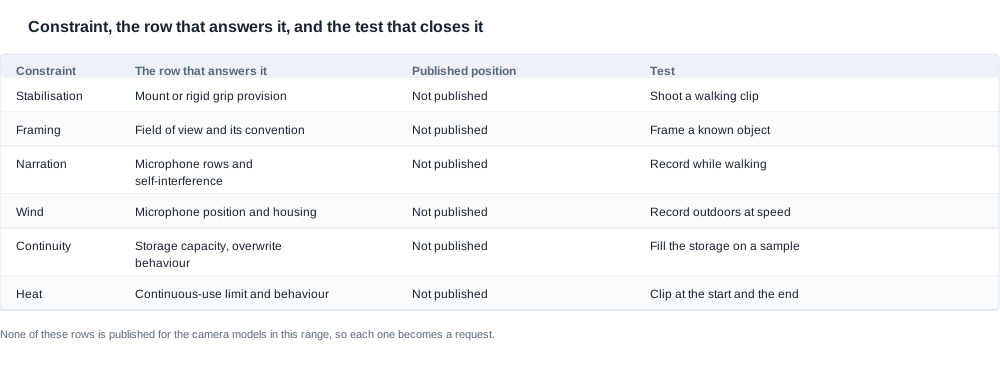
What the table above is for. Every row in it is a request plus a test, and every row is currently open. The published rows answer a different question — what the device is — and the outcome rows answer what the file is, which is what the customer judges. A buyer who puts the table above into the purchase order has converted five open rows into five actions with owners and dates.

The continuity constraint: storage, transfer and the heat limit
Whether a unit stores locally, streams to a paired phone, or does both determines what happens when a take goes wrong. A streamed-only arrangement with no local copy loses the take when the connection drops. A local-only arrangement needs a transfer step with its own failure modes and its own cost in time, and that cost is paid on every take rather than once. The storage capacity, the overwrite behaviour, the file format and the transfer path are not published for any model, so the behaviour has to be established on a sample.
The five-minute fill test is the cheapest item on this list. Fill the storage on a sample and record what happens: does the device stop, does it overwrite, does it drop the file, and does it warn first. A device that stops without warning is a lost take; a device that warns is a pause. Nothing else in this article costs five minutes to establish and carries the same weight.
Transfer has to be tested with a large file, on the customer's own phone and network. A transfer that works on the supplier's setup is not a transfer that works at a client's location. The number that matters is the time, and it is the time that decides whether the shoot day has a transfer step in it.
Heat is the constraint that has no specification at all. A head-mounted camera runs continuously with the lens and the cell in a closed frame against the head, and sustained use in a warm environment produces a thermal limit that has nothing to do with the published battery figure. The published rated use of five to eight hours says nothing about the temperature the unit reaches while recording, and the thermal behaviour is not published for any model. Ask how the unit behaves at the point where it gets hot: whether it records a partial file, drops frames, or shuts down. A partial file is recoverable. A shutdown mid-take is not, and the difference determines how a shoot day is structured.

Why the gate has to be a document. The six steps in the flow produce a short file: the shoot type, the binding constraint, the request, the results with their conditions, and a list of what was tested and what remains open. That file is what a procurement manager attaches to the purchase order, and it is what a channel operator attaches to a listing decision. Without it, the same five constraints are re-discovered separately by each person, usually later.
Turning the constraints into a purchase order
What to put in the request, and what to put in the order. The request carries the five rows: the field of view with its convention, the stabilisation provision, the microphone rows and the self-interference behaviour, the storage and transfer behaviour, and the thermal behaviour under continuous recording. The order carries the measured values with their conditions attached, the pass lines, and the warranty period with a stated response.
How many tests are enough. Two. Identify the binding constraint for the shoot type, then run the two tests that close it — usually one on framing and one on sound for a narrated walk, or one on continuity and one on heat for a long event. A buyer who runs five tests on every configuration is buying evidence they will not use; a buyer who runs none is buying a returns rate.
The questions to ask in the order that avoids rework. What is the field of view, measured how? Is there a mount or a rigid grip point? What are the microphone rows, and what happens when the device plays audio while recording? What happens when the storage fills? How long does the unit record before the picture changes? Each of those is one question, each closes one row, and asking them in that order means the answer arrives while the configuration can still be changed.
The two red flags to watch in the answers. A specification that names a product family rather than a buildable configuration, because the constraint will differ between members of the family. A figure that arrives without its measurement condition, because a figure without a condition is a claim and a claim cannot be tested. Both are common, both are answerable with one more question, and both are recorded in the same file as the rest.
Three questions a buyer can answer alone, without the factory. First, whether the segment's existing footage was shot on a head-mounted camera or on a handheld one, because that tells you what the audience is used to and what the stabilisation constraint has to deliver. Second, whether the editing chain is a desktop application or a phone application, because the transfer path and the file format behave very differently in the two. Third, whether the content is published the same day it is recorded or on a later schedule, because an editing cycle that runs overnight tolerates a slow transfer and a same-day publish does not. None of these three needs a supplier, and all three change which constraints bind.
What the published data already settles, so the effort goes elsewhere. The endurance question is answered at the category level — five to eight hours on the 220 mAh models and about seven on the 290 mAh models — and the charge time is answered at two hours or less across the range. The case capacities are answered where they are published, and the charging interface is answered on seven of the eleven camera models. Those rows decide the accessory chain and the battery plan. The five constraints above decide whether the product works, and none of them is in the published set.
A worked example of the gate, with no product named. A two-person team shoots a narrated walk-through of about forty minutes at a time, indoors in the evening and outdoors in daylight, and edits on a laptop. The binding constraint is the sound constraint, because the narration carries the message and the daylight segments are the ones where wind is present. The gate therefore asks for two rows — the microphone rows and the self-interference behaviour — and runs two tests: one narration recording outdoors at walking pace, and one continuous recording long enough to show whether the picture changes. Everything else on the list stays open and is written down as open. The purchase order that follows contains those two measured values with their conditions, the published rows for the configuration, and the warranty period. The important part of the example is what it leaves out: the buyer did not test five constraints, did not commission a full evaluation, and did not wait for the field of view to arrive, because the field of view was never the constraint in that shoot.
What we publish on these five constraints
Stated plainly: a checklist is only worth running if the buyer can see which lines are closed and which are open, and the honest way to present an open line is to name it. We publish the rated runtimes, the charging interfaces, the cell capacities, the charge times, the published structural features, the published case capacities and the camera tiers for each configuration, and we publish the absence of a field of view, a stabilisation provision, a microphone count, a pickup distance, a self-interference behaviour, a storage capacity, an overwrite behaviour, a transfer path, a thermal behaviour and a per-model unit weight with the same prominence. Where a figure exists somewhere in the range but not on the row for your configuration, we will not carry it across.
We will also say when a model is the wrong choice for the shoot. A configuration that is published for short sessions and a configuration that is published for about seven hours are not interchangeable for a four-hour recording day, and neither is a substitute for the thermal behaviour nobody has published. The models and their published rows are listed at the AI camera glasses range, the testing sequence is at how to test a unit for this application, and the trade-offs between the models are at the honest pros and cons.
What a buyer should take away from this checklist. The five constraints are not unusually difficult to satisfy; they are simply not written down anywhere in the published material for this category, which leaves them to be discovered in production instead of in procurement. Each one has a cheap test, each test has a pass line, and each pass line belongs in the purchase order. A programme that carries those five lines into the order is buying a specification. A programme that does not is buying a category, at the standard unit price of one.
Sending the shoot type and the two models
Send the shoot type, the longest continuous segment and the two models you are considering. We will tell you which of the five constraints binds for that shoot, which published rows already apply, which rows have to be requested, and which two tests would close them.
Include the editing chain and the publication schedule if you have them, because those two facts change which constraints bind more often than any published specification does, for any model.
The compliance side of a first-person camera is covered at legal considerations, and the channel context is at smart glasses for content creation.
Related reading
- How to test — the test that finds the problems
- Pros and cons — the honest trade
- Legal considerations — consent and footage
Tell us the shoot type and the models, and we will tell you which constraint binds first and which two tests close it.


