
Smart glasses for outdoor charging is not a charger question. It is a question about which power source travels with the kit, because in the field the wall socket is usually several hours away from the task. Three published facts decide the answer before any supplier conversation starts: the charge time every model carries, the charging-case capacity the catalogue publishes for seven of the eleven camera models, and the fact that the charge time is published without the state the battery starts in. That last gap is the one that breaks field plans, because a charge window computed from a published figure alone is a window nobody can schedule against. This page is written for the brand manager and channel buyer who has to hand a working kit to a team, and it treats the power supply as a bill of materials rather than an accessory.
Smart glasses for outdoor: carried power rather than the wall socket
Who is buying, and what the kit has to survive
A brand product manager is putting together a kit that will be carried, dropped, rained on and used by people who did not choose the equipment. The decision in front of them is which models enter the kit at all, because the power strategy follows the model: a camera model that ships with a case can run two shifts on one charge, and a camera model that does not can run one.
A channel buyer is building a package for resellers and for rental operators, and the package has to include a power plan, because a customer who cannot keep the product powered will not return it as an exciting product. Their exposure is a support load that arrives as a technical complaint and turns out to be an absent case.
A procurement manager for an outdoor or events supplier is buying fleet hardware against a service schedule, and the question they have to answer is how many spare units, spare cases and spare cells the pool carries, and what the lithium transport obligations are for each. The transport file for a kit that contains a case with a cell is not the transport file for a bare device, and the difference is a documentary task that arrives early if it is planned and late if it is not. The requirements are set out at battery transport.
In all three cases the fear is the same shape: a kit that leaves the base charged and arrives at the far end of the trail empty, with nobody able to say whether the plan failed or the product did.
The published rows, and the one gap that decides the whole kit
The catalogue is unusually complete on the electrical side of this question. Every one of the 28 models publishes a charge time: two hours or less for 26 of them, and roughly one hour for the D17 and the ZH12. The camera models publish runtime bands — 5 to 8 hours on the V06 and the V03 Pro, and the V03 and the S7, 6 to 8 hours on the KY06 and the MT5, and around 7 hours on the CY05 and the L1 Pro, and the MT6 and the L2 Utral, and the CY03. The charging method is published for 24 models: a magnetic method on 17 and a Type-C port on 7. The charge time and runtime arithmetic is at battery life, and the model configurations it applies to are listed at camera and audio smart glasses.
What is missing is the state the battery is in when the timer starts and the state it reaches when the timer stops. A charge time without a start state is not a duration a team can schedule; it is a number to repeat. In the office, a two-hour charge that starts at 20 per cent and one that starts at zero are the same shape of problem. In the field, where a vehicle alternator or a single panel is the only source, that difference is the whole plan: the difference between one usable charge cycle per day and a meaningful fraction of one.
The second missing row is the charging method on four camera models. The CY05 and the L1 Pro, and the MT6 and the CY03 publish a capacity, a charge time and a runtime band, and the catalogue carries no charging-method row for them at all. Those four models have to be treated as interface-unknown until the factory answers in writing, and a kit plan that quietly assumes a cradle for them is a plan built on an assumption.
The four case states in the catalogue, and what each one does to a field kit
Mapping the eleven camera models onto the case states
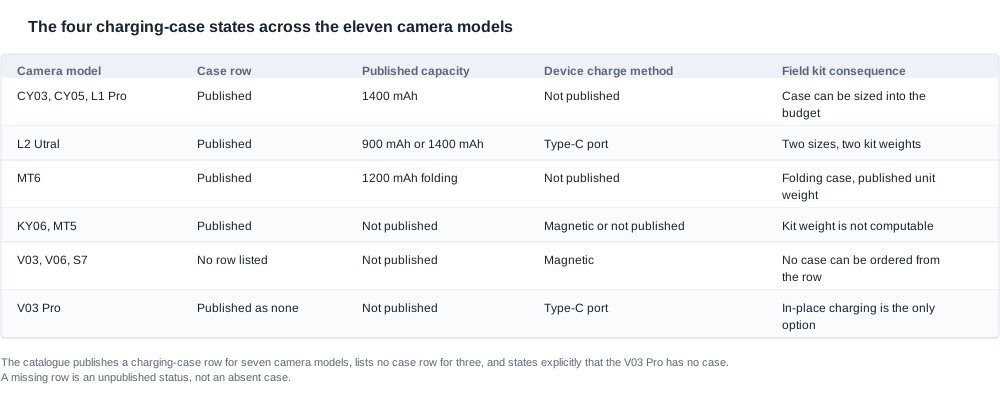
The charging case is the difference between one shift and two shifts, and in a field kit it is frequently the power source rather than the accessory. The catalogue splits the eleven camera models into four states, and the four are not interchangeable.
Five models publish a case capacity. The CY05 and the CY03, and the L1 Pro publish 1400 mAh. The L2 Utral publishes two sizes, 900 mAh and 1400 mAh, which is a packaging decision the buyer has to make rather than a technical constraint. The MT6 publishes a 1200 mAh folding case, and the MT6 is also the only model in the whole catalogue with a published unit weight at 158 g for the glasses themselves, including the battery and the camera but excluding the folding case. The case weight is not published, so the kit weight for an MT6 deployment is not computable from the catalogue.
Two models publish a case row without a capacity. The KY06 and the MT5 both carry a case in the catalogue, and neither publishes what is inside it. A buyer cannot size a power budget from these two, and cannot quote a kit weight either.
Four models publish no case row at all. The S7 and the V03 Pro, and the V03 and the V06 have no charging-case row in the catalogue. That is an unpublished status, not an absent case, and the practical difference is that a buyer cannot order a case for these models on the strength of the catalogue and has to ask the factory whether one exists.
For the V03 Pro the answer is not known either. Its page carries no charging-case row, so the arrangement has to be built around a question as well.
What the published capacities actually buy in a deployment
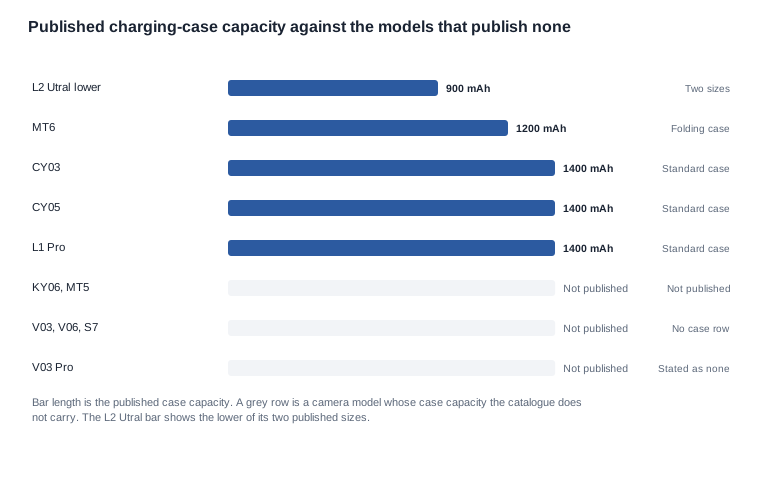
The capacities are large relative to the device cells, and that is the point of a case. The camera models carry 220 mAh on the V03 and the V03 Pro, and the MT5, 260 mAh on the S7 and the V06, and the KY06, 265 mAh on the MT6, and 290 mAh on the CY05 and the L1 Pro, and the L2 Utral and the CY03. A 1400 mAh case against a 290 mAh cell is a multiplier of roughly five, and a 1200 mAh folding case against the MT6's 265 mAh cell is close to four and a half. Those are arithmetic comparisons between two published figures, not derived product claims, and they are the reason a case turns a one-shift camera into a multi-shift one.
The multiplier also sets the weight arithmetic, and the weight arithmetic is where outdoor deployments usually break. The catalogue publishes exactly one weight in the entire range, and it belongs to a camera model whose folding case is a second item of unstated weight. A kit that has to be carried on foot for a full day has a weight budget, and for seven of the eleven camera models the catalogue gives the buyer nothing to put in it. The honest position is that the kit weight has to be requested per model, with the case, as a single figure.
Choosing the power topology for a deployment that leaves the vehicle
Three topologies, and the question each one answers
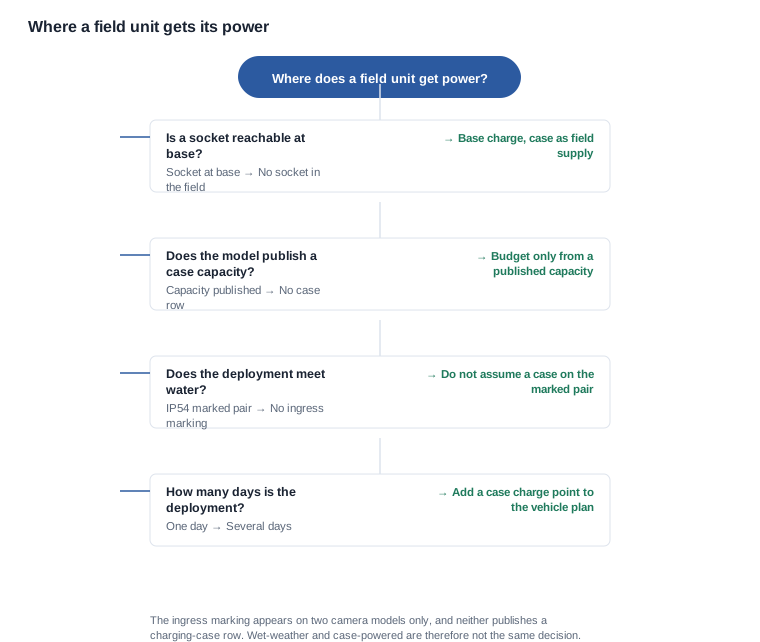
Base charge, vehicle charge. The device is charged to full before departure and again on return, and the case is treated as convenience power inside a short radius. This topology needs a socket at the base and a socket in the vehicle, and it puts the whole day's energy requirement on the device cell, which means it only works for deployments shorter than the published runtime band.
Base charge, case as the field supply. The case is charged at base and carried as the day's reserve. The device is swapped into the case during the day. This topology needs the case to have a published capacity, and it needs the case itself to have a place to be recharged, which adds a second item to the kit and a second lithium item to the transport file.
Vehicle charge, case as the reserve. The vehicle is the working supply and the case is the contingency. This is the topology for multi-day deployments where the vehicle returns to base each night, and it is the one where the charge start state matters most, because a vehicle charge is a partial charge in practice.
The question that gets answered wrongly most often is the third one in the decision chart. The catalogue publishes an IP54 ingress marking on exactly two models, the V06 and the S7, and the way that marking is read is covered at IP ratings and at what the second digit means. Those two models are the wet-weather candidates in the camera range. They are also two of the four camera models that publish no charging-case row. A buyer who pairs "splash-proof" with "case-powered" in the same line of the kit plan is combining two catalogue statements that do not belong together.
The field power plan has to be verified before the order
Closing a field power plan, one written standard at a time
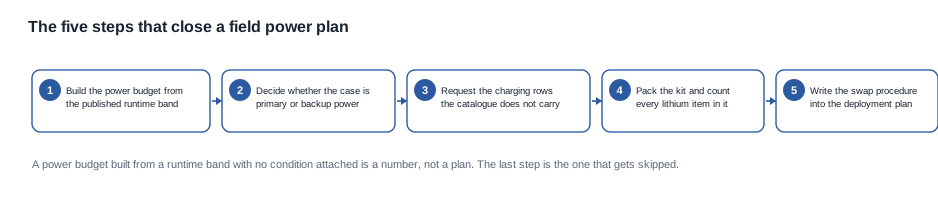
A power plan that has not been verified is an opinion with a spreadsheet attached. Five steps, each closed by something in writing:
- Budget. Build the power budget from the published runtime band for the model, not from a figure a reseller quoted. The completion standard is a written budget that states the band it was built from and the length of the deployment it has to cover.
- Decide. Choose the topology, and write down why the alternative was rejected. The completion standard is one named topology per model in the kit, with a published capacity behind it wherever a case is involved.
- Request. Ask for the charge start state and the termination point, the charging method for the four camera models that do not publish one, the case charge time and its pass-through behaviour, and the unit weight of the device with the case attached. The completion standard is a written answer per item.
- Pack. Count the lithium items in the kit, not the devices in the kit, and confirm that the transport documentation covers the case as well as the device. The completion standard is a packing list with a cell count that matches the file.
- Schedule. Write the swap procedure into the deployment plan, including what happens when a case arrives empty and what happens when a device is flat at the end of a leg. The completion standard is a named decision point in the plan rather than an improvisation in the field.
The document set to request in one message
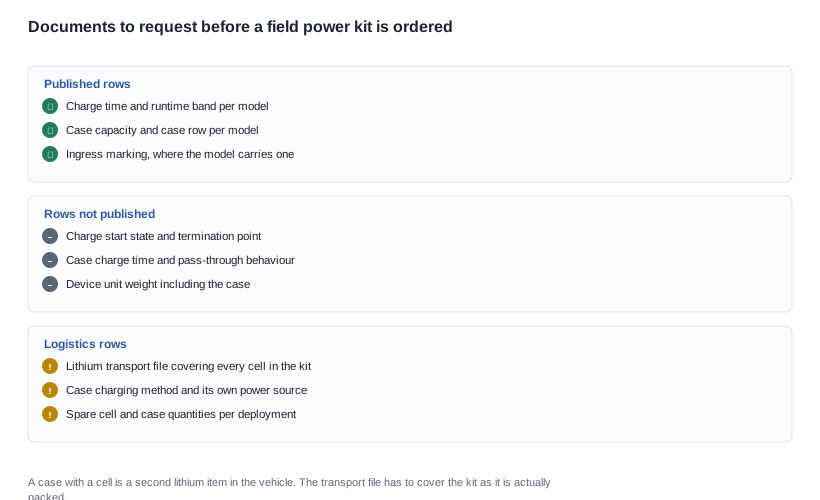
Three groups, sent together, because the logistics rows and the technical rows constrain each other. The published rows — charge time, runtime band, case capacity, case row, ingress marking — should be confirmed against the catalogue rather than re-derived from a sales sheet, because a sales sheet for a camera model rarely carries the case state. The unpublished rows are the ones that decide the kit: the charge start state, the case charge time and pass-through behaviour, and the weight of device plus case. The logistics rows are the ones that arrive late if nobody asked: the lithium transport file for every cell in the kit, the method the case itself is charged by, and the spare quantities.
Sampling and the commercial conditions that go with the first order are covered at samples and pricing, and the agreement clauses that belong with them are at contract terms.
Where field charging arrangements fail
The case was assumed to be the power source without a capacity. The symptom is a kit that leaves base with three charged cases and returns with none of them charged, because the case was never in the power budget as a second device. The root cause is that the case was treated as an accessory rather than as a second battery with its own recharge cycle. Prevention is to put the case in the budget with its published capacity, and to add a case charge point to the vehicle plan.
A missing case row was read as an absent case. The symptom is a short shipment, or a kit assembled from an assumed accessory that never existed. The root cause is that "not published" and "does not exist" were treated as the same statement. Prevention is to ask the factory which of the four camera models without a case row can be supplied with one.
The charge window was scheduled from a published time alone. The symptom is a device that arrives at the far end of the leg flat, with a full charge log behind it. The root cause is that the charge time was used without the start state. Prevention is to ask for the start state and the termination point, and to build the schedule on the conservative assumption.
The two ingress-marked models were assumed to be case-capable. The symptom is a wet-weather kit with no reserve power. The root cause is that two catalogue attributes were read as one product feature. Prevention is to check the case row separately for the V06 and the S7, and to plan their power on the device cell alone until the factory answers.
The kit weight was never computed. The symptom is a team that leaves the trailhead, and the complaint about the product arrives at the retailer rather than at the specification sheet. The root cause is that the catalogue publishes one weight in the whole range, and the case weight is not published at all. Prevention is to request the assembled weight per model, and to check the packing procedure at how to pack smart glasses for outdoor.
The transport file covered the device and not the case. The symptom is a kit that is refused at a freight check, on the day it is supposed to be in the field. The root cause is that the case was added to the kit after the paperwork was done. Prevention is to count cells, not devices, at battery transport, and to include the case in the certification checklist at certification checklist.
| Field failure | Root cause | Preventive action |
|---|---|---|
| Cases return uncharged | Case treated as an accessory | Put the case in the power budget |
| Short shipment of cases | Missing row read as no case | Ask which models can be supplied with one |
| Device flat at the far end | Charge time used without a start state | Request the start and termination points |
| Wet kit with no reserve | Two catalogue attributes merged | Check the case row on the marked pair |
| Weight complaint in the field | Assembled weight never requested | Request device plus case weight |
| Freight refusal | Transport file covers the device only | Count cells, not devices |
What we publish about outdoor charging, and what we will not estimate
Concretely, the outdoor power question is settled by the case states and by the start-state gap, and both are questions a supplier can answer in writing today. We publish the charge time for every model in the range, the runtime band, the charging method where the catalogue carries one, the charging-case capacity where it is published, and the case state for every camera model — including the four that publish no charging-case row at all. We publish the IP54 ingress marking on the two models that carry it as a catalogue attribute, and we do not extend it to any other model.
What we will not do is publish a charge start state, a termination point, a case charge time, a pass-through behaviour, a charging method for the four camera models whose row is absent, or an assembled unit weight for any model beyond the single 158 g whole-unit figure for the MT6 glasses. We will not present a published runtime band as a full working day, and we will not present a charge time as a schedulable window without the start state behind it. We will not estimate a kit weight by combining a published case capacity with a guessed cell weight.
What we will do is take the deployment length, the environment, the carrying load, the models you are considering and the markets you are shipping into, and tell you which case states apply, which power topologies each one supports, which rows still have to be closed, and where the transport documentation has to extend beyond the device. The product families are at sport smart glasses and camera and audio smart glasses, the deployment checklist is at outdoor checklist, and the scenario entry point is outdoor.
What to send us next. Send the deployment length, the environment, the load each person has to carry, the model shortlist and the shipping market. We will return the case-state map, the power budget per model, the list of rows still open, and the documentation the kit needs on top of the device.
Related reading
- The product families — camera and audio smart glasses and sport smart glasses
- The deployment checklist — outdoor checklist
- The packing procedure — how to pack smart glasses for outdoor
- The ingress marking — IP ratings and what the second digit means
- The scenario entry point — outdoor
Tell us how long the deployment runs, what has to be carried, and which models you are considering, and we will tell you which case states apply and which rows still need closing.


