
Smart glasses for content creation: the question the first take never answers
Most evaluations of a first-person camera are finished in the first two minutes, and most of them answer the wrong question. A creator opens a file, studies a still, and concludes that the camera is fine. What a still cannot tell you is whether the frame rate holds while the creator walks, whether the storage survives a three-hour session, whether the device is still recording at the ninety-minute mark, and whether the file that came off the device opens in the editor that the customer actually uses. Those four results decide whether the product can be sold as a first-person camera, and all four are properties of a session rather than of a photograph. This is why a test programme for smart glasses for content creation has to be built around a session and not around a sample: the sample is a delivery mechanism, and the session is the thing being bought.
The second thing the test has to settle is whether the numbers can be repeated. A measurement produced by one operator, in one room, with one unit, under one set of conditions, is a demonstration. It becomes a purchase criterion only when it can be re-created by an incoming inspection on an arbitrary unit from an arbitrary batch, and that transition is the whole of the verification work. The catalogue publishes enough rows to write a shortlist against, and it does not publish any of the four properties above, which means the test programme is not a formality added to a decision — it is the decision.
The reader here is a brand-side buyer, a channel buyer or an e-commerce seller who is deciding whether a first-person camera belongs in the range at all, or which one of two or three candidate models should carry the category. The situation is usually a quotation to compare, a new programme to open, or a market to enter with a customer who already knows what a first-person camera has to deliver. The fear underneath is not a bad price. It is an opening consignment that is not the unit that was approved, a listing that has to be pulled because that claim cannot be defended, or a production batch that starts to behave differently from the sample by week three of the programme.
Our published position for the camera tier is a cell capacity, a rated runtime, a charge time, a resolution class, a charging interface, a colour count and, on five of the eleven camera models, a case capacity. Not published for any model: the sensor, the field of view, the video resolution and frame rate, the stabilisation, the low-light behaviour, the storage capacity and overwrite behaviour, the capture latency, the thermal behaviour, the per-model unit weight and a runtime test condition. A buyer who runs a ten-minute demo cannot produce any of those numbers, and the numbers are the point.

The six-stage session protocol and the number each stage produces
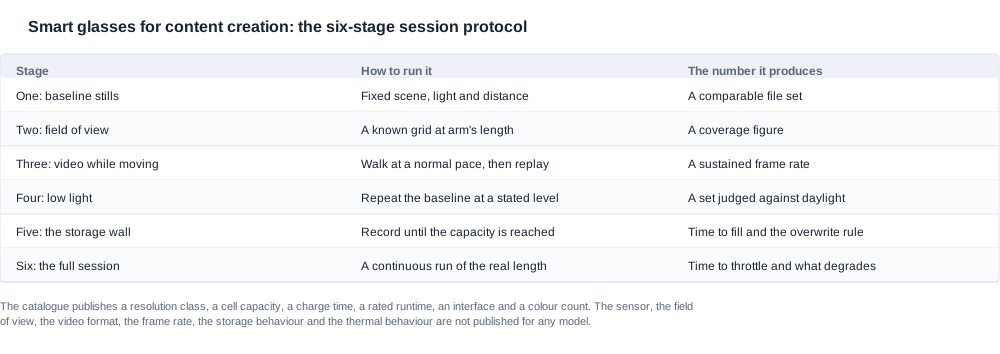
The protocol below is ordered by dependency rather than by convenience. Each stage produces a number, and each number answers a question that a later stage would otherwise have to guess at.
Stage one: baseline stills. A fixed scene, a fixed light level, a fixed distance, shot across the candidate range so the file sets can be compared frame by frame. The number it produces is a comparable set, and its value is entirely in the comparability — a single beautiful still proves nothing about a second model shot in a different room.
Stage two: the field of view, measured. A known grid held at arm's length, then the covered width and height read off it. The number is a coverage figure, and it is the number that decides whether the listing photographs are honest. A listing photograph taken at a focal length the product does not have is a misrepresentation that a buyer discovers with a returns rate rather than with a support ticket.
Stage three: video while moving. Record while walking at a normal pace, then replay and check whether the frame rate holds. The number is a sustained frame rate and a stated video format, both of which the catalogue does not publish for any model, and both of which a creator's edit will expose within a week of use.
Stage four: low light. Repeat stage one at a stated low light level and judge the set against the daylight set. The number is a comparable judgement, and the stated level matters more than the result — an unstated light level produces a photograph that cannot be argued with either way.
Stage five: the storage wall. Record until the capacity is reached and watch what happens. The number is the time to fill, the overwrite behaviour, and whether there is any notification at the limit. This is the stage that gets skipped and it is the stage that costs the most, because a camera that fills its storage without warning loses the take, and a lost take in a creator's workflow is not a defect report — it is a customer who does not come back. The storage capacity, the overwrite behaviour and the notification at the limit are not published for any model, so the only way to know is to fill it and watch.
Stage six: the full session. A continuous run of the length the customer will actually use, with the device working the whole way. The number is the time to thermal throttle and what degrades first. A camera platform is a small computer carried against the head, and heat is the usual failure mode on a long session. A device that throttles after forty minutes is a different product from one that runs for two hours, and neither fact appears in a catalogue row.
The resolution class deserves one warning, because it is the row a buyer is most tempted to rank models by. The eleven camera models publish two classes: 8 megapixels on the V03 and the V03 Pro, the CY05 and the KY06, and the MT6 and the CY03, and the MT5 and the V06, and 13 megapixels on the L1 Pro and the L2 Utral, and the S7. A megapixel count is a quantity of detail, not a ranking of quality, and it says nothing about the sensor, the lens, the field of view, the frame rate or the stabilisation — none of which is published for any model. Two models in the same class can produce visibly different footage, and in practice the difference between a 260 mAh cell and a 290 mAh cell changes the session length far more than the difference between the two resolution classes changes the picture. The class belongs in the shortlist because it is a published, comparable row that two quotations can be checked against. It does not belong in the ranking as though it settled the question.
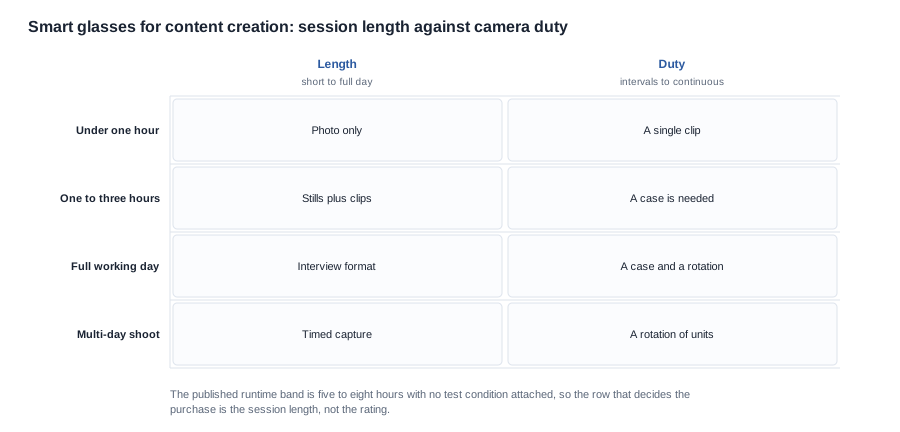
The published runtimes cluster between five and eight hours across the eleven camera models — five to eight hours on the S7 and the V03, and the V06 and the V03 Pro, six to eight hours on the KY06 and the MT5, and about seven hours on the MT6 and the L1 Pro, and the L2 Utral and the CY05, and the CY03 — and none of them carries a test condition. A camera workload sits at the bottom of that band, not the middle, because a camera running continuously draws more than a device that is mostly idle. That is why the session length, not the rating, is the row that decides the purchase for this scenario. A creator shooting three-hour blocks needs a device that survives a three-hour block, and a buyer who selects on the published figure alone is selecting on a number that describes a workload the customer does not have.
Running the session so the result can be repeated by somebody else

A test that only the tester can repeat is a demonstration. Turning it into a criterion takes five disciplines, and each of them is cheap to impose and expensive to retrofit.
Fix the conditions before the first frame, not after the last one. The light level, the distance, the movement, the phone state, the storage state, the ambient temperature and the volume all have to be written down before anything is captured. A runtime measured at a fixed volume with the device connected and a runtime measured across a three-hour shoot with the camera running are different numbers, and no published figure in this range carries its condition. The same discipline applies to the still sets: one camera, one lens, one light, one distance, and the device settings recorded.
Hold the receiving end constant too. The far end of a call, the playback device, the editor and the network all affect what the creator sees, and if they are not held constant between two candidates, the comparison measures the setup rather than the product. The classic version of this error is a file that plays perfectly on the device and does not open in the editing application — which is why stage three has to end on the editing machine and not on the phone.
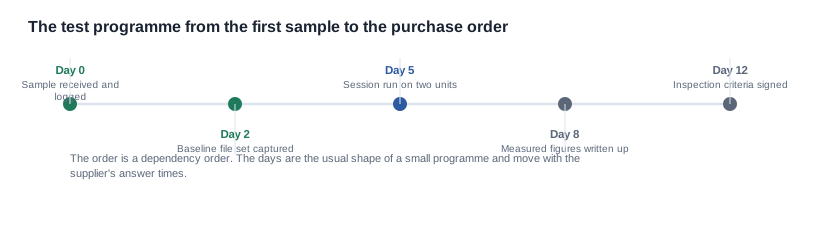
Run it on two units from the same batch. That single step separates a design characteristic from a manufacturing inconsistency, and the two need completely different remedies: one is a product change and the other is a supplier conversation. Doing it on one unit and discovering the problem three weeks into production is the expensive version of this lesson. Where the volume justifies it, three units is better still, and the spread between them is itself a number worth having.
Write the pass line before the test. A criterion written after the result is a negotiation, and the same session run twice produces two different conclusions. The pass line for a content-creation session is short and blunt: the file opens and plays on the editing machine, the framing is acceptable for the content type, the transfer completes without intervention, and the device is still recording at the end of the session length the customer actually uses.
Ask for the four rows that would close the gaps in writing. The field of view, the video resolution and frame rate, the storage path and overwrite behaviour, and the capture latency. Each with a method attached, because a figure without a method is a claim and a figure with a method is a criterion. These four are the difference between a test programme that ends in a purchase order and one that ends in a photograph.
Decide the listing boundary before the copy exists. The resolution tier, the cell capacity, the charging interface, the rated runtime, the charge time and the case capacity are published rows and can carry a listing. The seven gaps are not, and a listing that borrows from the second group is a listing that has to be withdrawn. The case row is the one a buyer has to handle with care, because the catalogue states it in four ways: five camera models publish a capacity — 1400 mAh on the L1 Pro and the CY05, and the CY03, 900 mAh or 1400 mAh as a configuration choice on the L2 Utral, and a 1200 mAh foldable case on the MT6 — two more, the KY06 and the MT5, are published with a case whose capacity is not stated, three have no charging-case row at all, and the V03 Pro has no charging-case row. And four of the eleven camera models publish no charging interface at all: the CY03 and the MT6, and the CY05 and the L1 Pro publish only the cell, the charge time, the runtime and the case capacity, so how they recharge has to be established with the supplier rather than read from the catalogue.
Where a content-creation test programme goes wrong
Testing the photograph and assuming the rest follows. A still is the easiest thing to shoot and the least predictive thing to sell. Symptom: a listing that reads well and a return rate that does not. Prevention: the session protocol, not the sample.
A protocol that changes between candidates. If the volume, the light or the distance moves between runs, the comparison is a comparison of setups. Symptom: a result that reproduces for nobody else. Prevention: the conditions sheet, written before the first frame.
Accepting a result with no conditions attached. A figure of eight hours without the workload behind it is the most expensive sentence a procurement file can contain, because a creator will test it on a real shoot and find the difference. Prevention: the condition travels with the number into the agreement and into the listing copy.
One unit, and a defect found in production. One unit cannot separate design from manufacture, and the remedy is different in each case. Symptom: a batch that behaves unlike the sample. Prevention: two units from the same batch as a minimum.
A test that produces no criterion. A measurement nobody writes into the incoming inspection is a demonstration, and a demonstration belongs to the supplier rather than to the buyer. Symptom: a quality escape on the second shipment. Prevention: every measured figure ends as a line in the inspection criteria.
A protocol written before the workload is defined. The workload is what makes two numbers comparable, and it comes from the customer rather than from the laboratory. Symptom: a perfectly executed test that answers a question nobody asked. Prevention: the session length and the content type are fixed before the protocol is written.
A storage wall left untested because it takes too long. It takes hours, and it is the one stage that finds the failure a creator cannot forgive. Symptom: a lost take on a long shoot. Prevention: schedule it deliberately, or accept that the risk is being carried unpriced.
What a measured result is worth commercially
A content-creation programme is renewed on a number, and the number is one the catalogue cannot produce. The six stages cost a day of lab time and they close the seven documentation gaps that a content listing depends on, and in a channel where the creator's first published piece is the one the product is judged on, that day is the cheapest protection available. The measured figures also do something the published rows cannot: they convert an abstract rating into a sentence that a listing, a support script and an inspection document can all use, which is why the measured figure belongs in the agreement rather than in a side file.
The commercial terms that are settled by the catalogue are settled by it. The resolution class and therefore the ceiling on image quality, the cell configuration and therefore the runtime ceiling, the charging interface, the certification cost and its lead time, and tooling — amortised across the first order and quoted as a separate line rather than folded into the unit price. These do not move, and they are what makes two quotations comparable at all.
The terms that do move are specific to this scenario. Whether the supplier will run the protocol against production units rather than engineering samples is the first one, and the difference between the two is the difference between a result and a guess. Whether the supplier will supply the recordings so the result can be re-judged later is the second, and it costs a supplier very little to agree to. Whether the case is included and at which capacity is the third, because the case is what decides the session length in the field and the 1400 mAh capacity across three models makes it the natural way to build two price points from one platform. The incoming inspection criteria are a negotiation between two parties rather than a unilateral document, and that is worth saying out loud when it is raised. Whether the supplier funds a baseline measurement on the production batch is the fifth, and it is the document that answers every complaint in the second year. Minimum order quantity tiers are open. Logo, lens tint and packaging are open. A content channel that grows in stages is the case where a first order split across two deliveries with staged payment belongs, and how many units remain at pilot quantity is the term that holds the most slack.
The documents that turn a test result into a purchase criterion
The documents to request before a deposit are the signed test sheet with its conditions attached, the output parameter sheet with methods, the two runtimes per model with their conditions, the storage and overwrite behaviour, the thermal behaviour, the four supplier answers in writing, the model designation table, the certificate register with numbers and validity dates, the battery transport file for the configuration actually ordered, and the agreed incoming inspection criteria. The buying-side list is at the content creation checklist, the trade-offs are at content creation pros and cons, and the recording and privacy thread is at content creation legal considerations. The clause language is at contract terms, the commercial structure of a first order is at pricing, and the scenario entry point is smart glasses for content creation.
Stated plainly: the published material is the part of the specification we can stand behind, and the rest is a question for the supplier's own file. We publish what our documentation states, we mark the rows that are open, and we will not fill an open row with a typical figure taken from a general data sheet. A buyer who builds a listing claim on an estimated number finds the error in the field rather than in the quotation, and the correction is more expensive than the question was. We will also not publish a field of view, a video format, a frame rate, a storage path, a transfer method, a low-light behaviour or a runtime condition for a model where the manufacturer has not provided one, and we will not present a published rating as though it were a test result.
What we will do is take the content types, the session lengths, the channel, the price band and the markets, and tell you which published rows apply, which stage of the protocol decides the purchase for that combination, which claims the listing can carry without overreaching, and which numbers have to be confirmed on a production unit before a purchase order is raised. Send those five and we will return the protocol written for your workload, the pass lines, and the document list that has to be settled before the order.
Related reading
- The point where the scenario starts — smart glasses for content creation
- The buying-side list — content creation checklist
- The trade-offs — content creation pros and cons
- The regulatory thread — content creation legal considerations
Tell us the content types and the session lengths, and we will say which stage decides the purchase.


