

Smart glasses for field work are not charged from a wall, because a field shift does not contain one. The unit goes out at the start of a shift, spends the shift away from any socket, and comes back at the end of it to whatever the crew can reach — a vehicle, a site cabin, a depot at the end of the drive. That turns the charging case from an accessory into the power supply, and it turns the question from "how long does the battery last" into "how much reserve does the crew carry, and where does that reserve get charged".
The catalogue publishes the cell capacity, the charge time and the rated runtime for every model, and it publishes the case capacity for five camera models and no case row at all for four more. It publishes nothing about the case's own charge time for any model, which in this scenario is the number that has to be right.
This page is written for the buyer equipping a crew, for the procurement manager sizing a second-cell deployment, and for the operations lead who has to answer where the charge happens.
Smart glasses for field work: the shift has no socket in it
Why a field shift is a different planning problem
Three properties of field work break the assumptions that make an office deployment easy.
There is no power where the work happens. Whatever the crew carries is the entire power budget for the shift, and the unit is only one part of that budget. A crew of six carrying a camera model and a case each is carrying twelve cells, and every one of them has to be accounted for in the battery transport documentation and in the freight class.
The shift length is set by the job, not by the battery. A twelve-hour shift is a twelve-hour shift whether or not the device can serve it. The catalogue's published camera runtimes run from five to eight hours on the V03 Pro and the V06, and the V03 and the S7, through six to eight hours on the KY06 and the MT5, to about seven hours on the CY03 and the L2 Utral, and the L1 Pro and the CY05, and the MT6. None of those figures publishes the workload behind it, so a buyer cannot turn a published runtime into a shift plan without a measurement.
The crew's turnaround is not the crew's choice. The gap between the end of one shift and the start of the next is a drive, a briefing, a meal and a handover, and it is fixed. The charge happens in that gap or it does not happen at all, which means the charging plan for field work is a turnaround plan.
The four questions a field-work buyer is really deciding
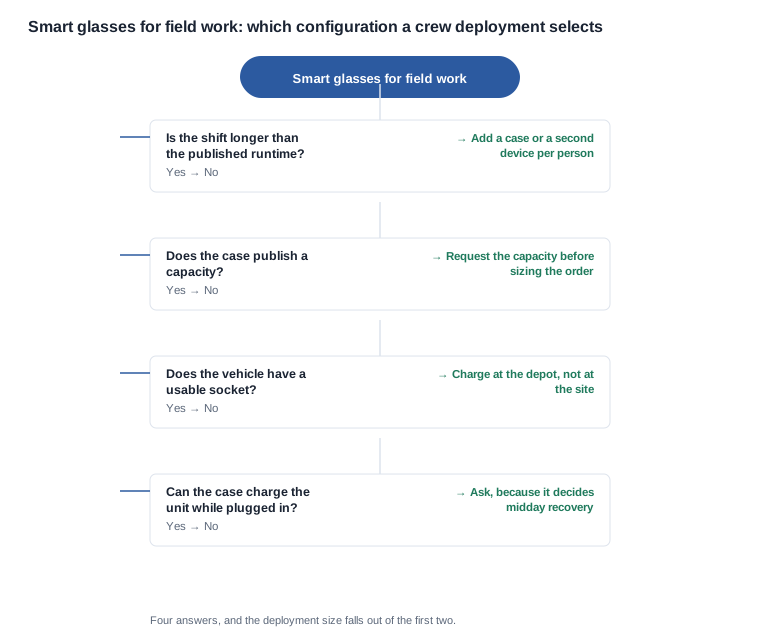
- Does the unit need a case to cover the shift, or does it need two devices? This is a power-versus-bulk trade-off, and the answer depends on how the device is carried. A camera model with a published case is one object; two camera models without cases are two objects and two charging cycles. Both designs work; they have different pack weights, different unit costs and different battery declarations.
- Where does the case get charged? If the answer is "wherever the device gets charged", then the case's own charge time has to be known, and it is not published for any model.
- What does the crew carry as the interface? Four camera models publish no charging interface row at all — the MT6 and the L1 Pro, and the CY05 and the CY03 — and a crew that cannot name the connector cannot standardise what goes in the vehicle.
- What is the pack weight per person? The catalogue publishes exactly one weight anywhere in the range, and a field pack weight is a number the crew will feel.
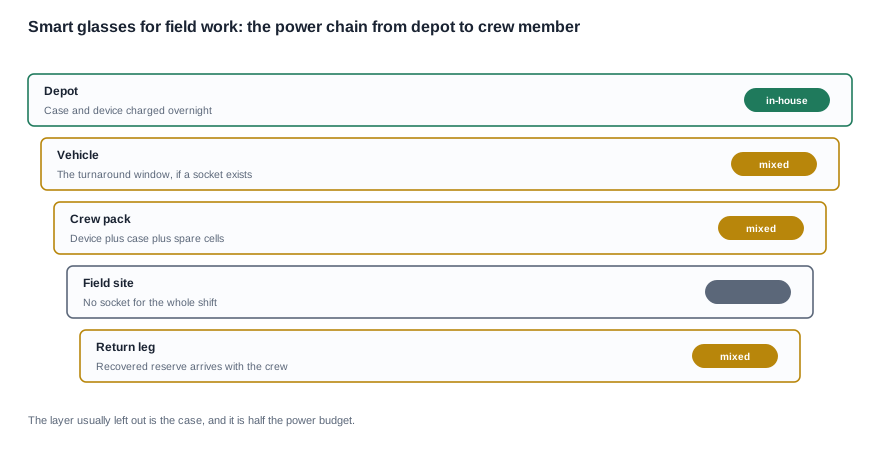
The chain above is the whole argument of this page. Every layer is a place where power has to be handed over, and the layer that is usually left out is the second one — the case — because in an office deployment the case is a nicety and in a field deployment it is half the power budget.

The case is the power supply, and the catalogue describes it in four different ways
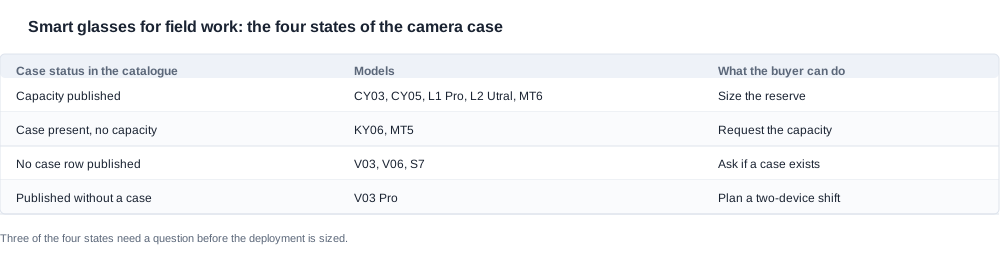
The four states of the camera case
The camera models are where a case-led field deployment is decided, and the catalogue's coverage is uneven in a way that has to be planned around rather than discovered later.
| Case status in the catalogue | Models | What a buyer can do with it |
|---|---|---|
| Capacity published | L1 Pro and CY05, and CY03 — each at 1400 mAh; MT6 at 1200 foldable | Size the reserve against the published figure |
| Capacity published as a configuration choice | L2 Utral at 900 or 1400 | Decide which pack ships before the purchase order is raised |
| Case present, capacity not published | KY06, MT5 | Request the capacity before sizing the deployment |
| No case row published | S7 and V03 Pro, and V06 and V03 | Ask whether a case exists, and in which configuration; plan a two-device or shift-boundary arrangement in the meantime |
Three of those four rows are questions rather than answers: the L2 Utral configuration choice has to be settled at the order, the KY06 and the MT5 need a capacity before the deployment can be sized, and the four models with no case row at all need a straight answer on what the carton carries. A buyer who reads a blank row as a settled answer will build a plan that does not work.
The published capacities themselves are worth reading carefully. The L2 Utral publishes 900 or 1400 milliamp-hours, and that is a configuration choice rather than a variant: the lower capacity is a smaller pack and a smaller declared energy, and the two are different products on the freight paperwork and in the battery transport file. The MT6 publishes 1200 milliamp-hours in a folding case, and the same model is the only one in the catalogue with a published weight — 158 grams for the eyewear body, including the battery and the camera and excluding the folding case. The MT6 is therefore the one camera model where a field pack can be specified from published numbers at all, and even there the case weight is not published.
The row that is missing for every case in the range
No case in the catalogue publishes its own charge time. That is the number that decides a field deployment, because the case is what has to be full when the crew walks out of the depot. If the case charges slowly, the case is charged the night before, which means the vehicle or the depot has to be the place where a charge happens overnight rather than at the end of a shift — and that is a facility decision, not a device decision.
Two related rows are also unpublished for every model: the charging input, and whether a plugged-in case can charge the unit while it is charging itself. The second one decides whether the vehicle can be used as the wall or only the depot can. A case that cannot pass through means the reserve has to be fully charged before the shift and cannot be topped up between sites; a case that can pass through turns the vehicle into a charging point. That single unpublished behaviour is the difference between a crew that recovers reserve at midday and a crew that does not.
The battery transport route is the document side of the same issue, because a configuration with a case is two cells in one package, and the file has to cover the configuration being shipped rather than the model family.
Sizing a crew deployment: headcount, not device count, drives the second cell
This is the commercial point that is usually missed, and it is the reason a field deployment and a retail deployment of the same device count have completely different quotes.
The second cell scales with people, not with units. A crew of eight needs eight cases, which means sixteen cells in the field rather than eight, and that single ratio changes three lines in the quotation at once: the unit price, the freight class, and the battery transport documentation for the configuration. A buyer who quotes a field deployment from a device unit price and adds the case later will find that the case minimum order quantity is the number that actually sizes the deployment.
The spare-parts line is a different order. If the field configuration includes a case, the contact, the dock and the case itself are all consumables over a multi-year deployment, and none of them shares the device minimum order quantity. Asking for the accessory lines separately, at their own tiers, is worth doing before the order rather than after the first replacement request.
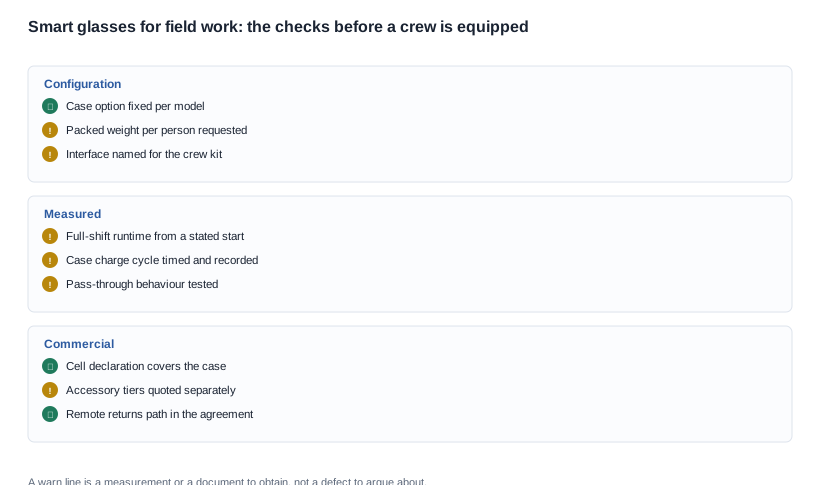
The pack weight is an acceptance criterion, not a detail. The catalogue publishes one weight for the whole range, and it excludes the case. A field deployment therefore has an unpublished pack weight, and the honest way to specify it is to require a packed weight per configuration, per person, including the case, the spare cells and the cables.
The warranty and the returns path are field-specific. A device that comes back from a site with a damaged contact, a scuffed hinge and no charger is a different warranty conversation from a desktop unit, and a returns path that assumes a courier and a label does not work for a crew that is forty kilometres from a depot. The warranty period and the response time belong in the agreement, and so does the replacement policy for a unit that fails mid-shift.
Three shift patterns, three different configurations
A field deployment is not one thing, and the three common shift patterns produce three different configurations out of the same model list.
The single shift that fits inside the published runtime. A seven-hour shift against an about-seven-hour camera runtime is a tight fit with no test condition behind either figure, so the measurement has to come before the order. In this pattern the case is optional and the design question is a single charged unit per person, with a case or a second unit as the contingency.
The long shift that the runtime does not cover. A twelve-hour shift against a seven-hour runtime needs a reserve, and the reserve is either a case or a second device. The case is lighter and cheaper and it needs a charging place; the second device needs two charging places and two sets of accessories. The decision criterion is the charging infrastructure the site already has, not a comparison of the two options in isolation.
The rotating multi-day deployment. Where a crew works three or four days away from a depot, the reserve has to be recharged away from the depot, which moves the whole problem onto the case and onto the vehicle. This is the only pattern in which the unpublished case charge time and the unpublished pass-through behaviour decide the outcome, because they decide whether the vehicle can serve as the wall. In this pattern the case's own charge time is the first number to obtain and the first number to measure.
The criterion across all three is the same, and it is worth stating in one sentence: the configuration is set by the shift pattern, and the model is chosen afterwards from the configurations the catalogue publishes. A buyer who picks the model first and works the shift pattern out afterwards is doing it in the wrong order, and the published rows are rich enough to support the right order.
The pilot that answers most of the questions
One crew, one shift pattern and one configuration, run for a full working cycle, answers more of these questions than any amount of documentation. It produces the runtime under the real workload, the pack weight as carried, the number of charges a person actually performs, the reserve level that turns out to be right, and the failure modes that only appear in weather.
The pilot is also the cheapest place to discover that a crew's charging routine is wrong, and it is the only place to discover it before the deployment has been sized around a routine that does not work. A supplier prepared to supply one crew's worth of configuration against a written acceptance list, and willing to report what the crew actually did with it, is answering the question that matters.
The criteria for judging a pilot are simple, and they are not the device's specification: the runtime achieved against the shift, the number of charge events per person per shift, the reserve level that proved sufficient, the accessories the crew reached for and the ones they ignored, and the occasions when the routine failed. Those five answers set the deployment size.
The vehicle is the wall, and the turnaround between shifts is the constraint
Designing the turnaround
The turnaround between two shifts is the charging window, and it has to be designed rather than hoped for. The design inputs are simple.
- The turnaround length, which is a fixed number of minutes that the operations team already knows.
- The number of people, which is the number of parallel charges available, because a crew charges in parallel and not in series.
- The interface each model needs, which determines whether one cable serves the whole crew or the crew carries several. Six models in the range publish a Type-C port — the ZH12 and the D17, the D12 and the L2 Utral, and the V03 Pro and the D11 — and one cable serves all six. The seventeen magnetic models each need their own contact or dock, and the four camera models with no published interface cannot be equipped for at all until that row exists.
- Whether the vehicle has a socket and how many. This is the number that decides whether the crew recharges in the vehicle, at the depot, or both.
The IP54 marking belongs to two models
IP54 appears on the V06 and the S7 and on no other model, with no published test report behind it. Those two models also publish a removable inner frame, which matters for a field deployment where a damaged unit can be reconfigured rather than written off.
The handling of the marking has to be precise. IP54 covers splashing water and a dust protection level; it does not cover immersion, it does not cover a sustained downpour, and it says nothing about a charging contact that has been in a wet pocket or a dusty van. The commercially correct approach is to describe the marking as a catalogue attribute and to keep it out of the general protection language. The IP ratings page sets out what the digits establish.
The field-work measurement programme
Three measurements close the gaps, and all three are straightforward on a sample.
- A full-shift runtime under the workload the crew actually generates, started from a stated state of charge, with the recording and idle pattern recorded. The battery life test protocol is the reference for the method.
- A recharge cycle measured from a stated start, and a case charge cycle measured from a stated start, with the charging input recorded against both.
- A pass-through test, whether a plugged-in case can charge the unit while it is charging itself, and whether the interface seats reliably after the unit has been in a van all day.
What a field-work charging plan costs, and where the terms sit
A field deployment has commercial lines that a retail deployment of the same device count does not, and they are worth pricing separately rather than discovering at the first replenishment.
The case line and the cell declaration move together. A case-led configuration is a second cell per person, a freight class, a battery transport file for the exact configuration, and a pack weight. Ask for the case at each volume tier rather than accepting a bundled device price, and ask for the battery transport documentation against the configuration that will actually ship.
The accessory lines have their own minimum order quantities. Contacts, docks, spare cables and replacement cases are ordered on their own terms, and in a multi-year deployment they are ordered more than once. The restock interval is a better negotiation target than the unit price, because it is the interval the operations team actually carries.
The terms worth negotiating. Unit price and volume tiers; the case and accessory set with its minimum order quantities; the packing specification for a case-led configuration; the battery transport file for each configuration; the warranty period with a stated response time; the replacement policy for a unit that fails mid-shift; the returns path for a crew that is remote; delivery splitting against a staged payment; and the terms of a pilot order with one crew before a fleet rollout.
The terms that are better budgeted than argued. The cost and the lead time of the battery transport documentation for a new configuration, and the cost and the lead time of a conformity document for a new destination market. Tooling is amortised across the first order and quoted as a separate line rather than folded into the unit price.
The short answer: a field deployment is a power budget with people in it, and the charging case is the power supply rather than an accessory whenever the shift has no socket in it. We publish the charge times, the charging interfaces, the rated runtimes and the case capacities where they are published and the cell capacities where they are published, and we will not publish a case charge time, a charging input, a pass-through behaviour, a packed weight or a conformity position for a model where we have not been given one. The field work application page covers the deployment context, the field work product recommendations article is the model-level entry point, and the certification checklist, samples, contract terms and pricing pages cover the documents a crew deployment needs before the purchase order.


