

Nine phrases carry almost the entire marketing load in this category, and every one of them can be turned into either a specification or an admission with a single question. Open ear audio glasses smart glasses manufacturer claims is therefore less about what a particular supplier says and more about the shared vocabulary: the reason so many product pages in this category sound alike is that the format is new, the reference language belongs to sealed audio products, and nobody has published a figure that would let a page make a stronger claim honestly. A buyer who has the phrase set in their head can interrogate any supplier in this category in an afternoon, with no laboratory and no acoustic expertise.
The commercial reason to do this before the sample order rather than after it is simple. A claim is cheap to interrogate and expensive to inherit. Once a phrase is on your product page, it is in your listing, in your marketplace metadata, in your packaged documentation and in your support script, and a customer who can falsify it will do so in a review that then takes the whole page's credibility with it.
Open ear audio glasses: the phrase library suppliers reach for
Why the same words appear on every page
Start from the structure of the problem. This format has no published acoustic baseline: no model in our audio tier carries a driver size, a frequency response, a leakage figure, a microphone pickup figure or a codec list. That is a property of the product type rather than a failing of any one supplier, because an open-ear frame has no seal and no coupler, so the reference points that the headphone measurement world depends on simply do not exist.
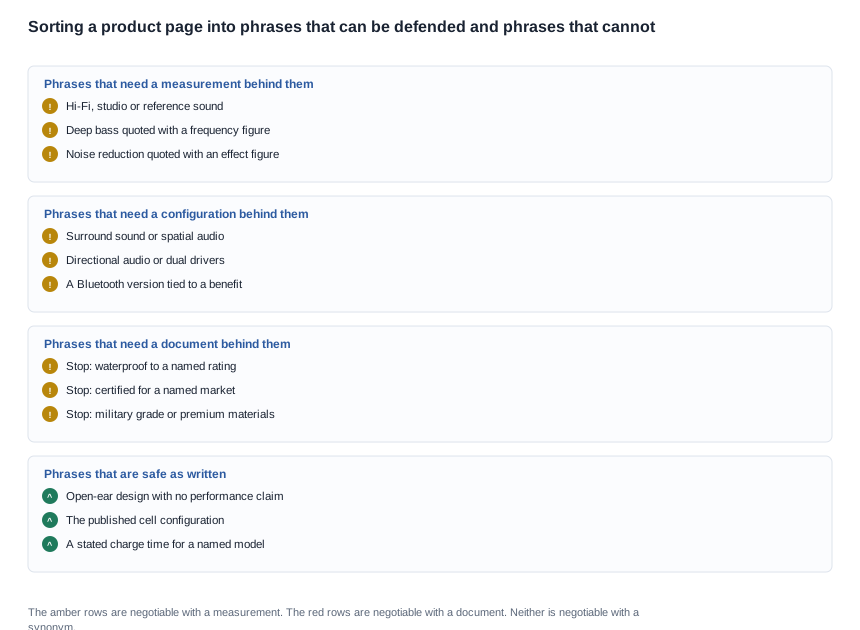
With no figure available, a product page falls back on vocabulary. And the vocabulary that is available is borrowed from sealed audio products, where those words have a settled meaning. "Deep bass" means something measurable in an earbud. "Hi-Fi" has a reference standard behind it in a closed-back headphone. "Waterproof" is a rating on a product with a rating scheme. "Surround sound" describes a well-understood signal path in a home cinema system.
Transplanted onto an open-ear frame, each of those words keeps its grammar and loses its referent. That is why the pages read as confident and the products test as ordinary, and it is why the buyer's job here is not to judge the claims but to classify them.
The three categories that every phrase falls into
There are three, and the classification is mechanical once you have it.
A method name tells you what was done to the signal: noise reduction, surround processing, directional rendering, beamforming, a codec. A method name is not a claim about the outcome. It is a claim about the design, and it is perfectly legitimate to publish a method name — what is illegitimate is to let the method name stand in for the outcome.
A measurement states a result obtained by a stated method on a stated sample: a figure in decibels, a number of hours, a frequency range, a distance. A measurement is publishable, and it becomes useful the moment its conditions are attached, because conditions are what make two measurements comparable.
An adjective asserts a quality with no referent at all: rich, premium, hi-fi, advanced, professional. An adjective cannot be interrogated, which is precisely why it is dangerous. You cannot ask for the method behind "advanced" because there is no method to produce.
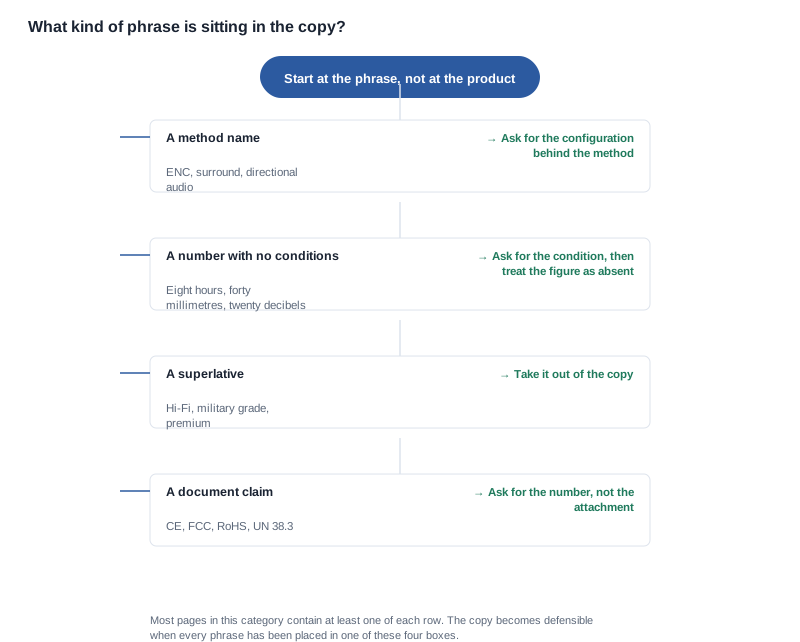
There is a fourth category that sits outside the acoustic argument entirely: a document claim, which asserts that a certificate exists. Those are handled by a different procedure — a number and a register lookup rather than a test — and the two categories are constantly confused in procurement conversations. A certificate number tells you a body assessed something; it tells you nothing about how the product sounds.
The three equipment-free checks a buyer can run this afternoon
The excuse of not having the equipment does not survive the first call, because three of the most consequential claims in this category can be tested with a phone, a colleague and a quiet room.
The intelligibility check. Seat a colleague two metres away in a quiet room. Have them read a fixed passage aloud while you listen at arm's length in the temple area rather than over the ear. Record whether you follow it. Then repeat with a fan running and a window open. The first result is a sanity check — almost every unit passes. The second result is the decision, because it separates a microphone that degrades in noise from one that does not.
The leakage check. Play a fixed passage at a level a customer would plausibly use for music, with a second person seated at arm's length, and note whether they can hear it. This is the check most likely to produce a finding, and it is also the check a customer or a reviewer will run deliberately. It takes five minutes and it does not require the supplier's cooperation.
The reconnect check. Pair the sample, power cycle it, then reconnect — with the phone the customer will actually use, not the one in the demonstration. A claim about connection stability is a claim about this sequence, and the version number in the specification says nothing about it.
All three produce a result you can write down, and all three can be repeated by someone else later. That is the entire difference between a finding and an impression.
The nine phrases and the question that settles each one
The phrase set, and what would answer each one
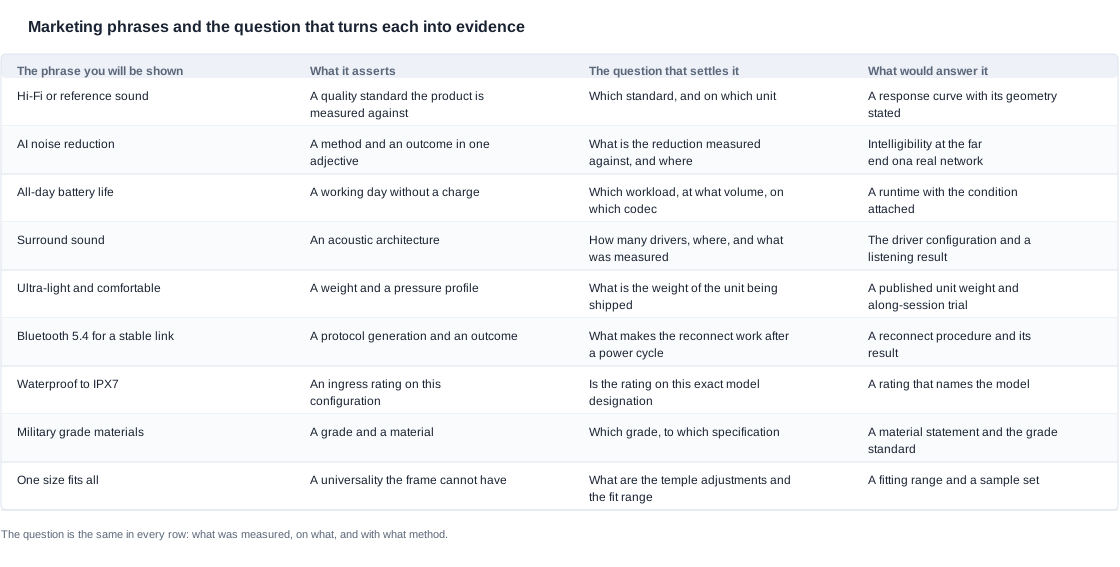
Read across the right-hand column and a pattern appears: the question is always the same shape. What was measured, on what, and with what method. A supplier who answers that shape has a documentation habit, and a supplier who answers two of the nine has told you something about their operation that will matter later, when the claim is not the issue but the paperwork is.
Where the phrases break down individually
Hi-Fi, reference or studio sound. The word asserts a standard, and a standard is a comparison against something. The question is which standard and against what reference. There is a second-order question that catches most of these pages: was the figure taken on the model being sold, or on a reference unit the supplier keeps for demonstration. The difference between two suppliers' published curves is usually rigour rather than product, and asking the question takes one email.
Deep or rich bass. This is the phrase that fails first and hardest in this format, because the low-frequency path in an open frame is the part of the design that cannot be engineered around. There is nothing to interrogate: bass is an adjective here and stays one. The correct response is not to ask the supplier but to change the copy, because no measurement of this product's bass will produce a number that supports a "deep bass" line.
AI noise reduction, or ENC. A method name carrying an implied outcome. The question is what the reduction is measured against, and where. The relevant figure is intelligibility at the far end of a real call, in a stated environment, on a real network rather than a local loopback — a loopback skips the codec and the packet-loss behaviour where wearable microphones fail and phones do not. The words "AI" and "reduction" tell you neither.
Surround sound or spatial audio. An architecture. The question is how many drivers, where they sit in the temple, and what was measured. Our own catalogue lists surround sound as a feature row on five models in this tier — the ZH12 and the YK12, the D11 and the D17, and the YKC02 — and publishes no figure beside it. That is the honest position, and the counter-question to a supplier is exactly the same one we would ask ourselves.
All-day battery life. A working day without a charge, asserted as a figure. The question is which workload, at what volume, on which codec. This tier publishes rated runtimes of roughly six, seven and eight hours with no condition attached to any of them, which means the phrase "all-day" is not supported by the published rows even for the model with the highest rating.
Ultra-light and comfortable. Two claims in one. The weight is measurable and the supplier can state it; the second half is not a property of the number. This tier publishes no unit weight for any of its eleven models, so a buyer asking about weight is asking for something the supplier may genuinely not have measured — and a supplier who answers that question clearly is giving you a useful signal about the rest of the operation.
Bluetooth 5.4 for a stable connection. A protocol generation followed by an outcome. The version number is the easiest row on the page to check and the one that settles least. The reconnect check above settles more in five minutes than the version number settles in a year.
Waterproof to a named rating. A document claim wearing a performance costume. An ingress rating is a fact about a specific model designation, and asking whether the rating names the exact unit you are ordering is the whole of the interrogation. If the rating is on a different model, it is not on yours, whatever the page says.
Military grade or premium materials. A grade and a material, both undefined. Ask which grade, to which specification, and the answer will either be a standard you can look up or nothing at all.
A tenth phrase that is safe, and why the safety is easy to miss
"Open-ear design" is a method statement about the architecture, and it is publishable as written because it makes no performance assertion. Many pages dilute it by attaching a benefit to it — "for clear calls while staying aware" — which is a claim about the environment rather than about the acoustics, and which can usually survive if it is written as the situation the product is for rather than as an outcome it produces.
That distinction is worth holding onto, because it is the difference between a defensible listing and one that will be falsified. "Designed for calls in places where you need to hear what is around you" is checkable against the product. "Immersive sound" is not checkable at all, and therefore is not a claim, and therefore is a liability.

Running the interrogation before the sample order
The order that gets an answer rather than a deflection

The order above matters for one reason: the first step is free and the last step is expensive. Most pages fail at step two, before any sample has shipped, and the failure is visible in the copy alone.
There is a detail in step four that changes how the conversation goes. When you run a check yourself on a sample and then ask the supplier for the method behind their number, the question is no longer hypothetical. A supplier who has a method answers immediately. A supplier who does not has a choice between saying so and inventing one, and the inventory of suppliers who invent one is much shorter than the inventory of suppliers who simply never measured it.
How to phrase the question so it can be answered
Three phrasings work and one does not.
"What was measured, on which unit, and with what method?" — This works because all three answers are factual and none of them requires the supplier to concede anything.
"Was this figure taken on the model we are ordering or on a reference unit?" — This works because it is a yes-or-no question with an obvious answer, and because the answer materially changes what the figure is worth.
"Under what conditions was this measured — volume, distance, environment, workload?" — This works because conditions are cheap to supply when they exist, and the pause before answering is itself informative.
The phrasing that does not work is "Can you justify this claim?" It invites an argument about whether the claim is justified rather than producing the information you need, and it gives a supplier the opportunity to answer at the level of marketing rather than of measurement.
Twelve questions to put to a supplier before the sample order
- What did you measure, on which unit, and with what method? One question covers most of the page.
- Was that figure taken on the model we would be ordering, or on a reference unit? The answer changes what the figure is worth.
- Under what conditions was it measured — volume, distance, environment, workload? Conditions are cheap to supply when they exist.
- Which of your claims are measured, and which are design statements? The split tells you what you may publish.
- What can you put in writing that you will stand behind in our copy? A supplier who will sign it is a supplier you can work with.
- Which claims are settled for the exact model designation we are quoting, and which belong to a different unit?
- What does the product do at the top of its volume range? Every open-ear design has a ceiling and the copy should name it.
- What happens to a call when the unit runs flat? A silent shutdown mid-call is a support ticket and a warranty question.
- What is the recharge time measured on, and what supply do you ship in the box? The interface row does not answer either.
- What is the unit weight of the model we would receive? This tier publishes no weight for any model, so the answer may be a surprise.
- Which phone platforms have you qualified, and what happens during a call on the paired phone? Coexistence is a behaviour, not a version number.
- Which of these claims would you refuse to publish, and why? The refusals are the most reliable part of the answer.
Turning the answers into a specification
Once you have answers, the commercial step is to convert them into something contractual. For every claim you intend to publish, you want four things attached: the figure, the conditions, the unit it was taken on, and the date. If the supplier cannot supply all four, the claim does not go on your page, and that is a decision rather than a compromise.
Two things are worth asking for in the same conversation. The first is the claim set itself in writing — the supplier's own wording — because your page will end up close to it and you want to know where the gap is before the artwork is approved rather than after. The second is a written statement of which claims the supplier considers settled for the exact model designation you are ordering, which is a document that does not usually exist and is worth creating.
What this is worth commercially
The claim set is the cheapest part of the whole programme to get right and the most expensive part to get wrong. A claim that cannot be defended does not disappear quietly — it surfaces in a review, and a review is a permanent, indexed, searchable artefact that follows the listing into every subsequent conversion decision on the platform.
There is a second-order effect that procurement managers appreciate more than the first. A supplier who can state, in writing, exactly which of their claims are measured and which are not, has an operation worth working with. A supplier who cannot has a documentation problem that will surface again at the conformity file stage, at the artwork stage and at the warranty stage, and each of those is more expensive to fix than the claim was.
What a defensible claim set is worth in the negotiation
There is a commercial case for running the interrogation early, and it is not a price case. A claim set is the one part of a programme that multiplies: it ends up in the listing, in the marketplace metadata, in the packaged documentation, in the support script and in the artwork, and every additional copy is a copy somebody has to defend. A claim that fails once is a claim you amend in five places.
The criteria a buyer should use to evaluate a claim set are simple enough to state. A claim with a method is a specification you can act on. A claim without one is a description you publish at your own risk. A document claim is settled by a register lookup rather than by a test. How to choose between two suppliers whose pages both read as authoritative is therefore a question of which one will produce a measurement on your own units, and the answer is usually visible in how quickly they answer the questions to ask.
The first negotiation to run is the one about the claim set itself. Most suppliers will accept a written list of the claims they stand behind and the claims they do not, because it costs them little and it gives your team a defensible boundary. Some will offer a stronger version of the same document: the wording they will support in your copy, with the conditions attached. That is worth more than a unit price reduction of the same size, because it is reusable across every listing and every market the product goes into, and because it removes the argument from your own organisation every time the page is rewritten.
The second negotiation is about what happens when the sample does not match the claim set. A supplier who has agreed to publish a measurement with its conditions has implicitly agreed that the measurement holds, so the natural clause is that a sample failing the agreed protocol is a defect against the specification rather than a matter of interpretation. Settle the cost allocation for that case before the deposit, because the case where the sample fails the protocol is the one where nobody wants to negotiate and the clock is running against a launch date.
The third negotiation is narrower and is usually granted quickly: the documentation pack. You want the claim set in writing, per model designation, with the conditions, in the market languages you ship into. That is a small production job on their side and it removes your team's translation and interpretation burden entirely.
The trade-offs are worth naming plainly. A narrow claim set costs you reach. A page that says only what has been measured is less exciting than one that says everything the product could be said to do. The usual business answer is not to narrow the claim but to narrow the audience: publish the measured claims prominently and keep the aspirational language in the campaign material that does not carry a specification. Which of those you choose is a channel decision, and it should be made before the artwork rather than after the first review.
The pitfalls cluster around one mistake, which is treating a supplier's refusal to give a method as a reason to drop that claim. It is usually a reason to drop the claim while keeping the supplier, because the method may sit with their module maker rather than in their own lab. The honest answer to "we do not measure it here" is a very different answer from the answer to "we will not tell you", and the second question is worth asking.
What we publish, and what we will not turn into a claim
Why we publish feature names without a number next to them
The short answer: we publish the methods our catalogue states — the open-ear structure, directional audio, intelligent noise reduction and, on five models in the audio tier, surround sound — and we publish the empty measurement rows next to them rather than filling them with values from a typical device. We publish no driver size, no frequency response, no leakage figure, no microphone pickup distance, no codec list and no latency for any model in the audio tier, and we will not infer any of them from a method name.
We will also not quote a typical performance figure for the category. A typical figure is the one that ends up on a product page, and a product page figure that no one measured is the exact failure this article is about.
The objection to that position is that a page without numbers converts worse. It is a fair objection and it has a fair answer: the conversion lift from an indefensible claim arrives with the falsifying review attached, and a review that says the product is nothing like the page describes does not stay in one listing. The defensible page is slower to write and cheaper to keep.
The copy we would sign, and the copy we would not
Here is the distinction we apply to our own pages, offered so a buyer can apply the same test to somebody else's. A phrase goes on the page if it can be traced to a published row, to a measurement with its conditions attached, or to a documented fact about the configuration. A phrase comes off the page if it can only be traced to a method name, an adjective, or a document that names a different model.
Applied to this tier, that means the cell configuration, the charge time, the radio generation, the rated runtime, the charging interface, the control method and the feature rows are all publishable as written, provided each is attached to the model designation it belongs to. It means any figure about level, leakage, response, pickup, codec or latency is not publishable from our catalogue, because we do not hold it. And it means a privacy claim is not publishable at all, because an open-ear product is by construction audible to a person nearby.
Four things to send us
-
Send us a supplier's product page, in full, including the text inside the images. We will mark every phrase as a method, a measurement, an adjective or a document, and tell you which of them can survive into your own copy.
-
Send us the claims you have already drafted. The set that has been written is harder to remove than the set that has not, and it is worth finding out which category each one falls into before the artwork is approved.
-
Send us the equipment-free checks you have run on a sample. We will tell you what those three results already settle and what they leave open, which is usually a much shorter list than it seems.
-
Ask us which of our own claims are measured. We will answer for each one, and where the answer is that we do not measure it, we will say so rather than offer a typical figure.
The radio context is in Bluetooth connectivity, the sample route and what to ask for on a sample order is at sample evaluation, the vocabulary behind these phrases is in the open ear audio glossary, the technology background is under open-ear audio, and the range itself is at Bluetooth audio glasses.
Related reading
- The terms used — open ear audio glossary
- The sample route — sample evaluation
- Bluetooth audio glasses range
Send us a supplier's copy and we will mark each phrase as a method, a measurement, an adjective or a document.


