

Smart glasses for education raise a legal question that is not about the hardware, and the question is asked in the first minute of every institutional review. What is the product, what is it allowed to say about itself, and whose name is on the paperwork when something goes wrong. Three answers are needed, and they are answers a procurement file can hold. The first is a classification: a device sold for use by children is not an adult wearable with a smaller frame, and the frameworks that follow from the classification decide how large the document pack has to be. The second is a claim boundary: a device that detects a posture or a viewing distance and reminds is not a clinical intervention, and no listing may say otherwise. The third is a named party: in every market there is one entity responsible for the conformity file, and it is either you or the entity you have named. This page sets out those three answers for an education deployment, and it is written for the buyer who has to assemble the file rather than the reader who wants a summary of the law.
Who this is for. The reader is a brand manager, a channel buyer or a distributor's compliance lead who has been asked to place a children's model in a school, a training centre or an education retail programme. Their real deadline is somebody else's: a school board, a district procurement office or a retailer's technical team, each of whom will ask for the file and will not ask for a conversation. The fear is specific and expensive — that the file does not exist, that the supplier answered for the family rather than for the model, and that the gap is discovered by a third party after the goods are on a shelf in a building the buyer does not control. The education channel page covers the commercial context, and the kids smart glasses range is where the published rows for the three models in this tier are set out.
Smart glasses for education: the cost when the file becomes an opinion
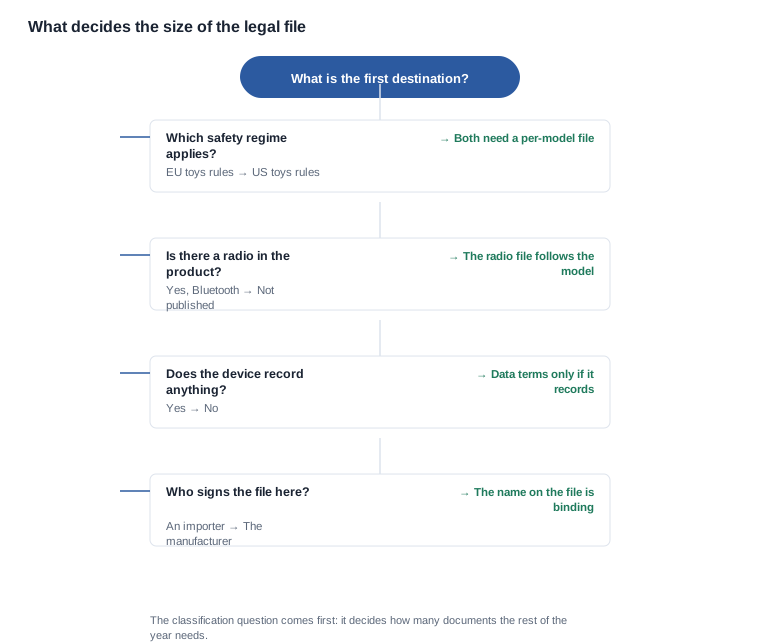
The classification question comes first, and it decides how many documents the rest of the year needs. A product sold for use by children is not an adult wearable with a smaller frame, and the frameworks that follow from the classification decide how large the document pack has to be.
Which regime decides the size of the document pack
The single most expensive question in this category is a classification question, and it is asked at the start rather than at the end. A product sold for use by children under the age of three falls under the toys regime in Europe and under the children's product rules in the United States — EN 71 in the European Union, ASTM F963 together with the Consumer Product Safety Improvement Act in the United States — and those frameworks are separate from radio approval, separate from the General Product Safety Regulation, and separate from the rules on a product that makes a medical claim. A product that carries a valid radio declaration can still be non-compliant for children's use, and a product with a complete children's file can still be non-compliant as a radio device.
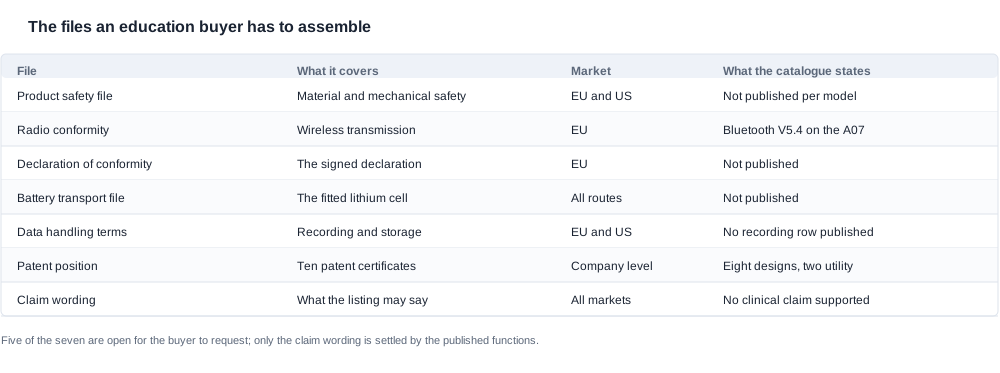
The table above is the working list for a European buyer with a United States destination as well. Two rows deserve comment. The battery transport file is not a toy-safety file at all: it is a transport document for the fitted lithium cell, it follows the model wherever the model goes, and the requirements are set out at battery transport. It is also the row most often discovered late, because it is triggered by the cell rather than by the market. The data handling row is conditional: it only becomes a document if the device records, and the catalogue publishes no recording row for the three models in the children's tier, which means that question is open rather than answered in the negative.
What the catalogue states, and what it does not. Being precise here protects a buyer from two opposite mistakes. Our catalogue holds a company-level export certification page whose content is imagery rather than wording, and no reference to CE, FCC or RoHS is written into the catalogue text. There is no per-model certification row anywhere in it. The export page shows ten patent certificates — eight appearance-design patents and two utility-model patents — which is a statement about the company's design position and not a conformity statement about any model. So the catalogue cannot be cited as evidence that any model is certified, and equally the absence of a certification row must not be read as evidence that a model is uncertified. Both of those statements are gaps, and a gap has to be closed with a document from the supplier or with a test of your own. The catalogue does publish the electrical rows that a technical file needs — a 40 mAh cell on the A05 and the A06, 70 mAh on the A07, a charge time of two hours or less, a rated use of about twenty hours and a magnetic charging interface — and it publishes Bluetooth V5.4 for the A07 only. Everything else in the file is something a buyer asks for.
Why a family-level answer is not an answer. The most common reply from a supplier to a request for the certification file is a document that says "smart glasses" in the product field. That document covers nobody, and it is worse than no document, because it allows a buyer to believe the file exists. The workable request lists, per model designation, the standard name with its edition, the certificate number, the issuing body and the validity dates. The detail about the edition is not pedantry: the frameworks work on an edition cycle, and a file prepared against a superseded edition is a retest waiting to happen. The correct place to discover that is before the order, not in the second year of a programme. The procedural version of the same point is at certification checklist, and the substantive one is at children's product compliance.
The claim boundary a school reviewer will test in the first minute
The published functions on the A05 and the A06 are a lens-based electronic fogging arrangement and posture and viewing-distance detection, published by name. The A07 publishes neither. What can be said about a device that detects a position or a distance and reminds is straightforward: it detects, it reminds, it is a reminder. What cannot be said is anything about eyesight, vision, myopia, eye protection or hearing assistance, because none of those are clinical claims a consumer device can carry and none of them are supported by any published parameter.
Why the boundary is a legal matter rather than a marketing preference. In the United States a device whose intended purpose is to diagnose, treat or prevent a disease enters the medical device framework, and a device that makes such a claim while sitting outside that framework is a regulatory exposure rather than a copy error. The boundary marker for that framework is 21 CFR 800.30, and the practical effect of crossing it is a file you cannot assemble after the fact. In Europe the equivalent line sits in the medical device rules, and the same logic applies: a product whose function is to detect a position and issue a reminder is not a therapeutic device, and describing it as one changes the applicable conformity route, the documentation obligation and the claim rules all at once. The medical boundary is set out at medical boundary.
The place where this actually goes wrong is the product name. The catalogue names the two models in English as children's smart protection glasses, and the Chinese product names carry the word for protection. That naming is a description of the product category, and an English listing that inherits it verbatim creates a claim the documentation cannot support, because no published parameter relates to vision or to protection of the eyes. The fix is not to argue about the name in the abstract; it is to write the listing from the published function and check it against the name. A listing that says the device detects posture and viewing distance, reminds the user, and provides a lens-based fogging arrangement is defensible. A listing that says it protects a child's eyes is not, and the second version is the one that gets a listing pulled and a school's legal team involved.
Three layers, and they drift apart. The claim has to be consistent in the retail listing, in the printed manual and label, and in what the sales conversation says. These are the three places where a legal position is actually communicated, and they drift apart because they are written at different times by different people. The three layers, and where each one usually fails:
- The retail listing. Written for a search result, under a deadline, and therefore the layer most likely to acquire a claim nobody approved. This is where "protects" and "eye care" tend to appear.
- The printed manual and label. Written close to the product and therefore usually the most accurate of the three. It is also the layer that a customs or safety reviewer reads, so its wording has to survive a document check.
- The sales conversation. Improvised, and therefore the layer with the widest gap between what is said and what is written. A buyer who has approved a claim sentence still has to give the sales team the sentence.
The procedure that catches the drift is to publish one approved claim sentence, require that it be used verbatim in all three places, and make the approval a line in the purchase order so that a change requires a decision rather than a reminder. The boundary on vision and eye-protection claims is the same in every market and does not need local advice; the labelling rules around it do, and they are per market.
The clauses that carry a legal position into a purchase order
A legal position that lives in an email is not a legal position. It becomes one when it is attached to a lot, named in a clause and made binding against a payment milestone or an acceptance inspection. The clauses below are the ones a buyer in this category should insist on, and they cost nothing to write and everything to omit.
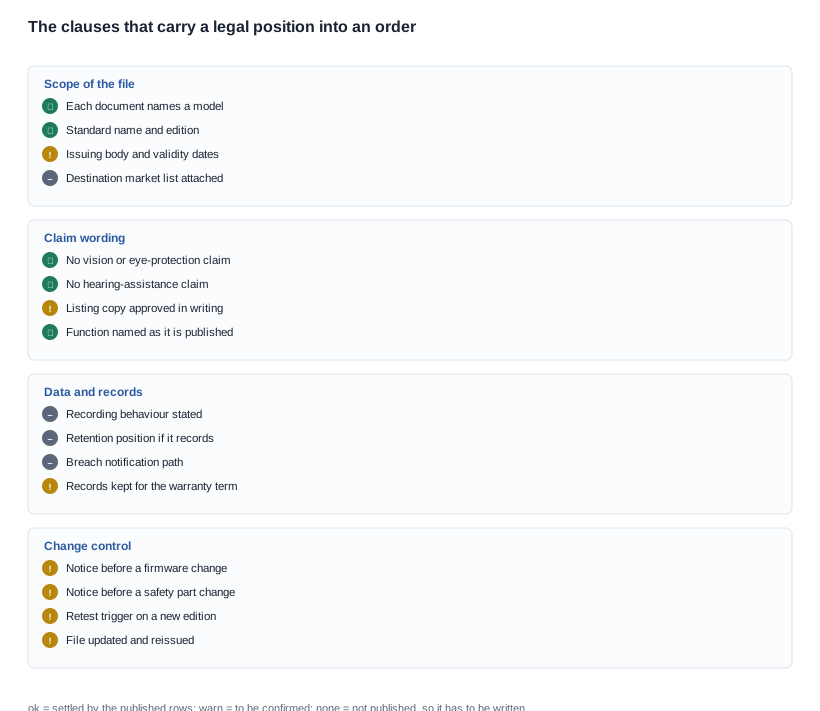
Clauses on the scope of the file. Each document names a specific model designation, with the standard name, the edition, the issuing body and the validity dates, and the destination market list is attached to the order rather than described in correspondence. Where the file covers one market and not another, that difference is written down, because a buyer who discovers it at customs has learned it at the worst possible price. Where a document covers a family rather than a model, the clause says which model designations are treated as covered and who confirmed it; that sentence is the entire defence, and it has to be written before the shipment.
Clauses on the claim. The listing wording is approved in writing before the artwork goes to print, and the approval is tied to the artwork version rather than to a general agreement. The no-vision and no-hearing-assistance boundaries are stated in the order as a positive obligation, not merely implied by silence, and the supplier is obliged to notify the buyer before any listing copy, packaging artwork or sales material changes. A clause that only restates the law is worth less than a clause that requires notice before a change, because the notice clause is the one that acts before the problem exists.
Clauses on data and records. Where the device records, the recording behaviour, the storage position and the retention period have to be stated in writing and agreed, and the breach-notification path has to name who tells whom within what window. Where it does not record, the absence has to be stated as well, because the school will otherwise assume the device is recording and will restrict its use. Records retention is worth specifying against the warranty term rather than in general terms, because the two periods rarely coincide and the gap is where a return is refused on the grounds of missing paperwork.
Clauses on change control. This is the clause group that decides whether the file stays valid. Notice before a firmware change, notice before a change of a safety-relevant component or a component supplier, a defined trigger for retesting when a standard's edition changes, and an obligation to reissue the documentation pack. The firmware clause matters more in this tier than in an adult line, because the published detection functions on the A05 and the A06 are firmware behaviour, and a change to the default threshold changes the product the school approved. The clause language is set out at contract terms, and the due-diligence pattern for a supplier's file is at factory audit.

How the file is assembled when the supplier's answer is partial
Most suppliers in this category will answer the first two questions and go quiet on the third. The chain below is designed for that, and every step has a completion condition that can be checked by someone who did not attend the meeting.

Step one is naming the model. The catalogue publishes the A05, the A06 and the A07 as three separate models, and the A05 and the A06 publish identical electrical rows, which makes them easy to conflate and dangerous to conflate in a document. The designation string on the unit, the string in the document and the string in the purchase order have to be identical, character for character, and the check at receipt is physical rather than documentary: read the marking on the unit against the order.
Step two is the classification. Establish, per destination market, which frameworks apply to a product of this type sold for use by children. The answer determines the size of the pack and the elapsed time, and it is the step most often skipped because it feels like a formality until it turns out to be the reason a launch is three months late.
Step three is the request, in list form. Standard name, edition, certificate number, issuing body, validity dates, per model and per market. A supplier who answers in this format has a documentation habit. A supplier who answers with a PDF whose product field says "smart glasses" is telling you the file does not exist yet, and the useful response to that is not a second request but a smaller order — one model, one market, one file — so that the programme can start on the part that is documented.
Step four is the register lookup. A certificate number is only worth something because somebody can look it up in the issuing body's public register and find the model designation, the standard and the date. A number that cannot be found is not a certificate, and this step takes minutes. It is also the step that catches a certificate that belongs to a different product in the same family, which is the single most common defect in a real file.
Step five is the claim sentence. Write the one approved sentence, in plain words, that describes what the device does. For the two models with published detection functions, that sentence names the detection and the reminder and stops there. It is signed off by the person who owns the listing and by the person who will answer a school's legal team, because those two people are usually different and because their disagreement is what causes the drift described earlier.
Step six is writing it into the order. Criteria attached to a payment milestone and to an acceptance inspection become enforceable. The same criteria in a presentation become a memory. The practical form is short: the acceptance criteria from the pilot, the days and the pass conditions, the file references attached as an annex, and the lot-level obligation that a document failing to name the model is a non-conforming delivery rather than a paperwork query.
When the chain cannot be completed. Sometimes the supplier has no per-model certification file, and the honest response is not to proceed as if the file exists. Two options remain: narrow the programme to the model and market where the file does exist, or commission the test yourself and build the file in your own name. The second option is expensive and slow, and it is the right one for a brand that intends to stay in the children's segment. The children's product compliance record keeping page covers how the file has to be maintained once it exists, which is a different and easier problem than creating it.
What we will and will not state about the legal position
The boundary we hold: the published rows are enough to start a programme and not enough to close it, and we would rather a buyer knows exactly which documents we hold than discovers the gap in a review.
What we publish for this tier: the cell capacities of 40 mAh on the A05 and the A06 and 70 mAh on the A07, a charge time of two hours or less, a rated use of about twenty hours, a magnetic charging interface, Bluetooth V5.4 on the A07, and the published functions on the A05 and the A06 — a lens-based electronic fogging arrangement and posture and viewing-distance detection, named without parameters. What we do not publish, and will not estimate on a buyer's behalf: the detection thresholds, the delays, the false-positive rate, the alert format, the frame weight, the frame dimensions, the ingress marking, the lens material, the certification status per model, and the radio version for the A05 and the A06. We will also not state that any model in our range is certified to CE, FCC, RoHS or any other regime, because the catalogue text contains no such reference and no per-model certification row exists. And we make no vision, health, eye-protection or hearing claim for any product in any market; a device that detects a position and reminds is not a clinical device, and if a channel's proposition depends on those outcomes, this is the wrong category.
What we will do is tell you which of the seven documents above our published rows already answer, which have to come from the supplier, and which have to be created by your own test. Send us the models, the destination markets and the customer type — a parent, a school, a district or a retail programme — and we will say which regime applies to which of them, what the published rows cover, and which questions have to be settled in writing before a purchase order.
What to send this week. Send the model list and the market list, and ask for the file per model rather than per family: standard name, edition, certificate number, issuing body, validity dates. Send the approved claim sentence and ask whether the supplier's listing and artwork copy can carry it without change, because a supplier who objects to the sentence is telling you something about the product. And ask for the battery transport documentation for the configuration you intend to ship, since that file follows the cell rather than the market and is the one most often left until the freight is booked. The compliance entry point lists the frameworks we work to, the child product page covers the children's regime, and the school requirements for kids smart glasses article sets out the institutional side.


