

Smart glasses for office is a workplace decision with a social variable in it, and the variable is not the wearer. In an open-plan floor the person who decides whether the device was a good purchase is the colleague one metre away who can hear it, and the person who decides whether it stays in the drawer is the employee who received it. Both of them are outside the procurement file. A buyer who specifies an office fleet on cell capacity and Bluetooth version alone will produce a programme that looks right on paper and quietly declines at month three, and the reason will not be in any datasheet.
Smart glasses for office: the colleague is the real reviewer
The commercial risk in an office programme is not a defective unit. It is a device that is technically fine and commercially dead, because the user took it off at the end of the first morning and never put it back on, and the only evidence is a return rate that arrives too late to diagnose and a renewal order that quietly shrinks.
Three parties sit behind that outcome, and only one of them signs the purchase order.
A brand owner is deciding which configurations enter a workplace channel at all, and what the listing is allowed to say about a product whose main output is audible in a shared room.
A procurement manager is deciding which published rows are sufficient to write a specification, and which require a supplier measurement before the order is placed.
A channel buyer is deciding how the product is positioned against the colleague's objection, which is the objection that closes the sale in this category.
What makes the office decision unusual is that the published rows are quite good, and they answer a question the buyer did not ask. Eight audio models publish a cell configuration, a charge time, a Bluetooth version, a rated runtime, a charging interface and a set of structural features. That is enough to write a procurement specification, plan a fleet rollout and cost a pilot. None of it touches the three things that decide whether the programme succeeds: how far the audio carries, what the microphone picks up in a call, and where the unit physically lives between uses.
The three published facts that change an office configuration
Three rows in the audio tier have consequences that are easy to miss and expensive to discover late.
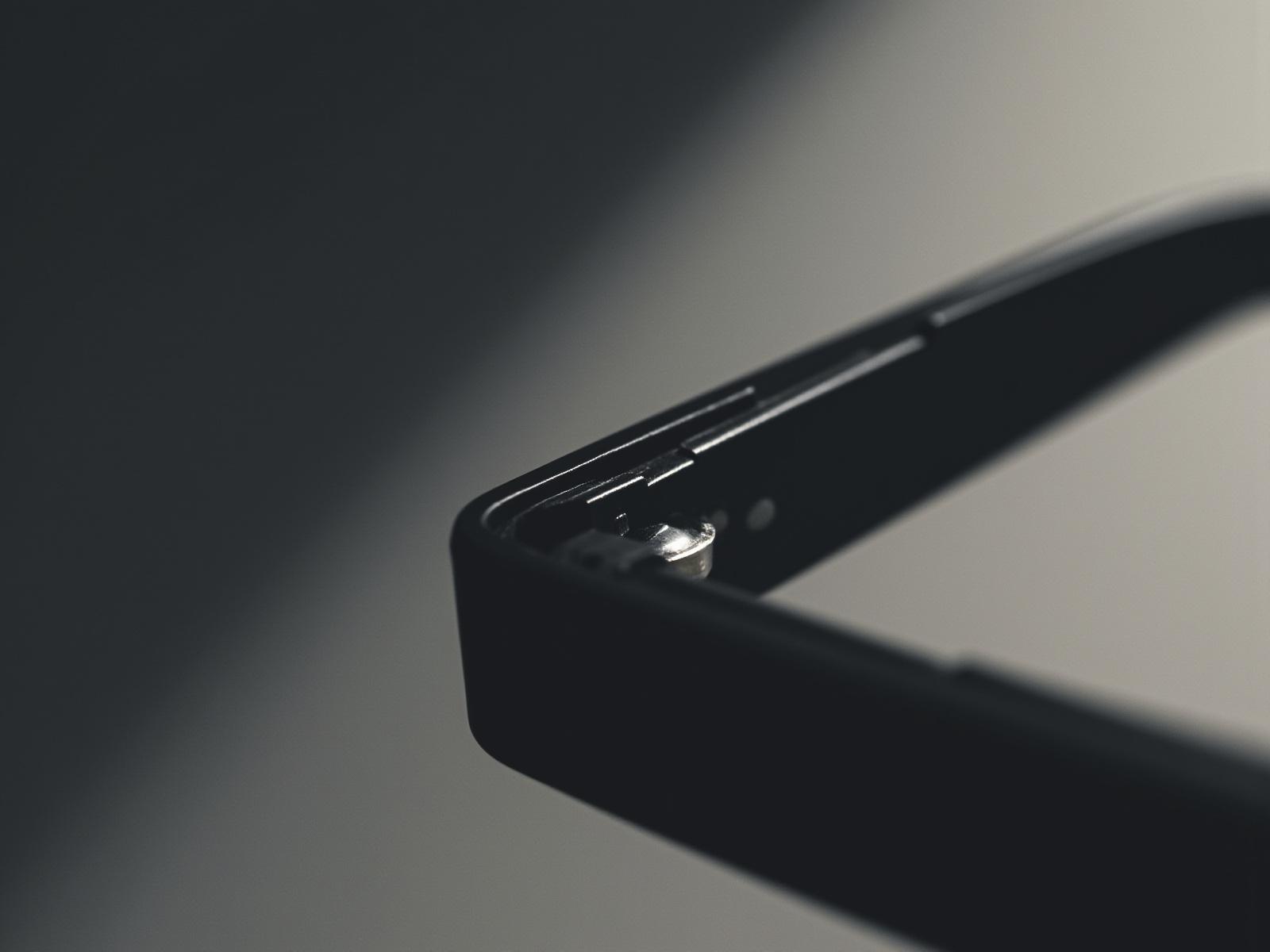
No audio model publishes a charging case. The eight audio models — the K02 and the K01, the YK12 and the G07, the LC-105-1 and the D12, and the LC-105-2 and the D11 — publish cell configurations, charge times, rated runtimes, charging interfaces and radio versions, and not one of them has a charging-case row in the catalogue. Cases appear in the catalogue on camera models, and on the camera tier they are a major part of the proposition; in the audio tier there is no case at all. An office programme therefore cannot be designed around a case as the desk solution. The device recharges directly, on a magnetic puck or on a Type-C cable, which means the charging point has to be designed into the furniture, the consumables and the stock process instead of being shipped in a box.
No model in the range publishes a touch row. The catalogue text carries no capacitive-touch entry for the K01 or for any other model, so a temple control surface is a question for the supplier rather than a line you can order from. A fleet specification that asks for touch as a family requirement will be quoted against every model in the tier, and the quote will be wrong. Touch belongs in the supplier questionnaire, not on the model designation table.
The radio version splits the tier. Bluetooth 5.3 is published on the K01 and the K02, and 5.4 on the YK12 and the LC-105-2, the G07 and the LC-105-1, and the D12 and the D11. The version is published; the pairing behaviour, the simultaneous-device limit and the radio coexistence behaviour in a dense office are not, and those are the questions a workplace buyer actually needs answered about a fleet of twenty units in a building full of Wi-Fi.
What the audio tier publishes, and the gap that decides a desk programme
The table below is the published position for the eight audio models. Everything in it is a catalogue row; everything a workplace buyer would want to know about the acoustic behaviour is absent from it.
The cell configurations cluster into four groups: the LC-105-2 and the G07, and the YK12 and the LC-105-1 — each at 55 mAh × 2; the D11 and the D12 at a single 100 mAh cell; the K01 and the K02 at 90 mAh × 2. The catalogue publishes the cells and the count, not a total, so a buyer comparing platforms should compare them as configurations rather than converting them into a single number.
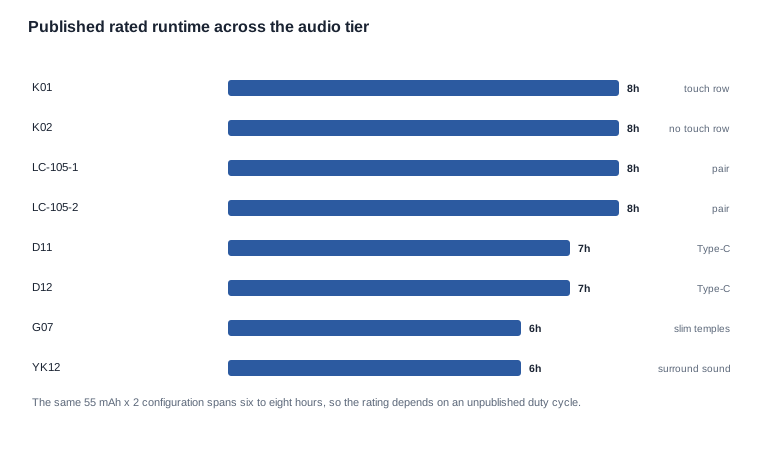
The rated runtimes sit between about six and about eight hours, and the spread is not random: the two models with the smallest published cell configuration, the G07 and the YK12, publish the shortest runtimes at about six hours, and they are the two models that carry the slim and detachable temple structures. The G07 publishes ultra-slim detachable temples; the YK12 publishes surround sound with a slim temple. The LC-105 pair, which shares the 55 mAh × 2 configuration with them, publishes about eight hours. So the same cell configuration produces a two-hour difference between models, which tells a buyer that the published runtime reflects a duty-cycle assumption the catalogue does not state, and that the runtime cannot be transferred between models.
The structural rows matter for a workplace for reasons that are not cosmetic. A detachable temple is a size-range mechanism: it lets one SKU cover a workforce with a wider range of head sizes, which is a supply-chain decision rather than a design one, because it reduces the number of variants the buyer has to hold. Surround sound is a published row on the D11 and on the YK12, and a feature name with no measurement attached is still a claim the buyer has to either qualify or leave out of the listing.
What is not published for any of the eight
No leakage figure at any distance. No microphone specification, no pickup characteristic and no speech-to-noise ratio. No speaker sensitivity, no frequency response, no active noise cancellation figure. No frame weight — the only published weight anywhere in the catalogue is 158 grams for the MT6 camera glasses body, excluding its foldable case, and it belongs to a different tier entirely. No runtime test condition, no charge time start state and no charge time end point. No per-model certification row, and the catalogue contains no CE, no FCC and no RoHS text anywhere, so every conformity question in this tier is a supplier document request.
The absence of the runtime condition is the quiet one. A rated runtime in this range is an intermittent-duty figure; an office day with three hours of calls and four hours of intermittent playback is a different workload, and the buyer cannot convert the published number into a shift plan without the condition behind it. That is a request, not a complaint.

Three costs an office buyer has to model outside the datasheet
The costs below are not in the catalogue and they are not in a supplier's specification either. They are the ones a buyer has to construct themselves, and constructing them badly is how an office programme fails without anyone being able to say why.
The cost of being audible to a colleague
Open-ear audio is not private, and no audio model in this range publishes a leakage figure that would let a buyer state how far it carries. That leaves the buyer with a measurement to make and a claim to decide.
The measurement is simple: two sample units, a fixed distance, a fixed level, a quiet room and a busy room, and a written protocol, because a leakage figure without a distance and a level is not a figure. The colleague's ear position matters more than the device's specification, so the protocol has to fix it — at a desk, roughly a metre, with the colleague seated as they would be in the office.
The claim is the harder half. A workplace listing cannot say "private" or "discreet", because neither is established by anything the catalogue publishes. It can say what the device is — an open-ear audio model with a published radio version, a published cell configuration and a published runtime — and let the buyer qualify the acoustic behaviour. The related question is at will others hear my music, and the honest answer for an office channel is that the acoustic characterisation has to be measured and the claim has to be limited to what the measurement supports.
The cost of a device with no case
This is the cost that is specific to the audio tier and it is invisible in the datasheet. With no published charging case, an office fleet has no per-user storage and no per-user charging dock in the box, so every unit in the building depends on the furniture. A magnetic model needs a charging position on every desk it will be used from. A Type-C model needs a cable, and the Type-C models — the D11 and the D12 — have the advantage that the cable is already in the building.
That turns into three cost lines the buyer has to raise: the charging accessories, which are a separate order with their own minimum order quantity; the charging point density, which is a facilities question rather than a product question; and the loss rate, which in a shared-office fleet is frequently the largest single cost in the programme and is entirely absent from every published row.
The loss rate is worth modelling properly because it changes the order quantity. A pilot that runs for a month in one department produces a loss figure, and that figure is more valuable to the buyer than the runtime, because it sets the replacement rate and therefore the true cost per active user. It also determines the asset-tracking process, which in turn determines whether the returns data is usable.
The cost of a return signed by someone else
In a workplace programme the employer buys and the employee returns. The two are rarely the same person, and the consequence is a returns dataset that cannot be analysed, because the returned unit carries no record of who used it, which configuration it was or how long it was kept.
Two instructions fix most of it. The packaging carries the model designation and the asset tag, so a returned unit can be traced to a configuration. The return form asks for how long it was used and for the reason in the employee's words rather than in a menu, because a menu produces "other" and "other" is where the acoustic failures hide. A programme that separates the return data by model designation will find the model that does not work in the office within two returns; a programme that does not will find out at renewal.
Qualifying a fleet candidate before the bulk order
A workplace pilot is not a demonstration, and the difference is worth stating. A demonstration produces a supplier document; a pilot produces a buyer's criterion. Five things have to come out of a pilot with a written number attached, because each of them changes the order.
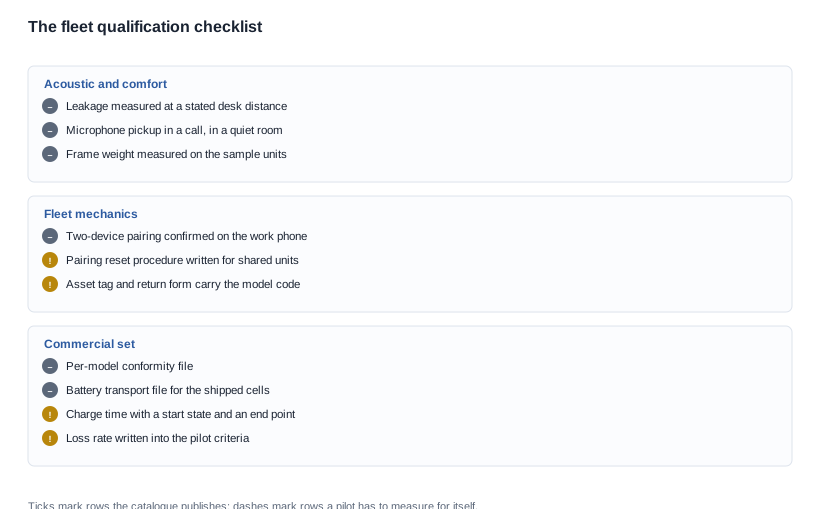
- The runtime under the real working pattern. Not the published rating, but the hours actually achieved on the actual call schedule, with the pattern written down: device count, volume, call hours, and whether the device is connected to a work phone, a personal phone or both.
- The leakage at a desk. A fixed distance, a fixed level, two rooms, two units, and a written protocol. The result is an observation with conditions attached, and it becomes the basis for the listing's acoustic wording.
- The two-device pairing behaviour. Whether the device holds a work phone and a personal phone at the same time is a published-nowhere question that determines whether the device is usable at all for a working day, and whether it is the device that switches or the phone that switches.
- The point at which the user takes it off. A short, honest answer from the pilot group is more useful than a positive review, because it identifies whether the constraint is acoustic, physical or situational.
- The loss rate and the return rate, by model designation. The two figures that the returns data will otherwise never produce.
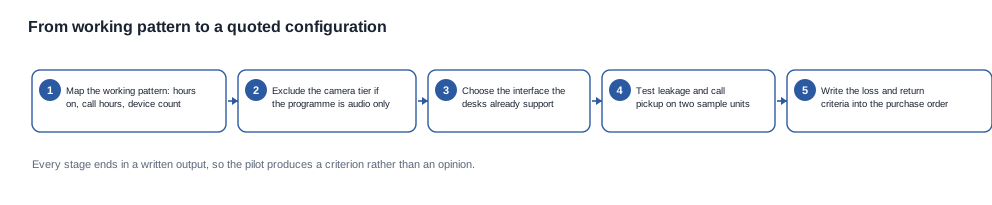
The documents to request before a deposit are the runtime with its condition per model, the leakage measurement with its method, the pairing and reset procedure, the model designation table, the per-model conformity file, the battery transport file covering the cells actually shipped, and the agreed incoming inspection criteria. The compliance route is at certification checklist, the sample stage is at samples, the battery requirement is at battery transport, the clause language is at contract terms, and the commercial structure of a first order is at pricing. The test procedure is at how to test smart glasses for office, and the product range is at Bluetooth audio glasses.
A first enquiry that carries four questions will produce most of that list on its own. Which model designations are being quoted, and what each of those published rows lists. Which interface will the fleet be charged from, and where do the charging points sit. Does the configuration include a charging case, and if not, what replaces it on the desk. What happens to a unit that is lost, and how is that cost carried in the agreement.
The red flags in this segment are recoverable if they are caught before the bulk order. A quotation that describes a case in the box for an audio model that has no case row. A specification that asks for touch as a family requirement when no model publishes a touch row. A pilot run without a written protocol, which produces a comparison of two setups rather than two products. A returns process that does not capture the model designation, which ends the analysis at month twelve instead of month two.
The commercial structure of an office and workplace programme
Workplace programmes are bought in volume and used individually, which puts the commercial argument in an unusual place: the unit price is negotiated over a large quantity, but the margin is decided by the loss rate, the return rate and the acoustic complaint rate, none of which appear on a quotation.
Charging accessories are a separate order and should be quoted as one. The magnetic models need a charging position per desk and the Type-C models need a cable, and both are consumable or accessory lines with their own minimum order quantity and their own lead time. Quoting them inside the unit price hides the fact that the accessory cost is a real per-user cost and makes the loss-rate economics impossible to model.
The interface is worth more than a price reduction. Type-C on the D11 and the D12 removes a cable from the customer's facilities budget and removes a support category from the programme. In a fleet that runs to hundreds of units, that is worth more than a percentage point on unit price.
Minimum order quantity and variant count pull in opposite directions. A workplace programme wants one configuration for swapability, while a retail channel wants a ladder. A buyer who negotiates the single fleet configuration and keeps the retail ladder on the same platform gets both, and the artwork question — whether the fleet unit and the retail unit can share a packaging shell — is worth more than the unit price conversation because it decides the number of stock-keeping units the channel manages.
The returns reserve is the line most often missing. In a workplace programme the reserve has to cover both the returned unit and the replacement unit, because an employee who cannot be reissued quickly stops using the device rather than waiting. Quoting the reserve as an explicit percentage of unit price, with a stated replacement lead time, is a normal request.
Tooling and certification are quoted apart. Tooling is amortised across the first order; certification cost and lead time are governed by the schedule and by whoever runs the test. The two are frequently bundled into one line that hides which is which, and a buyer who cannot see the split cannot model the break-even volume against the pilot.
Stated plainly: we publish the Bluetooth version, the cell configuration, the charging interface, the rated runtime, the charge time and the structural feature rows exactly as the catalogue states them, and we publish the absence of a leakage figure, a microphone specification, a runtime test condition, a frame weight and a per-model certification with the same prominence. We will not rank two of our own models on an acoustic characteristic nobody has measured, and we will tell you when two models are effectively the same platform, which in this tier they frequently are.
What we will do is take the working pattern, the fleet size, the desk environment, the channel and the price band, and narrow the range to the two or three models that fit, state which published rows cover them, and list the measurements and documents to obtain before the bulk order. The scenario entry point is smart glasses for office.
What to send us. Send the working pattern, the number of devices, the desk environment, the channel and the price band, and we will return the shortlist, the published rows behind it, and the pilot criteria to write into the purchase order.
Related reading
- How to enter the scenario — smart glasses for office
- The range covered — Bluetooth audio glasses
- The privacy question — will others hear my music
- The test procedure — how to test smart glasses for office
Tell us the working pattern and the fleet size, and we will narrow the range to the models that fit and the pilot criteria that settle it.


