
Smart glasses microphone quality: the chamber matters, not the component
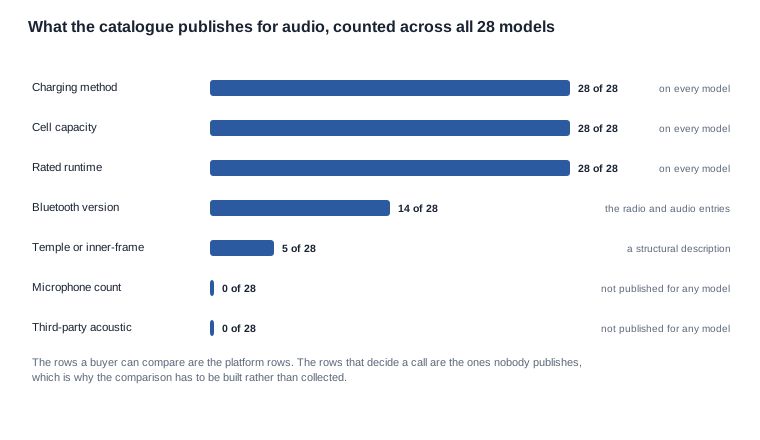
Choosing between two smart glasses on microphone quality is decided on the wrong basis more often than not, because the published data in this category contains no microphone figure for any model. The published position across our range is that the audio is described as open-ear acoustic structure, directional audio and intelligent noise reduction, and that no third-party measurement supports any of it.
That leaves two honest routes: compare the architecture, then verify on samples, or accept a feature name and hope. Everything between those two is guesswork presented as a comparison, and the failure it produces does not appear until the product is in a customer's hand.
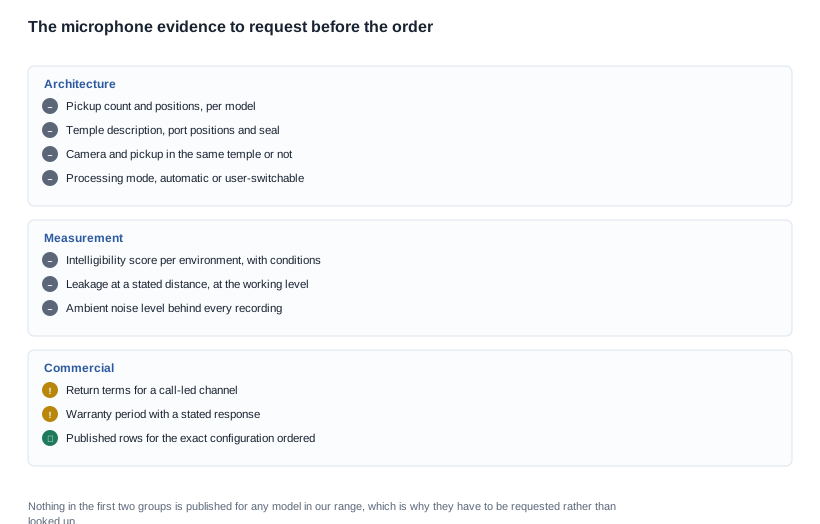
The decisive point is this. A microphone is a component; the pickup is a property of the temple it sits in. Two products with identical electronics and different temple geometry can behave differently enough that the second one cannot be sold on the same claim as the first, and no spec sheet will tell you which is which. So the questions to ask are architectural, they cost one email, and they are answerable before a sample is ordered. This page sets out the four architecture questions, the four measurements that follow from them, and the commercial position a call-led line actually depends on.
The buyer signing a call-led line, and the risk they carry
The three roles that arrive at this comparison
A procurement manager is comparing two candidates for a channel whose proposition is a call — field service, logistics dispatch, translation support, a meeting-heavy business buyer — and there is no published row on which to compare them. Their deadline is a purchase order, and their exposure is the return rate on a product whose only function is to be used in the worst acoustic conditions available.
A product manager is deciding whether the voice feature can carry the proposition at all, and the microphone is the row that decides it. If the microphone fails, the product is an audio product with a camera attached, which is a different product with a different price band and a different listing.
A channel buyer is writing the copy and needs to know what may be claimed about call quality. This role arrives late and discovers that the claim boundary was never set, and a listing that says clear calls is a claim the brand has to defend.
The specific fear shared by all three is a call quality surprise in the first week of a listing, because the test that reveals it happens in an environment the brand does not control: a customer in a vehicle, a customer on a street, a customer in a warehouse. A quiet-room comparison cannot predict any of them, and the gap between the two is where the returns live.
Why a call-led line costs more than an audio line
Microphone quality is not a feature cost; it is a structure cost, and the structure is decided before the electronics are chosen. The temple has to carry a pickup, an isolation path, a processing path, and, on camera platforms, a camera module with its own power and its own thermal output, inside a moulding with a wall thickness chosen for comfort and mass.
Three consequences follow, and each of them shows up in a different part of the commercial conversation.
The first is that the pickup position is constrained by the frame. A pickup that sits far from the mouth produces a weaker, more reverberant signal, and the only way to move it is to change the temple geometry — which is a tooling change, not a component substitution. The second is that a camera and a pickup sharing a temple share an acoustic and an electromagnetic environment, and the interaction is described in no supplier material. The third is that the processing that recovers intelligibility consumes power, which moves the runtime figure, which moves the price of the battery, which moves the unit cost. A microphone decision is therefore a battery decision and a tooling decision before it is an audio decision.
That is also where the negotiating room is. The unit price of a call-led product is largely set by the chamber, and the chamber is set by decisions the brand makes about positioning, colourways and configuration count. A supplier who will change the temple, the pickup position or the processing mode is telling you the product is not fixed, and no commercial term changes that. A supplier who will not is telling you the opposite, and the programme should be built around the fact rather than against it.
Four architecture questions that decide the microphone outcome
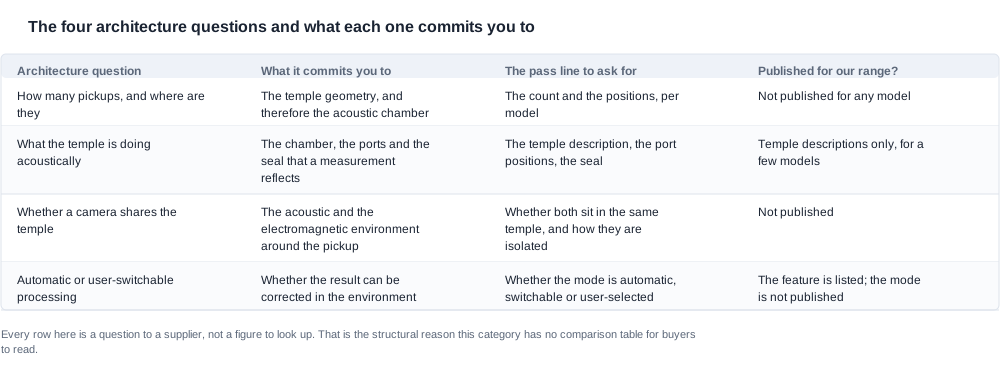
Question one: how many pickups, and where are they
Ask for the count and the positions per model, not a description of an array. A single pickup with processing and a positioned array are different products, and the difference is a hardware fact that is verifiable without a laboratory and without a supplier's cooperation.
This is the question with the largest commercial consequence, because the pickup count and position constrain the temple geometry, and the temple geometry is the acoustic chamber. A supplier who answers with a number and a location has given you something you can compare. A supplier who answers with the word directional has given you a marketing category that covers several entirely different implementations.
Ask the question the same way to every candidate, and write the answers into the comparison table in the same order. The purpose is not to pick a winner on the number; it is to establish which candidates are even comparable, because a two-pickup candidate and a single-pickup candidate are not competing on the same axis and a price comparison between them is meaningless.
Question two: what the temple is doing acoustically
The chamber geometry, the port positions, the seal, and the way the frame meets the head. These are the things a measurement actually reflects, and they are the least published rows in the category.
Our range shows the variation. The G07 publishes a slim and detachable temple. The YK12 publishes a slim temple with a surround sound configuration. The V03 Pro publishes flexible temples. The V06 and the S7 publish a removable inner frame. The LC-105-1 and the LC-105-2 publish no temple description at all. That is the entire published evidence base for how the chamber is built, and it is why the temple is the row that decides the result.
The practical consequence for a buyer is that a temple description is a partial specification. A detachable temple implies a contact interface, and a contact interface implies a variable. A flexible temple implies a stiffness that changes with temperature and time, and a stiffness that changes is a fit variable. Neither of those is an audio specification, and both of them sit upstream of the audio result.
Question three: whether a camera shares the temple
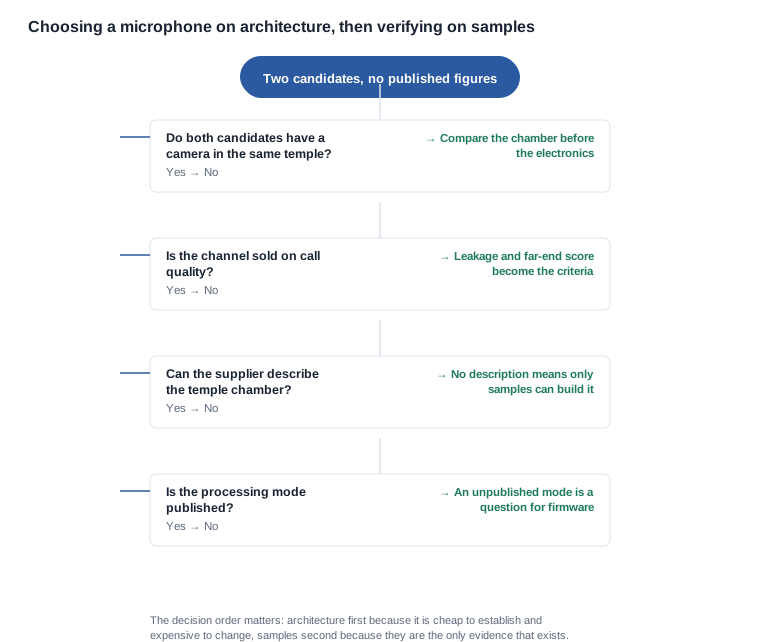
Ask whether the camera module and the pickup sit in the same temple, and how they are isolated from each other. For a product sold on calls, this is a question rather than a comparison row, because nothing in the published material describes the interaction.
Why it matters commercially: on camera platforms the acoustic environment inside the temple is crowded with a cooling path and an image sensor, and the processing that works on a clean audio platform may behave differently when the chamber is shared. A call-led product should be compared against another call-led product, and a call-led product compared against an audio-only product is being judged on a different axis.
Note also that eleven of the twenty-eight models in our catalogue are camera platforms. The proportion matters for any buyer choosing a tier: a call-led line built on an audio platform and a call-led line built on a camera platform are different sourcing exercises, and the second one has a much smaller published evidence base.
Question four: automatic or user-switchable processing
Ask whether the noise processing mode is automatic, switchable, or user-selectable, and whether the mode can be changed by the end user or only by firmware. Intelligent noise reduction is listed across our range; the mode is not published for any model.
This is the cheapest of the four questions and the most informative answer. Manual control in a product sold for sport suggests the automatic mode was not sufficient for that use, and a product sold for a noisy workplace with no user control suggests the same. Either answer is useful, and the buyer who does not ask gets nothing.

How to run the four measurements that separate two candidates
Architecture tells you what you are comparing. Only measurement tells you which one is better, and the measurement has to be built before the samples arrive, because the protocol is what makes two results comparable.
- The scripted call, in your own environment. A fixed sentence at a fixed distance, recorded, judged by the same person, repeated across units. The environment is the variable that matters and the script is what makes the result repeatable. If the product is sold into a warehouse, a vehicle interior or a street, the quiet room is not a substitute for the warehouse, it is a different test.
- The noise floor. The same script against a defined background condition, with the background level written down. This is the measurement that finds where the signal-to-noise ratio breaks down, rather than only whether the call succeeded. A call that succeeds in a quiet room and fails in a car is not a marginal result; it is a result, and it is the one your customer will produce.
- The leakage measurement. A fixed distance in a quiet room, measured at the listener's position. Leakage is the most common returns driver in this category and it appears on no specification sheet. It decides whether the product can be used in a shared space, which for a call-led business product is often the whole proposition.
- The movement case. The same script, with the person walking, turning their head and going up stairs. Whether what the far end hears changes with movement is a fit question rather than a microphone question, and it is a question that the far end's scoring will expose even when the near end cannot hear the difference.
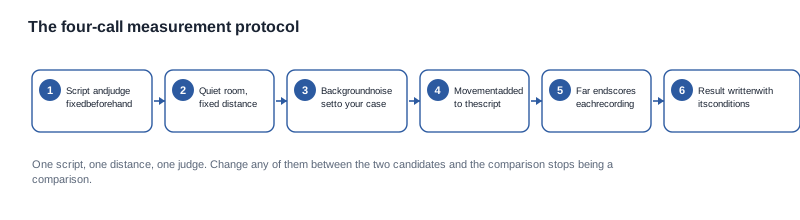
Two units of each candidate, not one. A single unit cannot separate a product difference from a unit difference, and a unit difference is what a returns curve is made of. Record the conditions with every result: the distance, the background, the movement, the person, the date. A result without its conditions is an anecdote.
The result that matters is the far end's judgement, not the near end's. A five-point intelligibility score, repeated across two environments and two products, is a defensible comparison and one that survives a commercial dispute. Volume is not the outcome; a product that reproduces a voice loudly and unintelligibly is a worse product than one that reproduces it quietly and clearly, and no specification row in this category can tell you which you have.
The hidden cost of a microphone choice, and who pays it
Five ways a microphone decision is made wrongly
Two candidates were compared on feature names. Symptom: the chosen product's call quality surprises the customer in the first week of a listing. Root cause: directional audio and spatial audio were read as microphone rows. Prevention: compare the architecture first, then measure.
The quiet-room result was published as the field result. Symptom: a customer in noise finds the calls unusable, and the listing says nothing that promised it would work there. Root cause: the test was run where the product was not going to be used. Prevention: build the target environment into the protocol before the samples arrive, and require the test to be repeated in it.
The temple was ignored. Symptom: two products with the same electronics behave differently in a call, and nobody can explain the difference from the specification set. Root cause: the chamber was never compared. Prevention: ask for the temple description, and measure leakage on both.
The camera's presence was ignored. Symptom: a call-led camera product performs worse than an audio-only product carrying the same claim. Root cause: the shared temple environment was never considered. Prevention: ask which temple each sits in, and evaluate the camera product on its own merits rather than by transfer from an audio platform.
The processing mode was assumed to be automatic. Symptom: a person in a noisy environment cannot adjust the result, and reports the product as faulty. Root cause: the mode was never established. Prevention: ask the question, and put the answer in the documentation and the support script so the field team is not guessing either.
There is a sixth pattern, commercial rather than technical, and it is the one that damages a programme fastest. The return terms were left to the end. A call-led product's return rate is the direct output of the microphone, and the return terms decide who carries it. Agreeing them after the first large return wave means negotiating from the worse position, with data that the supplier has already seen.
The terms that carry a defensible audio position
Where this tier gives way, and what stays fixed
A microphone tier is bought on evidence, so the commercial terms that carry the most weight are the ones that let you buy evidence cheaply before you commit volume. The lines worth negotiating time on in this tier are:
- Unit price and volume tiers.
- The accessory set with its own minimum order quantities.
- Packaging specification, including the market labels and the language of the documentation pack.
- Delivery splitting against a sample-approval milestone, which is often granted more easily than a price concession because it moves the approval risk onto the schedule where it belongs.
- Payment node structure — a deposit at order placement, a balance triggered by the inspection pass, and a holdback against the document package.
- The warranty period with a stated response time, which matters more in this tier than in most because the failure is invisible to the end user until they make a call.
- The return terms for a call-led channel, which are the line that moves most here.
- The terms of a pilot order, which is the cheapest way to buy evidence.
Two cost lines in this tier can only be quoted, never negotiated. Certification cost and lead time are set by the process and by the testing body that runs it, so they move with the schedule rather than with your order size. Tooling is normally amortised across the first order and quoted as a separate line rather than folded into the unit price — ask which one you are being quoted, because the two are frequently bundled into a single line that hides which is which. Below both of them sits the acoustic engineering itself: a supplier who will not change the pickup position, the temple geometry or the processing tuning is telling you the product is fixed, and no commercial term changes it.
The agreement is where the acoustic configuration stops being a conversation and becomes a commitment. Write into it the published rows for the configuration ordered, the pickup count and positions, the temple description and the chamber configuration, whether the camera module and the pickup share a temple and the isolation method if they do, the processing mode and whether the end user can change it, the intelligibility result per environment with its condition attached, the leakage figure with its distance and level, the warranty period with a stated response, and the return terms.
Equally important is what the agreement should leave out: any call-quality, noise-cancelling or intelligibility claim that has not been measured on a sample in the environment the product is sold into, and any acoustic figure that is not published for the model.
A worked example: a field-service brand qualifying a call-led line
Read what follows as a worked example of how the checks are ordered. It is constructed to make the sequence visible, and it does not record a real order.
Assume a mid-size European field-service brand that installs and maintains industrial equipment. Its technicians work in plant rooms, on scaffolding and in plant yards, and its proposition is a headset-free hands-free line to a dispatcher. Two supplier samples are on the table, and the brand has a target price band and a market list of three countries.
Step one, the environment. The brand writes down the exposure before it looks at either sample: plant machinery, a reflective concrete room, wind, and a radio dispatch channel the technician must be able to hear at the same time. That is a harder case than a quiet office, and it establishes the noise floor the test has to reproduce.
Step two, the architecture. Both suppliers receive the same four questions. The first reports two pickups with positions, a published temple description, and a user-switchable processing mode. The second reports a single pickup, no temple description, and an automatic mode with no user control. Neither answer is good or bad yet, but the first candidate can be compared with another call-led product and the second cannot, which is already a structural difference in how much the comparison will cost to run.
Step three, the camera question. The first candidate has a camera in the same temple as the pickup. The brand now knows that the shared chamber is a variable, and it writes the shared-temple case into the measurement protocol as its own condition rather than averaging it away.
Step four, the measurement. Two units of each candidate, one scripted call in a quiet room, one against a recorded plant-machinery background, one with the person walking, and one leakage measurement at a stated distance. The far-end scorer records a five-point score for each recording, and every result is written down with its conditions before anyone discusses it.
Step five, the result. The first candidate scores materially better in the plant background but leaks more at the measured distance. That is a real trade-off, and it is a channel decision rather than a product defect: the brand's technicians work in a plant where leakage reaches a colleague, and the brand decides that intelligibility wins, while writing the leakage position into the training material for the technicians who share a vehicle.
Step six, the commercial structure. The brand negotiates the return terms before the first large order, on the strength of the intelligibility data rather than after the first return wave. It takes a pilot order at the smaller tier, and holds a retention against the documentation package that names the exact model designation.
The decisive decisions were all made before the purchase order, and none of them was about a feature name. The trade-off the brand accepted was a deliberate one, recorded in a training document, which is a far better position than a product nobody asked about.
What we publish about microphones, and the boundary we keep
Here, the microphone question in this category is answered on architecture first and on samples second, and a buyer who asks the four architecture questions will choose better than one who compares feature names.
We will not publish a pickup count, a pickup distance, a frequency response, a leakage figure or an intelligibility result for a model where the manufacturer has not provided one, and we will not present a feature name as if it were a measurement. What we publish for audio across the catalogue is the charging method, the cell capacity, the rated runtime and the Bluetooth version for the relevant models, plus the structural descriptions where the catalogue states them: the G07's slim detachable temple, the YK12's slim temple, the V03 Pro's flexible temples, and the V06 and S7's removable inner frame. No third-party acoustic measurement supports the audio claims in our range, and we say so with the same prominence as the positive rows.
What we will do is give you the four questions, the four measurements and the boundary of what can be claimed. The input side of the chain is covered at noise control and microphone pickup, the rows to request are at microphone buying checklist, the vocabulary is at microphone glossary, and the models with their published rows are at Bluetooth audio glasses range.
The four requests to open this comparison
- Ask the four architecture questions in one request, per model. Pickup count and positions, temple description, camera and pickup in the same temple, and the processing mode. Same wording to every supplier.
- Run the four measurements on two units of each candidate. Same script, same distance, same judge, same background, and the conditions written down with every result.
- Test in the environment the product will be sold into. A quiet-room result does not predict a warehouse, a street or a vehicle interior.
- Put the intelligibility results, the leakage conditions and the return terms in the agreement. Those three together are what converts a microphone choice into something a brand can defend.
Related reading
- The input side of the chain — noise control and microphone pickup
- The rows to request — microphone buying checklist
- The vocabulary — microphone glossary
- The models and their published rows — Bluetooth audio glasses range
Tell us the channel, the environment and the models you are comparing, and we will tell you which rows are documented and which have to be measured.


