

A microphone buying checklist is a strange document, because the thing you are buying is not a microphone. It is a microphone system in a frame, worn on a head, in an environment, and the published specification for the component does not exist. You cannot buy a pickup distance, because nobody publishes one; you cannot compare rejection levels, because no supplier in this category publishes one. What you can buy, and what this checklist is for, is a set of decisions that are yours to make and a set of tests that will produce the numbers a data sheet would have carried.
So smart glasses microphone quality smart glasses buying checklist is a checklist of the questions and the tests, organised the way a procurement programme actually runs: what to establish before you compare anything, what to test on a sample, and what to settle commercially before the order is placed.
Smart glasses microphone quality: what a buying checklist is actually for
The published position across our range is that the microphone is described as open-ear acoustic structure, directional audio and intelligent noise reduction, alongside Bluetooth 5.3 and 5.4, cell configurations from 40 mAh up to 290 mAh, charge times of two hours or less on every entry, runtimes from roughly five to eight hours and roughly twenty hours on the children's models, and magnetic or Type-C charging.
What is published nowhere in the range is the number of microphones, the capsule type, the pickup pattern, the sensitivity, the frequency response, the pickup distance, the cancellation depth and the microphone model.
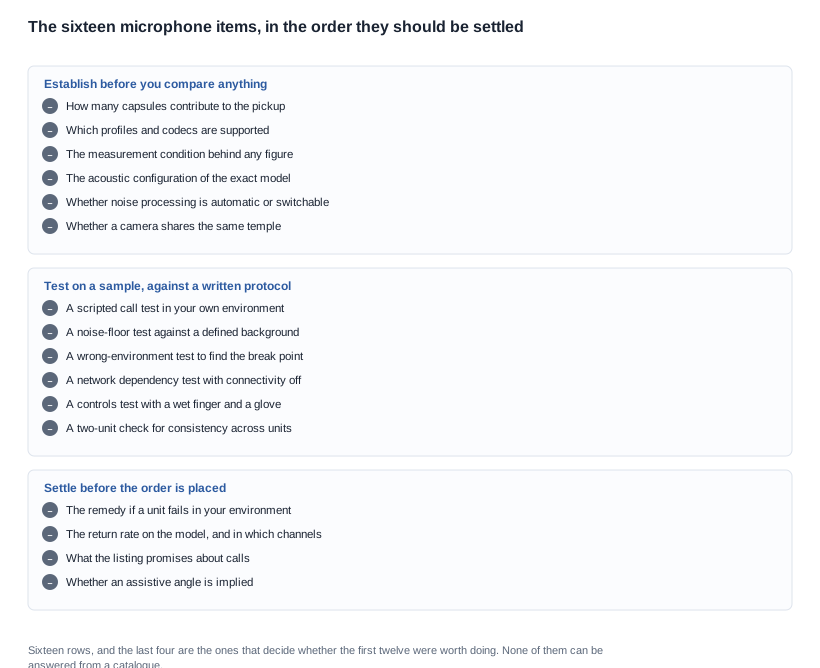
That gap is why a checklist is more useful than a comparison here. The sixteen items below are grouped by stage, and the grouping is deliberate: the first six cost nothing but a request, the next six cost a sample lot and some days, and the last four cost an argument you would otherwise have in month six.
The published position across our range, stated plainly
The audio tier is where most of the range sits, and the published rows are specific enough to be useful for configuration decisions even though the microphone rows are empty.
| Model | Bluetooth | Cell as published | Runtime | Charging | Published audio or temple note |
|---|---|---|---|---|---|
| K01 / K02 | V5.3 | 90mAh*2 | ~8 h | Magnetic | — |
| D11 / D12 | V5.4 | 100mAh | ~7 h | Type C | D11 lists surround sound |
| LC-105-1 / LC-105-2 | V5.4 | 55mAh*2 | ~8 h | Magnetic | — |
| G07 | V5.4 | 55mAh*2 | ~6 h | Magnetic | Ultra-slim, detachable temples |
| YK12 | V5.4 | 55mAh*2 | ~6 h | Magnetic | Surround Sound slim temple |
| YKC02 | V5.4 | 70mAh*2 | ~8 h | Magnetic | Sport glasses, long battery life |
Two things in that table matter commercially for a microphone programme. The first is that the 55mAh*2 group is not one row: the LC-105 pair publishes roughly eight hours while the G07 and the YK12 publish roughly six, and the two that publish the shorter figure are precisely the two with a slim or detachable temple. The second is that the cell figures above are the catalogue's own values, written as the cell count times the cell capacity rather than as a single total, and they should be quoted that way.
Elsewhere in the range, the camera models carry their own published runtime rows — the V03 and the V03 Pro at 5~8 h, the KY06 and the MT5 at 6~8 h, the CY03, CY05, L1 Pro, L2 Utral and MT6 at ~7 h, and the V06 and the S7 at 5~8 h — and the sport models D17 and ZH12 publish Type-C charging at roughly one hour with runtimes of ~7 h and ~8 h respectively. A bone-conduction entry publishes a 200 mAh cell, Type-C charging, ~7 h runtime and an amplification gain of 35 dB, with no model designation of its own.
The first six: what to establish before you compare anything
These six can be settled with a request and an answer, and settling them before the samples arrive is what makes the sample work efficient.
1. How many capsules contribute to the pickup, and where are they positioned? A hardware fact, verifiable without a laboratory, and the foundation of everything else. A single capsule with processing is a materially weaker proposition than an array, and the two are described with the same words in every listing you will read.
2. What profiles and codecs are supported, and which is negotiated by default? The microphone path in practice is determined by the profile, and the hands-free profile and the stereo profile behave differently. This is on no data sheet, and it is the single most common cause of a call that works with one handset and not another.
3. What is the measurement condition behind any figure that is quoted? Level, distance, orientation and the pass criterion. A number without a criterion is not a measurement, and a supplier who cannot supply all four has not measured. The related question, which saves a lot of time, is whether the figure was measured on the finished product or on a bare capsule.
4. What is the acoustic configuration of the exact model? Temple geometry, the speaker arrangement, and whether the temple is slim, detachable or fixed. Our range shows the spread: the G07 publishes a slim, detachable temple, the YK12 a slim temple with a surround-sound configuration, and the LC-105-1 and the LC-105-2 publish no temple claim at all. The temple determines the chamber the microphone sits in, so this is a specification and not a styling detail.
5. Is the noise processing automatic or user-switchable? A manual control in a product sold for sport tells you something about the automatic mode — most often that the automatic mode was not good enough on its own.
6. Does the product have a camera, and does the microphone coexist with it? A camera and a microphone in the same temple create a shared acoustic and electromagnetic environment, and the interaction is not described in any data sheet. Eleven of the twenty-eight models in our range carry a camera, so this is not a corner case.
Why the acoustic configuration is a specification and not a detail
The temple is the acoustic enclosure for a wearable microphone. Its width, its length, whether it is detachable and where the capsule sits relative to the front of the frame all change the direct-to-reverberant ratio of the pickup. Two products with identical published electronics can behave differently because one of them has a wider temple, and the published rows will not show it.
This is also why the detachable and slim temples in our range are worth reading as engineering rows rather than as form factors. The G07's ultra-slim detachable temple and the YK12's slim temple are the two entries in the 55mAh*2 group that publish the shorter runtime, around six hours rather than the roughly eight hours of the LC-105 pair — which is a reminder that a slim temple is a design decision with a power budget attached.
The next six: what to test on a sample
A protocol written before the samples arrive turns the next six items from opinions into measurements.
7. The scripted call test, in your environment. A fixed sentence at a fixed distance, judged by the same person, recorded in each environment that matters to you. The script matters: it has to be the same every time, or the results are not comparable.
8. The noise-floor test. The same script in a defined background condition, so you can see where the signal-to-noise ratio breaks down rather than only whether the call succeeded. "Succeeded" is a binary that hides the point where the product stopped being usable.
9. The wrong-environment test. Deliberately run the script in an environment you do not care about, to find the failure point. The break point is the only number worth having, because it tells you where the listing copy has to draw its line.
10. The network dependency test. With connectivity off, see what still works. This tells you more about the architecture than an hour of specification review, and it takes five minutes.
11. The controls test. A wet finger, a glove, at speed, in the dark. A temple control surface is a real interface with a real failure mode, and because the catalogue publishes no touch row for any model, whether a given build carries one is a question for the supplier rather than a published row; the remote shutter control on the D17 and the ZH12 is a durability decision rather than a feature.
12. The two-unit test. One unit tells you whether it works. Two units tell you whether it works consistently, which is the question a production order actually needs answered.
The two-unit check that answers the question a production order needs
Item twelve is the most important line on the list, and it is the one most often dropped because it costs one more unit.
A single unit that works proves very little, because a working unit and a broken unit are indistinguishable in a test that only tests one. Two units from the same lot tell you whether the fault is batch-wide — a design or firmware condition, where no unit is defective — or unit-specific, where one unit is defective. That distinction decides whether you replace a lot or a unit, and it is a distinction that cannot be recovered later from a returns pile.
Extend it across two batches and you have something more valuable: the ability to detect drift between production lots, which is the failure mode that reaches your channel quietly. The protocol for that is not expensive. It is the same scripted test, run on two units from each of two lots, with the results recorded against the lot reference.

The last four: the commercial questions
These four decide whether the first twelve were worth doing, and they are the ones that cannot be answered by a sample.
13. What is the remedy if a unit fails in your environment? A replacement policy that assumes calls happen in quiet rooms is not a policy for a product sold for calls. The remedy has to be written against the environments the product will actually be used in, and that has to happen before the listing is written, because the listing sets the expectation that the policy has to meet.
14. What is the return rate on this model, and in which channels? If a supplier has data on where their units are returned, that data is more valuable than any specification they could publish. Ask for the rate split by cause rather than the headline number, because the headline number usually aggregates a design limit with a hardware defect and tells you nothing about either.
15. What does the product's proposition promise about calls? Open-ear audio is not a private listening experience and it leaks. A listing that implies otherwise generates returns that have nothing to do with the microphone, and those returns are the most expensive to argue with because they are a copy problem wearing the costume of a product problem.
16. Is there a medical or assistive-listening angle in the marketing? If a product with amplification is being positioned as assistive, that is a regulatory question before it is a marketing one, and it should be settled early rather than at the listing review. Our range contains a bone-conduction entry with a published amplification gain of 35 dB and no model designation, and any positioning around it needs advice before artwork is approved.
The commercial terms the checklist has to feed into
A checklist produces evidence, and evidence has to land somewhere. Four commercial lines take the output directly, and each of them is usually negotiated before the test programme finishes — which is why the test programme has to be scheduled early enough to influence the quotation rather than merely to audit it.
The minimum order quantity and the per-configuration minimum. The audio tier in our range spans several distinct configurations, and a configuration that carries a different temple, a different cell or a different charging interface is a configuration with its own minimum. A microphone requirement that adds a configuration adds an MOQ, and the negotiation is over the combination count rather than the unit count.
The tooling and the sample cost. Where a microphone requirement implies a different temple geometry, that is a tooling question and it belongs in the quotation rather than in a follow-up negotiation. Ask for the sample cost and the freight terms as separate lines, because a supplier who credits the sample against the order has told you something about how the relationship will run.
The lead time for a configuration change. Changing the temple, the cell or the charging interface moves the production date, and the production date is usually derived from the last of the document dependencies rather than from the factory schedule. Ask for the date the units will be built rather than the date they will ship.
The warranty and the defect rate. The checklist's output is what a defect claim will be argued from, so the warranty should be written against the criteria the checklist produced — the scripted call, the silence recording, the wind exposure — rather than against a general durability statement. A defect rate expressed against a named criterion is enforceable; a defect rate expressed against "the product performs as described" is not.
The return-rate question worth more than any specification
Item fourteen deserves an explanation, because suppliers are not always able to answer it and it is the most valuable thing on the list.
The useful answer is not "two per cent". The useful answer is a rate split by cause: a cluster of units returned because the customer could not hear them in a car, a smaller cluster returned because the charging contact failed, and a handful returned because the unit stopped working after a firmware update. With that split, a buyer can make three different decisions — adjust the copy, raise a defect claim, or fix a rollout. With the headline number, there is one decision, and it is usually to negotiate a discount.
Ask for the split and for the channel it came from. A rate that is concentrated in one channel is a market-fit problem, and a rate spread evenly across channels is usually a design limit.

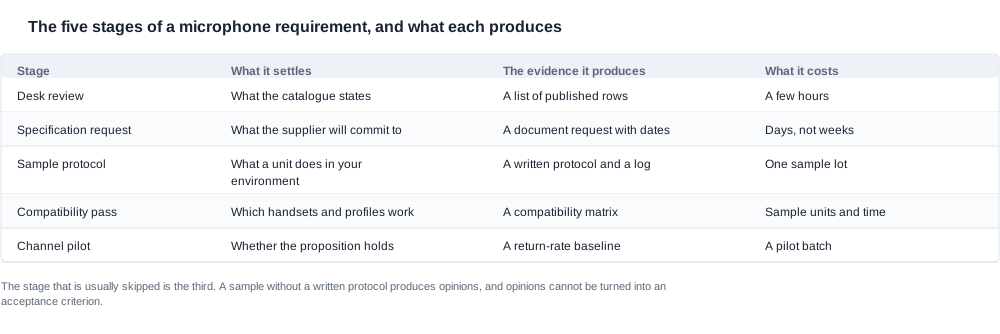
The five stages, and what each one produces
The sixteen items sit inside five stages, and the stages have a natural order because each one depends on the output of the one before it.

Desk review. What the catalogue states. A list of published rows, and in this category that list is mostly about configuration and almost entirely silent about the microphone. The output is a shortlist of models whose published configuration actually suits the use case.
Specification request. What the supplier will commit to. A document request with dates attached, covering the capsule count and geometry, the profile and codec list, the measurement conditions behind any quoted figure, and the acoustic configuration of the exact model. The output is a set of written answers, and the ones that come back as answers rather than as descriptions are the signal.
Sample protocol. What a unit does in your environment. A written protocol and a log, with the script, the distance, the background condition and the pass mark fixed before the units arrive.
Compatibility pass. Which handsets and profiles work. A compatibility matrix built from the models that dominate your market, which becomes both the evidence and the support script.
Channel pilot. Whether the proposition holds in a market. A return-rate baseline with the causes separated, which is the number you will negotiate against later.
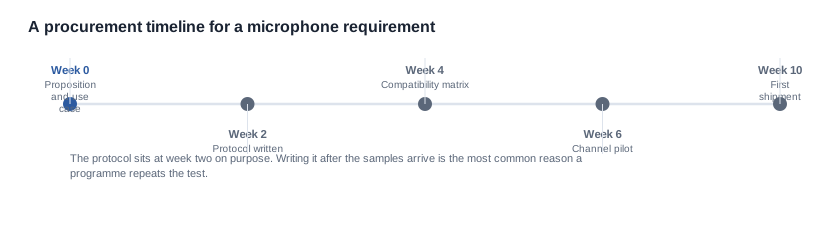
The timeline shows where the risk sits. The protocol is written at week two on purpose, because a protocol written after the samples arrive is the most common reason a programme repeats the test — and a repeated test costs a month, not a day.
A worked scenario for a brand specifying calls for the first time
The sequence below is a hypothetical case, included to show how the check would be run rather than to report a client project.
Assume a brand with an established camera-glasses platform that wants to add a call feature, and that has no in-house audio capability. The temptation is to compare two models on the published audio rows and pick the one with the longer runtime.
Step one: it stops comparing on runtime. The published rows do not include the microphone specifications at all, so the comparison it was about to make would have been a comparison of battery capacity dressed up as a comparison of audio quality. It writes the specification request instead, asking both suppliers for the capsule count and geometry, the profile and codec list, the measurement conditions behind any quoted figure, and the acoustic configuration of the exact model.
Step two: one supplier answers with numbers and one does not. The first returns a capsule count, a geometry, a profile list and a figure with its conditions attached. The second returns a feature line about intelligent noise reduction. The second is not disqualified, but it is a factory with no characterisation of its audio path, and the brand now knows that before it has spent a sample lot.
Step three: it picks the configuration on the published rows that do exist. The open-ear structure, the cell configuration, the charging interface, the runtime and the temple architecture are all published, and they are what decide whether the model suits the use case. In our range that would mean checking whether the temple architecture suits the channel, whether the runtime covers the working day, and whether the charging interface matches the charging case the brand already stocks.
Step four: it writes the protocol before the samples arrive. The scripted call test, the noise-floor test, the wrong-environment test, the network dependency test, the controls test and the two-unit test, each with its script, its condition and its pass mark. The two-unit test is placed first because the batch-wide versus unit-specific question decides everything that comes after it.
Step five: it builds the compatibility matrix. The handsets that dominate its market, paired one by one with the sample, recording what actually happens. The matrix becomes the published supported-device list, which is both a support script and a marketing asset.
Step six: it settles the commercial questions in writing. The remedy for a unit that fails in the intended environment, the return-rate baseline from the channel pilot, the wording of the call proposition, and — because the bone-conduction entry in this category carries a published amplification gain — whether any assistive positioning is implied anywhere in the plan.
By the end, the brand has not chosen a model on a specification, because there is no microphone specification to choose on. It has chosen one on evidence it generated, and it has a set of written answers that will hold up when the first field report arrives.
The rows we cannot supply, and what we do instead
It is worth being precise: we publish the audio technologies as the catalogue states them, and we will not attach a microphone figure, a profile list or a codec list to any model in this range, because none is published to us and a wrong microphone claim in a listing is a claim the customer will test.
What we will do is give you the published configuration accurately, tell you which models carry which features and interface, and help you design a test that produces a number you can rely on. We will also be direct about the limit: we cannot tell you which of our models performs best on a noisy street, because we do not hold that measurement. If you tell us the environment and the channel, we will say which of these sixteen items are decisive for you.
The supplier-side equivalent of this list is in microphone supplier verification, the published configuration rows are set out in microphone quality key specifications, and the wider acoustic treatment sits under noise control and microphone pickup and open ear audio technology.
Which of the sixteen items are decisive for you
Tell us the environment and the channel, and we will say which of these sixteen items are decisive for you and which are not. If you want the sample protocol as a document rather than as a list, we will send you the version we use, including the pass marks and the log format — it is the part of this programme that costs the least and protects the most.
What the checklist is built from
- Noise control and microphone pickup
- Microphone quality key specifications
- Microphone supplier verification
- Open ear audio technology
Tell us the environment and the channel and we will say which of these items are decisive for you.


