

Microphone vocabulary in this category is a mixture of headset terminology, telephone terminology and acoustics terminology, and none of the three was designed for an open-ear device worn on a face. That is why the words feel familiar and why the answers they produce are often wrong.
A buyer who negotiates a microphone at the level of vocabulary gets a different answer from a buyer who negotiates at the level of numbers, because a term names a mechanism and a number names a result. A mechanism can be confirmed on a drawing, in a bill of materials, or in a line written into a purchase order. A result has to be produced on a unit, in an environment, with a method, and only then compared. The glossary below is therefore organised as a procurement instrument rather than a dictionary: each entry states the assumption the term carries silently, and the question the term should raise when it appears in a supplier's reply.
Our published position across the range is that the audio is described as open-ear acoustic structure, directional audio and intelligent noise reduction, alongside Bluetooth 5.3 and 5.4, cell configurations from 40 mAh up to 290 mAh, charge times of two hours or less, runtimes from roughly five to eight hours and roughly twenty in the children's models, and magnetic or Type-C charging. On the microphone itself, no third-party measurement is published anywhere in the range: no pickup distance, no frequency response, no signal-to-noise figure, no cancellation depth, no microphone model.
Smart glasses microphone quality: shared vocabulary as a sourcing instrument
The commercial damage in this category is rarely caused by a supplier withholding a fact. It is caused by three parties using the same word for three different objects: the brand's product manager, the factory's acoustic engineer, and the copywriter who turns the resulting specification into a listing. The engineer hears "noise reduction" and thinks of a chain of filters. The product manager hears it and thinks of a customer expectation. The copywriter hears it and writes "advanced noise cancellation". All three are working from the same word, and no amount of negotiation will reconcile them unless the word is unpacked first.
That is the practical argument for a glossary, and it is a procurement argument rather than a language one. Every term that reaches a purchase order without being unpacked becomes an unpriced risk. If "directional audio" has not been defined as a capsule count and a geometry, then the buyer has not bought a direction and has not bought the hardware that produces one. If "pickup distance" has not been defined as a source level, a talker distance and a pass criterion, then the buyer has not bought a distance, only a number that will be quoted back at them by a competitor's listing later.
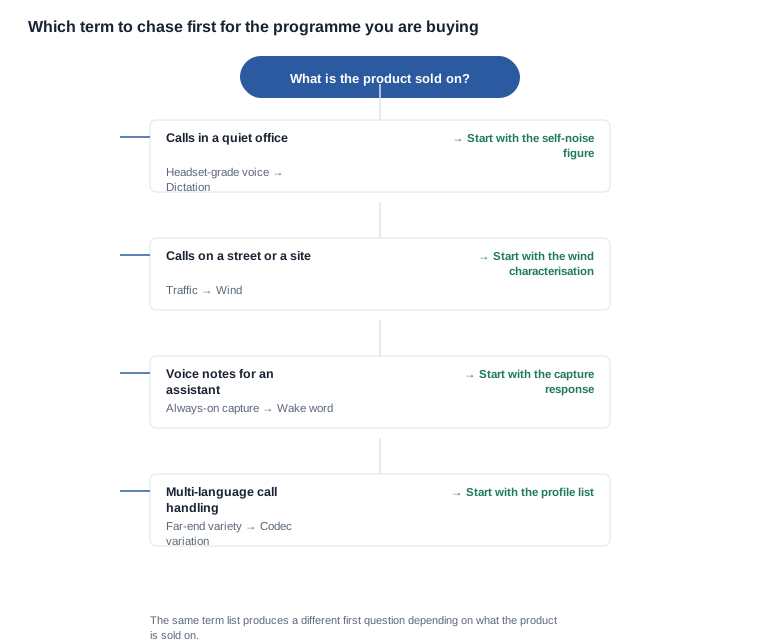
The same logic applies to the questions a supplier asks you. A factory that hears "we need good microphone quality" will quote a catalogue position, because the request is a description of a feeling. A factory that receives "three-metre intelligibility in a 65 dB office environment, scored by a named pass criterion, on production units" will quote a scope of work, because the request is a specification. The difference in the quotation is not a matter of supplier goodwill; it is a matter of what the buyer wrote down.
The third reason to fix the vocabulary is auditability. A compliance file, an incoming inspection criteria sheet and a product listing all have to use the same row names, because they are all read by different people at different times, and the person reading the inspection criteria a year later will not remember what the product manager meant. In our experience the row names are the only part of a microphone programme that survives a change of staff, and the ones that survive are the ones that were defined once and written down.
The capture terms and the assumptions they carry
Six terms in this category describe the source side of the chain, and each of them hides a different assumption about the conditions under which the number was produced. The table below pairs each term with the assumption it carries and the question that makes the term usable.
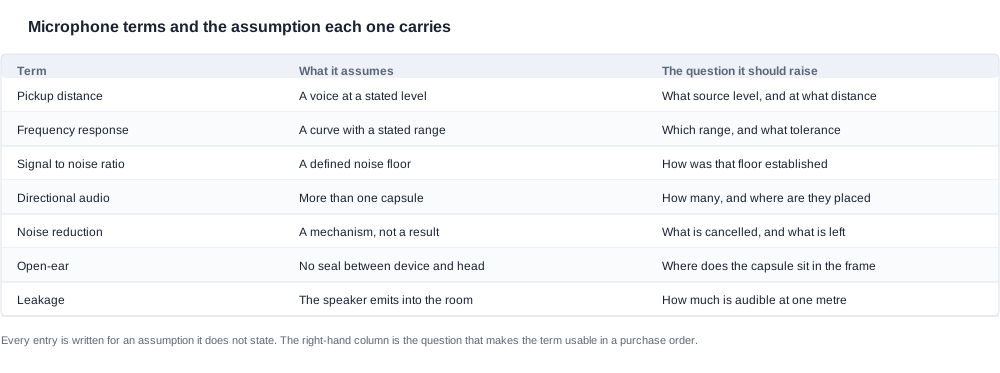
Pickup distance is the most quoted and the least comparable figure in the category. A pickup distance is only meaningful together with a source level, a talker distance, an orientation, and a pass criterion, because the same microphone at the same distance produces a different number when the source is louder. A supplier who quotes a pickup distance without the source level has quoted a condition, not a performance. The question to ask is what the reference level was and how the result was scored, and a supplier who has genuinely measured will supply both without being asked twice.
Frequency response is one of the few genuinely standardised figures in audio. The curve is comparable between products if the range and the tolerance are stated, and the same term means different things at different bandwidths, so a response quoted without a range is a description rather than a specification. For a buyer in a noisy-work environment this is the row that decides whether speech is captured cleanly, and it is almost never published.
Signal-to-noise ratio is quoted more often than sensitivity, and the two are frequently confused. Sensitivity is the output produced for a stated input. Signal-to-noise is the relationship between that output and the noise floor of the microphone. A ratio quoted without the floor is not comparable to anything, because the same ratio can be produced at very different absolute levels.
The noise floor, or self-noise, is the level the microphone produces in silence, and it is the figure that limits every other measurement in the list. It is also the figure that exposes a supplier describing noise reduction, because a claimed cancellation depth is only meaningful relative to the floor it is cancelling from. When a supplier offers a suppression figure, the follow-up question is the floor, and the answer to that follow-up is the most reliable test of whether the first figure was measured.
Directional audio and beamforming are used interchangeably in listings and are not the same thing. Beamforming is a hardware and processing arrangement in which several capsules at known positions contribute to a directional result, and the positions determine what the arrangement can reject. A single capsule with processing is not beamforming, however the listing is worded, because there is no geometry for the processing to exploit. The procurement question is therefore the capsule count and the position of each one, and the answer is a drawing rather than a number.
Sensitivity and omnidirectional versus unidirectional round out the capture group. A microphone that picks up equally from all directions and one that favours a direction are different components, and in an open-ear frame the wearer's own voice arrives from a direction that is not the front. That single geometric fact is the reason a whole class of processing claims cannot deliver what a buyer expects, and it is worth stating in the specification so that it cannot be argued about later.
The processing terms, where the marketing and the mechanism diverge
The processing group is where copy and engineering diverge most sharply, and the divergence is systematic: processing terms are cheap to publish because they name an approach, and expensive to prove because they name a result.
Noise reduction, noise suppression and noise cancelling are three labels for overlapping ideas. Noise reduction and noise suppression are broad terms for attenuating unwanted signal. Noise cancelling, in a microphone context, usually means the unwanted component is estimated and subtracted rather than merely filtered, which is a more demanding operation with a more audible cost on the wanted voice. A listing that uses any of the three without saying which one is describing a method rather than a result, and the question that settles it is what is cancelled and what is left behind.
Intelligent noise reduction is the phrase most often used and least often defined. It may mean an algorithm, a multi-capsule array, a filter, or some combination of the three. The published position across our range is that the microphone specification itself does not exist, so the phrase cannot be evaluated from any document a supplier can send. It is not a forbidden phrase and it is not necessarily inaccurate. It is simply unpriceable, and a buyer who accepts it in a specification is accepting a position that cannot be checked at incoming inspection.
Automatic gain control is a real feature with a specific trade-off, and it is the mechanism behind a familiar complaint: in a quiet room the gain is raised, and the raised gain amplifies the background as well as the voice. It stabilises the output level as the distance between the person and the capsule changes, which is valuable on a call, and it degrades the quiet case, which is where a voice product is used most often. The question worth asking is what the device does in a loud environment, because that is where the mechanism has to work hardest and where the compromise is visible.
Echo cancellation addresses the wearer's own voice feeding back into the capsule in a device with no acoustic isolation, and it is a harder problem in an open-ear frame than in a handset because there is no seal and no echo path estimate to work from. Its practical consequence for a buyer is that a device can be perfectly usable in a quiet room and unusable in a loud one, and that a demonstration conducted in a quiet room is not a demonstration of the thing being bought.
Noise gating suppresses the signal below a threshold, and it is the mechanism behind the pumping or clicking that open-ear devices are reported to produce in quiet conditions. It is also the mechanism that makes a device go silent in the middle of a phrase. Any buyer with a call-handling use case has to know whether gating is present, because its absence produces background noise in quiet rooms and its presence produces artefacts in quiet rooms.
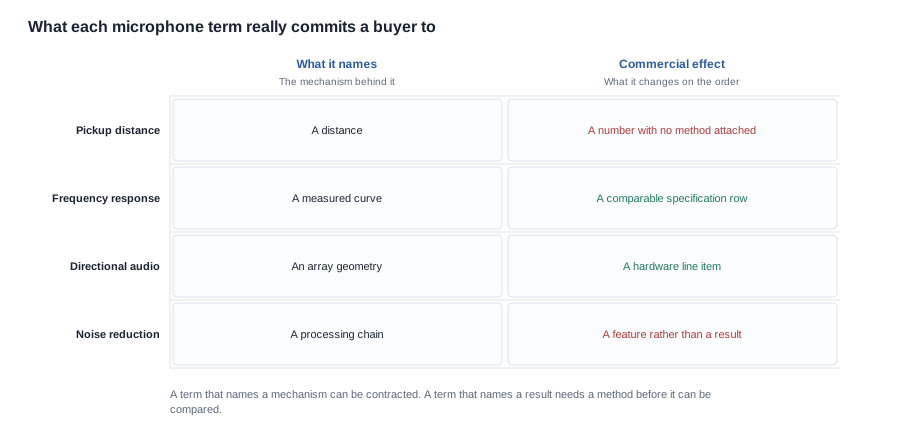
The practical rule that falls out of this group is simple enough to put in a specification: a processing term may be written into a requirement as a method, and it may only be written into an acceptance criterion as a result with a method attached. Most of the wasted negotiation in this category comes from mixing the two, and the fix is a sentence rather than a price reduction.
It is worth being precise about the commercial consequence, because buyers often assume the gap between a method and a result is a documentation detail that a good supplier will close at the end of the project. It is not. A method can be accepted at the quotation stage at no cost, because it is a description of what the supplier intends to build. A result has to be produced on units that exist, in an environment that has to be set up, scored by someone whose judgement has to be fixed in advance, and that work has to happen before the artwork is printed rather than after. Moving a row from the method column to the result column after the sample order converts a conversation into a development programme, and it does so at the point where the schedule has least room for it.
The same distinction applies to the terms on the other side of the chain. A requirement written as "suppression to 12 dB" invites a supplier to argue about the method. A requirement written as "suppression of traffic noise measured in a 65 dB road environment at one metre, scored by intelligibility, on production units" invites a supplier to answer whether it can be done and at what cost. The second version takes one exchange to settle and the first takes three, and the difference is almost always a cost the buyer did not know was there.

The device terms: open-ear, leakage and the one published row with a compliance tail
Three terms describe the device rather than the microphone, and they are the terms a buyer is most likely to inherit from a previous programme without ever seeing them defined.
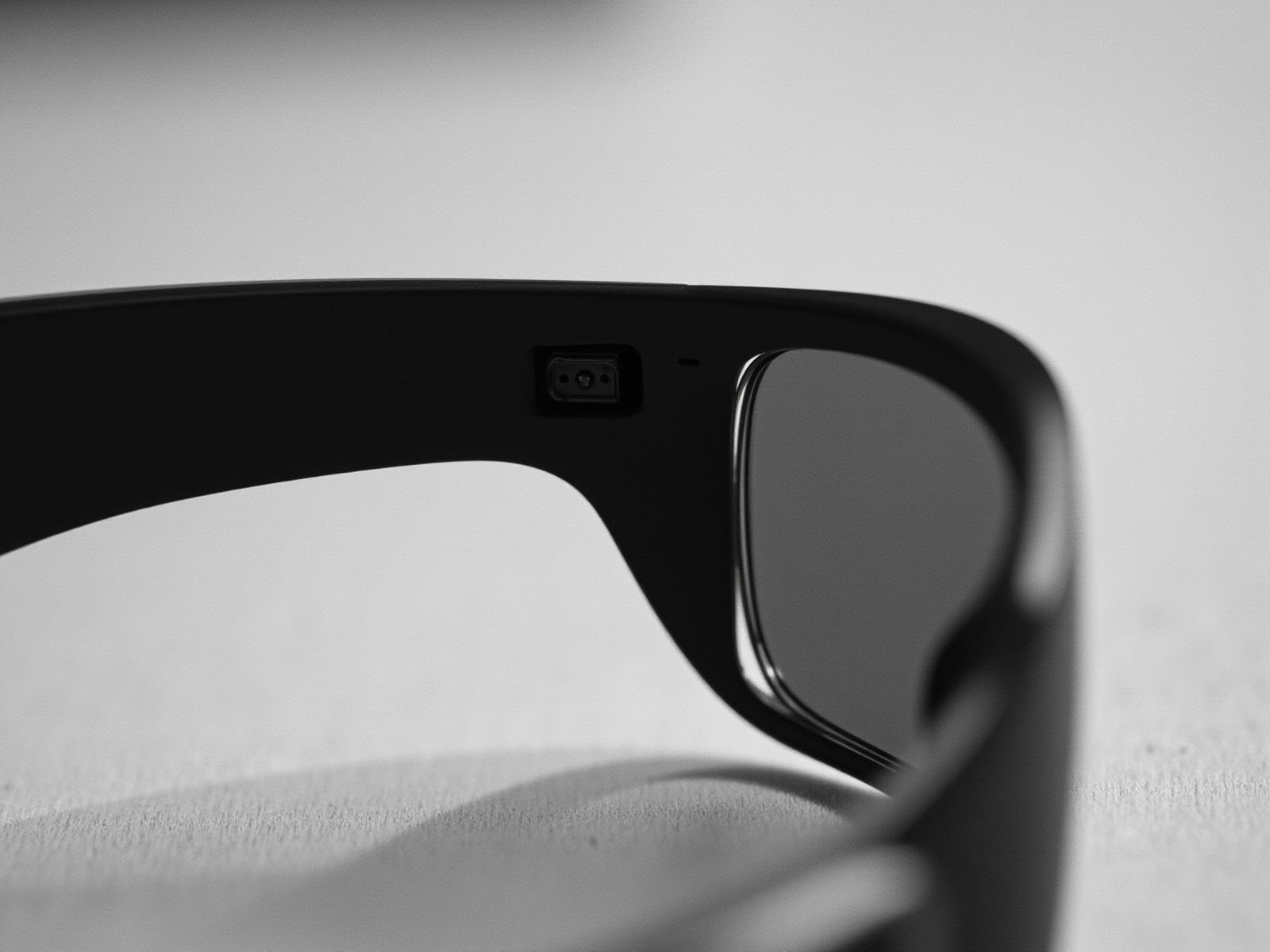
Open-ear is the architecture, and it is the single assumption that every other term in the list has to be read against. There is no seal between the speaker and the ear, and no seal between the microphone and the environment, so the head cannot be used as an acoustic baffle and the capsule cannot be shielded from the room. Every number that is quoted for a sealed device, and every expectation that a buyer carries over from a headset, has to be discounted for that. It is also the reason the acoustic path from the mouth to the capsule is a property of the frame rather than of the microphone, which is why two devices with identical capsules can behave differently.
Leakage is the sound the device emits into the room, audible to a person nearby. It appears on no specification sheet in this category, and it is one of the most reliable predictors of a return rate for an open-ear product sold for calls. The question to ask is how much is audible at one metre, because one metre is roughly where a colleague sits, and a figure at that distance is directly comparable to a channel expectation.
Bone conduction is a transmission path rather than a microphone characteristic, and it is the term in this list that carries a compliance tail. The catalogue entry for our bone conduction product publishes an amplification gain of 35 dB, which is the most aggressive published parameter in the range. The 35 dB figure is the reason a buyer must handle the output stage with care, because the boundary at 21 CFR 800.30 in the United States is a boundary on what a product may be presented as, and the guidance that bone conduction products cannot be sold as over-the-counter hearing aids follows the amplification rather than the pickup. The technical background on that path is under bone conduction audio technology, and the boundary itself is under medical boundary compliance.
Surround sound is a published feature term in the range, used for several sport and audio models, including the slim-temple and long-battery configurations. It describes an impression rather than a topology, and it establishes neither a channel count nor a routing. A buyer who needs a channel count has to ask for the topology, because the feature name will not carry it.
The six-term request to attach to a microphone RFQ
The list below is the form in which these terms become usable. It is deliberately short, because a request that a supplier cannot answer in one sitting will be answered with the easiest thing available, which is a catalogue line. Every item is a question rather than a demand, and each has a completion criterion that can be checked without a laboratory.
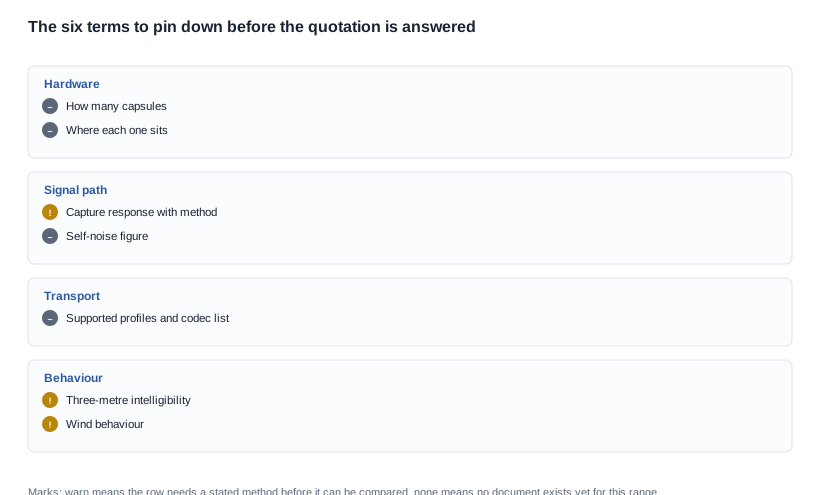
- How many capsules contribute to the pickup, and where is each one positioned? The answer is a drawing or a written position list. It can be answered with no measurement at all, and a supplier who cannot answer it has not examined the product they are quoting.
- What is the capture response, with a stated range and tolerance, and what method produced it? The method is the deliverable. A response without a method cannot be compared with a second supplier's response, including with our own.
- What is the self-noise figure, and how was it established? This is the number that makes a suppression claim meaningful, and it is the one most often declined.
- Which processing runs on the captured signal, in what order, and what does it cost at the quiet end? A description of the chain is acceptable here. The question about the quiet end is what separates a supplier who has tuned a system from one who has fitted a part.
- What is the measured leakage at one metre, and under what playback condition? This is a document request, not a laboratory request, for most suppliers who have checked it at all.
- Can a fixed protocol be run on production units, and will the supplier run it against our own sample? The answer decides whether the evaluation is the buyer's or the seller's, and it is the single most useful question in the list.
Alongside these six, a quotation request should carry the commercial items that a microphone specification usually omits: the sample order cost and terms, the quantity bands and the price tier at each band, the lead time for a configuration change, the tooling position if the enclosure is affected, the certification position for the model as configured, and the incoming inspection criteria the supplier is willing to be held to. A supplier that answers the acoustic six and declines the commercial six has told you something about the programme.
What the catalogue vocabulary settles, and what it leaves open
We publish the audio technologies as the catalogue states them, and we will not attach a microphone figure, a profile list or a codec list to any model in this range, because none is published to us. We will not repeat "intelligent noise reduction" as though it were a specification, and we will not rank products on acoustic performance we have not measured.
What the catalogue does settle is worth stating precisely, because a buyer who knows the boundary can plan inside it. Across the range, the audio family names are open-ear acoustic structure, directional audio and intelligent noise reduction. The published electrical rows are the ones a supplier can verify: Bluetooth 5.3 on the K01 and K02, Bluetooth 5.4 across the rest of the audio models, cell configurations of 55 mAh by two, 70 mAh by two, 90 mAh by two and 100 mAh, charge times of two hours or less, runtimes of roughly six to eight hours, and magnetic or Type-C charging depending on the model. The K01 and K02 carry a roughly eight-hour figure; the G07 and the YK12, both of which use the slim or detachable temple, carry roughly six hours on the same 55 mAh by two configuration. That difference is published and it is not a microphone row.
The bone conduction entry publishes a 35 dB amplification gain with a 200 mAh cell, a roughly seven-hour runtime and Type-C charging. That is the only output-stage number in the range, and it carries the compliance consequence described above.
What the catalogue does not settle is any part of the capture chain: no capsule count, no capture response, no self-noise figure, no pickup distance, no suppression description, no codec list, no leakage figure, and no third-party acoustic report for any model. The practical consequence is that a buyer who wants a microphone specification in this category has to commission it, and a buyer who asks a supplier for one will be told, in most cases correctly, that it does not exist as a document.
That is the position we will hold. If you send us the environment, the platforms your customers call from, the quantities and the target market, we will tell you which of the six questions decides the project, which published rows apply, and which of them will have to be written into the incoming inspection criteria before you commit to a volume. The range is at Bluetooth audio glasses, the technology background is under noise control and microphone pickup, and the comparable model in the open-ear family is at open ear audio technology.
Related reading
- Noise control and microphone pickup
- Microphone specifications to request
- How to measure microphone quality
- Open ear audio technology
Send us the environment and the use, and we will say which of the six questions to chase first.


