

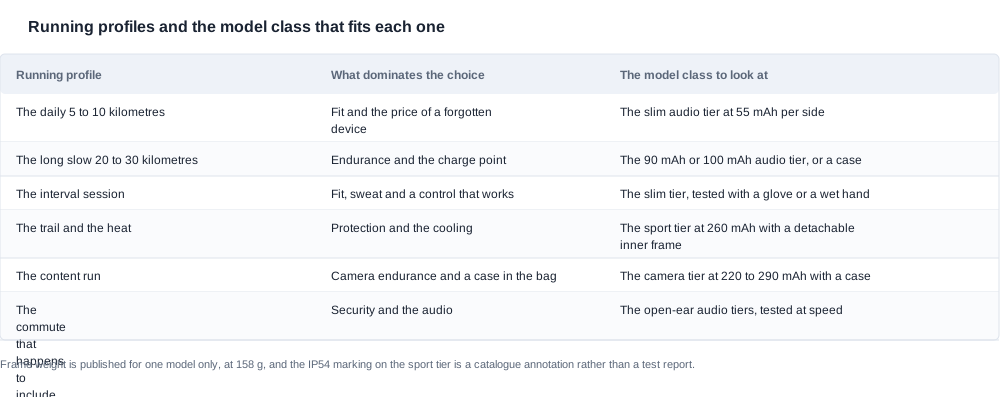
The uncomfortable finding. Smart glasses for running is decided by two variables that our catalogue does not publish at all: how much the device weighs, and whether it stays on during a run. Everything else in the range is published — a resolution class, a charge time, a cell capacity, a rated runtime, a charging interface, a colour count, an ingress marking on the two sport camera models — and none of those published rows is the one a running customer checks first. That makes a running programme a different kind of buying exercise from the rest of this catalogue. It is not a comparison to be completed from the datasheet; it is a set of sample-stage measurements to be commissioned before the artwork is approved, plus a decision about what the product page is allowed to say while the weight is still unknown.
Smart glasses for running: the two variables nobody publishes
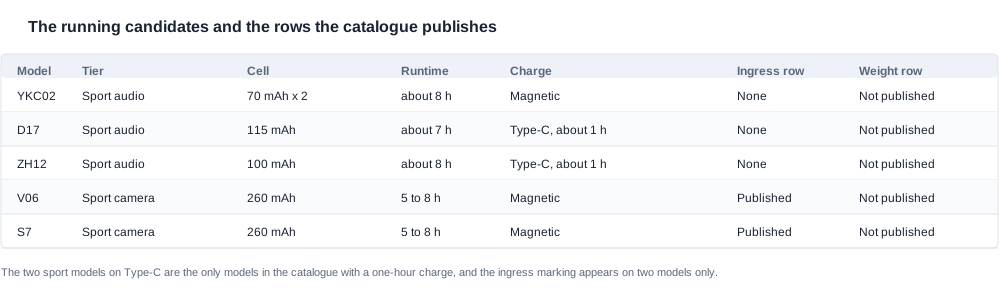
What is published in the running candidates. The three sport models publish a Bluetooth V5.4 radio, a cell configuration, a charge time, a rated runtime, a charging interface and a feature row. The YKC02 publishes two 70 mAh cells, magnetic charging, a rated use of around eight hours and a surround sound feature with a long-battery-life row. The D17 publishes a 115 mAh cell, charging over Type-C in roughly an hour, a rated use of around seven hours, and a remote capture control. The ZH12 publishes a 100 mAh cell, charging over Type-C in roughly an hour, a rated use of around eight hours, and a remote capture control. The two sport camera models publish an 8 megapixel tier on the V06 and a 13 megapixel tier on the S7, both on a 260 mAh cell, both magnetic-charged, both rated five to eight hours, both with a detachable inner frame and both with the ingress marking; the V06 also publishes four colours. The product families are at sport smart glasses and AI camera glasses.
What is not published for any of them. Unit weight. On-body retention across a movement cycle. The charging behaviour after a session. Any ingress test report behind the marking. Any runtime test condition. Any frame size. Any field of view or video specification. A buyer with these gaps has exactly three honest options: request the measurements, omit the claims, or publish something the documentation cannot support. The third option is the expensive one.
Why weight decides the commercial result even though it is the least published row. A running product page is judged on weight before anything else, because it is the first number a customer looks for and the first number a review repeats. The catalogue publishes one unit weight in total — the MT6 at 158 g, and that figure is the glasses body including its 265 mAh cell and its camera, excluding the folding charging case, whose own weight is not published. No bare frame weight is published anywhere in the range. So a running product page built from our published rows has no weight on it at all, and the buyer has to choose between a page that is missing its most important number and a page that carries an estimate. An estimate is worse than a gap: it is falsifiable, and the customer finds out.
Why retention is the second deciding variable. The published rows describe a device that works. They do not describe a device that stays on a moving head for forty minutes while the runner turns, accelerates and sweats. Retention is a property of the geometry, the mass distribution and the temple structure, and the catalogue publishes one structural feature that bears on it — the detachable inner frame on the V06 and the S7, which lets one outer frame serve different nose shapes and bridge heights. That is a sizing system rather than a trim option, and in a running channel with a wide size range it is a return-rate lever and a stock simplification. It should be specified, shown in the product photography and explained in the onboarding material, not treated as an accessory.
The sport and camera rows that survive the first two questions
| Criterion | How to read the published row | Pass line for a running line | A weak answer in practice |
|---|---|---|---|
| Camera or audio | Whether the run is recorded | A decision with a stated reason | "Both would work" |
| Charge interface and time | Magnetic across most; Type-C at about one hour on the D17 and the ZH12 | A charge that fits the post-run window | One interface claimed for the tier |
| Remote control | Published on the D17 and the ZH12 | A feature that answers an on-stride problem | A feature name with no use case |
| Cell and rated runtime | Published capacity and rating per model | A figure that covers the session, condition stated | A rating quoted as a working day |
| Ingress marking | Published on the V06 and the S7 only | A report number, or a written statement that none exists | "Waterproof" on a product page |
| Weight | Published for the MT6 only, at 158 g | A per-model measurement before the artwork is frozen | A category average |
| Retention | Not published | An observation across a full movement cycle | "Secure fit" without a test |
| Colour availability | Four colours on the V06 | A count per configuration | A colour named without a count |
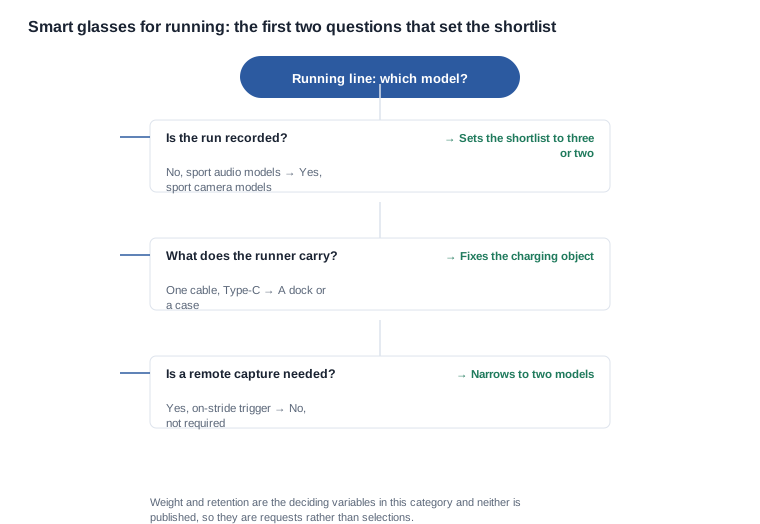
The remote capture control is published on exactly two models. The D17 and the ZH12 both carry a remote capture control, and neither the YKC02 nor any camera model in the range does. For a running programme this is not a convenience feature; it is the answer to the problem that a runner does not want to reach for a device mid-stride, and it is a procedure answer rather than a marketing one. It also narrows the shortlist in a useful way, because a buyer who needs a remote capture in a running product has two candidates in the whole catalogue rather than eleven.
The one-hour charge models are the only two in the catalogue. Every model publishes a charge time and all of them publish two hours or less except the D17 and the ZH12, which publish roughly one hour. For a running product this is the difference between a device that is charged in the window after a session and one that is charged the following morning. A consumer channel that lists a "fully charged in two hours" claim is describing a product that a runner will charge overnight, and the overnight charge is the norm anyway — so the charge time is not a headline number in this category, it is a return-driver number.
The ingress marking is on two models and neither of them is a sport audio model. The V06 and the S7 carry it, and the three sport models do not. That distinction matters twice for a running line. First, a listing for the YKC02, the D17 or the ZH12 cannot make any ingress claim at all, which is a real limitation on a product category where customers expect water resistance. Second, an ingress marking is not a sweat rating, and sweat is a wear condition rather than a weather condition: the marking says nothing about the charging contacts, which is where the running-specific exposure actually sits.
The resolution tiers are a price ladder for a camera programme. The V06 at 8 megapixels and the S7 at 13 megapixels sit on the same 260 mAh cell with the same runtime band and the same detachable inner frame, and the V06 publishes four colours. For a channel building a running camera line, that is two price points from one platform with a colour ladder on the entry model. It is not an image quality comparison, because nothing published about the sensor, the lens or the processing chain would support one, and a listing that ranks the two tiers on sharpness is making a claim the documentation cannot carry.
The charging arithmetic for a runner who carries one cable
The pack constraint, which is the real one. A runner carries fewer objects than any other user in this catalogue, and the number of objects is what decides the interface. A Type-C device recharges from the same cable as the phone and the watch charger, so the charging object in the pack is one object fewer. A magnetic device needs a dock or a case, and both are volume in a small pack and one more thing to lose. That is why the D17 and the ZH12 being the only Type-C sport models is commercially more important than their cell figures suggest: the interface decision is a packing decision.
The case is the wrong shape for this category. The camera models publish case capacities of 1400 mAh on the CY05 and the L1 Pro, and the CY03, 900 or 1400 mAh as a configuration choice on the L2 Utral, and 1200 mAh in the MT6's folding case; the KY06 and the MT5 have a case row with no published capacity; the catalogue lists no charging-case row at all for the V03 Pro and the S7, and the V06 and the V03, which is a gap a runner has to close with the supplier before a kit is quoted; A case is a second lithium cell that has to be declared for transport, and it is volume in a pack. For a running product the case is usually a decision to exclude, and for a channel that wants a long-session camera model it is a decision to include with a price point that reflects the second cell.
The contacts are the failure point, and nothing is published about them. A magnetic device is recharged after every session, in whatever state the contacts were left in, and the running-specific exposure is sweat and salt. Our catalogue publishes a charge time for every model and publishes no contact life, no insertion cycle rating and no behaviour for a fouled contact. That is the single most valuable unpublished row in this category for a running programme, because it is the failure the customer will actually experience first and because it is measurable on a sample in an afternoon: leave the contacts in the state a session leaves them, then run a charge cycle and record the outcome.
The runtime condition is the other half of the arithmetic. The published runtime bands are six to eight hours across the sport models, which is generous for a running product and irrelevant without the condition, because a rating is a ceiling under favourable conditions and the condition is not published. A running product does not need a runtime claim; it needs a charge-cycle behaviour claim, and the first one is unfalsifiable while the second is testable. The charging plan for this scenario is at charging for running.

Sampling for the two unpublished variables
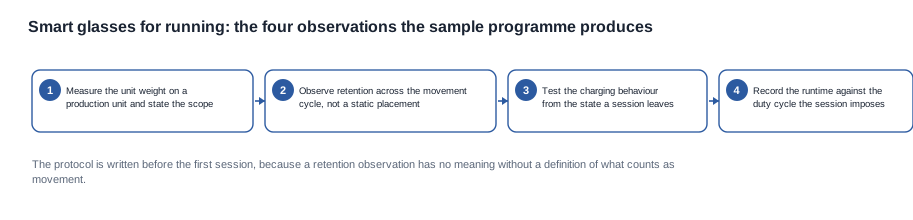
The sampling programme for a running line is short, cheap and specific. Two units per shortlisted model, more than one person, one full session each, and a written protocol covering four observations. The first is the weight, measured on a production unit with the measurement scope stated — whether the figure includes the cell, and whether it includes any case. The second is retention across the movement cycle: does the device stay in position through the turns and the acceleration, and where does it move first. The third is the post-session charging behaviour, from the state a session leaves the contacts in. The fourth is the runtime against the duty cycle the session actually imposes.
Why the protocol has to be written before the first session. A retention observation has no meaning without a definition of what counts as movement, and a charging observation has no meaning without a definition of a successful charge. A protocol written afterwards describes what the buyer already suspected. Written in advance, it produces a number that can go into the acceptance criteria and, later, into the product page.
What the sample is for, precisely. The sample is not for confirming what the datasheet says. It is for producing the two figures the catalogue does not carry, and for establishing whether the charge behaviour survives a session. That reframing matters commercially because it changes what a buyer asks a supplier for. A buyer asking for a confirmation gets a confirmation. A buyer asking for a measurement programme gets a measurement programme, and the supplier has to price it and schedule it.
Where the answers change the model choice. A weight result in the 200 g range disqualifies a camera model for a running line that has to be carried for an hour, and the buyer finds that out on a sample rather than in the returns column. A retention result that shows movement at the temple pushes the choice towards a model with the detachable inner frame, or towards a lower mass tier. A charging result that shows a fouled contact failing pushes the choice towards the Type-C models, because a cable does not depend on a contact alignment.
What a supplier has to put in writing for a running line
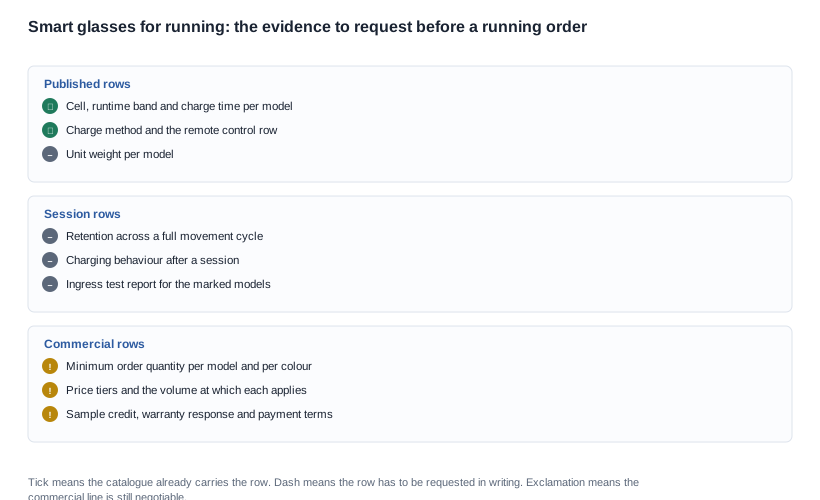
- A per-model weight, measured on a production unit, with the measurement scope stated, and a written statement of which components are included.
- A retention observation protocol and its results, covering the movement cycle rather than a static placement, on more than one person.
- The charging behaviour after a session, including what a fouled contact does and whether the charge time changes.
- The ingress test report — institution, report number and standard — for the two sport camera models, or a written statement that none exists.
- The runtime figure with its condition stated, and the case specification, its capacity and its input where a case is included in the configuration.
- The model designation on the unit checked against the paperwork, every certificate number checked in the issuing body's public register through the procedure at certification checklist, and the battery transport file requested at battery transport.
Documents to request before a deposit. The per-model weight with its measurement scope. The retention observation protocol and results. The post-session charging behaviour statement. The ingress test report, or a written statement that no such report exists. The runtime figure with its condition. The case specification. The model designation table. The certificate register. The packaging artwork proof with the hygiene step on the insert. The agreed incoming inspection criteria. The clause language is at contract terms, the commercial structure of a first order is at pricing, and the scenario entry point is smart glasses for running.
Where running programmes break after the launch. The first pattern is a product page with no weight on it that competes against pages that have one, and the reviews repeat the absence rather than the specification. The second is a device that charges unreliably after a wet session, which reads as a defective product rather than as a contacts problem, because the contacts problem is not in the documentation. The third is a listing that claims water resistance on a model with no ingress marking, which is the fastest way to lose a channel's trust. All three are prevented by the same three-hour sampling programme.
The commercial structure of a running order, and what we publish
The lines that decide the order. The unit price is the line the supplier controls most and moves least. The lines that decide a running order are the minimum order quantity per model and per colour, the lead time from purchase order to shipment, the production capacity behind the quoted date, the price tiers and the volume at which each one applies, the artwork and packaging setup cost including the insert, the sample cost and whether it is credited against the first order, the warranty period with a stated response time and a written definition of a defective unit, and the payment terms including the deposit structure.
What is fixed and what is negotiable. The camera or audio architecture, the cell, the interface and the ingress architecture are fixed. Certification cost and certification lead time are fixed. Tooling is a one-off cost which is usually amortised across the first order, so the useful questions are over what volume it is amortised and what happens to it if the programme is discontinued. What is negotiable is whether a case is included and at which capacity, the colour count, the minimum order quantity tiers and whether the camera and sport models share a purchase order, the logo, the lens tint and the packaging including the insert, whether the supplier funds a second sample round for the retention and post-session charging work, and whether a first run is split into two deliveries against a staged payment.
Where the negotiating capital sits. On the setup lines, the per-model minimums, the artwork round count, the sample credit, the spare-unit ratio, the warranty response time and the payment terms. Not on the unit price of a single model in a single market.
What goes into the agreement. The exact model designations attached to the order, with the colour and configuration list. The published row values the quotation was priced against. The weight figure with its measurement scope, once measured. The retention acceptance criterion, once observed. The charging behaviour after a session, once tested. The documentation package with an obligation to re-issue it after any configuration change and to notify the buyer before one. Three elements belong in the warranty terms: the cover period, a response time stated on paper, and what the seller treats as a defect. The battery transport file for the shipped configuration.
What we publish and what we will not do. Our position is that we will help a buyer narrow to two or three candidates and then state exactly which published figures cover those candidates and which do not. We will not fill the second list with typical industry weights to make a comparison look complete. For the sport camera models we can answer the resolution tier, the cell capacity, the charge time, the interface, the rated use, the colour availability and the presence of an ingress marking. We cannot answer the weight, the field of view, the video specification, the low-light performance or the test reports behind the marking.
What to send us. Tell us whether the run is recorded, what the runner already carries in the pack, the price band and the market, and we will narrow the range to the two or three models that fit, with the missing data listed and the sampling programme scoped. The scenario entry point is smart glasses for running, the adjacent endurance case is at running product recommendations, and the measurement approach is at measuring results for cycling.
Related reading
- Where the scenario starts — smart glasses for running
- The families in the range — sport smart glasses
- The adjacent endurance case — running product recommendations
- The measurement approach — measuring results for cycling


