
Smart glasses for cycling products have a result that only exists on a bicycle, and the first question for a buyer is therefore not what to measure but which models can produce a measurable result at all. Two of the three sport models publish a photo feature and no pixel class, so a cycling listing built on them has no published resolution behind its imagery — nothing to compare, nothing to verify, nothing to defend. The camera models do publish a pixel class, and two of them also publish an ingress marking. Between those two facts sits the real measurement work: a ride that is repeatable, a unit whose position and charge state are recorded section by section, and two numbers at the end — whether the unit stayed in place, and how many minutes of usable recording it produced per charge.
Smart glasses for cycling: the ride result to compare with bench tests
The reader is a brand owner, a channel buyer or an e-commerce seller putting a cycling product into a channel — a rider kit, a bike-shop range, a club or tour operator, a rental operation. The decision in front of them is which model the cycling SKU is and what the listing may claim about it. The risk is specific to the category: a product that is perfectly good on a desk and disappointing on a bicycle, and a customer who will find that out on the first ride rather than in a review.
Two things make a cycling measurement different from every other measurement in this catalogue. The first is that the environment moves the unit, so the two properties that matter — that it stays in place and that it keeps recording — are both properties of motion rather than of the device. The second is that the rider is the test instrument, which means the protocol has to control the rider or the result is a description of that rider on that day. Neither the catalogue nor the supplier can supply that control; it has to be written down.
The conclusion for a procurement team is a method with two parts. Choose the model on whether it can produce a measurable recording, which in practice means a published pixel class unless the listing is making no resolution claim; then design the ride so that somebody else could repeat it and get the same numbers. The second half is what separates a result from a demonstration, and it is the half that a cycling channel skips most often, because a ride on a nice day with a new unit produces an excellent impression and no reusable figure.
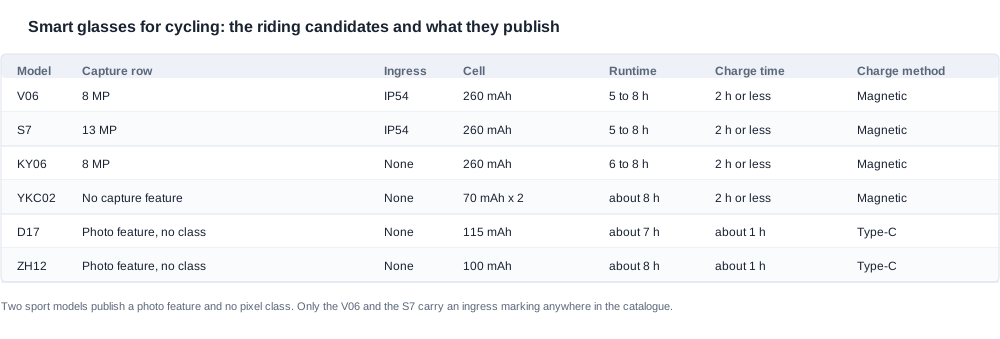
Which models can produce a measurable recording at all
| Model | Capture row | Ingress | Cell | Runtime | Charge time | Charge method |
|---|---|---|---|---|---|---|
| V06 | 8 MP | IP54 | 260 mAh | 5 to 8 h | Two hours or less | Magnetic |
| S7 | 13 MP | IP54 | 260 mAh | 5 to 8 h | Two hours or less | Magnetic |
| KY06 | 8 MP | None | 260 mAh | 6 to 8 h | Two hours or less | Magnetic |
| YKC02 | No capture feature | None | 70 mAh × 2 | About 8 h | Two hours or less | Magnetic |
| D17 | Photo feature, no class | None | 115 mAh | About 7 h | About 1 h | Type-C |
| ZH12 | Photo feature, no class | None | 100 mAh | About 8 h | About 1 h | Type-C |
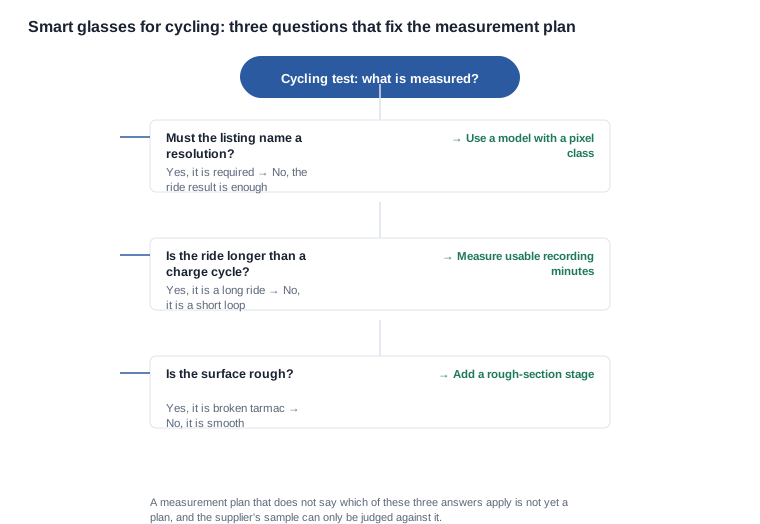
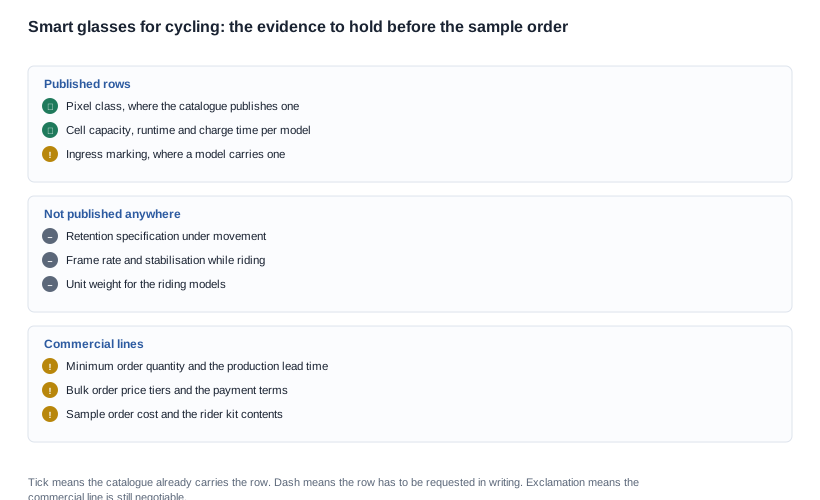
The first row of that table is the one a buyer has to read carefully. The D17 and the ZH12 both publish a photo feature — the D17 publishes remote control photo and surround sound, the ZH12 publishes remote photo and surround sound — and neither publishes a pixel class. That is not a technicality in a listing, because a resolution claim is the claim a customer compares on a product page, and a model that publishes a photo feature without a resolution leaves the buyer with a claim it cannot verify. A buyer who wants a defensible image claim has to choose a model that publishes one: the V06 and the S7 at 8 MP and 13 MP, or the KY06 at 8 MP.
The second row is the ingress marking, and it is confined to two models in the whole catalogue. The V06 and the S7 publish IP54, both with a detachable inner frame, both with a 260 mAh cell and both publishing a rated runtime of five to eight hours. The remaining candidates publish no marking at all. A cycling listing that needs to speak about weather has to be built on the V06 or the S7, and a listing built on a sport model has to speak about conditions instead — which is a legitimate form of claim and a weaker one.
The third row is the charge method, and it splits along the same line the sport tier split elsewhere in the catalogue. The two models that publish the one-hour charge time are the D17 and the ZH12, and both charge over Type C; the rest charge magnetically, and the two models whose charge method the catalogue does not publish at all are camera models outside this table. For a long ride, a charge cycle is not part of the ride, so the charge method matters less here than the charge case — and that is where the third fact arrives: the KY06 publishes magnetic charging with a charging case, the V06 and the S7 publish no charging-case row at all, and the YKC02, the D17 and the ZH12 publish no case row either. A rider who intends to record a full day needs a second cell, and in this table only the KY06 has a published case.
The comparison between the two marked models makes the point better than any amount of specification prose. The V06 and the S7 publish the same 260 mAh cell, the same five-to-eight-hour runtime band, the same two-hours-or-less charge time, the same magnetic charging, the same detachable inner frame and the same IP54 marking. The single published row on which they differ is the pixel class — 8 MP against 13 MP. So a buyer choosing between them is choosing a claim rather than choosing a product, and the choice has to be justified by the delivery specification of the platform the footage will be published to. If the two cannot be told apart downstream, the honest answer is to take the one that costs less and keep the other as a second listing only if the channel can justify two.
One more published fact belongs in the same paragraph because it changes how the numbers can be compared. Every runtime in the catalogue is published without a test condition — no volume, no paired phone state, no ambient temperature, no workload — and the camera models publish their runtimes as ranges rather than as points, with five to eight hours on the V06 and the S7 and six to eight hours on the KY06. A rider's usable recording time is bounded by the lower end of that range rather than the middle, because the conditions on a bicycle are harder than the conditions a catalogue photograph was taken in. That is why the measurement has to produce a minutes-per-charge figure rather than an hours-per-charge figure, and why it has to be produced on a route rather than inferred from a band.
The two numbers a ride has to produce
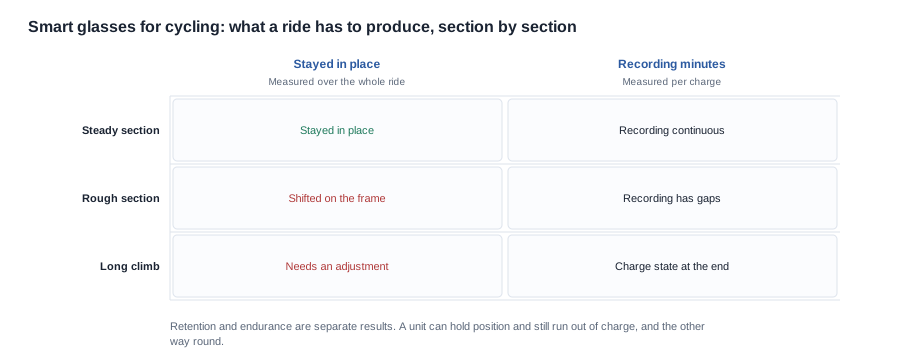
Retention and endurance are separate results, and the useful mistake is to expect one of them to imply the other. A unit can hold its position perfectly and still leave the rider with a recording that stops before the ride does, because the charge state went in lower than expected or the workload on a climb is heavier than the band suggests. A unit can also keep recording all day and be re-adjusted by the rider three times, which is a different kind of failure because it is an intervention the rider has to make, and it is invisible in a recording that still looks complete.
So a ride result has two components, and each needs a measurement that is not a survey. Retention is measured by what the camera actually saw: a section of the ride where the unit points away from the direction of travel, or at the ground, or at the rider's own shoulder, is objective evidence that the unit moved. Endurance is measured by the length of continuous usable recording before the charge cycle ends, with the gaps marked against the route. The unit of measurement is the ride, which means the result carries its own conditions — the route, the distance, the surface, the weather and the start charge state — and a result without those conditions is not repeatable and therefore not a result at all.
A third thing is worth measuring on the same ride, and it is the one that decides whether the footage survives: how the recording behaves while the rider is moving. Frame rate under motion, whether the image stabilises or shakes, and whether the audio stays intelligible over a rough surface are all unpublished for every model in the catalogue, and all three are visible in the produced file rather than in a specification. The camera testing route that covers this is at camera technology testing, and the imaging detail is at camera imaging.
A repeatable route protocol

Six steps, each with a completion standard:
- Ask for the capture row, cell, runtime, charge method and case position per candidate model. With the unpublished cells left visible as unpublished. The completion standard is a written reply per model.
- Fix the route and the section boundaries. A repeatable route with a steady section, a rough section and a climb, the distances marked, and the start charge state recorded. The completion standard is a route sheet that another rider could follow and reproduce.
- Run two units from one batch over the same route in the same conditions. Two units separate a design characteristic from a unit fault, and the same route separates a product property from a rider's day. The completion standard is a log for each unit with the conditions recorded.
- Record the position and the recording gaps section by section. Where the unit moved, and where the recording stopped. The completion standard is a marked log that a colleague can read without being told the story.
- Measure usable recording minutes per charge and the distance covered. The end-of-ride charge state is part of the result. The completion standard is two numbers per unit, each attached to its route.
- Write the ride profile and the measured figures into the order. The route, the measured minutes per charge, the measured retention result, the sample cost, the spare ratio and the warranty response time. The clause language is at contract terms, the price structure is at pricing, and the sample process is at samples.
Two of those steps decide whether the result survives contact with a supplier. Step two is the route sheet, and its real purpose is control: the same rider on a different day, a different rider on the same day, and a different set of tyres on the same route all produce different results, so the conditions have to be named rather than assumed. Step five is the units of measurement, and using minutes per charge rather than a published runtime band is what makes the figure usable in a listing — a buyer can say what the rider got, and the supplier can be asked to meet it.
There is also a sampling point that a cycling channel has to handle explicitly, because the rider is the most variable part of the test. A single rider on a single ride produces one data point, and in a category where retention is a design characteristic and endurance is a condition, one point cannot separate the two. The protocol that separates them is simple: two units, two riders, the same route. If both riders on both units lose position in the same section, that is a design characteristic; if one unit loses position on one rider's ride and not the other's, that is a unit fault and a supplier conversation.
One further condition belongs on the route sheet and is easy to omit: the season. A cycling range sells into a wet season and a dry one, and the two produce different results for every reason that matters — a wet road changes the surface, the light and the rider's concentration, and a dry one does the opposite. A result measured in one season is not a result for the other, so the route sheet has to name the season, and a listing that speaks about weather has to state which season the test was run in.
Where a cycling measurement programme breaks commercially
The model was chosen on a photo feature. The symptom is a listing whose images cannot be compared on resolution with a competitor's. The root cause is that the D17 and the ZH12 publish a photo feature and no pixel class. The prevention is to require a published pixel class whenever the listing makes a resolution claim.
The route changed between runs. The symptom is a comparison between two products that measures the rider rather than the products. The root cause is that the route was treated as a detail rather than as a controlled condition. The prevention is a route sheet that fixes distance, surface, weather and start charge state.
One unit, one rider. The symptom is a design characteristic attributed to a single faulty unit, or a unit fault treated as a product property. The root cause is that retention and endurance cannot be separated with one observation. The prevention is two units and two riders on the same route.
The runtime band was used as the result. The symptom is a claim about hours that a rider cannot reproduce. The root cause is that no runtime in the catalogue carries a test condition and the range was treated as a point. The prevention is to publish the measured minutes per charge instead.
The movement of the unit was assessed by asking. The symptom is a retention claim that the recording contradicts. The root cause is that rider perception was used where the produced file was available. The prevention is to measure the direction the camera faced in each section.
The kit was not the shipped kit. The symptom is a delivered unit whose case and charging behave differently from the sample. The root cause is that the rider kit contents were specified after the test. The prevention is to name the kit in the order, including the case position, which is a published fact for only one of the models in this table.
An assumed scenario shows the sequence. A channel buyer is building a cycling range for a bike brand whose customers ride in mixed weather and record their rides, and the brand's listing needs a claim that survives a customer who checks it on the first weekend. The first move is the capture row, because two of the sport models publish a photo feature without a pixel class and the brand's listing needs a resolution it can defend. The second is the route sheet, written before the first ride so that the test is repeatable. The third is the two-unit, two-rider run, which is what separates a design property from a unit fault. The fourth is the order, in which the route, the measured minutes per charge and the retention result appear as lines rather than as adjectives. The outcome is a cycling SKU whose claim describes a measured ride under stated conditions, which is a far stronger position than a specification restatement and the only kind of claim in this category that a customer can actually check.
What we publish for cycling and where we stop
We publish the rows a cycling buyer can specify against, and we do not fill the gaps with figures nobody has verified. For the riding candidates that means the pixel class where one is published, the cell capacity and cell count, the rated runtime, the charge time, the charge method, the charging-case position where the catalogue publishes one, and the IP54 marking on the V06 and the S7.
We do not publish a retention specification, a frame rate, a stabilisation figure, a field of view, a low-light behaviour, a capture latency, a storage and overwrite rule, or a runtime test condition. We do not publish a pixel class for the D17 or the ZH12, because the catalogue does not carry one for those models, and we will not describe a photo feature as a resolution. We also do not publish a per-model certification scope, because the catalogue carries a company-level export certification page rather than model rows and its text contains no CE, no FCC and no RoHS reference at all, and we do not publish a unit weight for any of the models in this table.
What we will do is take your route profile, your typical ride length, your surface conditions, your price band and your quantities, and tell you which published rows apply, which models can produce a verifiable capture claim, which measurements a protocol has to produce, and which acceptance criteria belong in the purchase order. The product families are at AI camera glasses and sport smart glasses, the scenario entry point is at cycling, the endurance detail is at battery life, and the marking reference is at IP ratings. The adjacent selection route is at choosing a model for cycling.
What to send us next. Send the route profile, the ride length, the surface conditions, the price band and the quantities, and we will return the published rows that cover the range, the capture-claim position per model, the measurement protocol to run on samples, and the acceptance criteria to write into the order. Transport documentation for the shipped configuration is at battery transport, and the evidence list for a supplier evaluation is at certification checklist.


