
Smart glasses for education are rarely owned by one person. They are issued from a pool, handed to a class, returned to a shelf, collected at the end of a session and handed to somebody else — and the lens is the only surface on the product that every one of those hands reaches. That single fact changes the buyer. An institutional procurement team is not buying a product with an attractive specification sheet; it is buying a device that will still be in working order after a term of shared handling, and it is buying that assurance on the basis of documents rather than on the basis of a demonstration unit. The decision that settles this is therefore a documentation decision with a hygiene consequence: request the lens material, the coating and the prohibited agents for the exact model in the framework, decide whether the device will carry a camera at all before anyone discusses the lens, and put a written issue-and-return condition in front of the assessment panel before the sample is scored. The catalogue publishes the lens material, the coating and the surface treatment for no model, and it publishes no per-model certification row, so every one of those requests is a document to obtain from whoever holds it rather than a row to read.
Smart glasses for education: the condition shared handling sets for the lens
The institutional buyer and the tender clock
The reader is a procurement manager in a school trust, a vocational training provider, a university department or a workplace training arm, working inside a framework agreement or a tender that will be evaluated against a written specification and a scored sample. The task is not to select a product. It is to write a specification that a supplier can answer, to evaluate sample units against criteria that will be applied identically to every supplier on the panel, and to manage the handover of a device pool that will be touched by people the procurement team never meets.
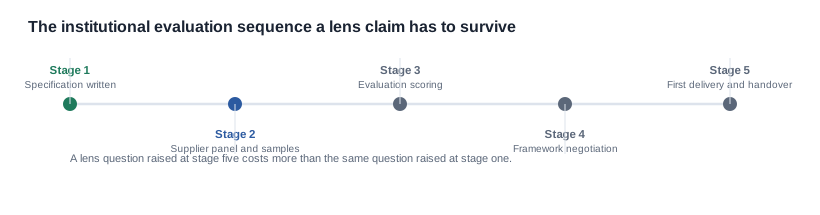
The clock is what makes this category different from a retail purchase. Institutional buying has a long front end and a long back end, and the pressure sits at the front: a specification that is ambiguous cannot be scored, and a specification that is scored against criteria that a supplier cannot document produces a dispute at the contract stage rather than a decision at the evaluation stage. That is why the most useful thing a supplier can do in an education tender is to state plainly what it does not publish. A shortlist that publishes its lens material, its charging interface and its runtime conditions, and explicitly marks the lens coating and the per-model weight as unpublished, is a shortlist that can be evaluated. A shortlist that leaves the rows blank cannot be compared, and the comparison is the whole point of the exercise.
The second pressure is the end of the contract, which is where the device pool actually exists. A framework agreement may run for years, and the units in circulation during those years will not be the units that were demonstrated. They will be the units that were handled by a hundred people, stored in a cabinet, charged by whoever arrived first and dropped into a school bag at the end of the day. What an institutional buyer needs is therefore not a care instruction for a single unit but a control that survives contact with an ordinary institution.
Why a classroom device pool is not a retail order
Three things separate an education device pool from a retail order, and each of them changes what a lens specification has to contain.
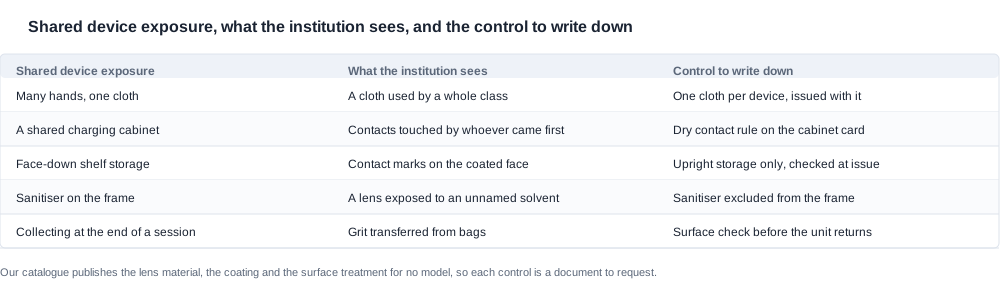
The first is the number of hands per unit. A retail unit has one owner for its whole life. A pooled unit can have a different person every hour, and the instruction has to be short enough to be followed by someone who has never seen the device before. Instructions that assume familiarity do not survive a handover; instructions that assume a single cloth per device do, because the cloth travels with the device rather than with the person.
The second is the environment. A classroom is a warm, enclosed, high-contact space with an institutional sanitiser on the wall for surfaces, and a sanitiser used near the device is a solvent applied to a frame and a lens whose material and coating nobody has published. The hygienic instinct in an institution is to sanitise the device; the correct instruction is usually to sanitise the frame and never the lens, and to state that in a way that survives being repeated by a facilities contractor. This is the single most likely place for an education programme to create an avoidable batch-level defect.
The third is the audit trail. A school or a training provider can be asked to account for a device pool: how many units are in service, what condition they were issued in, what condition they came back in, and what happened to the ones that did not come back. A device pool without a written condition list produces an argument at every handover and an unreconciled count at the end of the term. The lens is where that argument starts, because a lens is the part a person will describe rather than measure.

The camera decision comes before the lens decision
The privacy and marking gates that sit in front of a classroom
Before any lens question can be evaluated, an institutional buyer has to answer a question that a retail buyer never has to answer: whether the device carries a camera at all. Our catalogue publishes eleven camera models, and in an education or training setting the camera decision is a governance decision before it is a technical one. Recording in a classroom or a training room engages the institution's own policy, the data protection rules that apply to it, and — where staff and learners are involved — a consultation that does not move quickly. A camera model proposed into an education framework without that decision having been taken first creates a problem that no specification clause can solve later, and the lens specification is downstream of it.
The marking question sits next to the camera question and is easier to get wrong. Two models in this range, the V06 and the S7, publish an IP54 marking; no third-party test report is published behind it and no other model publishes an ingress rating at all. In a school specification, an ingress marking matters more than it does in a retail listing, because the specification will be used by facilities staff who will read "water resistant" and will infer that the device can be cleaned under a tap or left in a wash bay. The marking's actual coverage is a dust protection level and protection against splashing water, and a specification that says anything beyond that will be relied on. The digit reading is at IP ratings.
A third gate belongs here because it is the gate most often crossed silently. If the device will be handled by children, the applicable child-product test requirements come into the evaluation — and our catalogue publishes no child-product test reports, no per-model certification row, and no CE, FCC or RoHS text anywhere in it. That does not make the products unsuitable for an education setting; it makes the reports a document to request from whoever holds them, and a buyer who cannot obtain them for a model that will be handled by minors should not put that model into the framework. The child-product requirements are set out at child product compliance, and the medical boundary that keeps these devices out of any clinical claim is at medical boundary.
The criteria a school evaluation should score
The criteria section is where an education tender is usually weakest, because the evaluation panels tend to score what they can see in a demonstration rather than what they will have to manage for years. Six criteria carry the weight, and each one is written so that a supplier can answer it with a document.
Criterion one: the surface statement, scored as a document rather than as a claim. How it is measured: the lens substrate and the coating treatment, stated for the exact model, with the model designation on the document. Pass line: the statement names the material and the treatment, and a second supplier's statement on the same model can be compared against it. What a soft answer looks like: "HD lenses" or "premium optics" in a specification response, which cannot be scored and therefore should be scored as a zero. Our catalogue publishes none of this, so on this criterion a buyer should score the response, not the product range.
Criterion two: the prohibited-agents list, scored for ownership. How it is measured: a named list of solvents and abrasives, and a named owner at the supplier for the version. Pass line: the list exists, and it names the agents that the institution's own sanitiser could contain. What a soft answer looks like: "avoid harsh chemicals", which cannot be compared against a sanitiser bottle.
Criterion three: the camera position, scored as a governance answer. How it is measured: a written statement of whether the model carries a camera, and if it does, the position the supplier takes on where that leaves the institution's own policy. Pass line: an unambiguous answer that lets the panel classify the model as in-scope or out-of-scope for the setting. What a soft answer looks like: leaving the camera out of the response and letting the panel discover it from the specification table.
Criterion four: the issue and return condition list, scored on completeness. How it is measured: a written standard covering the lens, the contacts and the frame, with the visual reference attached. Pass line: a panel can apply it to a unit that has been in service for a term. What a soft answer looks like: a condition list that only covers whether the unit powers on.
Criterion five: the charging and contact routine, scored against the interface. How it is measured: the published charging interface for the model, and an instruction for the contacts that matches it. Pass line: the instruction names the interface — a magnetic model and a Type-C model are reached differently — and says the contacts are handled dry. Four camera models in this range publish no charging-method row at all, so an instruction that assumes a method for those models is itself a scoring failure. What a soft answer looks like: "ensure contacts are clean before charging" with no method behind it.
Criterion six: the consumable and the storage position. How it is measured: whether a cloth ships with each unit, and how the unit is stored between sessions. Pass line: one cloth per unit issued with the unit, and an upright storage position stated in the handover instruction. What a soft answer looks like: a communal consumable at the cabinet, which will be exhausted within a week and then replaced by whatever is in a pocket.
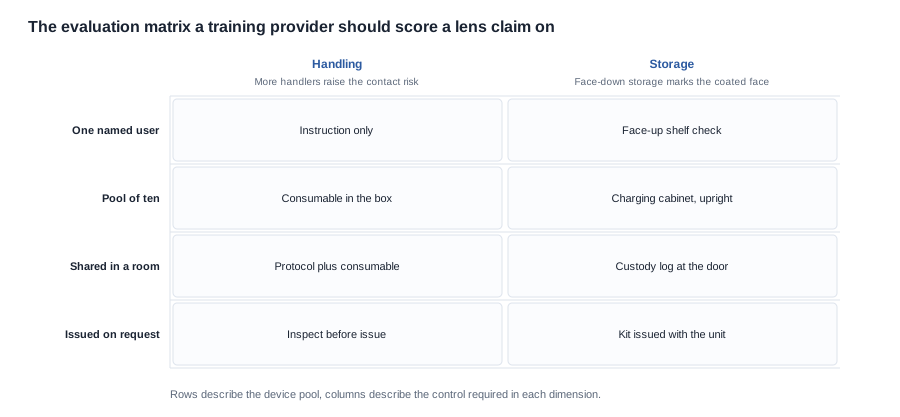
The six criteria are ordered by how early they can be settled. The camera position is first because it determines whether the model is in scope at all. The surface statement is second because it determines what the consumable and the prohibited-agents list can be. The issue and return list is third because it is the criterion the panel will still be using five years into the framework. The interface routine and the consumable position come next because they are operational. The storage position comes last because it is the one the institution controls most directly.
Verifying the lens position in an institutional evaluation
A sample evaluation that produces evidence, not impressions
Institutional sample evaluations fail in a predictable way: the panel scores what it can hold, and nobody records what was held. The fix is to insist that the evaluation produces a document per criterion, and that the document is written by the supplier rather than inferred by the panel.
- Require one sample unit per model on the panel, in the configuration that will be ordered, including the accessory set that will ship. Completion test: the sample in the room matches the configuration code on the quotation.
- Ask for the surface statement and the prohibited-agents list before the samples are opened. Completion test: both documents are in the panel pack, dated, and carrying the model designation.
- Have the panel score each criterion against a document, and record the evidence reference next to the score. Completion test: every score has a document reference, and a criterion that has no document is scored as a zero rather than as a discussion.
- Run the routine on one sample and record what a pooled unit looks like after a simulated term — one unit marked by several hands, stored face-down for a day, and recharged by someone else. Completion test: a written observation of the lens and of the contacts, with photographs.
- Ask the supplier to review the handover instruction and the return condition list as part of the evaluation, and record whether they will. Completion test: a written answer, which is itself a scoring criterion.
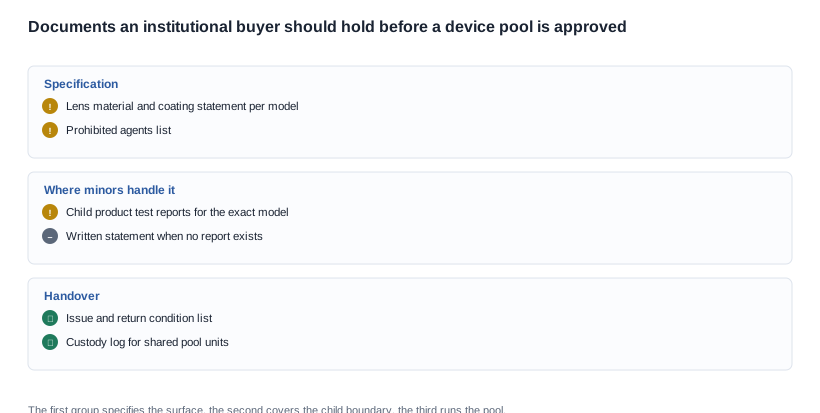
The supporting pack is the surface statement, the prohibited-agents list, the ingress position for the model, the child-product position where minors are in scope, the battery transport file for any configuration with a case, the model designation table and the certificate register that goes with it. The certification register procedure is at certification checklist, the transport file is at battery transport, the clause language is at contract terms, and the commercial structure of a first order under a framework is at pricing. The product families are at AI camera glasses, Bluetooth audio glasses, sport smart glasses and kids smart glasses.

Where an education lens position fails commercially
Six failure signatures in a school or training environment
The sanitiser applied to the lens. Symptom: haze on a batch of units, or a sudden cluster of "camera not clear" reports after the facilities team changed its cleaning routine. Root cause: an institution-wide hygiene practice applied to a surface whose specification nobody published. Prevention: the prohibited-agents list, written into the institution's own device policy rather than left in the box.
One cloth for a class. Symptom: grit and print reaching the lens from a consumable that was shared. Root cause: a communal consumable instead of a per-device one. Prevention: one cloth per unit, issued with the unit.
Face-down storage on a classroom shelf. Symptom: contact marks that get reported as coating defects. Root cause: a storage position nobody specified. Prevention: an upright storage instruction with a check at issue and at return.
A device pool without a count. Symptom: a device budget that does not reconcile, with the difference attributed to loss. Root cause: no custody log, so a returned unit in poor condition is indistinguishable from a unit that was never returned. Prevention: the custody log and the condition list as a pair.
A camera model entering the framework by default. Symptom: a governance review that stops the programme after delivery rather than before it. Root cause: the camera decision was never taken as a separate question. Prevention: criterion three, scored before the samples are scored.
An antibacterial claim on the listing. Symptom: a claim the documentation cannot carry, in a setting where the buyer is accountable for every published statement. Root cause: a hygiene adjective used in place of a test report. Prevention: publish no antibacterial or sterilising claim for the lens unless a test report exists for the exact model, and note that a surface that can be wiped is not the same as a surface that resists contamination.
The clauses an institutional buyer should write
A worked scenario for a training-provider framework
Take a vocational training provider running a technician academy across three sites, with a framework agreement for a pool of sixty units, one of which is a camera model for the inspection module. The first decision is the camera position, and it is taken before the tender: the inspection module is filmed by a fixed camera in the room, so the camera model moves to an adult-only, instructor-controlled pool, and the remaining units are audio and sport models issued to trainees on a rota. The second decision is the consumable, and it is settled on the handover count rather than on the unit price: one cloth per unit with the unit, because a communal cloth is exhausted inside a week and then replaced with whatever is in a pocket, which is the same failure the cycling and retail channels see. The third decision is the storage position, and it is settled at the cabinet: upright charging with a card that states the dry-contact rule, since the cabinet is the place where the most hands touch the least carefully.
The fourth decision is the evaluation pack, and it is settled by requiring a document per criterion, with a criterion that has no document scored as a zero rather than discussed. The fifth decision is the handover instrument, and it is settled by writing the issue and return condition list once, with a visual reference, and requiring that the same list governs both the issue bench and the returns bench. The sixth decision is the framework clause, and it is settled by asking for the surface statement as a named deliverable with a date attached, and by asking the supplier to review the handover instrument before it is printed. The outcome is a framework where the lens is a managed control rather than a recurring complaint, and where the acceptance test at delivery is the same document the returns desk uses five years later.
Where the commercial room actually sits
The lens material, the coating and the surface treatment are fixed for a given model revision, and the certification cost and lead time behind them are a cost of market access rather than a price item; tooling belongs in a separate line amortised across the first order so that the one-off charge stays visible. What an institutional buyer can move is the consumable, the storage accessory, the handover instrument's wording, the consumable quantity per unit and its restock interval, the split of a first delivery into two staged batches against a staged payment, the number of models per call-off, and the share of units taken at the pilot tier rather than the run tier. In an education framework the last of those is unusually valuable, because the pool grows over the contract and a pilot tier taken early is the cheapest way to find out which model a site actually keeps in service.
What we publish for institutional buyers, and what we will not claim
It is worth being precise: we publish the rows a buyer can order from and the absence of the other rows with the same prominence, because an evaluation panel can only score what is written down. For this range that means the resolution class, the cell capacities from 40 mAh to 290 mAh, the charge times, the rated runtimes between five and eight hours, the charging interface per model, the colour counts, the case capacities where they are published, and the structural features the catalogue states — the detachable temples on the G07 and the YK12, the removable inner frame on the V06 and the S7.
What we do not publish, and will not estimate: the lens material, the coating, the surface treatment, the hinge specification, the field of view, the video specification, the runtime test condition, the standby draw, the cycle-life rating and the operating temperature range. We publish one weight figure in the whole catalogue — 158 g for the MT6, a camera model, which is the whole unit including its 265 mAh cell and its camera and excluding the folding charging case — and we will not present it as a frame weight. We will not state that any product is tested to IP54, because the marking appears on the V06 and the S7 with no test report published behind it. The catalogue carries no per-model certification row and no CE, FCC or RoHS text anywhere in it, so we will not present those as ours to have; in an education evaluation they are documents to be requested from whoever holds them, and a response that does not include them is scored as an unanswered criterion.
What we will do: take the device pool size, the model list, the setting and the contract shape, and tell you which published rows apply to each model, which documents have to be obtained before the evaluation, what the handover instrument should cover, and which claims the available evidence supports. The scenario entry point is smart glasses for education, the product families are at AI camera glasses and kids smart glasses, and the selection logic upstream of the lens position is at how to choose smart glasses for education.
What to send us next. Send the pool size, the model list, the setting, whether minors will handle the units and the contract shape, and we will return the published rows for each model, the evaluation pack to request from the shortlist, and the handover instruments we would expect to agree.
Related reading
- Where the scenario starts — smart glasses for education
- The families in the range — AI camera glasses and kids smart glasses
- The child-product boundary — child product compliance
- The obvious question — materials and ergonomics
Send us the pool size, the model list and whether minors will handle the units, and we will return the evaluation pack to request from the shortlist.


