
Smart glasses for kids parenting sit inside the tightest claim regime in the catalogue, and that changes what a buyer has to decide first. A product placed for children cannot carry a claim about sight, hearing or development, and in the United States the medical-device boundary in 21 CFR 800.30 is what makes that concrete: a supplier who describes a benefit that crosses the line is describing a different product from the one you ordered. The cleaning instruction is the last artefact of that regime and the one most likely to be read by an adult in a hurry, so the permitted claim set has to be settled before the insert is written, not after.
Smart glasses for kids parenting: the permitted claim set comes first
The buying task behind this article. The reader is a brand-side product or development buyer, a channel buyer or an e-commerce seller placing a product for the children's segment. The task is to decide the market document set, the claim language and the routine that goes with them, in that order. The commercial risk being managed is a claim that cannot be defended in the destination market: a packaging panel or a product page that says something the market file does not support, which is the kind of error that is discovered by a platform rather than by a customer.
What the catalogue publishes for the children's models, and what it does not. The range publishes three models intended for children. The A05 and the A06 publish a 40 mAh cell, roughly twenty hours of rated runtime, a charge time of two hours or less and magnetic charging, with no Bluetooth version published. The A07 publishes a 70 mAh cell, roughly twenty hours of rated runtime, a charge time of two hours or less, magnetic charging and Bluetooth V5.4. For the rest of the range we publish a resolution class, a cell capacity, a charging interface, a colour count, a rated runtime and a charge time. Not published for any model, and in particular not for the three children's models: the lens material, the coating, the surface treatment, any abrasion or chemical resistance figure, a per-model weight beyond the single 158 g whole-unit figure for the MT6, the field of view and the runtime test condition.
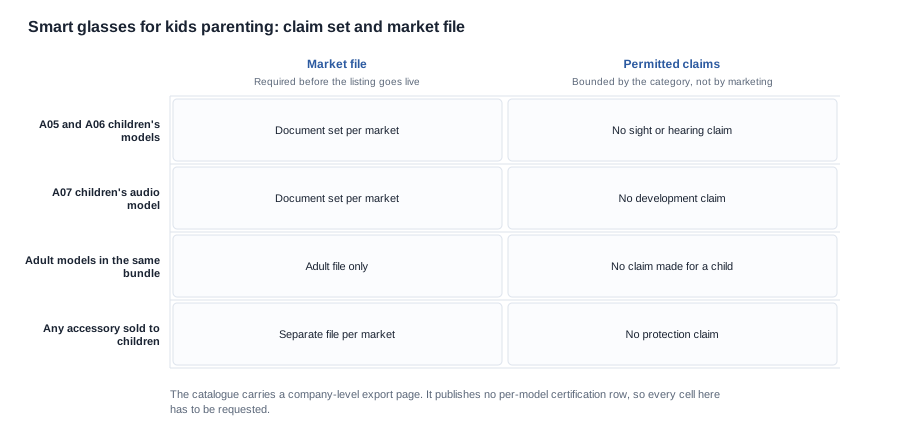
The catalogue's export page is company-level and cannot be used per model. The catalogue carries one page headed for export certification and it publishes no per-model certification row; the document text contains no CE, FCC or RoHS marking at all. So the buyer cannot infer a per-model certification scope from anything we publish, and every certificate number a buyer relies on has to be obtained as written material from the supplier and checked in the issuing body's public register. That is not a defect in the catalogue, it is the honest state of the file, and it is exactly why the claim set has to be requested rather than assumed.
Four categories of product, four different document routes. The matrix above pairs the market access requirement with the permitted claim language for each category of thing a buyer might put in a children's box: the A05 and the A06, the A07, an adult model bundled into the same offer, and any accessory sold to children. The row that gets skipped is usually the third one — an adult model placed in a bundle marketed to a parent — and it is the row where a claim set most often goes wrong.
The permitted claim set should be written down before any asset is made. It has to cover the product page, the packaging, the insert, the support script and the reseller's own copy, because in this segment the reseller's copy is usually the last document produced and the first one to be read. The agreed set should say what may be said about what the product does, in observable terms, and it should say what may not be said. Sight, hearing and development claims are outside it, and so is anything that implies the product treats, prevents or improves a condition.
The routine that goes with the claim set has to be written for the adult. A child is not going to assess a surface, choose a cloth or judge a prohibition list, and a routine that expects any of those things will not be followed and will produce the improvisation the routine exists to prevent. That is the design constraint, and it is a good one: it means the routine can be simple, because a single named item and a single named moment are all it needs to contain.
Smart glasses for kids parenting: a routine an adult actually owns
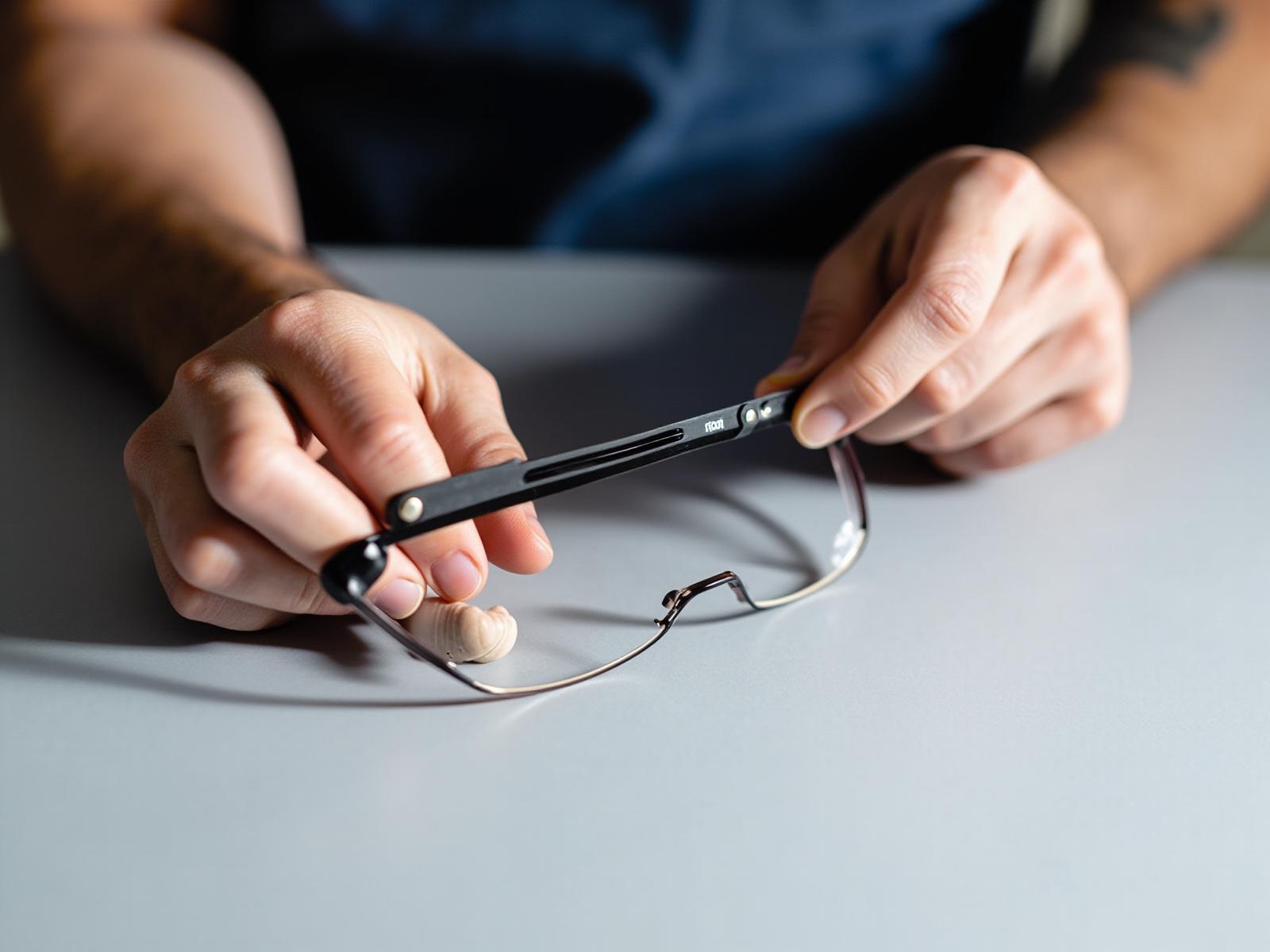
The adult is the operator, and the routine has to read like an instruction to an adult. It is one page, it is read once by the adult when the box is opened, and it is consulted afterwards only when something has gone wrong. The step order matters more than the detail: the box is opened, the device is read about, the lens is wiped once, the device is put on its dock, and a fault is reported rather than treated.

The frequency has to be low enough to survive. A weekly wipe of the lens and a check of the contacts when the unit will not charge are both realistic. A daily wipe is not, and a routine that is not followed is not a control, it is a line on a document that nobody believes. The commercial consequence is the consumable quantity: a weekly routine across a volume of units produces a rate that can be derived, whereas a daily routine that is quietly skipped produces a rate that can only be guessed at.
The storage position is the part that protects the unit most, and it is the part that is usually left to the family. A device that lives on a table or a bedside cabinet is a device that lives face-down at some point. The catalogue publishes case capacities on seven of the eleven camera models — 1400 mAh on the CY05 and the L1 Pro, and the CY03, 900 mAh or 1400 mAh as a configuration choice on the L2 Utral and 1200 mAh on the MT6's foldable case — with a case of unstated capacity on the KY06 and the MT5, no case published for the V03 Pro, and no charging-case row at all for the V03, the V06 or the S7. Whether a case ships in a children's configuration is therefore a per-model question, and a case is also a second lithium cell to declare, with the requirement at battery transport.
What the adult needs to be told about a fault, and what the adult must not be told to do. The instruction has to say that a damaged lens is reported rather than wiped harder, because the instinct to keep rubbing is what turns a surface defect into a claim. And it must not contain a repair instruction for anything the family could plausibly attempt, because a family that opens a unit is a family that has voided the warranty position.
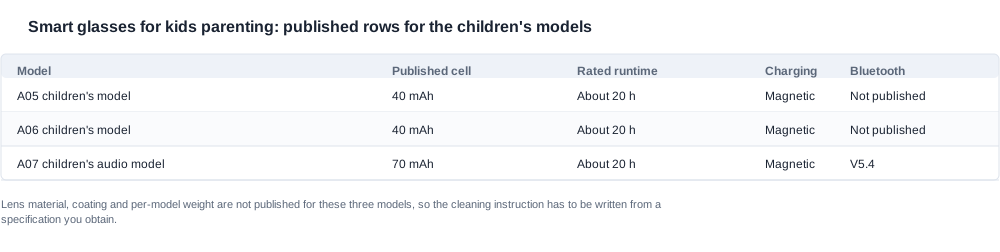
The published rows for the three children's models are narrow, and the gap between them and the routine is where the risk sits. The table gives the electrical rows that are published. The lens material, the coating and the per-model weight are not published for any of the three, which means the routine cannot be written from our documentation and has to be written from a specification the supplier provides in writing. A routine that recommends a specific agent without that specification is a recommendation the buyer cannot defend.
Those published rows, in the form a buyer compares them, are these, and the last column is the one that decides whether the unit can join a child's routine at all.
| Model | Published cell | Rated runtime | Charging interface | Bluetooth |
|---|---|---|---|---|
| A05 children's model | 40 mAh | About 20 h | Magnetic | Not published |
| A06 children's model | 40 mAh | About 20 h | Magnetic | Not published |
| A07 children's audio model | 70 mAh | About 20 h | Magnetic | V5.4 |
| Wider range, adult models | 220 mAh to 290 mAh | 5~8 h | Magnetic, Type C or unpublished | Not published for the camera models |
The wipe item itself is a decision, and it is decided differently here than in a fleet. In a fleet the item is a consumable issued against a rate; in a household it is an object that lives on a shelf and is used by whoever is nearest, which makes it a shared object with a hygiene dimension and a lifetime of its own. The trade-off a buyer is making is between a washable cloth, which is one item per unit but whose condition and storage nobody tracks, and a single-use item, which is a per-week cost but leaves no shared object in the house. The criteria are worth writing down before the order: the item must be one the adult can find without a search, it must not be a bottle that a child could open, and its unit cost has to be a number the brand can carry through a two-year programme. A buyer should also ask what the supplier's own recommendation is, because a supplier who has tested an item against a coating has information the buyer does not.
The pitfall to avoid is a "family pack" sold as a single accessory. A household kit that contains a spray, a cloth and an alcohol wipe looks generous and carries three risks at once: the spray may be applied to the lens, the alcohol wipe may be applied to the frame, and the pack invites a child to do the job. The design answer is a single named item in a single-use format, and it is also the cheaper answer once the number of units in the programme is counted.

Smart glasses for kids parenting: the market document set behind one insert
One cleaning instruction is the last artefact of the market file. It carries the prohibited agents, the storage rule, the fault-reporting route and the age-related handling instructions, and it is printed in the language of the market it ships into. When the market file changes, the insert changes with it, which is why an insert that was written first and the file that was assembled later will not agree.
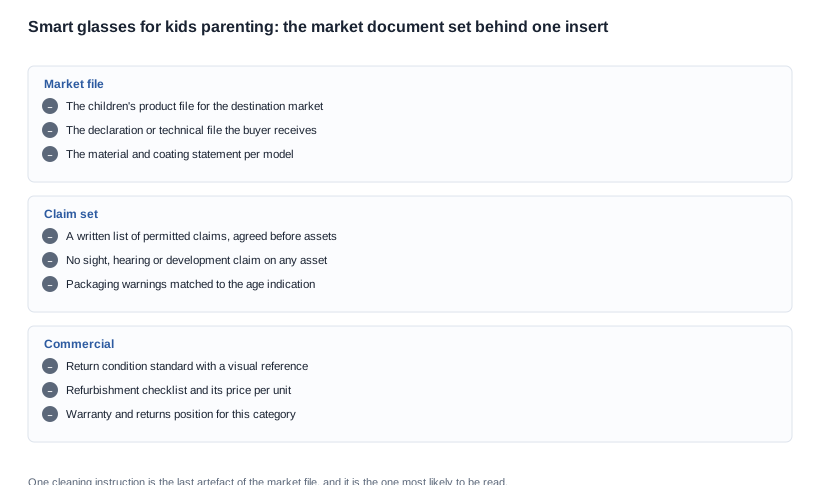
Eight requests close the file, and each one is a document rather than a conversation.
- The children's product file for the destination market. Ask for the file the buyer will receive, not a summary of it, and ask for it per market rather than for the home market. The market route for this segment is set out at children's product compliance.
- The permitted claim set, in writing, agreed before any asset is produced. Ask the supplier to state the claim set they will support and the claims they will refuse to support in writing, so that the disagreement happens on paper rather than after the artwork is printed.
- The material and coating statement per model. Ask specifically about the three children's models, and ask whether the surface treatment differs from the rest of the range.
- The labelling and warnings position. Ask which warnings the destination market requires and how they are placed, and check that the insert does not contradict them.
- The age indication and the independent-use boundary. Ask what the product is graded for, what a child can do without an adult, and what requires one. A listing that leaves a parent to discover the boundary is a support cost and a review.
- The warranty and returns position for this category. It differs from an adult product and it belongs in the quotation rather than in a later amendment. The channel context is at kids parenting warranty and returns.
- The return condition standard with a visual reference and the refurbishment checklist with its price per unit. A parent returning a device is usually making a decision about trust, and it converts into a public review.
- The designation table, the certificate register and the battery transport file for the shipped configuration. Certificate numbers have to be checked in the issuing body's public register, at certification checklist, and the transit file is at battery transport.
The training programme is part of the same file, and it belongs to the adult. A support script that explains the routine in two minutes, together with the insert, does more for the return rate than any consumable. How the adults are trained on the product is covered at how to train parents on kids smart glasses.

Smart glasses for kids parenting: the commercial cost of entering a children's market
In this segment the commercial question is about the position a product can take rather than about the price. A product placed for children carries documentation obligations and a warranty position that an adult equivalent does not, and both are costs that belong in the quotation. The returns reserve is again the block to insist on, because a return made by a parent is usually a decision about trust, and a decision about trust becomes a public review.
Compliance cost is per market, per product family, and it is almost never compressible. That makes the market count a commercial decision: entering three markets is three document sets, and the buyer should know the price of each before the market is announced. Where a market is added later, the change route should say what it costs and how long it takes, because a market added without that clause is paid for by the supplier and passed to the buyer in the next quotation.
The four questions worth putting in the first enquiry.
- What age is the product graded for, and how does that appear on the packaging?
- What can the user do without an adult, and what requires one?
- Which claims about the product are permitted in this market, and which will you not support?
- What is the warranty and returns position for a product in this category?
A buyer who asks all four in the first round is establishing which quotation is complete. A comparison only works between quotations that answer the same questions, and the question most often left unanswered in this segment is the claim set — which is the one that decides whether the asset can be sold at all.
The terms that move inside the order. The kit contents and their per-unit cost, and the frequency the routine specifies, since the frequency sets the consumable rate. Whether a lens film is supplied, and whether the factory applies it before packing. Whether the insert artwork is produced and reviewed by the supplier, and whether the support script is supplied with it. The wording of the return condition standard. Whether the refurbishment checklist is the supplier's or the buyer's, and whether a refurbishment partner is trained on it. Minimum order quantity tiers. Colour, logo, lens tint and packaging, including the insert, in each market's language. Splitting a first run into two deliveries against a staged payment, which suits a market entered in stages.
The terms that do not move. The lens material and the coating, and therefore what the routine may safely recommend. The certification cost and lead time for each market, which is fixed by the market rather than by the volume. The tooling line, amortised over the first order, stands apart from the unit price.
A scenario rather than a client project, worked through in the passage that follows. Assume a brand placing one of the children's models in a single market through a reseller, at a consumer price band, with a wipe item in the box. The first decision is the claim set, agreed in writing with the supplier before the product page is written, so that the page and the packaging say the same thing and neither says anything about sight, hearing or development. The second is the routine, which is one page for the adult, names a single item, sets a weekly frequency and attaches the wipe-down to the moment the device goes back on its dock. The third is the storage position, which follows from the configuration: if the configuration ships with a case, the case is named in the routine and the transit file covers it; if it does not, the routine says where the device lives instead. The fourth is the file, which is requested per market and attached to the quotation, including the declaration, the labelling position and the warranty and returns position. The outcome is a product that can be sold in the market it was documented for, a routine an adult will follow, and a claim set that will not need to be withdrawn.
Our position and the boundary of it. We publish the rows a buyer can order from, and we publish the absence of the rest with the same prominence. For the children's models that means the cell capacity, the rated runtime, the charge time and the charging interface, with Bluetooth V5.4 published on the A07 and no Bluetooth version published for the A05 or the A06. We publish the absence of the lens material, the coating, the surface treatment, any abrasion or chemical resistance figure and a per-model weight for these three models with the same prominence as the rows we do publish. We will not publish a maintenance recommendation for a lens whose material and coating we have not been given, we will not infer a per-model certification from the company-level export page, and we will not support a claim about sight, hearing or development for any model in the range.
What to send us next. Send the markets, the age indication you intend to use, the claim set you have already agreed with your reseller, the brand arrangement and the volume, and we will return the document set each market requires, which parts of the file sit on our side of the line, and what the routine and the insert should carry for the configuration you are ordering. The product range is at kids smart glasses, and the scenario entry point is smart glasses for parenting.
Related reading
- The returns side — kids parenting warranty and returns
- The training programme — how to train parents on kids smart glasses
- The channel situation — smart glasses for parenting
- kids smart glasses
Send the configuration, the quantity and the market, and we will say which parts of the children's programme are settled and which are yours.


