
Smart glasses for livestreaming are not a consumer product with a livestreaming use case. They are a production accessory whose failure is priced in broadcast slots, and that single change of currency decides the maintenance position. Our catalogue publishes the cell capacity, the charge time and the rated runtime for every camera model, the charging interface for seven of the eleven, and it publishes no lens material, no coating, no surface treatment and no runtime test condition. The consequence for a buyer is that the routine has to be scheduled into the show rather than left to the streamer, the power path has to be designed before the broadcast rather than improvised in the break, and the accessory kit has to contain a second unit.
Smart glasses for livestreaming: a dead segment is not a return
The buying task behind this article. The reader is a purchasing manager at the brand, a channel buyer or a product manager specifying a first-person camera product for a streaming operation, whether that is a creator programme the brand runs itself, a roster of partner streamers, or a reseller supplying small production units. The task is to decide what the maintenance routine is, what it costs the streamer in time, and what it costs the buyer when a broadcast is interrupted. The commercial risk being managed is a segment that does not happen, because the thing that failed was a charging contact and the thing that was missed was a slot.
What the published rows settle for a broadcast buyer. The camera tier publishes a resolution class, a cell capacity from 220 mAh to 290 mAh, a charge time of two hours or less on every camera model, a rated runtime, a charging interface on seven of the eleven and a colour count. The rated runtimes run at roughly seven hours on the MT6 and the CY05, and the L2 Utral and the CY03, and the L1 Pro, six to eight hours on the KY06 and the MT5, and five to eight hours on the V03 Pro and the V06, and the S7 and the V03. The charging interface is magnetic on the V06 and the MT5, the V03 and the S7, and the KY06, Type-C on the V03 Pro and the L2 Utral, and unpublished on the CY05 and the MT6, and the L1 Pro and the CY03, although those four publish a charging-case capacity. Not published for any model: the lens material, the coating, the surface treatment, any abrasion or chemical resistance figure, a per-model weight beyond the single 158 g whole-unit figure for the MT6, the field of view, the video specification and the runtime test condition.
Why the currency changes the decision. A consumer product that fails produces a return, which is a known cost with a known ceiling. A broadcast product that fails produces a slot, which is a revenue event, and the cost of a slot is usually higher than the cost of the unit that produced it. Every decision downstream follows from that: a maintenance step that takes thirty seconds is worth taking, a maintenance step that takes five minutes is worth scheduling, and a second charged unit is worth more than a better lens. The buyer is therefore optimising an uptime number, and the accessory kit is part of the uptime design rather than a courtesy item in the box.
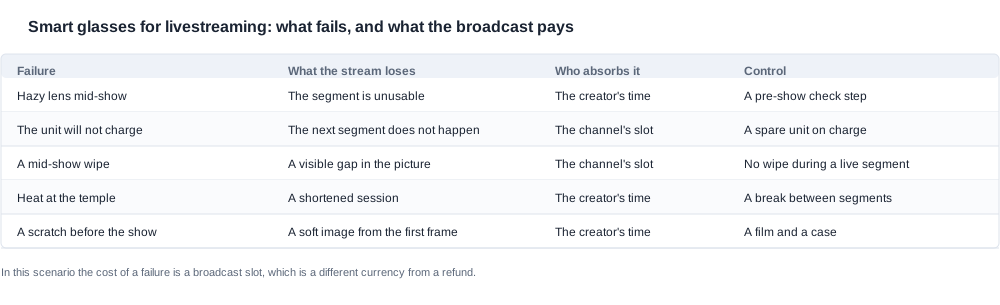
The table below prices the failures in the right currency. Notice that three of the five failures cost the channel a slot rather than the creator an evening, and that the control for all three is a pre-show step rather than a mid-show one. That is the whole of the livestreaming maintenance argument: the prevention has to happen before the broadcast starts, because during a live segment there is no moment in which the streamer can stop and fix a lens.
The review risk is still there, and it is a different cost. A stream that ends with a soft image produces comments and a clip that outlives the broadcast. That cost falls on the creator's channel and therefore on the brand's relationship with that creator, and it is the reason the pre-show lens check has to be written into the routine rather than assumed. The lens-side treatment is at cleaning lenses for livestreaming.
A claim the listing cannot carry. The lens material and the coating are not published for any model, so neither a material name nor a scratch-resistance figure can appear on a listing or an insert. The photochromic configuration on the V03 Pro is a different surface with different constraints, described at photochromic lens, and the general material background is at materials and ergonomics. A studio instruction therefore has to be restrictive: a named cloth, one motion, no solvent and no spray.
Smart glasses for livestreaming: the published row the show length comes from
The published runtime is the show length, and it is a range rather than a figure. A streamer who starts on a fully charged unit has roughly seven hours on a CY03, a CY05, an L1 Pro, an L2 Utral or an MT6, and between five and eight hours on a V03, a V03 Pro, a V06 or an S7. Because no runtime test condition is published, that number cannot be converted into a guaranteed segment length on the catalogue alone, which means the broadcast plan has to be built with margin rather than to the edge of the range. That is a procurement decision: the margin is bought as a second unit.
The same arithmetic, turned into a segment plan, looks like this, and it is the document the streamer is actually given.
| Point in the show | Unit state | Action | Cost if the step is skipped |
|---|---|---|---|
| Before the first segment | Charged, lens checked | Wipe once, check the contacts | A soft first frame on every clip |
| Mid-show segment | In use, untouched | Nothing at all | A visible gap in the picture |
| The break | Off air | Wipe the lens, confirm the charge | A missed segment |
| Second half | Second unit on air | Swap only if the fault recurs | A lost slot |
| After the show | Off air, contacts checked | Store lens-up, record the unit | A unit that will not charge next week |

The charge time decides whether one unit or two. Every camera model publishes a charge time of two hours or less, and a buyer has to plan against the two-hour end of that ceiling — which is longer than a typical break and long enough that a single unit cannot be recharged inside a show. The published case capacities give the second unit's budget: 1400 mAh on the CY03 and the L1 Pro, and the CY05, 900 mAh or 1400 mAh as a configuration choice on the L2 Utral, and 1200 mAh on the MT6's foldable case. A configuration that ships with a case has a second unit's worth of energy in the box, and a configuration that does not has to have one bought separately.
The interface decides where the second unit is charged. On the magnetic group the second unit needs a dock or the case, and the case becomes part of the kit rather than an accessory. On the Type-C group a second unit needs a cable, which is the cheapest possible answer. And on the four camera models where the charging method is unpublished, the buyer cannot state a charging requirement in the brief to a streamer at all, which is a practical problem for a support script as much as for the order.
The second unit is an accessory line and should be quoted as one. It is a per-creator item rather than a per-programme item, it has its own interface and its own charging location, and it has to be counted, stored and charged somewhere that is not the studio desk. A buyer who puts it in the kit with the cloth and the insert turns a durability problem into a logistics problem, which is a better trade.
Where the second unit is charged is a decision that belongs to the buyer and not to the creator. A creator who is asked to find a socket for a spare unit will not do it consistently, and a spare unit that is at forty per cent when the show starts is not a spare unit at all. The programme therefore specifies a charging location, a charge point count per active creator and a check on the night, and that is a line in the accessories plan rather than a line in the instruction. It also produces the programme's first useful measurement: the number of segments actually lost, which is the only figure that justifies the spare pool to a channel that buys on margins.
The condition of each unit has to be recorded, because the roster is the asset. Twenty creators with one unit each are twenty assets held in twenty places, and a programme that cannot say which unit is in service, which is on charge and which is at the workshop cannot manage its uptime. The record is one line per unit per session — identifier, creator, state — and it is what converts the interruption problem from an anecdote into a rate.
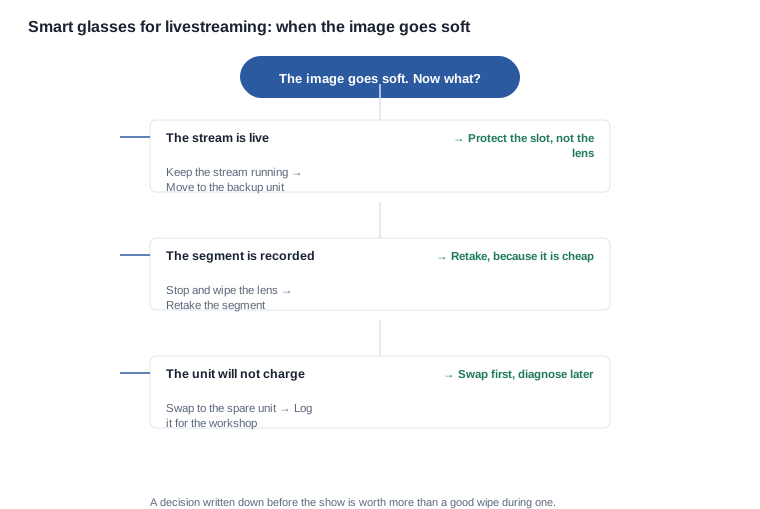
The decision tree for a mid-show fault is written before the show. Who keeps streaming, who swaps, who retakes — those three answers depend on whether the stream is live or recorded, and they cannot be worked out in the middle of a segment with an audience watching. The chart below is the decision, in the form a streamer could be given on a card.

Smart glasses for livestreaming: a lens that hazes between segments
A live segment has no pause inside it, so the wipe-down has to happen in the gap between segments. That is the design constraint for the whole routine, and it is a different constraint from the one that applies to a recorded shoot. In a recorded session the creator can stop; in a live broadcast the only safe moment is the break between blocks, and the length of that break is set by the broadcast schedule rather than by the routine.
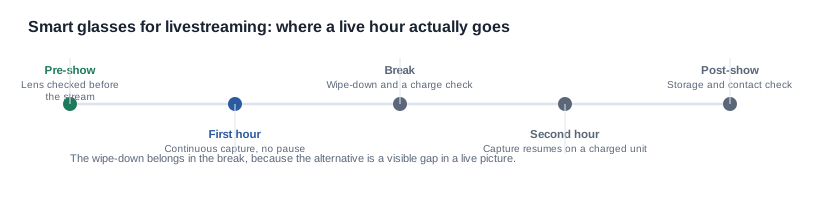
The timeline above is the shape of the maintenance window. The pre-show check is the only step that protects the picture, because it happens before the audience is watching. The break is where the wipe-down and the charge check happen. The post-show storage and contact check is what determines whether the unit is ready for the next broadcast, and it is the step most often skipped, which is how a unit that is fine on camera turns into a unit that will not charge the next week.
A haze that appears mid-broadcast is a production incident, not a maintenance problem. At that point the only decisions available are the three in the decision tree, and none of them involves cleaning the lens while the stream is running. The instruction for a streamer therefore has a rule attached to it — no wipe during a live segment — and that rule has to be printed, because the instinct to fix it immediately is what produces a visible gap in the picture.
The pre-show check is short and it has to be specific. A named cloth, one motion across the lens, a look at the contacts if the unit has not charged since the last session, and a check that the unit is in the state the lens was left in. Four things, all of them less than a minute, all of them attached to a moment the streamer already has. Anything longer does not get done before a broadcast, and what does not get done before a broadcast is done during one.
The storage position matters here for a reason that is specific to the format. A streamer who stops between broadcasts for a week leaves the unit wherever it was, and the case is what makes the storage rule enforceable. On the camera models where a case is published, the routine names it; on the models where no case is published, the routine has to name a place instead, and that is a weaker instruction and a weaker protection.
A second unit on charge also solves the storage problem. A unit that is charged and sitting on a dock has a defined position, and a defined position is what a storage rule needs.
Smart glasses for livestreaming: what to request before the insert is printed
Six requests close the file for a broadcast programme.
- The lens material and coating statement, per model, in writing. Ask for it per model, because the range includes a photochromic lens configuration on the V03 Pro and a different surface specification means a different instruction.
- A pre-show check step, written as a step. Ask the supplier whether it has a tested pre-show procedure for a first-person camera product, and ask for it in a form that fits on a card beside the unit. A supplier who has never tested a procedure is a supplier who is describing one.
- A charging behaviour test after a session, with the contacts in the state a streamer leaves them in. This is the failure that costs a slot, and it presents as a fault claim rather than as a routine gap.
- The runtime with its test condition, per model. Ask for the signal conditions, the start state and the end criterion for the published charge time. Without them the show length is a range and the margin is a guess.
- The factory-applied film question. Ask whether a film is available, at what per-unit cost, and whether it is applied before the unit reaches the buyer. On a product whose scratch becomes a published clip, a factory-applied film is the cheapest available reduction in the claim rate.
- The designation table, the certificate register and the battery transport file for the shipped configuration. The catalogue's export page is an image page, and the catalogue publishes no per-model certification row and no certification statement for a buyer to read on that page; its document text carries no CE, FCC or RoHS marking, so certificate numbers have to be supplied and checked in the issuing body's public register, at certification checklist. The transit file is at battery transport, and it has to cover the case if the case ships.
The document set a broadcast order should carry. The lens material and coating statement per model, the prohibited-agents list, the kit contents list with the per-unit consumable cost, the insert artwork, the pre-show check card, the return condition standard, the refurbishment checklist and its price, the model designation table, the certificate register and the agreed incoming inspection criteria. The contract terms page carries the clause language; the pricing page carries the commercial structure of a first order. The buying side of this scenario is collected at the livestreaming buying checklist.
Smart glasses for livestreaming: pricing the interruption rather than the parcel
A broadcast programme has a cost structure that a consumer channel does not, and the accessory kit is priced against it. The unit price is the smallest number in the model. The cost of a missed segment, the cost of a creator's evening and the cost of the second unit are all larger, and all three are consequences of the same thing — the device being in the wrong state at the wrong moment.
The terms that move inside the order. The kit contents and their per-unit cost, and the quantity per device and the resupply interval rather than whether the item is included. Whether the protective film is included, and whether the factory applies it. Whether the pre-show check card and the mid-show decision card are produced and reviewed by the supplier, because a card written by someone who has not run a broadcast will be wrong in the first minute of a live segment. Whether the second unit is in the box or sold as an accessory, which is the difference between a bundled cost and a per-creator cost that the creator can choose. The wording of the return condition standard. Whether the refurbishment checklist is the supplier's or the buyer's. Minimum order quantity tiers. Splitting a first run into two deliveries against a staged payment, which suits a roster that is built streamer by streamer.
The terms that do not move. The lens material and the coating, and therefore what the routine may safely recommend. The camera hardware, and therefore the ceiling on image quality. The certification cost and lead time. Tooling, amortised across the first order and quoted as a separate line rather than folded into the unit price, because a programme that grows has to re-quote the tool cost eventually.
The worked example below is written out as a scenario rather than a piece of client work. Assume a brand running a creator programme with twenty streamers, one camera model with a magnetic interface, one price band. The first decision is the margin: the published runtime leaves a range rather than a figure, so the programme ships a second charged unit per streamer as a line in the accessory kit rather than hoping for a break in the schedule. The second is the timing: the wipe-down and the charge check go into the break between segments, and the pre-show check is a printed card because it is the only step that protects the picture. The third is the prohibition: the insert names the spray and the solvent, and it says explicitly that nothing is wiped during a live segment, with the decision tree for a fault printed on the same card. The fourth is the film, factory-applied, because a scratch that reaches a published clip costs more than the film. The fifth is the documentation, covering the coating statement per model, the runtime test condition, the return condition standard, the refurbishment checklist and the designation and certificate material. The outcome is a programme whose segment loss is a measured number rather than a story, and a kit whose per-unit cost is small and whose uptime design is explicit.
Our position and the boundary of it. We publish the camera tier's resolution tiers, charge times, rated runtimes, charging interfaces, cell capacities, colour availability and case capacities exactly as the catalogue states them, and we publish the absence of lens material, coating specification, abrasion and chemical resistance data, the field of view, the video specification, a runtime test condition and a per-model weight beyond the single 158 g whole-unit figure for the MT6 with the same prominence. We will not publish a maintenance recommendation for a lens whose material and coating we have not been given, we will not state that any product in our range is tested to IP54, and we will not quote a show length from a rated runtime that carries no test condition.
What to send us next. Send the channel, the platforms, the price band, the number of creators, the length of a typical broadcast block and the interface you have decided on, and we will return which published rows apply, what the kit and the pre-show card should carry, which claims the listing can support, and which documents have to be settled before the insert is printed. The product range is at AI camera glasses, and the scenario entry point is smart glasses for livestreaming.
Related reading
- Where this scenario begins — smart glasses for livestreaming
- The range on offer — AI camera glasses
- The lens-side treatment — cleaning lenses for livestreaming
- The buying side — livestreaming buying checklist
Tell us the channel and the platforms, and we will say what the kit and the insert should contain.


