

Livestreaming is the hardest application in this category to specify, because the deciding rows are exactly the ones that are least often published. A camera product that is adequate for content creation is frequently unusable for a live session, and the difference shows up in the first session rather than in the sample. The checklist below is therefore not a list of features to compare. It is a list of rows, and each row carries an owner and a way of being closed — a published figure, a written answer, or a measurement on a sample.
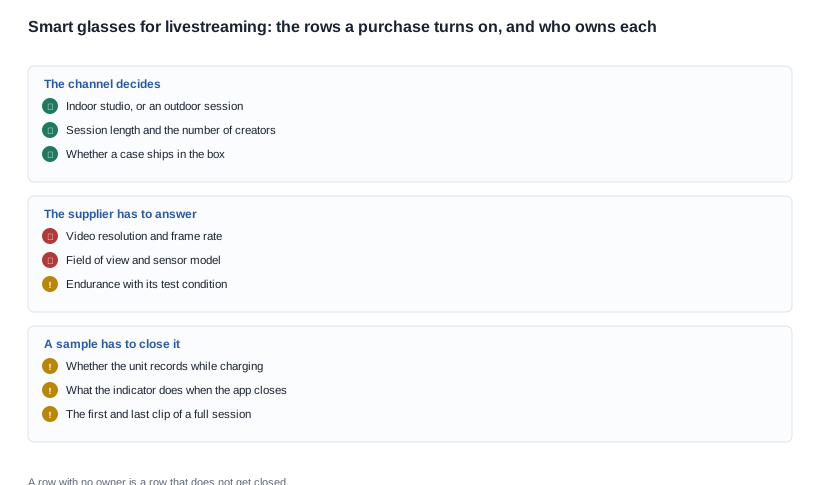
Smart glasses for livestreaming: a checklist is rows with owners
The reason most buying checklists fail in this category. A checklist is usually written as a list of things to ask about, which is a request list rather than a decision list. It does not say who answers, when the answer is needed, or what happens if the answer never comes. A livestreaming purchase has a hard deadline — the session date, or the channel launch — and a row that is still open on the day of the session is not a detail, it is a cancellation.
What is published and what is not, in one sentence. The camera range publishes cell capacity, charge time, rated use, charging interface, case capacity and a resolution class of 8 MP or 13 MP, and it publishes no video resolution, no frame rate, no field of view, no sensor model, no stabilisation data, no storage behaviour, no recording indicator behaviour, no Bluetooth version and no per-model certification row. That is the whole of the evidence base a buyer has to work from, and the checklist is the instrument for turning a short evidence base into a decision.
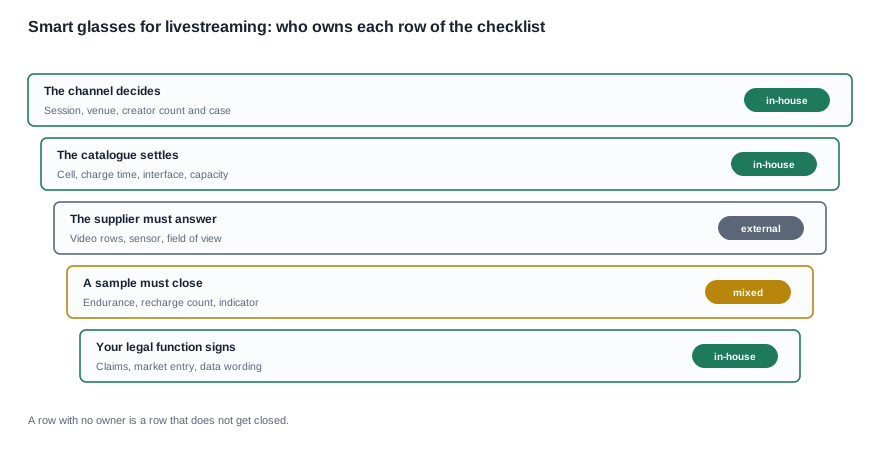
Three owners, and the three lists they produce. The channel decides the session, the venue, the creator count and whether a case ships in the box. The catalogue settles the electrical rows and the resolution class. The supplier has to answer the camera rows, the sensor and the field of view. A sample has to close the endurance, the recharge count and the indicator behaviour. And your own legal function signs the claims, the market-entry position and the data wording. A checklist that mixes these owners into one list is a checklist nobody can action, because each row needs a different kind of evidence.
The rule that makes the checklist work. A row is closed when it carries a value that somebody committed to, in a document that can be produced later. An adjective is not a value. A promise to confirm is not a value. A figure copied from a neighbouring model is not a value, and in this catalogue that last failure is easy because the rows genuinely are close together.
The rows, the published position, and what closes them
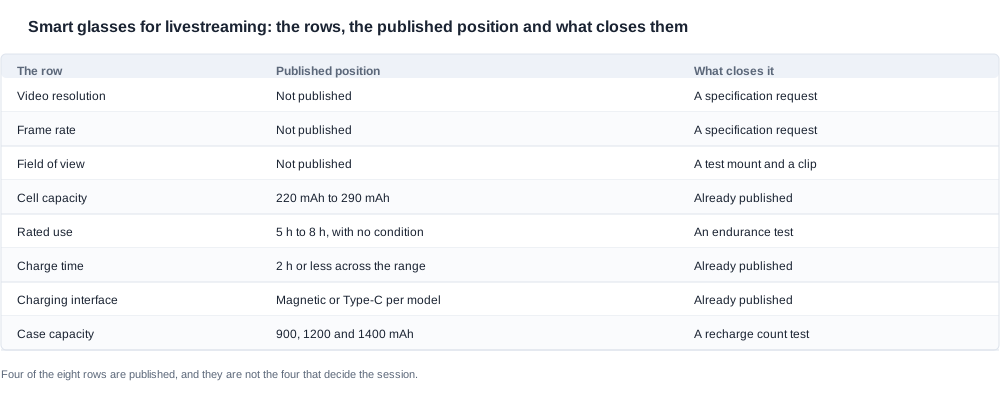
Row one, the video resolution and the frame rate. Not published in our documentation, and for a livestream this is the first row and the hardest to substitute. A product recording stills or a low-rate video cannot carry a live feed, and no amount of marketing language fixes it. What closes this row is a specification request against a named model, and if the answer is an adjective the row is not closed.
Row two, the field of view. Not published. It determines whether a presenter has to frame themselves or can move naturally, and it is the difference between footage that reads as produced and footage that reads as a webcam. It is also the row that decides the mount, because a wider view is what a mount is chosen to capture. What closes it is a test mount and a clip from the actual shooting position.
Row three, the storage behaviour. Not published. For a livestream this is secondary, since a session is generally relayed rather than stored, but if the device also records locally the behaviour still determines whether a three-hour session ends with a complete recording. What closes it is a specification request and, in the case of a recording device, a transfer test with a large file.
Row four, the battery with the camera active. The camera models publish cell capacities from 220 mAh to 290 mAh and a rated use between about seven hours and a band of five to eight hours, with no test condition stated. A livestream needs the camera active for the whole session, which is the least favourable condition the figure could describe. What closes this row is an endurance test on a sample at the full session length.
Row five, the charging interface and the case. The interface is published per model — magnetic on the V03 and the V06, and the MT5 and the KY06, and the S7, Type-C on the V03 Pro and the L2 Utral, and no interface row at all for the CY03 and the MT6, and the CY05 and the L1 Pro. The case capacity is published at 900, 1200 and 1400 mAh on five camera models, with two more publishing a case whose capacity is not published and four publishing no case row at all, which is a supplier question rather than a catalogue lookup. What closes this row is a recharge count measured on a sample, plus a written answer on whether the unit accepts power while recording.
Row six, the recording indicator. A livestream is a live broadcast, which is the most public form of recording there is. Whether the indicator is hardware, firmware or application-only — and what happens when the application is not running — is a row nobody publishes and everybody depends on. What closes it is the indicator behaviour, tested with the application closed.
Row seven, the front element. Not a specification row and yet decisive. A live front element is on screen for the whole session, and a fingerprint is visible in a way it never is in a still. The lens material is not published for any model, so the instruction has to be restrictive, and the cloth has to ship with the device. What closes it is a wipe instruction in the box, and it is the cheapest row on the list to close.
The rows nobody writes down, and they matter more than four of the seven above. Where the units are shipped and who receives them. Whether the channel already carries one cable type, which decides the interface programme. Whether a second unit is held as a spare. Whether the session is indoors or outdoors. And what the channel does when a unit fails mid-session, which is a run-sheet item rather than a product item and is the cheapest insurance in the category.
The order a livestreaming purchase gets cleared in

Step one is to write the session in the seller's own words. Length, platform, venue, number of creators, whether the device travels. A checklist written against a vague brief produces a vague answer, and a vague answer on the video rows is the most expensive outcome in the category.
Step two is to separate the rows the catalogue answers from the rows it does not, and put both on one sheet. The separation is what turns a checklist into a plan, because the two halves have different lead times: the published half can be written today, and the unpublished half has to be requested, and the request is the thing that takes weeks.
Step three is to send every unpublished row in a single message. Not a list of questions across a fortnight, but one request against named models with a date on it. A single request also has a diagnostic value that a drip-fed set of questions does not: the reply tells you how the supplier's documentation actually works, which is information a buyer needs before committing a quantity.
Step four is to run the endurance test on a sample, with the camera active, for the full session length. A shortened test tells you that the device survived, which is not the question. The question is where it was when the session ended, and a test that stops at the point of failure is a test that has already found the answer.
Step five is to test the mount in the position it will be used from, and record the angle and the stability. A mount is not in this catalogue, so the specification is the buyer's own document, and it has to be tested rather than assumed. This is the step most programmes skip, and it is the one most likely to make a good camera produce unusable footage.
Step six is to write the specification sheet from the answered rows only, and keep the open rows on a dated list. A specification sheet with an open row on it is a document that will be signed with a hole in it, and the hole is where the refund comes from.
Session length against interface, and the case that follows
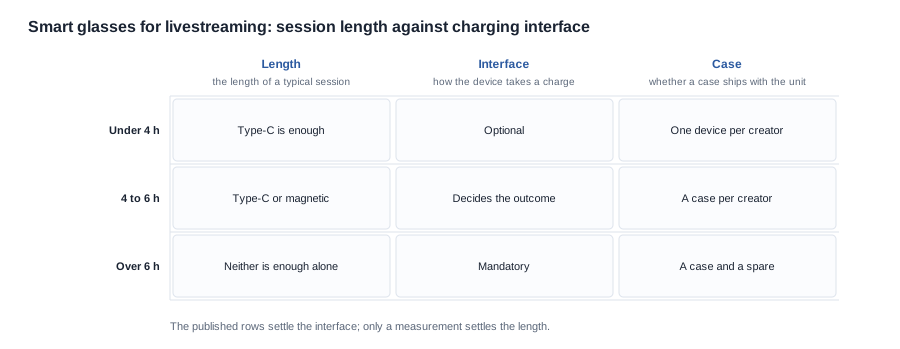
The matrix is a decision aid, not a published specification. The published rows settle the interface. Only a measurement settles the length, because the rated use figures are bands without a test condition and a camera-active load is the least favourable case. The matrix therefore says what has to be measured, not what the answer is.
Under four hours, the interface is a convenience question. The published rated band on the camera range is five to eight hours on four models, six to eight hours on two and about seven hours on five, so a session of this length sits inside the published range for every camera model in the catalogue — provided the camera is not running for the whole of it, which is exactly the assumption the measurement has to test. A case is optional at this length, and one device per creator is enough.
Four to six hours, the case decides the outcome. The session is still inside the published band on paper, but the margin has gone and the unit is carrying a camera workload throughout. Here the case configuration becomes the decision rather than the model, and the two questions to settle are the case's own charge time and the measured recharge count, neither of which is published for any model.
Over six hours, the case is mandatory and a spare is part of the configuration. The published band tops out at eight hours on the four models that publish it, and the honest reading of that band is a range rather than a promise. At this length a single unit with no buffer is a decision that has been made by omission.
What the interface actually decides, and it is not the session. Magnetic charging on the S7 and the KY06, and the V06 and the MT5, and the V03 means the case is part of the charging architecture and the lead is a proprietary consumable. Type-C on the V03 Pro and the L2 Utral means the case is optional and the lead is a commodity. And for the CY05 and the CY03, and the MT6 and the L1 Pro the catalogue prints no interface row, so for those four models the interface is an open question that has to be asked before the case can be assessed.
Whether a row is ready for the specification sheet
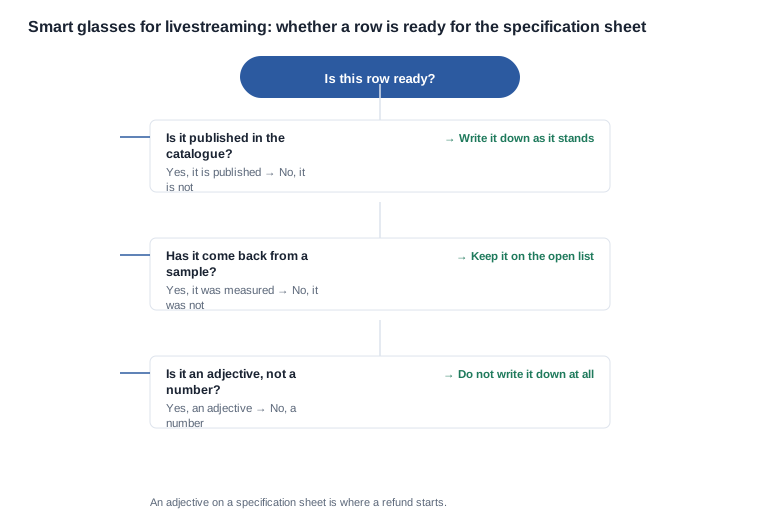
The first branch is the published rows. If the row is in the catalogue, it is written exactly as the catalogue states it, with the caveat attached, and the buyer does not get to round it. A charge time of two hours or less is written as two hours or less. A rated use of about seven hours is written with the absence of a test condition stated. A resolution class of 8 MP or 13 MP is written as a resolution class and not as a video specification.
The second branch is the sample. A row that has come back measured is written down with the measurement attached and the conditions noted. A row that has not been measured stays on the open list with a date against it, and it does not go on the specification sheet, because a specification sheet is a commitment and an open row is not one.
The third branch catches the failure mode that is hardest to detect later. If a row has come back as an adjective rather than a number, it does not go on the sheet at all. "Excellent imaging" and "long battery life" are not rows, and the reason they are dangerous is that they are unfalsifiable: nobody can prove them wrong, which is why they survive every review and end up on a live product page.
The two questions a buyer should ask about their own checklist. Which rows are still open, and who owns each one. And which open rows would change the model choice if they came back badly. Those two questions turn a checklist into a shortlist, because most open rows are survivable and one or two of them are fatal.
How to choose between two models that both clear the checklist. The criteria that survive contact with a deadline are the published ones: which model has a published case row, which has a published charging interface, which has the larger published cell, and which one the supplier will commit to on the video rows in writing. Everything else is a preference, and a preference is a legitimate reason to choose but it is not a due diligence finding.
The questions to put in writing before the order
Three questions, in this order, because each one determines whether the next is worth asking. What is the maximum continuous recording time, and what is the video specification? If either answer is an adjective, stop there — the product cannot be specified, and the conversation should move to a supplier who will answer. Does the unit accept power while recording, and does the case support it? This determines whether a long session is a battery question or a logistics one. And is the recording indicator hardware or firmware, and what does it do when the application is closed? A live broadcast with no reliable indicator is a channel risk rather than a customer one.
If all three come back answered, the product is worth evaluating. If one comes back with a promise to confirm, that row is not a row yet and it does not belong on the specification sheet. That rule is the whole difference between a checklist and a wish list, and it is worth writing into the review process, because the pressure to convert an open row into a closed one always arrives at the same moment: a day before the quantity is committed.
The three things to ask the supplier about the programme rather than the product. Whether the sample programme can be scoped to close the four camera rows rather than to demo the device, which is a different brief and a different cost. Whether the documentation for the exact configuration ordered will exist, including the case where a case is included, because the case is a second lithium cell and the transit file has to cover the configuration. And what the response commitment is on a technical answer, because a livestreaming channel's biggest cost after the device is a desk waiting for a date it does not have.
The commercial terms that belong on the same sheet as the checklist rows, because they decide what happens when a row comes back badly. The unit price and the price tier it applies to, so that a re-order at a different tier is a known number rather than a negotiation. The minimum order quantity for the device and, separately, for the accessory set, because a per-creator consumable has a different order profile from a device and the two are frequently quoted as one. Payment terms and the deposit structure, with an inspection point before the balance, because a livestreaming channel cannot inspect a thousand units. Packaging specification and the transit documentation for a configuration that includes a case, which is where the freight and the compliance cost actually sit. The warranty period with a stated response time and a returns policy that names the reason codes. And tooling, quoted as its own line with the amortisation stated, so that a second run in a second market can be costed.
The due diligence sequence, which is the order the rows should be closed in. A procurement manager running this checklist should work through it as: the supplier evaluation, which tells you whether the camera rows will ever come back; the sample order, which closes them; the contractual review, which puts the published rows and the measured results into the agreement; the certification route, which has the longest lead time of anything in the programme and is per product family; and the purchase order, which is the last step rather than the first. A supplier evaluation that asks only for the unit price at a volume tier has skipped the step that decides whether the purchase succeeds.
The risk management point that applies to every row on the sheet. The four unpublished camera rows, the storage behaviour, the data location and the certification position are all items a regulator, a retailer or a customer can ask about after the fact, and a channel that has not closed them in advance has a compliance exposure that sits on the brand rather than on the factory. A distributor or a brand owner who cannot answer those four questions with a document is carrying a risk that no price reduction compensates for.
Our position. We will give you the published configuration for any model and mark the rows we do not hold. We will not tell a livestreaming channel that a model is suitable for streaming when the rows that determine it are unpublished, and we will not substitute a figure from another product for one of our own missing rows. Our view is that the honest livestreaming proposition from this catalogue is the camera range with its published figures, and that a buyer should close the four unpublished camera rows before committing to a quantity. The application framework is at smart glasses for livestreaming, the configurations are on the AI camera glasses range page, and the accessory programme that carries the running cost is at livestreaming accessories.
What to send us next. Send the session length, the venue, the platform, the creator count and the destination market, and we will return the checklist with the owner marked against each row, the published figure where one exists, and the three rows that only a sample can close.
Related reading
- The livestreaming routine — the wipe-down procedure
- Livestreaming safety considerations — the non-hardware constraints
- AI camera glasses range — published configurations
- Sample evaluation — how to scope the sample programme
Send the session length, the venue and the creator count, and we will return the checklist with an owner against every row.


