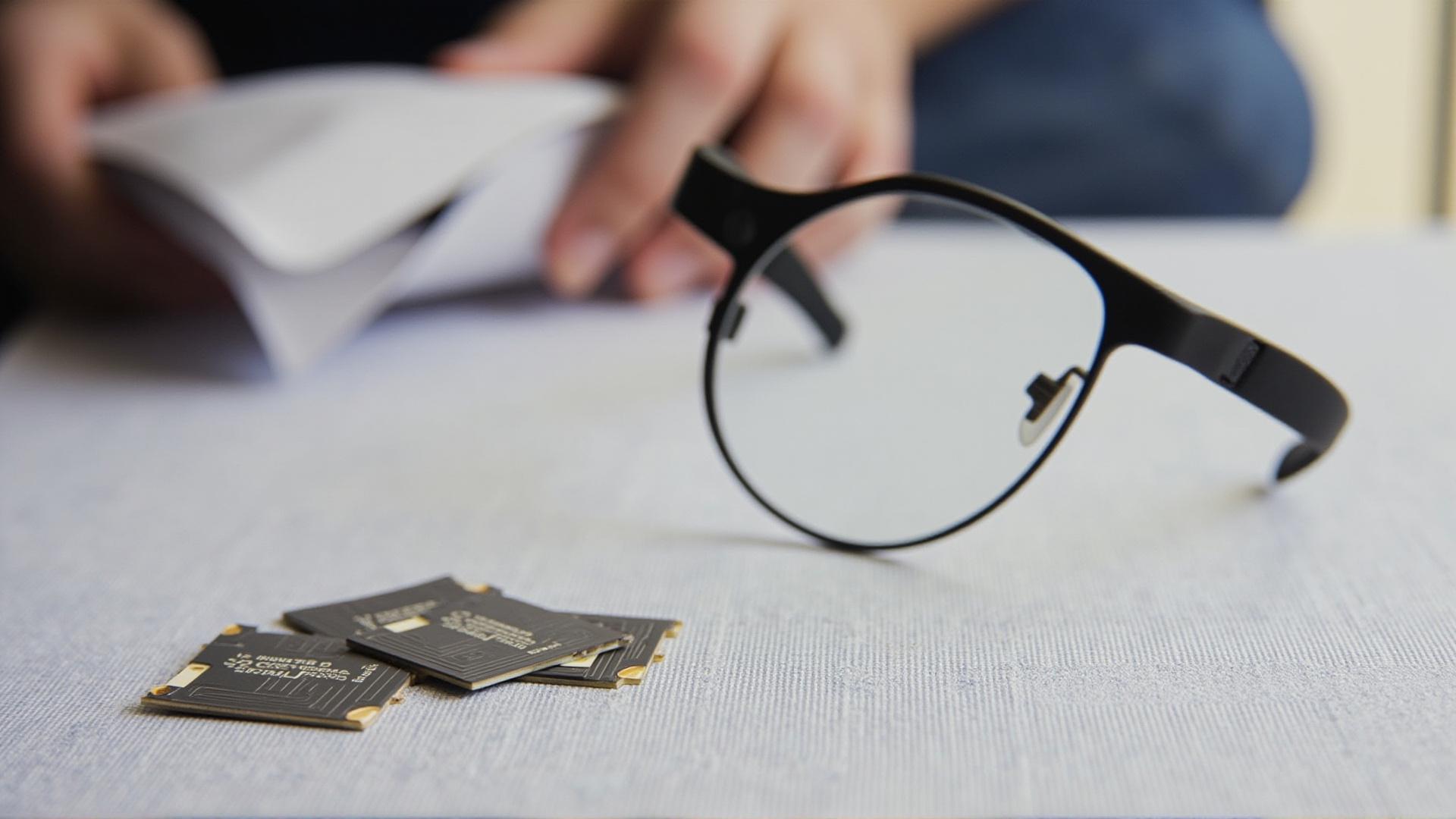
Smart glasses for office: a desk unit is not an accessory
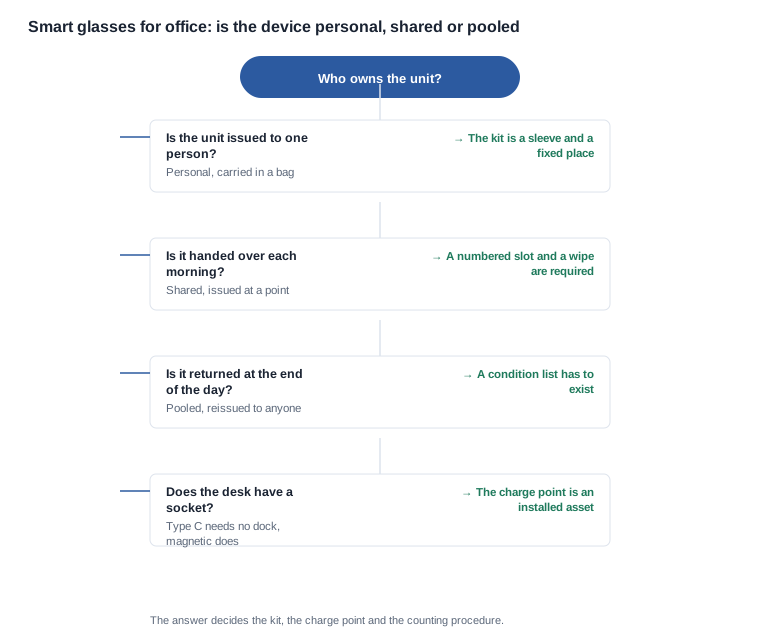
The short answer. The office kit is not a travel kit, and the mistake is to design it as one. In an office the device does not live in a bag all day; it lives on a desk, goes into a bag at midday, and comes back at the end of the afternoon. That single behaviour creates the quiet cost in this category, and it is quiet because it never appears as a complaint. A unit that goes into a bag at lunchtime and is not found at the end of the day is not a lost sale — it is a second order, which the accounts read as a repeat purchase and which is in reality a loss. The kit therefore has to do two things at once: it has to make the return path real, and it has to make the loss visible. A sleeve, a fixed desk position, a numbered slot for a shared pool and a consumable per unit are four different ways of doing that, and which one applies is decided by who owns the unit at four o'clock in the afternoon. A procurement manager who settles that question before the order is placing one of the cheapest loss-reduction levers available in this category.
Who is specifying the kit, and what they are defending. The reader is a buyer working for a brand, a channel buyer or a product manager specifying an office or hybrid-work audio product, and the decision in front of them is where the device lives during the working day and which consumables and storage items support that answer. What is being defended is not the unit. It is the unit's replacement rate, and the reason it is the wrong thing to defend last is that a replacement purchase is invisible in the unit economics until somebody separates the two. A channel that sells to an office of forty people and sees ninety units a quarter should be able to state how many of those units were bought twice.
Why two office kits for the same device can cost very different amounts. The published rows for the audio tier are close together, so the divergence between two quotations is rarely the battery. It is the charging interface, because the interface decides whether a floor needs a dock installed at every desk or whether the cable the employee already owns is enough. Our catalogue splits the charging method three ways across the twenty-eight models: seventeen are magnetic, seven publish a Type C interface, and four publish neither a charging method nor a charging port row. In the audio tier specifically, the Type C models are the D11 and the D12, and the other six audio models are magnetic; the sport tier adds the D17 and the ZH12 on Type C, and the bone-conduction entry sits outside both tiers. A magnetic product in an office is a dock per desk, which is an installation and a maintenance line rather than a per-unit line, and it is why the interface question is worth negotiating separately from the unit price. The charging decisions are at charging solutions, and the product ranges are at Bluetooth audio glasses and sport smart glasses.
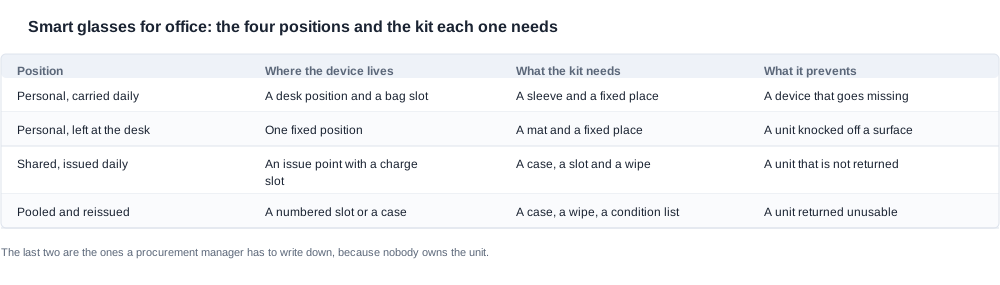

The four positions and the kit each one needs
The table is the working version of an office storage decision. Each row names the position, where the device actually lives during the day, what the kit has to contain, and the failure it removes. The last two rows are the ones that need a written position rather than a good habit, because in both of them nobody owns the unit at the end of the day.
A personal unit that is carried daily needs a sleeve and a fixed place. The sleeve handles the bag, and the fixed place handles the desk. Neither is expensive and neither is a catalogue line, but both have to be stated in the packaging and the insert, because a device that has a designated place at a desk is not the same as a device that is put down somewhere near the keyboard. The commercial risk is on the second row rather than the first: a unit that lives on a desk is knocked off a desk, and a knock is a warranty event that arrives with a story attached to it.
A shared unit that is issued each morning needs a slot, a case and a wipe. The slot is what makes the return path real, because a unit with a number on it is a unit that can be counted at the end of the day. A unit without a number is a unit that is simply not there, and nobody notices the absence of a thing that was never recorded as present. The wipe matters more in a shared environment than in a personal one, because a shared cloth is a cross-contamination route as well as an abrasive one.
A pooled unit that is reissued to anyone needs a condition list. The condition list is the document that decides what state a unit has to be in when it comes back, and it is the difference between a pooled fleet and a collection of used units. Its content is specific rather than general: the lens surface, the charging contacts, the open-ear sound outlets, and the case if one is in the configuration. Without it, the returns desk argues case by case, and the argument is always about the same three surfaces.
What the published audio rows mean for a desk station. The audio tier splits into three cell groups. The K01 and the K02 publish two 90 mAh cells, a rated runtime of about eight hours and a Bluetooth version of V5.3, and neither publishes a touch row, so the temple control on both is a question for the supplier. The D11 and the D12 publish a single 100 mAh cell, about seven hours and a Type C interface, and the D11 publishes a surround-sound row that the D12 does not. The LC-105 pair, the G07 and the YK12 publish two 55 mAh cells, magnetic charging, a Bluetooth version of V5.4, and runtimes of six to eight hours — with the G07 and the YK12 publishing the lower end, about six hours, and also publishing the detachable temples, ultra-slim on the G07 and slim on the YK12. A desk station sized on the LC-105 group has to assume six hours for two of the three models in it, and a buyer who reads the group as a uniform eight hours is planning a recharge that does not exist.
The structural features matter more in an office than in any other channel, because of the replaceable parts. The G07 publishes ultra-slim detachable temples and the YK12 publishes slim detachable temples, and a detachable temple is a sizing system rather than a cosmetic feature: one outer frame can serve different face shapes, and a temple that is replaceable is a part rather than a write-off. A buyer who has not asked whether spare temples are available has quietly decided to replace devices instead, and that decision appears as a warranty cost rather than as an accessory order. A pair of split temples also changes what a shared desk can be: the same unit serves two people, which is the cheapest way to halve a fleet.
What is not published, and therefore cannot be used to select anything. The frame material, the surface treatment, the lens material, a frame weight, a runtime test condition and a cycle life rating are all unpublished for this range, and the single weight figure in the catalogue is 158 g for the MT6, a camera model that is not an office model. A routine that recommends a treatment for a surface whose material is unknown has to be restrictive rather than permissive, and a desk environment makes that concrete because the most common desk product is a solvent wipe, which is the most damaging thing on a list of possible treatments.

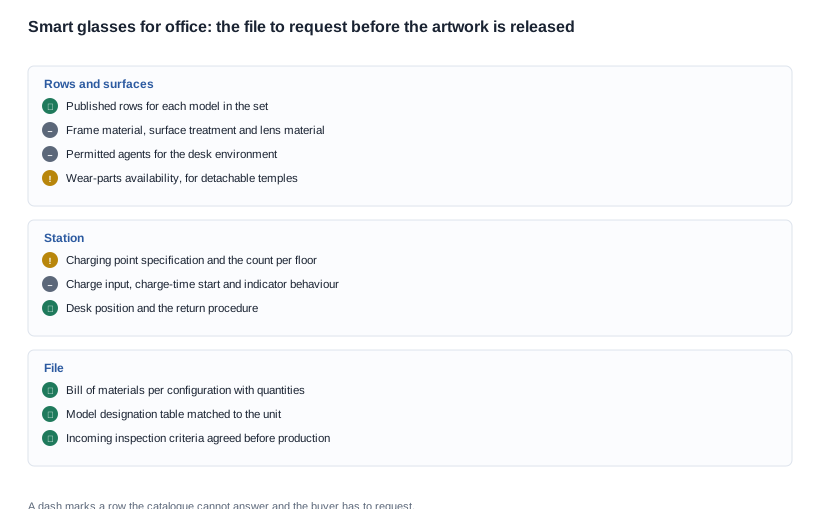
The file that makes an office kit quotable
An office kit is decided by a small number of documents, and each request below has a completion standard. The standard matters here because an office buyer is scoring a supplier against a written requirement list, and a supplier that answers every row affirmatively is less useful than one that marks the open rows.
- The bill of materials per configuration with quantities. The completion standard is a document that separates the consumables from the orderable accessories, because the two are re-ordered on different cycles and at different minimum order quantities, and because the slot and the condition list are neither of them a physical line at all.
- The published rows for each model in the set. The completion standard is the model, the cell, the runtime, the charge time, the interface, the Bluetooth version and the structural features, copied rather than summarised, so that the station plan is built on the catalogue and not on a range description.
- The frame material, the surface treatment and the lens material, in writing. The completion standard is a statement per model, because it is the statement that makes the permitted-agents list possible and the insert instruction specific.
- The list of agents permitted and prohibited in a desk environment. The completion standard is a list the insert can quote, and it has to name solvent wipes explicitly, because that is the product on the desk and it is the one that does the damage.
- The replaceable-parts availability statement. The completion standard is a yes or a no per detachable part, and a route to obtain a spare. For the G07 and the YK12 this decides whether a bent temple is a consumable or a write-off.
- The charging point specification and the count per floor. The completion standard is a plan with a number, and it has to state how many units charge simultaneously, because that is the number that decides whether a floor of forty people needs one dock or ten.
- The charge input, the charge-time starting point and the indicator behaviour. The completion standard is a written answer per model; none of the three is published for any model, and the indicator behaviour is what tells somebody at a desk that the unit is on.
- The desk position and the return procedure. The completion standard is an instruction that a person who was not consulted can follow, tested once with a colleague who has not seen the product.
- The model designation table and the incoming inspection criteria. The completion standard is that the designation on the unit resolves to the paperwork, applied to a stated sample of the production lot. The register procedure is at certification checklist and the battery transport file is at battery transport.

Where an office kit quietly costs money
The unit that was bought twice. This is the central cost and it is invisible in the accounts, because a replacement order reads like a second sale. The control is a number the channel agrees to measure: the ratio of units drawn in a quarter to units shipped in a quarter, per desk. A ratio above one is a loss rate dressed as a sale, and a kit that has no return path is the reason.
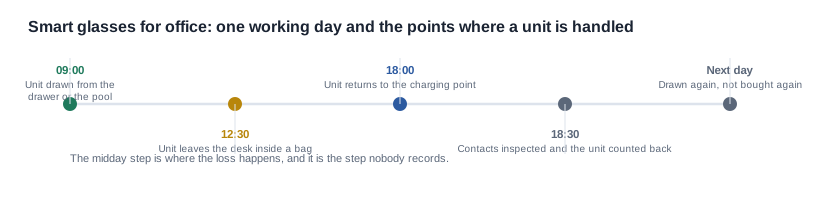
The unit that went into a bag at lunchtime. Nobody records the moment a unit leaves the desk, so the loss is discovered by absence rather than by exception. The control is a position that the unit has to come back to, and a count at the end of the day in a pooled or shared deployment.
The unit that was returned in an unusable state. Without a condition list, a unit with a fouled charging contact or a marked lens goes back into the pool, and the next person reports a fault. The control is a condition list with three named surfaces, and a wipe at the issue point.
The desk that collected dust. A unit on a desk all day collects dust on the charging contacts and in the open-ear sound outlets, and the outlets are the more expensive of the two because a muffled-audio complaint is reported as a hardware fault and is not reproducible on a support agent's desk. The control is a routine on the insert that names the outlets, which costs nothing beyond a line in the copy.
The consumables that were not in the box. In a shared office the wipe is a shared cloth, which is a cross-contamination route as well as an abrasive one, and the improvised wipe with whatever is on the desk is the commonest cause of a scratch claim. The control is a single-use item in the box, and a reorder interval agreed against the observed rate.
The unit that crossed between desks. A hybrid team is the hardest case in this channel, because the unit is used on Monday by one person at a desk and on Thursday by another in a different room, and the return path is a person remembering. A desk position only works for the person who owns that desk, and a pooled position only works if there is an issue point somewhere in the building. The control is to treat a hybrid floor as a pooled floor with a number of issue points, and to count the units against those points rather than against the headcount, because the headcount is not what goes missing.
The interface that was left to the employee. A magnetic product in an office means a dock at every desk, and a dock that is not placed is a unit that goes to the end of the day on the same charge it started with. The control is the count per floor, agreed before the order, and it is an installation cost rather than a per-unit cost.
The commercial terms of an office channel, and what to send us next
The loss rate is the commercial term nobody negotiates, and it is the one with the largest number attached. A device that is bought twice is paid for twice, and the second purchase competes for the same shelf space and the same budget as a new customer. The terms worth writing down are the ratio of units drawn to units shipped, the reporting period, the party that owns a unit that is not returned, and the replacement treatment. A buyer who has those four in the agreement can price the loss; a buyer without them discovers it.
Whether a case, a sleeve or a slot is the storage answer is a procurement decision with different cost shapes. A sleeve is a consumable that is re-ordered and never counted. A case is an asset that is counted, insured and returned, and it is also a second lithium cell that has to be declared for transport. A slot is neither a product nor a consumable; it is a packaging and logistics decision that has to be reflected in the artwork and the carton dimensions. Mixing the three in one quotation hides the difference between them.
The consumable model and its per-unit cost are worth negotiating on their own. A single-use item and a washable cloth differ by a small per-unit amount, and the difference across a floor of forty people is small enough to be decided in one conversation and large enough to be worth having. The quantity to negotiate is the quantity per unit per month and the restock interval, and the interval should be set from the rate observed over the first quarter.
What cannot be moved, because it is fixed before the commercial conversation starts. The frame material, the surface treatment and the lens material of any given model, and therefore the routine the insert can safely recommend. The cell configuration, the charging interface, the charge time and the runtime ceiling. Certification cost and its lead time follow the process and the testing body rather than the order size. Tooling and mould cost is a third category and the one most often bundled: tooling is normally amortised across an order while certification cost follows the product family, and a blended line hides a cost that repeats on every future order next to one that does not. Ask which line the quotation is charging.
The terms worth putting in the order. The published rows for each model in the set. The bill of materials per configuration with the consumables separated. The storage position, the slot scheme and the condition list. The charging point plan with its count per floor. The permitted-agents statement. The replaceable-parts availability statement. The loss-ratio reporting terms, with a period and an owner. The warranty period with a stated response, and the treatment of a unit returned with a missing accessory. The building blocks are at pricing, contract terms, MOQ and payment terms.
What we publish, and where we stop. We publish the audio tier's Bluetooth versions, cell configurations, rated runtimes, charge times, charging interfaces and structural feature rows exactly as the catalogue states them, and we publish the absence of the frame material, the surface treatment, the lens material, a frame weight, a cycle life rating and a runtime test condition with the same prominence. We will not publish a handling instruction for a surface whose material and treatment we have not been given, and we will not quote a replacement rate for a channel that has not measured one.
What to send us. Send the floor size, whether the unit is personal, shared or pooled, the channel, the price band and the markets, and we will tell you which published rows apply, what the storage position and the consumables should be, which four questions have to be settled before the packaging is signed, and which published rows do not cover the routine you are planning. The scenario entry point is smart glasses for office, the kit list is at the office gear checklist, and the longer-run behaviour is at office long-term use.
Related reading
- Where this scenario begins — smart glasses for office
- The range on offer — Bluetooth audio glasses
- The kit list — office gear checklist
- The charging decisions — charging solutions
Tell us the floor size and whether the unit is shared, and we will say what the storage position and the consumables should be and which number to measure.