

Smart glasses for office: not twenty units, but the layers around them
The hardware in an office deployment is the smallest part of what an IT team ends up owning. A twenty-unit issue also produces a set of charging points, a set of cases, a stock of hygiene consumables, a storage arrangement, a spare pool, and a second lithium cell count for every case in the building — and each of those has a different owner, a different cost treatment and a different failure mode. A gear list that lists only the twenty units is a shopping list, and it is the reason the second month of a deployment is where the problems start.
The decisive fact is the charging interface, and it is not uniform. Of the eleven camera models, five publish magnetic charging — the KY06 and the V06, and the S7 and the MT5, and the V03 — two publish Type-C — the V03 Pro and the L2 Utral — and four publish no charging interface row at all: the L1 Pro and the CY03, and the CY05 and the MT6, all of which do publish a charging case capacity. The audio tier splits differently again, with Type-C published on the D11 and the D12 and magnetic charging on the LC-105-1 and the K02, the G07 and the YK12, and the K01 and the LC-105-2, while the sport tier puts Type-C on the D17 and the ZH12. So the first question for any gear list is not how many units there are; it is which interface each model on the order uses, and whether it is published at all.
The second decisive fact is the case. Across the eleven camera models the catalogue publishes a case capacity for five, indicates a case without a capacity for two, and publishes no case row for the remaining four — the V03 and the V06, and the S7 and the V03 Pro. Every case in that list is a second lithium cell that has to be declared in the transport file, counted in the asset register and stored somewhere. The distinction between a case issued per unit and a case held at a central pool is therefore not a packaging preference; it is a decision about how many second cells the organisation owns, tracks and can lose.
The three layers of an office gear kit
The kit divides into three layers with different owners, and the division is what stops it from being handled as one purchase order. The per-device layer belongs to the individual and runs through the product budget. The per-location layer belongs to the desk or the vehicle and is usually an installed asset. The central pool belongs to operations and sits in a different account entirely from the product.
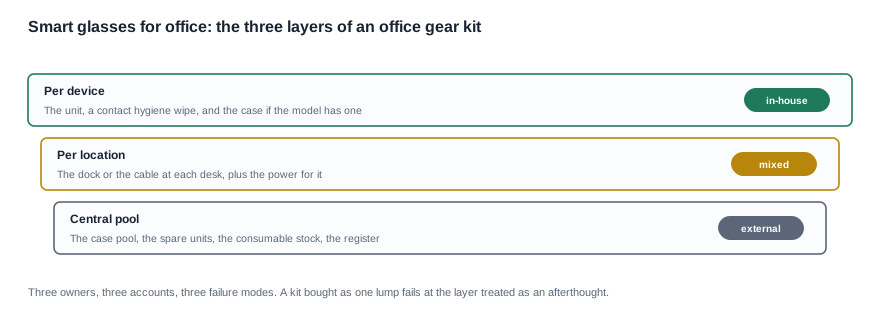
The reason the layers have to be separated is not administrative neatness. It is that each layer fails in a different way, and a kit assembled as one lump fails at the layer that was treated as an afterthought. A per-device consumable that is not restocked presents as a hardware fault rate. An installed charging point that was never specified arrives as a surprise capital request after the first invoice. A central pool with no drawing rule becomes a collection of cases and hygiene items in a cupboard that nobody opens.

The per-device layer: what each unit needs and what it costs
The per-device layer is small, cheap, and the one most often left out. It is the items that travel with the unit: a hygiene item for the charging contacts, and — where the configuration has one — the case.
The contact item deserves more attention than its price suggests. On a magnetic interface, debris on the contacts produces a unit that will not charge, and the unit presents as broken: it is handed to the service desk, it is replaced, and the actual cause never appears anywhere because the item that would have prevented it was not in the box. A single-use wipe removes the question of a shared cloth travelling between desks, and it is the cheapest evidence-quality improvement available anywhere in an office gear list. The rate to agree is not "one wipe per unit" but a stated interval per unit per week, because a rate is what lets a site stock a shelf; a single item is not a supply plan.
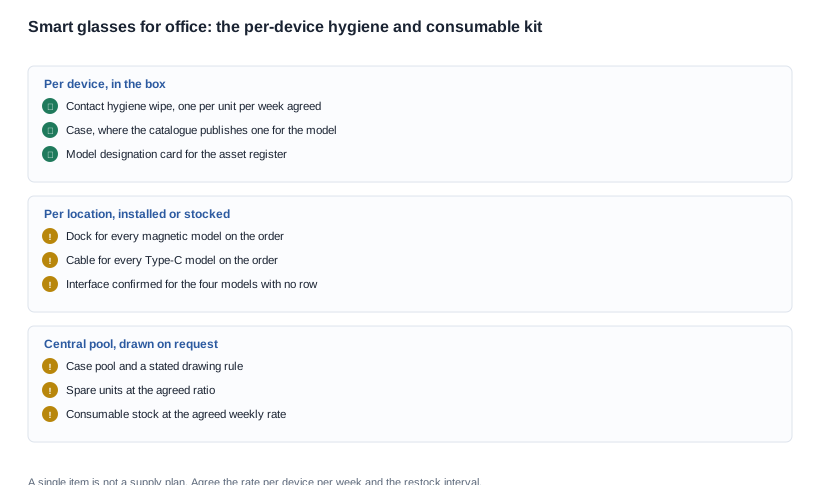
The second per-device item is the case, and the decision on it is the most consequential in the layer. Issuing a case per unit doubles the number of second cells the organisation owns, adds a second object to the issue register, and adds a second thing to lose — while removing the excuse that would otherwise keep a unit on a desk. Holding cases centrally reverses all four: fewer cells to declare and track, one place to store them, one drawing rule, and a unit that has to be returned to a charger to be ready.
For a fleet, the central pool is usually the better structure, and the exception is a role where the unit is issued to somebody who is genuinely out of the building for most of the day. A field team that carries a case is carrying a second cell in a vehicle, which is a transport file consideration as well as an asset one.
The per-location layer: the charging point is an installation, not a cable
A magnetic model needs the correct dock at every point where a unit is left. A dock is a fixed asset: it has to be placed, powered, maintained, insured, and counted, and the cost lands in a different account from the product and is usually discovered after the first invoice. A Type-C model needs a cable, and a cable is a consumable replaced from a stock rather than an installed item.
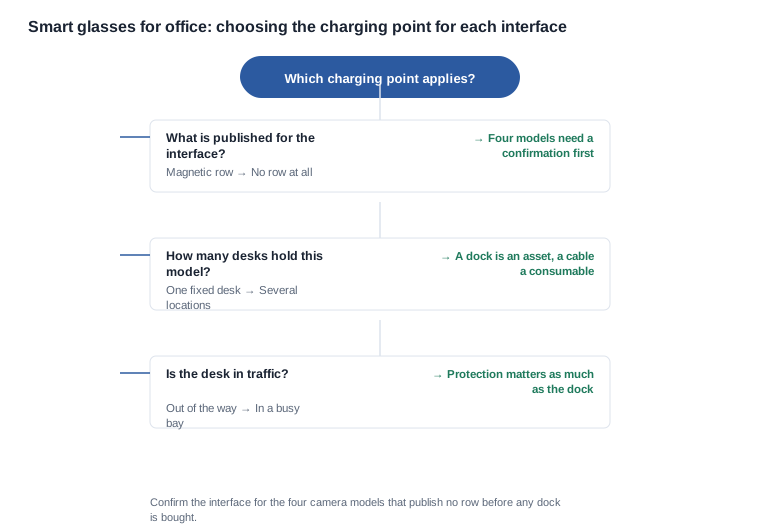
The decision diagram is short because the interface already answers it, and the only genuine branch is the one where the interface is not published. For the four camera models where the catalogue publishes no charging interface row — the MT6 and the CY05, and the CY03 and the L1 Pro — the charging point cannot be specified, and a gear list that assumes magnetic for them has ordered docks that may not fit. Asking the supplier to confirm the interface for those four models is a one-line request, and it is a precondition for buying any dock.
The audio tier adds a second dimension that the camera tier does not have: runtime. The LC-105-1 and the LC-105-2 publish a cell configuration of 55 mAh × 2 and a runtime of about eight hours, while the G07 and the YK12 publish the same 55 mAh × 2 configuration with a runtime of about six hours, and the G07 publishes ultra-slim detachable temples while the YK12 publishes surround sound with a slim temple. Against a conventional eight-hour office day, a six-hour model does not reach the end of it, and the per-location layer has to carry a mid-day charging point for the people issued with it. That is a kit decision, not a device decision, and it is invisible until the rota is built.
The physical part of the per-location layer that most gear lists omit is protection. A docked unit in a bay is exposed to dust and to the knock of a chair leg or a trolley wheel, and the failure it produces is a unit that no longer charges — which is the same failure the per-device hygiene item prevents, arriving from a different direction. A dock position that is out of traffic is worth more than a more expensive dock.
The power, the placement and the bay that breaks the kit
Three questions about the charging point are asked too late, and each of them has a straightforward answer that belongs on the gear list.
The first is how many charging points a location needs, and it is not one per unit. It is one per unit that will be left there, which is a different number once a shared desk, a hot-desking arrangement or a meeting room is in the picture. A location where three people share one desk needs one point with three cables rather than three points, and the difference between those two answers is the difference between a consumable and an installed asset. For a magnetic model it is the difference between a dock on the desk and a dock on the wall, and it is a decision about furniture as much as about hardware.
The second is where the point goes. A charging point next to a kettle, next to a window that opens, or at the end of a busy counter collects exactly the conditions that make a magnetic contact unreliable. Moving the point costs nothing at specification time and costs a site visit afterwards, which is why the location belongs in the gear list rather than in the installation.
The third is what happens when the point is occupied or out of service. A shared point that someone else is using is a point that a unit cannot reach, and the practical answer is a second point at the same location rather than a policy about queueing. This is cheap to specify and expensive to retrofit, and it is the item most likely to be left to the person who owns the desk, who is rarely the person who owns the IT budget.

The central pool: cases, spares and the second lithium cell
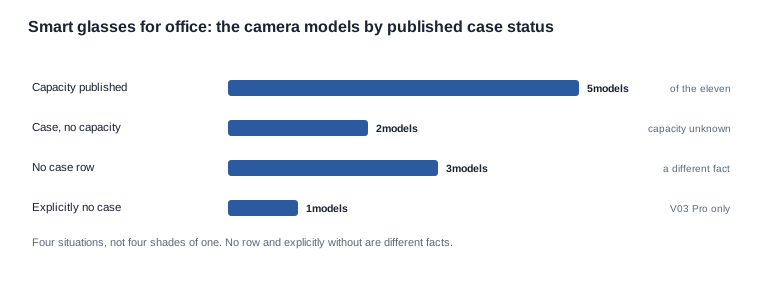
The chart above is the case position across the camera tier, and the bars on it are different situations rather than shades of the same one. Five models publish a case capacity — 1400 mAh on the L1 Pro and the CY05, and the CY03, 900/1400 mAh on the L2 Utral, and a 1200 mAh foldable case on the MT6. Two models indicate a case with no published capacity, the KY06 and the MT5. Four models publish no case row at all — the V03 and the V06, and the V03 Pro and the S7 — and what those four carry in the carton is not published either.
That last distinction is the one that causes the argument. "No row in the catalogue" and "explicitly without" are different facts, and a gear list that merges them either counts spare cells that do not exist or refuses to order a case for a model that has one. A kit that is built on the published position asks each of the three models to confirm whether a case exists, and orders a case for the two models whose capacity is not published once that confirmation arrives.
The second element of the central pool is the spare unit ratio, and it is a commercial term rather than a product fact. A unit withdrawn for servicing is a unit out of service, and in an office with a small issue the absence of a spare is felt immediately and felt by the person who was waiting for it. The ratio to agree is the one that makes the issue survivable during a repair cycle, and it belongs in the order rather than in a stock request six weeks later, because a spare ordered at the original unit price is not the same as a spare ordered later.
The third element is the cell count. A case is a second lithium cell, and an office holding one case per unit plus a central pool is holding a number of cells that has to appear in the asset register and in the transport documentation. Keeping that number correct is a small administrative task and it is the one most likely to be skipped, because nothing breaks when it is skipped and something eventually does.
The register, and the cell count that has to stay right
The register is the piece of the central pool that makes every other piece auditable, and it is simple: one line per physical object, carrying the model designation, a serial or batch reference where one is published, the location it was issued to, and the date. A case, a dock, a cable and a unit all appear in it, which is what allows a loss to be distinguished from a misplacement.
The distinction matters because the four categories behave differently when they go missing. A lost unit is a repurchase and a loss. A lost case is a repurchase and a cell-count error. A lost dock is an installation request. A lost cable is nothing. Treating all four as the same kind of problem is how a pool turns into an untracked collection, and the categories are separable at the moment of issue if they are not separable afterwards.
The second job of the register is the number it produces. The count of cases in the building is the number that has to be declared in the transport documentation, and the count of issued units is the denominator that turns a returns figure into a real failure rate. Both numbers come out of the same register, which is the argument for having it. A programme that counts returns without counting issues has a returns rate, and a returns rate always looks better than the truth.

The gear list, the cost treatment and the quantities to negotiate
The table below is the working gear list. What makes it useful is the third and fourth columns: the quantity basis for each line and the account it belongs to. A gear list without a quantity basis produces a one-off purchase that repeats at an unknown interval, and a gear list without a cost treatment produces a capital request that arrives after the product has already been paid for.
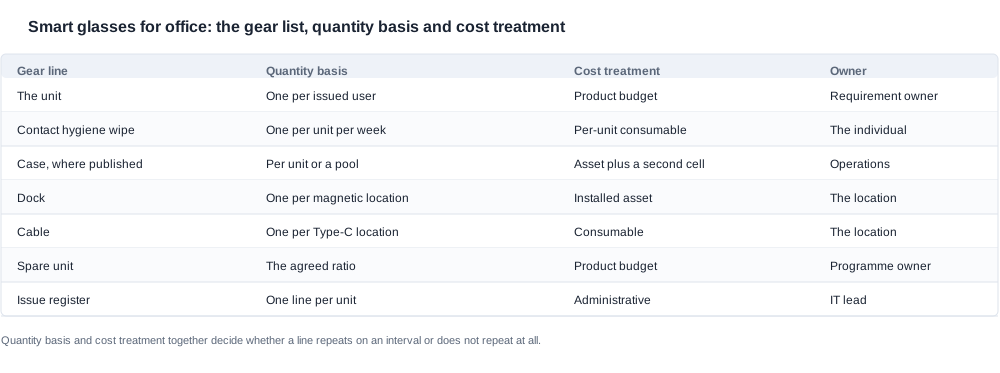
Three things on this list are genuinely negotiable and one is not. The hygiene consumable rate is negotiable and is the highest-return line available, because a few cents per device per week protects a whole fleet against a fault that presents as a defect. The case structure is negotiable and is the largest single lever, because it changes the cell count, the asset count, the freight weight and the storage requirement at once. The charging point specification is negotiable, and the question is not whether to buy the hardware but whether the supplier can place and document it, because a factory that documents the installation moves the installation risk out of the buyer's scope.
What is not negotiable is the certification cost and its lead time, which attach to the product and the destination market rather than to the volume, and the tooling, which is a one-time cost that can be spread across a second run but never removed. A quotation that folds tooling into the unit price has removed the one number a buyer needs in order to forecast a second order.
The remaining commercial line is the quote structure itself, and a procurement team that asks for it saves a procurement round later. A quotation that separates the unit price, the tooling, the certification, the packaging and the freight gives a buyer five numbers to negotiate and forecast with; a quotation that presents one number gives one number to argue about. The buyer should also establish at this stage which lines are quoted per unit and which are quoted once, and should have the supplier confirm that the per-unit lines are per unit of the configuration as shipped rather than per unit of a simplified version of it. The supplier's commercial terms and the buyer's contract language are set out at pricing and contract terms, and the quality-control arrangement that sits behind the defect remedy is part of the same conversation.
The consumable rate is the number to settle first, for a reason that has nothing to do with its price. A rate agreed per device per week, with a restock interval, converts the hygiene item from a line in a bill of materials into a managed supply, and a managed supply is the thing that stops the contact fault from appearing in the fault report. A budget note for the same items is at the office budget breakdown.
A thirty-person office, and the kit it needs
Take a hypothetical company with thirty people in an open-plan office on two floors, plus four people who spend most of the week at a client site. The order is a camera configuration for the record, and the interface question is settled first: the model chosen publishes a charging interface, so the per-location layer is a dock at each of the eight desk groups and a cable at the two hot-desking rows, rather than a dock per person.
The per-device layer is one unit each and one contact hygiene wipe per unit per week, which is a consumable line of a few cents per device, restocked monthly from a central stock. The case structure is the one real decision: the four people at the client site are issued a case each, and the twenty-six in the office draw from a pool of four at the IT desk, because a case issued to a desk in an open-plan office is a case that is never returned. The case count is therefore eight, every one of them a second cell in the register and in the transport file.
The per-location layer is eight docks and two cable sets, each positioned away from a window or a counter, with a second point at the two shared desks where one point would be occupied for part of the day. The central pool holds the eight cases, the spare units at the agreed ratio, and the consumable stock for a month. The register has one line for each of those objects and one line for each of the thirty units, which is what makes the issue count available later.
The kit that results has three accounts in it — the product budget for the units and the spares, a consumables budget for the wipes and the cables, and an installed-asset line for the docks — and each of the three has a different owner and a different approval route. That separation is the whole point of splitting the list into layers, because a kit bought as a single lump arrives as one invoice, one owner and one failure mode, and the layer that was treated as an afterthought is the one that fails.
What we publish about the office kit, and what to send us next
We publish the rows a buyer can order from, and we will not fill the gaps with typical figures. For the camera tier that means the resolution class, the cell capacity, the charging interface where it is published, the rated runtime, the charge time, the case capacity where it is published, the structural features that are published — the removable inner frame on the V06 and the S7, the foldable case on the MT6 — and the colour counts, with the IP54 marking on the V06 and the S7 stated as a catalogue attribute. For the audio tier that means the charge time, the rated runtime, the Bluetooth version, the cell configuration, the charging mode, the surround sound published on the YK12 and the ultra-slim detachable temples published on the G07 — and no touch row is published for any model, so a temple control surface belongs on the supplier questionnaire rather than in the kit list.
The rows a kit is specified from are published, and the rows a kit is not specified from are simply not there. What we do not publish and will not estimate is the frame material, the lens material, the coating, the hinge specification, the unit weight beyond the single 158 g whole-unit figure for the MT6, the field of view, the video specification, the storage and overwrite behaviour, the operating temperature range, the cycle life rating, the runtime test condition and the standby draw. That list matters more for a gear list than for a product page, because a gear list is made of objects that have to be ordered, and an object ordered against an unpublished attribute is an object nobody can specify. So where the interface is not published, the dock is not ordered until it is confirmed; where the case capacity is not published, the case is not counted until it is; and where the weight is not published, the sizing is not assumed.
Send us the issue count, the desk and site count, the models on the order, and whether the units are issued to people who spend the day away from a desk, and we will return the gear list with the quantity basis for each line, the cost treatment, the interface question that has to be answered before any dock is bought, and the case structure that keeps the second cell count right. A deployment template to hang the list on is at the office deployment template, the companion gate checklist that catches the specification problems before the kit is ordered is at the deployment gate checklist, and the commercial structure of the first order is at pricing. What a first order produces in practice is set out in what to expect from an office deployment, and the scenario entry point is smart glasses for office.
Related reading
- How to enter the scenario — smart glasses for office
- The published figures — battery life
- The commercial structure — pricing
- The gate checklist — the deployment gate checklist
Send us the issue count, the location count and the models, and we will return the gear list with the quantity basis and the cost treatment for each line.


