
Smart glasses for security: the handover is the unit of care
In a patrol deployment the device is issued, carried, used and returned by four different people, and the person who does the wiping is almost never the person who will be recorded. That single fact inverts the way a security buyer should think about surface care. The question is not "how do we keep this lens clean" and it is not even "how do we reduce the return rate". It is: what is the state of the lens at the moment the recording begins, who checked it, and can anybody show that they checked it? A patrol device is judged on the material it produced, and a smeared lens in a piece of recorded evidence is never returned, never complained about and never re-shot. It simply makes the record less reliable, and it does so invisibly.
That is why the hygiene budget in a security contract should be spent on a written handover check with a visual reference, not on consumables. A cloth is cheap and it does nothing for the problem. A check that is performed at shift change, by a named role, against a stated image, produces a record that the customer can rely on and that a supplier can be held to. So the procurement decision behind a security deployment is a contract decision about who is responsible for the condition of a device at the moment of issue, and what happens to the evidence when the condition is not what the standard says it should be.
Who is reading this and what they are holding. The reader is a brand buyer, a solution architect or a channel buyer specifying a device for a security company, a facilities contractor or a stewarded site. What they are holding is a contract term sheet with a device count, a unit price and a deployment schedule, and a customer who has asked a question the buyer cannot yet answer: who signs off the condition of a unit at handover, and against what. The task in front of them is to write that check, price the consumables and the refit cost, and make sure the paperwork that goes to a border and the paperwork that goes to a corporate security director say the same thing about the product. The commercial risk being managed is not a returns rate. It is a claim, in year three of a multi-year contract, that a piece of recorded evidence is unreliable because nobody specified a condition standard.
What the catalogue publishes for the camera tier, and what it does not. For the eleven camera models the catalogue publishes a resolution class, a cell capacity, a charge time, a rated runtime, a charging interface and a colour count, and on five of them a charging-case capacity. It publishes the IP54 marking on the V06 and the S7, and no test report behind that marking. It publishes no lens material, no coating, no surface treatment, no abrasion or chemical resistance figure, no per-model frame weight beyond the single 158 g whole-unit figure for the MT6, no field of view and no video specification. Every statement this article makes about a security deployment therefore rests on a published row, a published absence, or a question the buyer puts to the supplier in writing.
Why a security buyer is buying evidence utility rather than a smart glasses for security accessory
What the catalogue settles and what it leaves open for smart glasses for security
| Row a security buyer needs | Published position in the catalogue | Why it matters to a patrol deployment |
|---|---|---|
| Resolution class | 8 MP on eight camera models, 13 MP on three | Sets the ceiling on what the record can show; not a claim on its own |
| Cell and rated use | 220 mAh to 290 mAh, rated five to eight hours | Covers a shift; the question is what happens between shifts |
| Charge time | Two hours or less on every camera model | Published without a start state or an end criterion, so it is not a shift-planning number |
| Charging interface | Magnetic, Type C, or not published on four models | Decides whether the device is issued with a cable, a dock or a case |
| Case | Five models publish a capacity, two ship a case of unpublished capacity, three publish no case row, and one is published without a case | A case is a second lithium cell and a second object to lose from a vehicle |
| Ingress | IP54 on the V06 and the S7 only, with no report published | A weather statement in a contract has to match the marking and nothing more |
| Lens material and coating | Not published for any model | The condition standard cannot name what it is protecting |
| Field of view and video specification | Not published for any model | Cannot be written into an evidence specification without a sample |
| Unit weight | Published for one model only, the MT6 at 158 g | A twelve-hour shift is a weight question nobody can answer from a datasheet |
The three exposures in a patrol environment, and why they are not the returns problem
A patrol vehicle is one of the few environments where a cleaning spray is routinely within reach of the device. A spray on an undescribed coating is the most damaging single intervention available to a security team, and it is the one most likely to be applied by someone who has been told to "keep it clean" without being told what not to use. That exposure is a spray bottle on a desk, and it is the reason the condition standard has to be a list of prohibited agents rather than a request for tidiness.
The second exposure is the vehicle itself: dust off a road, salt in a coastal deployment, and a device that lives on a dashboard in summer. The third is the handover bench, where a unit is picked up, checked with bare fingers and put into a pocket or a locker. None of the three is severe. All three are cumulative, and the consequence of all three is a device that is returned in a condition nobody documented.
Here is the part that changes how a security buyer should budget. None of these exposures produces a return. The customer is an operator, not a consumer; a lens that has degraded does not come back for a refund, it comes back as a slightly worse recording that nobody is going to trace to a wipe. A buyer who monitors returns will never see this problem, and a returns reserve built for a security deployment will sit unused while the actual risk accrues. The control is a procedure, and procedures are written by the buyer — which is why this article is about a handover document rather than about a cloth.
The compliance thread sits next to this one and is settled at contract level rather than at product level. A device worn on the head and recording what the wearer sees raises questions that no product specification answers, and in a security deployment those questions are normally answered in the contract and in the data-handling policy rather than in the datasheet. The route is at general product safety regulation, and the certification route is at certification checklist. A buyer who is writing a handover check should settle that thread first, because the two documents frequently have to describe the same product in the same words, and because a camera that records without a stated condition standard is a document nobody can defend.
The documents that make a smart glasses for security handover check enforceable
The handover check, written as a document
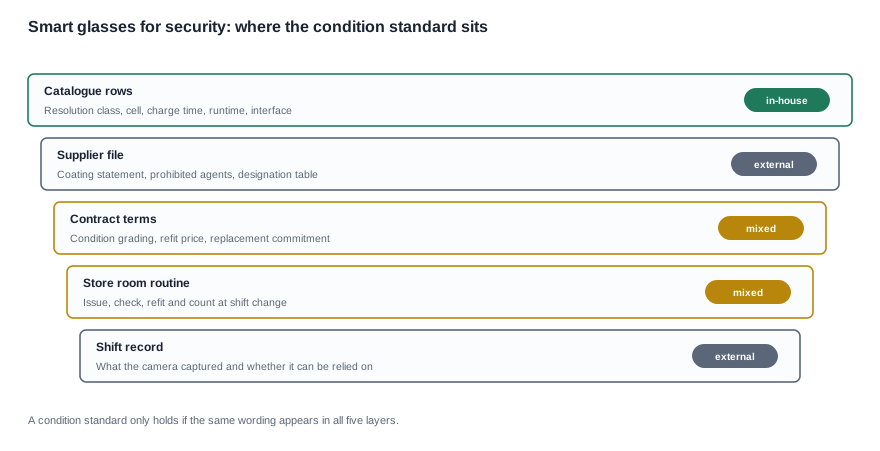
A handover check is only enforceable if four things are true of it, and a security buyer should be able to name all four before the order is placed. It is performed at a named point — shift change, not "when someone notices". It is performed by a named role, which in a pooled deployment is the store keeper and in an individually issued deployment is the outgoing officer. It is judged against an image, because "clean enough" is not a standard and a photograph of a lens in the acceptable state is the only unambiguous reference. And it is recorded, because an unrecorded check is a check that did not happen.
The four elements together produce a small record: device designation, date, shift, the checking role, and a pass or fail against the reference image. For a security company that has to answer a client question about an incident, that record is the asset. It is also, from the buyer's point of view, the thing that converts an invisible risk into a manageable one, and it costs nothing to design.
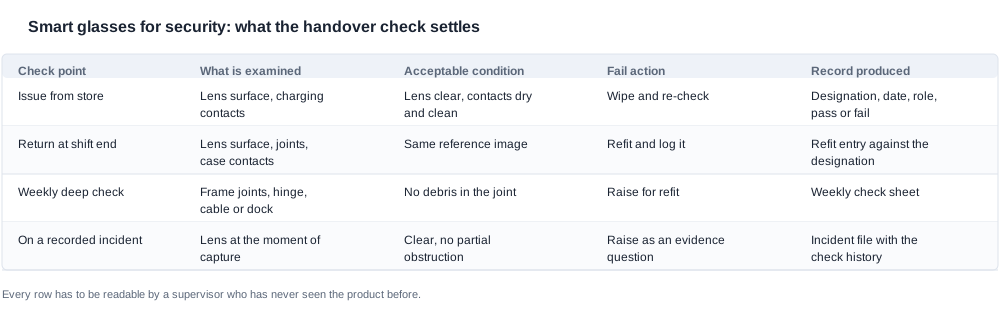
| Check point | What is examined | Acceptable condition | Fail action | Record produced |
|---|---|---|---|---|
| Issue from the store | Lens surface, charging contacts | Lens clear with no haze, smudge or abrasion; contacts dry and clean | Wipe and re-check before issue | Designation, date, role, pass or fail |
| Return at shift end | Lens surface, temple joints, case contacts | Same reference image, contacts free of grit | Refit to the standard, log the refit | Refit entry against the designation |
| Weekly deep check | Frame joints, hinge area, cable or dock condition | No debris in the joint, no cable damage | Raise to the supplier or the refurbishment partner | Weekly check sheet |
| On a recorded incident | Lens at the time of the capture | Clear, with no partial obstruction | Raise as an evidence-quality question | Incident file with the check history |
The table above is written so that it can be handed to a supervisor who has never seen the product. That is the test. A handover standard that needs interpretation at 3 a.m. on a Friday is a standard that will be skipped, and the skipping is invisible for exactly the reason described above.
The contract terms that carry the exposure
The commercial term that matters most in a security deployment is the one that assigns responsibility for the condition of the unit at the moment of issue. There are three ways to write it and each of them puts the risk somewhere different. The first puts it with the supplier, through a warranty that covers a unit whose condition has degraded inside a stated period; that is the version a buyer should push for, and it is negotiable because it is a commercial term rather than a technical one. The second puts it with the operator, through a handover standard that the buyer has written and the operator has signed; that is the version the buyer controls entirely and should not give away. The third puts it nowhere, which is what happens when the condition standard is absent, and the result is a dispute in the middle of a contract.
Two further terms carry cost rather than risk. A refit price per unit for a device that fails the check, which should be quoted and agreed before the deployment starts rather than discovered as an unforecast charge in month four. And a replacement commitment that states how long a failed device takes to be replaced, because a device out of service on a twelve-hour contract is costing the customer a shift, and the supplier who carries that risk has priced it. The clause language for all of this is at contract terms, and the aftersales side is at after-sales support and preventing returns.
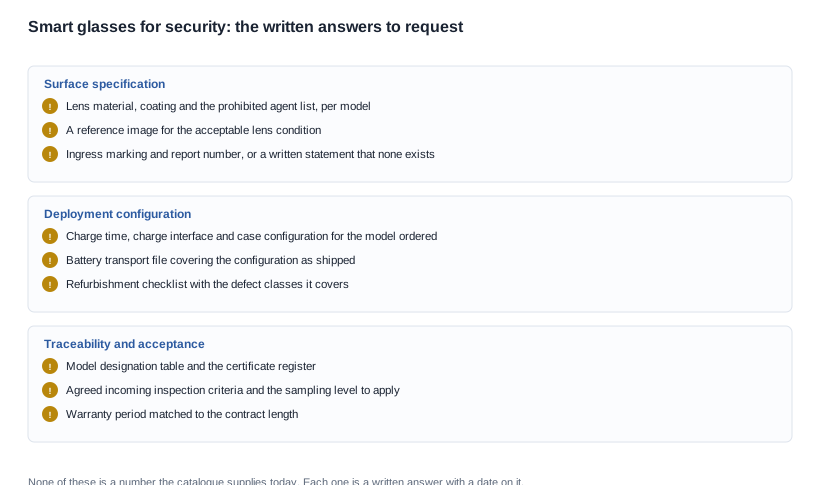
The written answers a security buyer should request before a deposit.
- The lens material, the coating treatment and the prohibited-agents list, per model, with an abrasion or chemical resistance figure if one exists. If none exists, that written absence is what forces the condition standard to be a prohibition list rather than a permission.
- A reference image for the acceptable lens condition, supplied by the factory if it cannot supply one. A standard without an image is a standard that two people will read differently.
- The charge time, the charge interface and the case configuration for the model ordered, including the case capacity where one is published, so the store can issue the right accessory.
- The ingress position in writing — the marking and the report number, or a written statement that no report exists — so the contract's weather clause matches the evidence.
- The battery transport file covering the configuration as shipped, including the case where a case is included in the deployment. The requirements are at battery transport.
- The model designation table and the certificate register, so that a unit in a store room can be traced to a document and to a certification record.
- The refurbishment checklist and its price per unit, with the defect classes it covers, so that the refit cost in the contract is a number rather than a discussion.
- The agreed incoming inspection criteria, with the sampling level and the defect classes you will reject on, applied to the first shipment rather than to the second.
The product range itself is at AI camera glasses and the scenario entry point is smart glasses for security.

A contract-year audit cycle for a smart glasses for security deployment
A handover standard that is written and then left alone decays within two quarters. The cost of a security contract is not the check; it is the drift. The cycle below is the minimum that keeps a deployment honest, and each step has an output that can be audited.
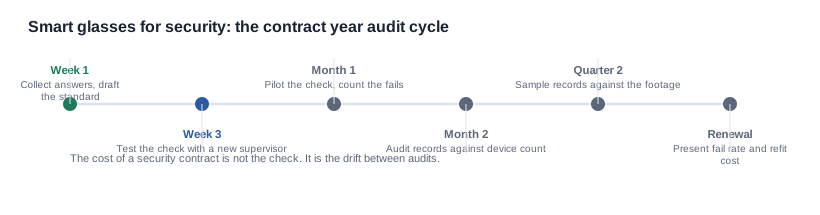
The audit cycle, step by step.
- Before the order. Collect the written answers listed above, and draft the handover standard against them. The standard is a buyer document, so it is drafted before the supplier is chosen, not after the sample arrives.
- At the sample. Run the check on the sample with a supervisor who has not seen the product before. If that supervisor needs a verbal explanation, the wording of the standard is wrong and it has to be rewritten before it is printed.
- Pilot month. Run the check across a small group of devices and count the passes and fails. The first month's fail rate is the measurement that tells you whether the refit cost in the contract is realistic.
- Month two. Audit the check records against the device count. A device issued without a record is a device in service without a condition history, and it is the beginning of the reconciliation problem.
- Each quarter. Sample the check records against the footage the deployment produced, and look specifically at whether any capture was made with a lens that would have failed the standard. This is the only step that connects the procedure to the outcome.
- At renewal. Present the fail rate, the refit cost and the incident count to the customer, and use them to set the next contract's terms. A supplier who sees those numbers before renewal is a supplier who has an incentive to improve the unit rather than to improve the argument.
What to measure, and what the measurement is worth. The useful number is not the pass rate. It is the fail rate at issue, because a unit that fails the check before it goes out is a unit that was returned in a bad state, and that tells you about the last shift rather than about the current one. The second useful number is the refit count per device per month, which is the number the contract's refit line has to absorb. The third is the count of captures that would have failed the standard, which is small, which is the point, and which is the only figure in this category that connects a procedure to the thing the customer actually bought.
There is a second measurement, and it is the one that makes the whole cycle worth running. If a deployment issues from a pool, then the rate at which a device fails the check on return is a direct measure of how the pool is being treated. A high return-fail rate on a pooled device is a supervision problem; the same rate on an individually issued device is a customer behaviour problem; and the two have different remedies. Sorting them is a conversation the supplier cannot have for you, which is another reason the buyer's reading position is upstream of the supplier's.
What breaks in a multi-year smart glasses for security deployment
The condition standard that was written but never printed. Symptom: a gradual fall in the pass rate that nobody can explain. Root cause: the standard exists in a file on a buyer's laptop and the shift supervisor has never seen it. Control: the standard is a printed sheet in the store room, and a copy sits in the handover pack with the device.
The handover check that depends on the outgoing officer's judgement. Symptom: the same device passes on one shift and fails on the next, and the deployment concludes the checks are unreliable. Root cause: the wording admits interpretation. Control: replace every descriptive term with a reference image and a binary outcome.
The spray on the bench. Symptom: a lens that hazes permanently within a month of deployment, on a subset of devices. Root cause: the instruction to keep the unit clean was given without a prohibition list, and a desk spray was used. Control: the prohibited-agents list, on the sheet, in the store room.
The device issued dirty because the pool is large. Symptom: a rising refit count with no change in the devices themselves. Root cause: pooled issue with no check at the point of return. Control: put the check on return, not only on issue, and count the failures by device.
A warranty that expired on the first contract year. Symptom: a refit invoice arriving in year two, with no route to recovery. Root cause: the warranty was negotiated as a product term and never read against the deployment length. Control: match the warranty period to the contract length, and state the replacement commitment separately.
The evidence question raised in year three. Symptom: a client asks whether a particular capture is reliable, and the answer is a shrug. Root cause: no check history exists for the device in question, so the question cannot be answered either way. Control: the record described above. This is the failure that the whole handover procedure exists to prevent, and it is the one that cannot be fixed after the fact.
A documentation route that stops the goods at a border. Symptom: a deployment that cannot start on the date it was planned. Root cause: the transit file was requested for a configuration that was later changed, usually by adding a case. Control: freeze the bill of materials before the file is requested, and request the file against the frozen configuration.
A kit inherited from a consumer programme. Symptom: an insert full of instructions for a customer at home, sitting in a store room with no supervisor assigned to act on it. Root cause: the packaging was reused rather than written. Control: the insert and the handover sheet are the same document, and both are written for a reader who has sixty seconds.
What we can and cannot evidence for smart glasses for security, and what to send us
It is worth being precise: the condition of a device at the moment of issue is a contract matter, and a supplier's useful contribution to it is written evidence about the product rather than a guarantee about how a team behaves on a night shift. For the camera tier we publish the resolution class, the cell capacity, the charge time, the rated runtime, the charging interface, the published case capacities and the colour counts exactly as the catalogue states them, and we publish the IP54 marking on the V06 and the S7 as a catalogue attribute with no third-party test report behind it. We publish the absence of a lens material, a coating specification, an abrasion or chemical resistance figure, a per-model frame weight beyond the single 158 g whole-unit figure for the MT6, the field of view, the video specification and a runtime test condition with the same prominence, because a buyer writing a condition standard needs to know which rows are settled and which are still open.
What we will not do is publish a wipe recommendation for a lens whose material and coating we have not been given, or state that any model in our range is tested to IP54, because no test report is published behind that marking. We will not extend the marking to the models where no rating is published, and we will not supply a condition standard that implies a surface specification we do not have. Where the catalogue carries a company-level export certification page rather than a per-model certification row, we will say so rather than let a buyer assume that a model-specific conformity record exists in our file.
What we will do is take the deployment type, the device count, the contract length, the markets and the handover arrangement, and return the published rows that apply, the case and charging configuration each device should be issued with, the documentation that has to be settled in writing before a purchase order, and the condition-standard structure we would expect to sign. The buying checklist for the scenario is at the security checklist, the product range is at AI camera glasses, and the scenario entry point is smart glasses for security.
What to send us. Send the deployment type, the number of devices, the contract length, the markets, whether the devices are pooled or individually issued, and the handover arrangement you have in mind. We will tell you which published rows cover the configuration, which questions have to be answered in writing before the order, and where the exposure sits once the handover standard is in place. The commercial structure of a first order is at pricing, and the materials background behind the lens questions is at materials and ergonomics.
Related reading
- The point where the scenario starts — smart glasses for security
- The buying side — security checklist
- The returns position — after-sales support and preventing returns
- The models the range covers — AI camera glasses
Send us the deployment type and the contract length, and we will say what the handover check has to contain.


