

Kids eye protection glasses technology: the eligibility gate comes first
Comparing two children's products is harder than comparing two adult products, and the reason is not that the specifications are thinner. It is that in this category the rows which decide whether the product may be sold at all are also the rows most often absent from a supplier's documentation, and a comparison that skips them produces a confident answer to the wrong question.
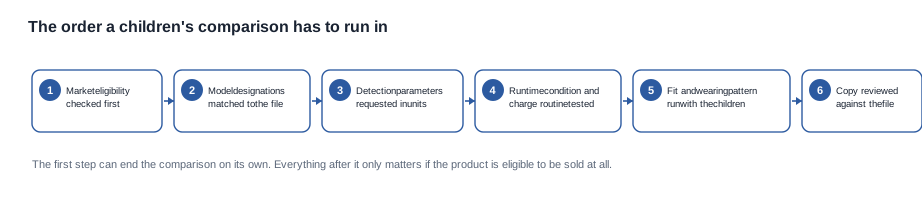
Kids eye protection glasses technology smart glasses how to compare therefore has to run in a fixed order: certification eligibility first, detection parameters second, runtime condition third, physical fit fourth, and only then the platform rows that are already published and already comparable. The published rows in this tier are nearly identical across models, which is precisely why a comparison built on them alone produces a tie that only the unpublished rows can break.
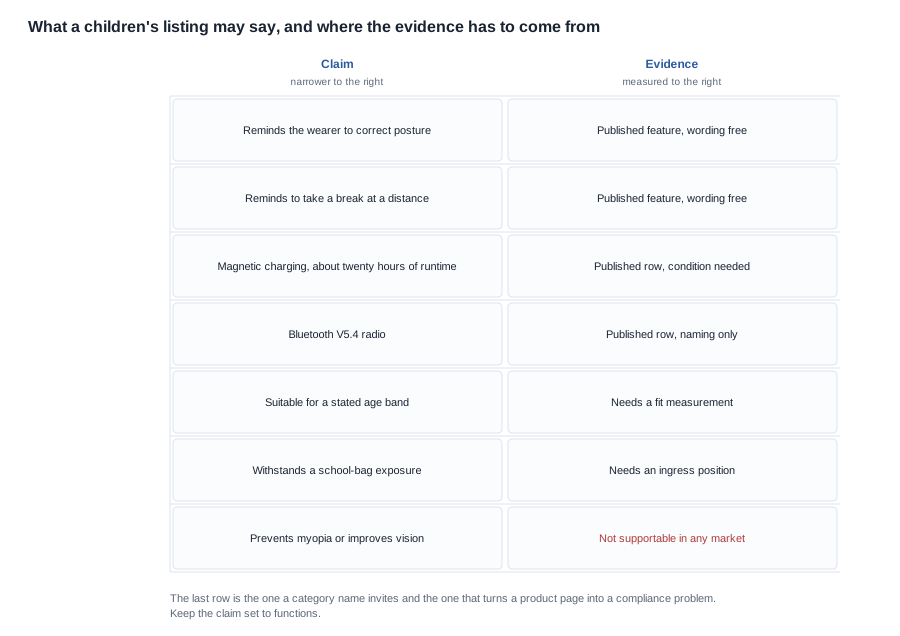
One point has to be stated at the top, because it governs every line of the listing copy that follows: we make no claim applying to eye-protection, vision or health for any product, and we advise any buyer building a listing in this category to do the same. A children's product carries a documentation and safety obligation, and the correct positioning is a compliant, well-made device with named functions, not a benefit claim about eyesight.
The buyer building a children's line, and the documentation burden
The answer in three sentences, and the boundary that governs the copy
Kids eye protection glasses technology smart glasses how to compare is an eligibility check followed by a parameter comparison, and the published rows on their own produce a tie. A buyer should send both suppliers the same four questions, in the same order, and should treat a difference in the quality of the answer as a difference in the products. And the boundary is this: a comparison that cannot be completed should be reported as incomplete rather than resolved on price, because the rows that complete it are the ones you have to obtain.
Why an adult platform in a children's wrapper is a common starting point
A buyer in this category is usually a brand team building a children's line, or a distributor adding one to an existing range. They will hold a customer profile, a target price, a market list, and a set of supplier samples or quotations. What they will almost never hold is the certification file for the exact model, because in this category it is genuinely expensive and slow, and because the children's models in many catalogues were derived from adult platforms without a re-test.
That is the structural problem. A product can be built on an adult platform, inherit a feature set, and be sold into a children's channel with a documentation package that does not cover it. The point at which it fails is the shelf, or the customs inspection, or a parent's complaint, and by all three of those points the packaging artwork is already printed.
The consequence for the buyer's own calendar is worse than the consequence for the product. An adult platform that has to be reworked for a children's channel re-opens the mechanical design, the certification file and the artwork, in that order, and the rework has to happen before the first order rather than during it. A buyer who asks the eligibility question in week one can still plan the season. A buyer who asks it in week ten can only explain the delay.
What the published rows actually say
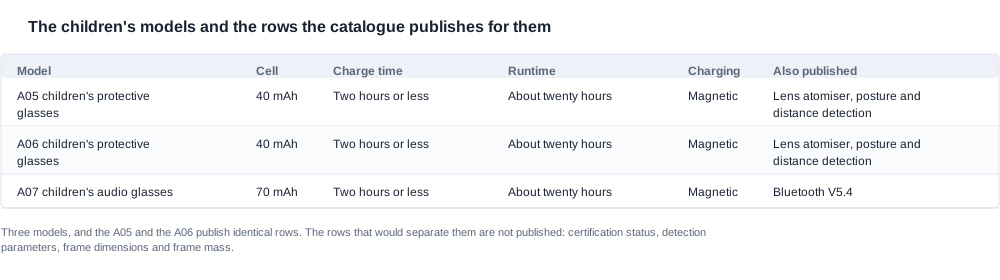
Our published position for this tier: two models with a 40 mAh cell, charging in two hours or less, roughly twenty hours of runtime, magnetic charging, a lens-based electronic atomiser, and posture and distance detection; and one model with Bluetooth 5.4, a 70 mAh cell, the same charge and runtime figures, magnetic charging, and an audio product position. Certification for all three is not published to us, and neither are the detection parameters, the frame dimensions, the frame weight or the model sizes.
The A05 and the A06 publish identical rows. That is not a coincidence and it is not a hidden difference; it is the same platform presented twice, and a buyer who lists both is running a merchandising decision rather than a product strategy.
The rows that decide a children's comparison, in order
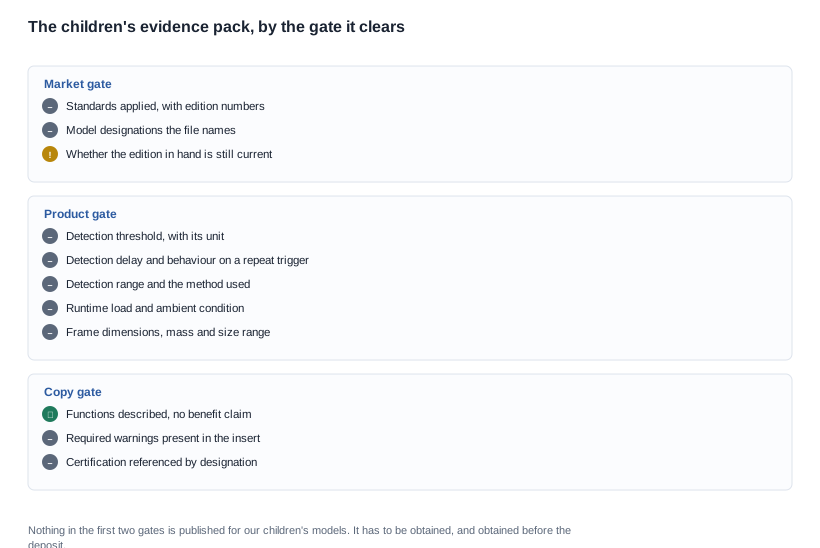
Market eligibility: EN 71 and ASTM F963
In the European Union the frameworks that apply to children's products, including EN 71, and in the United States ASTM F963 and the Consumer Product Safety Improvement Act, work on an edition cycle where a new edition can require retesting. If the certification position is unknown for either product, nothing else in the comparison matters, because neither may be sellable in your market.
Certification is an eligibility gate rather than a comparison row. It does not make one product better than another; it determines whether either can be sold. A supplier who cannot name the standard and the edition cannot tell you whether the file is still current, and an out-of-date edition is the most common way an otherwise compliant children's product becomes non-compliant.
The pass line is specific: the standards applied with their edition numbers, the model designations the file names, and the date of the most recent test. A family-level answer is not a pass, because a family-level document is not coverage for a private-label unit. The failure mode here is not a bad product; it is a good product with paperwork that names something else.
The detection parameters, which are the product
The published rows for this tier are the same across models — two hours or less to charge, roughly twenty hours of runtime, magnetic charging — with only the cell and the Bluetooth version differing. A feature-list comparison therefore produces a tie, and the tie is resolved by the rows that are not published.
The detection parameters are the product. The threshold, the delay, the trigger behaviour on repeated events, and the range are what the feature actually does. The threshold is the row that decides whether the feature helps or irritates, because a threshold that fires constantly gets disabled within a week, and a product with a disabled feature is a product that has been returned, usually with the description that it did not work.
The pass line is a measurable value with its unit, a delay figure with the behaviour on a repeated trigger, and a stated range with the method used to establish it. "Adjustable sensitivity", "real-time alerts" and "works within the room" cannot be tested at all, and a supplier who offers them has not measured them.
The runtime condition, and the fit nobody publishes
The runtime condition is what separates a figure from a claim. Two twenty-hour figures from two suppliers, neither with a stated condition, is a comparison of two claims rather than of two products. The number that matters is the one measured on your own units under your protocol, and the condition to ask for is the load, the interval and the ambient condition.
Fit is the variable that decides adoption, and it is not published anywhere. Neither the frame dimensions nor the mass are published for these models; the frame mass for the whole catalogue is available for one model, 158 g for the MT6. Fit has to be established on samples across a size range, with the actual children, rather than measured on one unit.
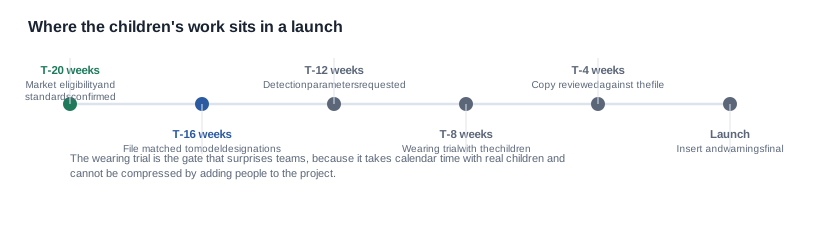
This is the row that most often gets skipped because it is not a document. A detection threshold is a number a supplier can send in an email. A fit result requires a wearing trial with real children over several days, and it is the only method that will show you what the runtime figure actually means in practice — because a child who removes the product after a short session makes the runtime irrelevant, and the return is filed against the battery.

How to test a detection feature and a wearing pattern
Each step has a completion condition that is written down, because in this category a step without a written condition is a step that gets skipped.
- Ask which model designations the certification file names, and check the edition dates. This is the first question because the answer may end the comparison. If the file covers a different model, you are not comparing two products, you are comparing one product with a gap.
- Ask for the detection parameters in units. A threshold expressed as a number with a unit can be tested on a sample and compared across suppliers. A threshold expressed as a quality cannot be tested at all.
- Run the detection on a sample, in the room the product will actually be used in. Write down the trigger distance, the delay, and the behaviour when the condition is triggered repeatedly. These three observations are the acceptance criteria for the feature, and they cost nothing to make.
- Test the charging routine in the real household pattern. Whether the device is charged when it is needed, and what happens if it is left charging unattended, is a design property you can only learn by running the pattern for a week.
- Run a multi-day wearing trial with the actual children. Record day six, not day one. The metric is how often the product is still on at the end of the day, and the observation that matters is the reason it came off.
- Compare the documentation received against the units received, by model designation. Not the product, not the family — the model. A unit whose model designation is not on the file is a unit you cannot ship.
- Check the listing copy for claims before the listing goes live. The copy should describe functions, materials, charging and certification, and nothing about the user's vision.

The breakdowns that end a children's comparison
Five breakdowns and the parents who decide the returns
The comparison is completed on the published rows and the tie is broken on price. Root cause: the published rows for this tier are nearly identical across models, so the only remaining discriminator is unit cost. Prevention: recognise the tie as a signal that the decisive rows are missing, and go and get them.
A product is certified as a family and a private-label unit inherits the assumption. Root cause: similarity between the factory's model and the branded model was treated as coverage. Prevention: ask which model designations the file names, and make the answer a condition of the purchase order.
The detection feature fires in the demonstration and gets disabled at home. Root cause: the threshold was never measured in the real environment. Prevention: test the trigger distance and the delay in the real room and record both, and set the acceptance criteria from the result.
A child removes the product after a short session, and the return is attributed to the battery. Root cause: the fit was never tested, so the runtime was irrelevant. Prevention: run a multi-day wearing trial with the actual children before committing the order quantity, and record day six.
The listing copy implies a benefit the documentation does not support. Root cause: copy written from the category name rather than from the certification file. Prevention: have the copy reviewed against the file before publication and keep the claim set to functions. This is the failure with the longest tail, because a claim challenged in one market tends to be re-examined in the next.
There is a sixth pattern that belongs to the schedule rather than the evidence. The certification work is commissioned after the artwork is approved. The artwork takes longer than people expect when it has to carry market labels and required warnings, and re-issuing it is a reprint with a new date. The sequence that avoids this is certification, then artwork, then copy, and it is worth writing into the project plan rather than remembering it.
The cost of documenting a children's line, and what cannot move
Terms that shift, terms that hold, and the children's documentation
A children's line is usually the first order a brand places in a new category, and that is exactly where a supplier has the most incentive to be flexible. The terms worth negotiating time on are:
- Minimum order quantity.
- Packaging and insert design, including the market labels, the language of the documentation pack and the required warnings — a compliance-adjacent negotiation rather than a cosmetic one, and one that carries no tooling implication.
- Delivery splitting against a certification milestone, which is often granted more easily than a price concession because it moves the approval risk onto the schedule where it belongs.
- How the money is staged: an upfront deposit, a balance after inspection and before shipment, and a holdback against the paperwork.
- The warranty period with a stated response, and the return terms for a channel where a parent's decision is the return decision.
The compliance side of a children's line is not a commercial lever, and in this category it is also a retest risk, because a new edition of the standard can require retesting a product that has already shipped. Certification cost and certification time follow the test laboratory and the review queue rather than your order size. Tooling, a one-off cost usually amortised across the first order, leaves a comparison two things to settle: the volume it is spread across, and the position on the tooling if the programme is discontinued. The safety documentation itself is fixed too, along with the supplier's willingness to permit an independent check of it.
The contract clauses that carry a children's programme are these: the exact model designations covered by the certification file, attached to the purchase order; the acceptance criteria for the sample, referencing the detection observations and the wearing trial; a clause requiring notice before any change of firmware, detection threshold default, frame material or supplier of a safety-relevant component; a clause requiring that a re-test triggered by a standard edition change is notified before the affected units are shipped; and a clause on who bears the cost when the sample does not meet the acceptance criteria.
A worked example: a distributor adding a children's line
To make the sequence concrete, the next passage walks through a constructed case. Nothing in it reports an outcome from a real order.
Assume a distributor in a European market who already sells connected audio products to retailers, and who wants to add a children's line for the coming season. Two suppliers have quoted, both with the same published electrical rows, and the distributor has a retailer customer who has already asked for a documentation pack.
Step one, the eligibility question. The distributor asks each supplier for the standards applied with their edition numbers and the model designations the file names. The first supplier provides both within two days. The second provides a statement that the range is fully certified to the applicable standard, with no edition and no designations. The second candidate is not eliminated — it is downgraded, because the brand cannot write a retailer's documentation pack on that basis, and the retailer's pack is a condition of the channel.
Step two, the detection parameters. Both suppliers are asked for the threshold with its unit, the delay, and the behaviour on a repeated trigger. The first gives numbers and a test method. The second gives a description of adjustable sensitivity. The comparison now has a real axis, and the axis is documentation quality rather than product capability.
Step three, the real room. Samples from both candidates are set up in a room that resembles a child's desk, and the distance and the delay are recorded on each trigger, and then again when the condition is repeated. The first candidate produces a consistent distance and a delay short enough to be useful. The second fires at a much shorter distance and on repeated events in a way the supplier cannot explain in writing. The first candidate proceeds; the second proceeds only with a narrower claim and a retuning request.
Step four, the wearing trial. Both candidates go home with two families for a week. The first is still being worn at the end of the day by the end of the week. The second is being removed after roughly half an hour, and the stated reason is that the alert arrives too often. That is the return, arriving a week before the season does, and it is invisible on every published row.
Step five, the claim and the copy. The distributor writes the listing from the certification file rather than from the category name, and the retailer pack is assembled from the same document. The copy describes the detection functions, the charging method, the runtime and the certification. It makes no claim about eyesight, because none of the evidence supports one.
Step six, the commercial structure. Because the documentation is the fragile part, the distributor holds a retention against the documentation package and takes a pilot order at the smaller tier with the retailer before committing the full season. The supplier's notice obligation on firmware and threshold changes is written into the contract, because a firmware change is exactly the kind of event that would silently invalidate the acceptance criteria.
The result is a line with a documented basis and a defensible listing, chosen partly on evidence the supplier had to produce and partly on a wearing trial the buyer had to run. Neither of those is visible on a specification sheet.
What we publish for the children's models, and the claim boundary we keep
Here, we publish the children's models' electrical rows exactly as the catalogue states them, and we say plainly that the rows which would complete a comparison are not published to us. We publish the 40 mAh and 70 mAh cells, the charge time of two hours or less, the roughly twenty-hour runtime, magnetic charging, Bluetooth 5.4 on the A07, the lens-based electronic atomiser, and the presence of posture and distance detection. We publish no certification status, no detection threshold, no detection delay, no detection range, no frame dimensions, no frame mass and no size range for this tier.
We will not fill a children's product comparison with plausible thresholds or a certification claim, because in this category an invented number becomes a safety statement on a product page that a parent will rely on. And we will also tell you plainly that a comparison built on the published rows alone cannot be completed, and that the rows which complete it are the ones you have to obtain.
We make no claim about eye protection, vision or health outcomes for any of our products, in any market. A listing in this category should describe functions and documentation, and we would rather a buyer runs the copy past someone qualified than find out afterwards that the claim is the problem. The category background is at kids eye care technology, the range is at kids smart glasses, and the compliance boundary is at child product compliance.
The four requests that open a children's comparison
- Ask the eligibility question first, in writing, of both suppliers. Standards with edition numbers, and the model designations the file names. A single sentence per supplier, and it can end the comparison.
- Ask for the detection parameters in units, from both suppliers, in the same message. A number with a unit can be tested; a quality cannot.
- Run a wearing trial before you commit the quantity, and record day six rather than day one. It is the only method that will show you what the published runtime means in practice.
- Send us the two products and the destination markets, and we will say which questions decide the comparison, which of them we can answer from our own data, and which have to be obtained from the factory in writing before a purchase order is signed. The method behind it is set out in kids buying mistakes to avoid.
Where the comparison method comes from
Send the two products and the destination markets and we will say which questions decide the comparison.


