
Kids eye protection glasses technology: five adult shortcuts
A children's smart glasses product is not a scaled-down adult product with a smaller battery, and the five mistakes in this article are all versions of that single error. Each one is a decision that would have been defensible on an adult line, applied to a product whose users are children, whose purchasers are parents, and whose regulatory regime treats them differently.
One point governs the whole set, and it has to come first: we make no efficacy claim covering vision, health or eye protection for any product, and we advise any buyer building a listing in this category to do the same. A children's product carries a documentation and safety obligation, and the correct positioning is a compliant, well-made device with named functions, not a benefit claim about eyesight. Everything below assumes that boundary is already drawn.
Our catalogue entries for this tier publish a 40 mAh battery for the two models that carry the lens-based electronic fogging arrangement, charging in two hours or less, roughly twenty hours of runtime, magnetic charging, and posture and viewing-distance detection. The A07 in the same tier publishes Bluetooth 5.4 with a 70 mAh cell on the same charge and runtime figures, and no sensing rows. The certification status across these models is not published to us, and neither are the detection parameters, the frame dimensions or the frame weight.
The two conclusions worth carrying into a sourcing meeting are these. First, the electronics are the least informative part of the decision: the published rows are comparable, and comparable rows answer questions that are already settled, while the rows nobody publishes are the ones a children's programme actually turns on. Second, the cost structure of this category is dominated by documentation, fit and support rather than by the bill of materials, so a buyer comparing on unit price against an adult line is comparing the wrong quantity.
What the buyer is holding when the shortcut is taken
A buyer making a children's line is usually a brand team opening a new category, and they hold a customer profile, a target price, a size range and a set of samples. What they will not hold is the certification file, and the reason is that in this category it is genuinely expensive and genuinely slow, and because the children's models in many catalogues were derived from adult platforms without a re-test.
That is the structural problem behind the first mistake. A product can be built on an adult platform, inherit a feature set, and be sold into a children's channel with a documentation package that does not cover it. Nobody in the chain has done anything wrong; the point at which it fails is the shelf, or the customs inspection, or the parent's complaint.
The other thing the buyer holds, usually without noticing, is a price expectation imported from the adult range. The electronics here are cheap — the two sensing models run a 40 mAh cell, and the quoted runtime is in the region of twenty hours — so the instinct is to treat the whole programme as a low-ticket electronics purchase. It is not. The money in this category is in the conformity file, the sampling programme, the labelling sets and the support handling, and none of those shows up in the unit price.
The four failures that cost the most when they land
Not all five mistakes are equally expensive, and ranking them is useful because it tells a buyer which one to guard against first.
The inherited conformity position is the most expensive by a wide margin, because it stops the sale rather than disappointing a customer. It surfaces at a customs inspection, at a marketplace review or at a school that will not accept delivery, and at that point the remedy is not a price adjustment but a qualification.
The runtime read as continuous is the most common and the cheapest to fix, because it is fixed by a measurement you run yourself and a condition you publish. It generates complaints rather than stopped sales, which is why it survives.
The sample accepted with no criteria is the one that quietly destroys everything else, because a sample without written pass conditions means the supplier's own definition of pass becomes the standard. Every later dispute then becomes a debate about what was agreed.
The price comparison against adult products and the unboxing designed for the wrong person are the two that decide whether the product is worn. Neither stops a shipment; both decide the return rate.

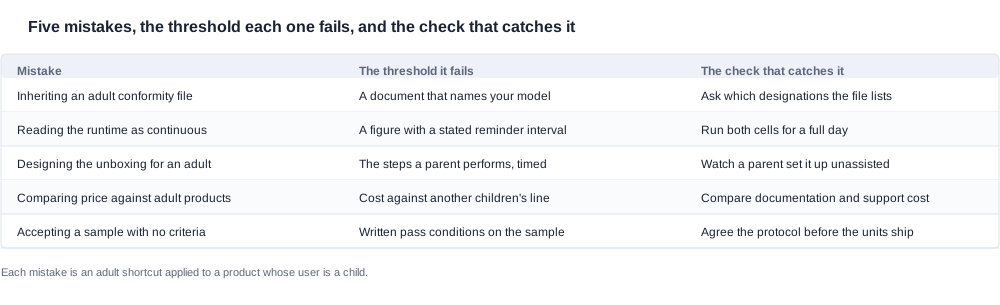
The five mistakes and the threshold each one fails
Mistake one: inheriting a conformity position from an adult platform
The threshold it fails: a document that names your model designation.
A product derived from an adult platform inherits its electronics, its app and often its conformity file. The electronics are fine. The file is not, because the frameworks that reach children's products — EN 71 in the European Union, ASTM F963 and the Consumer Product Safety Improvement Act in the United States — apply to the product as a children's item, and they are separate from the radio approval and separate from CE marking.
The prevention is a single question asked early: which model designations does the file name? If yours is not among them, the remedy is to extend the file to your configuration, to qualify your configuration, or to narrow the claim — and the choice has to be made deliberately rather than discovered at the border. Make the model designation a condition of the purchase order, so the answer is binding rather than advisory.
Mistake two: reading a duty cycle as a continuous runtime
The threshold it fails: a figure with a stated reminder interval.
Roughly twenty hours is a published figure with no test condition attached, and it describes a use pattern that is not published. A device checking posture and distance periodically is under a different load from one checking continuously, and the difference is not a detail — it is the whole of the claim. The identical figure appearing on a 40 mAh cell and a 70 mAh cell is the clue: something about the load differs, and it has to be somewhere.
The prevention is a measurement you run yourself: a full day at the reminder interval you intend to ship, on both cell configurations, with the ambient condition written down. Then publish the condition next to the number. A runtime with a condition is a specification; a runtime without one is a complaint waiting for a customer to write it.
Mistake three: designing the unboxing for the wrong person
The threshold it fails: the steps a parent performs, and how long they take.
The person opening the box is the parent, and the person wearing the product is a child with different proportions, a different attention span and a different relationship to a device that reminds them. An unboxing designed by people who did not watch a parent try it produces a product that sits in a drawer, and the return that comes back has no stated reason.
The prevention costs nothing: have a parent who has not seen the product set it up from the box, unassisted, and record where they stop. The steps they get stuck on are the steps that need to be in the quick start guide, and the ones they finish without thinking are the ones that have to be obvious.
Mistake four: comparing price against an adult line
The threshold it fails: cost against another children's line.
The comparison that matters is against another children's product, because the cost structure of this category is dominated by documentation and support rather than by electronics. Two programmes with identical unit prices can differ by a multiple in total cost once the per-model certification, the per-market labelling, the fit sampling and the support handling are counted.
The prevention is to build a total-cost view before the quotation rather than after the order, and to put the per-model and per-market items in it explicitly. A buyer who compares only the unit price will choose the adult-derived product, because the adult-derived product looks cheaper on the only line they are looking at.
Mistake five: accepting a sample with no written criteria
The threshold it fails: written pass conditions on the sample.
A sample without criteria is a demonstration, and a demonstration is won by whoever is more comfortable in front of the customer. Once the sample is accepted without conditions, the supplier's own definition of pass becomes the standard, and every subsequent conversation about quality becomes an argument about what was agreed.
The prevention is a protocol written before the units ship, with the pass conditions, the room, the workload and the number of attempts. This is the cheapest correction in this article and the one that protects every later claim you make about the product.

Where a children's line is actually decided
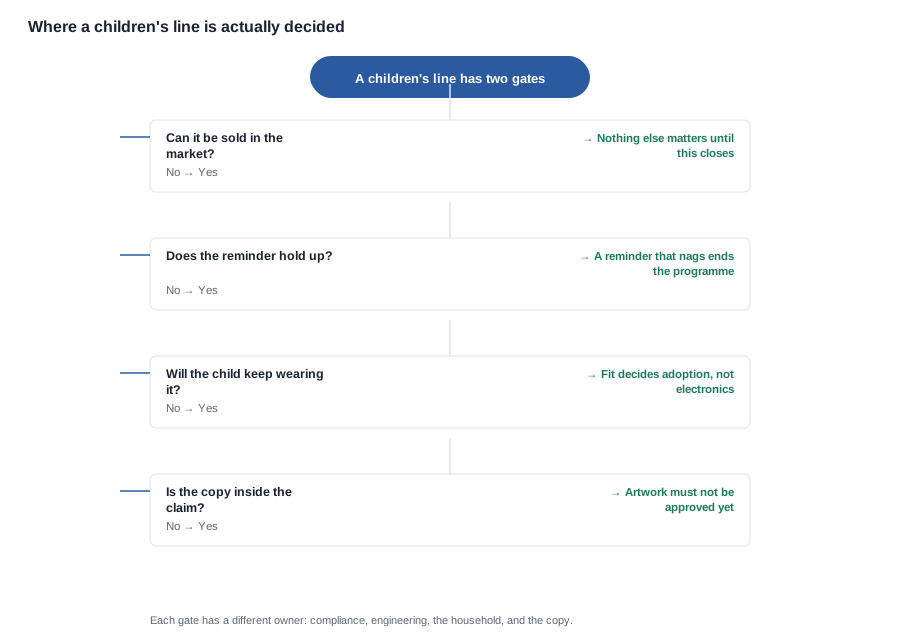
A children's programme has two gates and two owners, and confusing the owners is what produces a launch that stalls. The first gate is sellability, and it is owned by whoever carries the compliance risk. The second is adoption, and it is owned by whoever carries the return rate. The failure mode is a brand team that owns the second gate treating the first as a formality, or a compliance owner treating the second as somebody else's problem.
There is a practical symptom of that confusion, and it is worth naming because it is visible in the meeting. When the two gates are owned by one person, the meeting runs on the datasheet, because that is the artefact in front of everyone and the certification file is an abstract item that belongs to another department. When they are owned by different people, the meeting runs on the file — which is why a children's programme that has two owners tends to move faster and fail later rather than move slower and fail earlier.
The four branches above are the practical version of that statement. The market gate has to close first, because a product that cannot be sold in a destination market is not a candidate regardless of how well it performs. The detection and fit branches have to close on evidence rather than on a demonstration, because those are the two that decide the return rate. And the copy has to sit inside the claim, because the artwork sits at the end of the schedule and a claim problem found then is a reprint rather than a sentence change.
The five checks that catch the shortcuts before the order
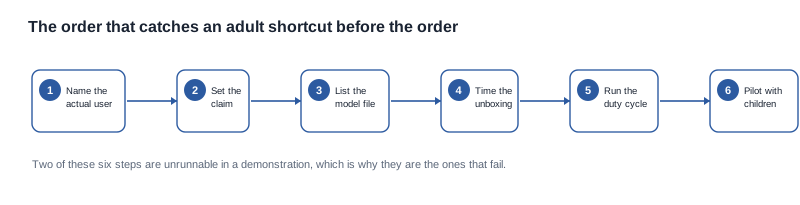
- Ask which model designations the conformity file names. If yours is not among them, decide deliberately between extending the file, qualifying your configuration, or narrowing the claim.
- Run a full day at the reminder interval you intend to ship, on both cell configurations, and record where the charge ends up.
- Watch a parent set the product up from the box, unassisted, and record the steps and the time.
- Build the total-cost view with the per-model certification, the per-market labelling and the sampling programme in it, and compare it against another children's line rather than an adult one.
- Write the sample's pass conditions before the units ship, with the room, the workload and the number of attempts recorded.
Each one is answerable before the deposit, and each one removes a decision that would otherwise be made by default in week twelve.

What the money does when a mistake lands
Where the electronics actually sit in the cost
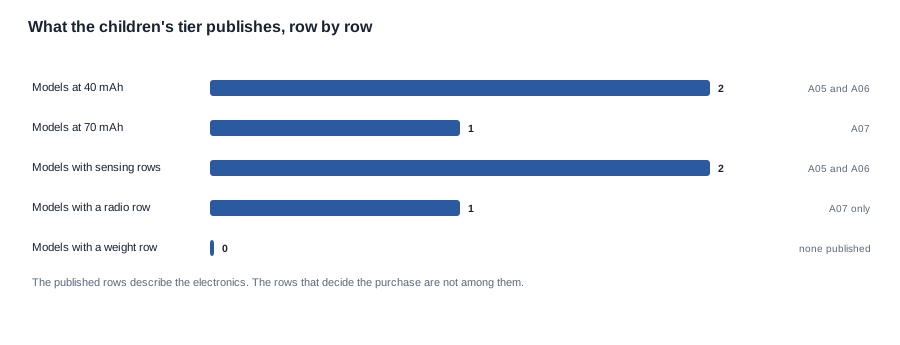
The chart above is the cheapest way to see the problem with a price comparison in this tier. Of the three models, two run a 40 mAh cell and one runs a 70 mAh cell; two carry sensing rows and one carries a radio row; and not one of them publishes a frame weight. Every row a buyer would normally put in a comparison table is present, cheap, and already known — while every row that decides the programme is absent from the catalogue and has to be obtained.
That asymmetry is why a total-cost view built at the quotation stage produces a different shortlist from a unit-price comparison. The per-model conformity work, the per-market labelling sets, the fit sampling across the age range and the support handling for a device worn by a child are all real costs, all borne outside the invoice, and all invisible to a spreadsheet built on catalogue rows.
There is a practical discipline that follows from this, and it is worth stating plainly: build the total-cost view from the count of models, the count of markets and the count of variants, not from the bill of materials. Three models, four markets and two colours is twenty-four document sets and a sampling programme that has to be scoped. That number is the real size of this category's commitment, and it is the number a buyer should carry into the negotiation.
The three commercial terms worth negotiating
The minimum order quantity is the first thing a new-category buyer reaches for, and in this category it is the least valuable of the available levers, because the unit price is the smallest component of the cost. Packaging and insert design — including the market labels, the language of the documentation pack and the required warnings — is a low-cost negotiation with no tooling implication, and in a children's line it is often worth more because each market carries a separate label set.
Delivery splitting against a certification milestone is usually granted more easily than a price concession, because it moves the approval risk onto the schedule where it belongs and the schedule is the thing the supplier also wants to protect. The way a payment falls due is the standard area: a deposit paid on the order confirmation, a balance on the inspection point before shipment, and a retention held against the document package protects the buyer on the failure that costs most in this category, which is a product that arrives with paperwork that does not cover it.
The one commercial term that is worth pushing hard on is the per-model and per-market scope of the documentation, because it multiplies with the range. Three models across four markets is twelve document sets, not one, and the buyer who commits to that scope at the quotation stage gets a materially better price than the buyer who commits to one model and discovers the multiplication later.
What cannot move, and what to write into the agreement
The certification cost and the certification time are a fixed cost per model and per market, and the elapsed time is set by the test body rather than by the order size. In the children's category they carry a second property as well, because a new edition of a standard can require retesting a product that has already shipped, so the cost is a recurring risk rather than a one-off. Tooling is a one-off cost usually amortised across the first order, so the useful questions are over what volume it is amortised and what happens to the tooling if the programme is discontinued.
The documents to request before the deposit are the conformity file references with standard names, edition numbers and model designations; the detection parameters with units, including the false-positive rate at the default setting; the runtime measurement condition, including the reminder interval; the unboxing and setup flow; the frame dimensions and weight with the measurement method; and the certificate numbers with the issuing body and the validity dates.
The clauses to write into the purchase order are the exact model designations covered by each document, attached to the order; the acceptance criteria for the sample, referencing the detection observations, the duty-cycle run and the wearing trial; a clause requiring notice before any change of firmware, detection threshold default, frame material or supplier of a safety-relevant component; a clause requiring the documentation pack to be updated when a standard's edition changes; and a clause on who bears the cost when a lot fails the acceptance criteria.
Where we hold a line, and what to send us next
The boundary we hold: we publish the children's models' electrical rows — the 40 mAh and 70 mAh cells, the charge time of two hours or less, the roughly twenty-hour runtime, magnetic charging, Bluetooth 5.4 on the A07, and the presence of posture and viewing-distance detection on the two sensing models — and we say clearly that the detection parameters and the certification status are not published. We publish no frame weight, no dimension and no size range for this tier, and we will not fill a children's buying decision with plausible thresholds or a certification claim, because in this category an invented number becomes a safety statement on a product page that a parent will rely on.
We also make no efficacy claim tied to vision, health or eye protection for any of our products, in any market. A listing in this category should describe functions and documentation, and we would rather a buyer runs the copy past someone qualified than find out afterwards that the claim was the problem.
We will also tell you plainly that a buying decision built on the published rows alone cannot be completed, and that the rows which complete it are the ones you have to obtain rather than the ones we publish.
If you send us the two products, the destination markets and the customer profile, we will tell you which questions decide the comparison and which we can answer from our own data. The background is under kids eye care technology, the documentation side is in kids certification requirements, the measurement method is in how to test kids eye protection glasses, and the range is kids smart glasses.
Where the mistake list comes from
Send us the two products and the customer profile, and we will say which of these five mistakes you are most likely to make.


