
Smart glasses for office: the desk recharge window decides the seat
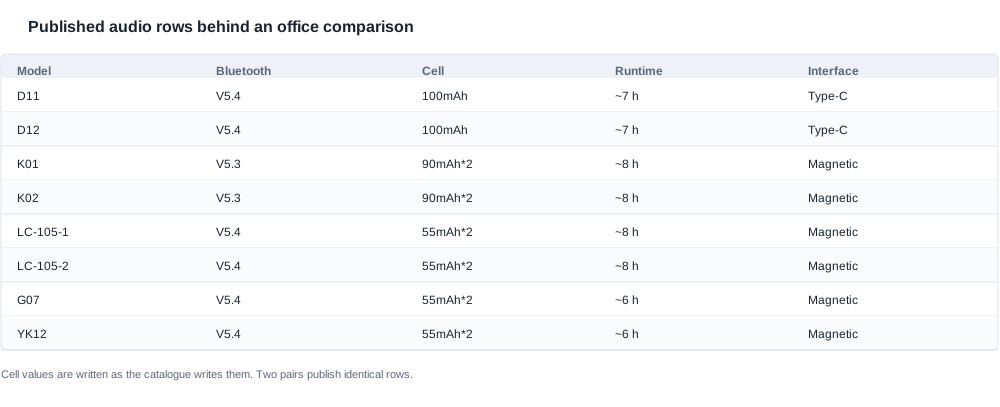
Smart glasses for office comparisons collapse onto three questions the catalogue does answer, and they collapse because the audio tier is electrically close to itself. The first is the charging interface: Type C on the D11 and the D12, magnetic on the YK12 and the LC-105-2, the K01 and the G07, and the LC-105-1 and the K02. The second is whether the two candidates are even different products: the D11 and the D12 publish identical rows, the K01 and the K02 publish identical rows, with no capacitive touch row published for either of them and any control difference left to be established on a sample, and the LC-105-1 and the LC-105-2 publish identical rows. The third is whether the unit is issued to one person or pooled at a desk, because that changes the cost basis and the cleaning obligation entirely.
What the catalogue does not answer is the number that would make the comparison easy: there is no runtime test condition, no third-party acoustic measurement, and no leakage figure for any audio model. A buyer who builds an office comparison sheet from feature names will produce a confident answer with nothing behind it. A buyer who builds the sheet from the interface row, the platform identity and the recharge window will produce a shorter answer that survives contact with a purchase order.
The buying task behind this comparison. The reader is someone buying for a brand, a channel buyer or a product manager specifying an audio product for an office, a hybrid workplace or a shared service desk, and the task is to compare the surviving candidates on the axes that change the invoice and the furniture, then to stop. The risk being managed is not a bad headset. It is a procurement error of the most expensive kind: a comparison that produces a false winner — a model that wins a spreadsheet and loses the building, because the spreadsheet ranked rows that do not predict how the device is actually charged, issued and collected at 6 p.m.
The three published rows that decide an office seat.
| Published row | What the catalogue states | Why it moves an office seat | What a soft answer looks like |
|---|---|---|---|
| Charging interface | Type C on the D11 and the D12; magnetic on the YK12 and the K01, the LC-105-1 and the G07, and the K02 and the LC-105-2 | A Type C unit charges from the cable already in the desk drawer; a magnetic unit needs a dock or a case added to the fit-out | Both interfaces offered without naming the desk standard |
| Charge time | Two hours or less for every audio model in the catalogue | Decides whether a recharge fits inside a lunch break or a shift change | "Fast charging" with no hour attached |
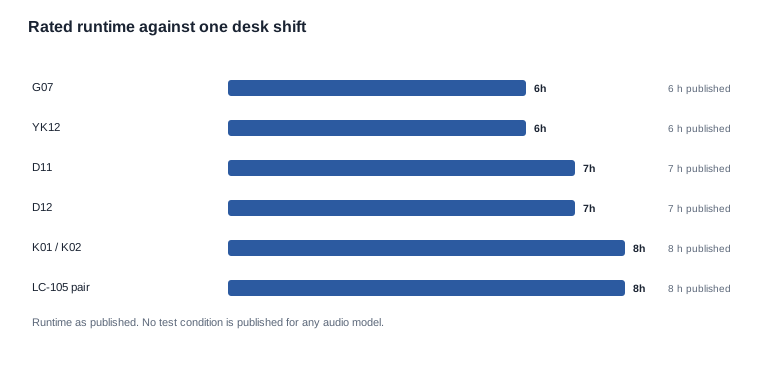
| Rated runtime | About six hours on the G07 and the YK12, about seven on the D11 and the D12, about eight on the K01, the K02 and the LC-105 pair | Decides whether one charge covers one shift | A rating quoted as a working day |
| Cell configuration | 55 mAh × 2, 90 mAh × 2 or a single 100 mAh cell | Changes how many units travel and how many spares sit in a drawer | A total capacity with the per-cell values dropped |
| Platform identity | Identical published rows on the D11 and the D12, on the K01 and the K02, and on the LC-105 pair | Two identical candidates are one decision, not two | Two models quoted as if they differ on spec |
| Control method | Not published for any model in the catalogue | Decides whether a shared unit can be operated without waking the person at the desk | A control feature attributed to both models of a pair |
| Leakage into the room | Not published | A privacy argument to a facilities or compliance reviewer | A privacy claim with no measurement behind it |
| Unit weight | Published for one model in the whole catalogue, and that model is not an audio model | Decides whether the packaging and the fit-out signage carry a number | A category average substituted for a measurement |
Why the desk recharge window outranks the runtime figure. A seven-hour rating sounds short against a nine-hour shift, and a buyer who stops there will pick the eight-hour model and feel that the problem is solved. It is not, because no runtime in this range carries a test condition, and the published charge time is two hours or less for every audio model without a published start state or end criterion. What actually decides an office seat is whether the recharge lands inside a break that already exists. In a desk-based office that is a lunch break, and two hours or less fits. In a shift-based service operation that is a fifteen-minute handover, and it does not fit, which is where the pooled-versus-personal question becomes a charging-bay question. The unit price comparison that follows is then a comparison of charging furniture, not of headsets.

What the audio tier publishes for office, and what it withholds
The published audio range is eight models, and the comparison is thinner than the model count suggests because several models publish the same rows. The K01 and the K02 sit on Bluetooth V5.3 with two 90 mAh cells, magnetic charging and roughly eight hours of rated runtime; neither publishes capacitive touch, and the catalogue carries no touch row for either of them, so no published row separates that pair. The D11 and the D12 sit on Bluetooth V5.4 with a single 100 mAh cell, Type C charging and roughly seven hours, and the D11 additionally publishes surround sound. The LC-105-1 and the LC-105-2 sit on Bluetooth V5.4 with two 55 mAh cells, magnetic charging and roughly eight hours. The G07 sits on the same electrical rows as the LC-105 pair but publishes roughly six hours, ultra-slim temples and a detachable temple. The YK12 sits on the same cell configuration and the same six-hour rating, with a slim temple described as surround sound.
The pair that behaves like one product, and the pair that does not. Two comparisons in this tier are merchandising decisions, and they should be priced as such. Choosing between the D11 and the D12 is choosing an appearance, a colourway or a moulding, because the published electrical rows are the same on both sides. Choosing between the LC-105-1 and the LC-105-2 is the same kind of choice. The K01 and the K02 pair publishes no row that separates it: neither carries a touch row in the catalogue, so whether a control difference exists at all is a question for the supplier rather than a published distinction. A control difference, if one is confirmed, changes whether the unit can be operated without a phone in the hand, which is a real operational property in a shared environment even though it is a small one. The pairs that genuinely differ are the ones separated by interface — Type C against magnetic — and by temple architecture.
The fitting system is a return-rate lever, and the catalogue treats it as a structural row rather than an ergonomic promise. The G07 publishes ultra-slim detachable temples and the YK12 publishes a slim temple, and a detachable temple is a fitting system: it lets one outer frame serve different face shapes, and in a workforce with a wide size range it reduces the number of units that come back for fit rather than for function. It also changes what the buyer buys after the first run. A detachable temple is a spare part; a fixed temple is a written-off device. A buyer who has not asked whether spare temples are supplied has quietly decided to replace whole units instead of parts, and that decision shows up as repeat purchase volume rather than as a warranty claim.
What is published nowhere in the audio tier, and what it costs you to guess. The catalogue publishes no third-party acoustic measurement, so "surround sound" cannot be compared between the D11 and the YK12 and cannot be defended in a tender response. It publishes no leakage figure, so an open-ear design cannot be defended in an open-plan floor on privacy grounds; if privacy is a stated requirement, it has to be measured at a stated distance and volume, and that measurement belongs to the buyer, not to the datasheet. It publishes no frame weight for any audio model, and the single weight figure in the whole catalogue belongs to the MT6, a camera model with a folding case, which is not an office audio candidate and must not be presented as one. It publishes no runtime test condition, no cycle life rating, no standby draw, no operating temperature range and no ingress rating for the audio models. The workplace considerations that sit around the selection are at office safety considerations.
Turning two office samples into one comparable sheet
A comparison that survives a procurement review is one where every row has a source, a method and a date. The method below is deliberately dull, because the value of an office comparison comes from its reproducibility rather than from its sophistication.
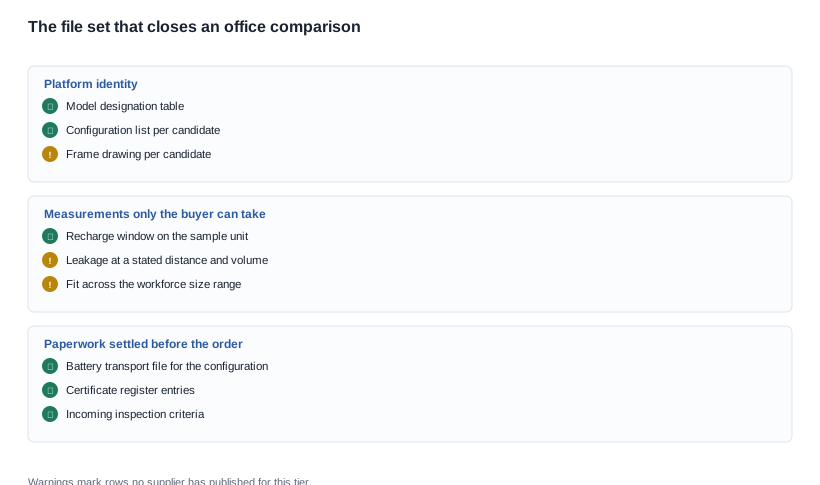
- Establish platform identity before comparing anything. For each candidate, take the model designation, the configuration list and the frame drawing. If two candidates publish identical rows, they are one platform with two configurations, and the sheet should say so before it ranks anything.
- Record the interface against the desk standard. Write down what the desk actually provides — a USB-C port, a company laptop with a single port, a shared charging cabinet — because the interface row only becomes a decision when it meets a known desk condition.
- Measure the recharge window, not the runtime. Time an actual charge on the sample unit and record the start state and the end criterion you used. That produces a number your facilities team can plan against, and it is the number the catalogue does not publish.
- Measure leakage at a stated distance and volume for any candidate that will sit in a shared or open-plan space, and record the method on the sheet. If the buyer cannot measure it, the claim cannot be made.
- Test the fitting system across the real size range rather than on one pair of faces, and note which temple configuration was worn and whether a spare temple was available at the moment of adjustment.
- Confirm the sample unit is the production configuration, using the procedure at samples, and check the packaging artwork proof against the shared-device procedure the customer will run.
- Confirm the model designation on the unit against the paperwork, check every certificate number in the issuing body's public register at certification checklist, and request the battery transport file at battery transport. An audio model has one cell, but the file still has to cover the configuration in the box.
- Agree the incoming inspection criteria before the first shipment, not after it, and write the pass line for each published row onto the purchase order.
The file set that closes an office comparison. The comparison sheet with the elimination reasoning recorded against each row, the configuration and designation table, the recharge measurement with its method and conditions, the leakage measurement where privacy applies, the fit test notes across the size range, the battery transport file for the ordered configuration, the certificate register, the packaging artwork proof, the incoming inspection criteria, and the per-seat cost model. The clause language is at contract terms, the commercial structure of a first order is at pricing, and the product range is at Bluetooth audio glasses.
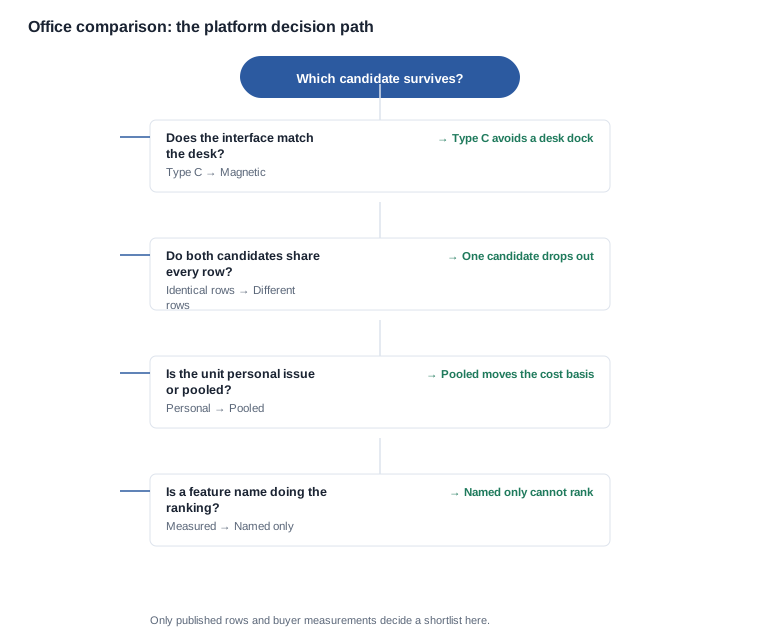
A worked comparison, in the order a buyer actually runs it. Take a financial services firm with 400 desks, a USB-C standard at the desk, a hot-desking policy and a security team that will ask whether an open-ear unit is audible from the neighbouring seat. The first screen is the interface, and it removes the magnetic models outright because the desk does not have a dock and adding one to a fit-out is a facilities conversation rather than a purchasing one. That leaves the D11 and the D12, which publish identical rows. The second screen is platform identity, and it collapses two candidates into one product with two configurations — at which point the sheet stops comparing and starts costing. The third screen is leakage, because the security team asked, and the buyer measures it at the neighbouring-seat distance on the actual sample rather than accepting a claim. The fourth screen is the per-seat cost: unit price, plus the charging furniture if the desk needs any, plus the expected replacement rate at the end of the deployment cycle, plus the cost of the units that will be reissued to a new joiner mid-cycle. The fifth screen is the paperwork, which the procurement team will not sign without the certificate register and the transport file. The outcome is a shortlist of one platform, one configuration decision, one measurement the buyer had to take, and a per-seat cost that survives a challenge.
The failure patterns that reach an office buyer as a returns line
Office failures are quiet. Nothing explodes and no claim is dramatic; the device simply stops being issued, and the unit goes into a drawer. Each pattern below has a symptom, a root cause and a prevention that can be written into the order.
A comparison built on feature names. Two candidates are ranked on surround sound and touch, and the ranking has no measurement behind either term. The symptom is a purchase order defended in review by adjectives. The root cause is treating an unmeasured feature as an axis. The prevention is to require a number, a method and a source for every row before the row is allowed to influence a decision.
A dock added late. A magnetic candidate is chosen, and the charging hardware is discovered during deployment. The symptom is a facilities ticket after the units have shipped. The root cause is comparing the interface row against nothing, so the interface was never matched to the desk. The prevention is to write the desk's charging provision into the specification, not the supplier's.
A unit issued to a person and then pooled. The device is bought as personal equipment and then becomes a desk pool during a hybrid-work change. The symptom is a hygiene complaint that has no procedure behind it, because the consumables and the case were specified for personal use. The root cause is a shift in operating model after the order. The prevention is to ask the customer which model will apply at the point of quotation, because the answer changes the accessory list and the replacement rate.
A pooled unit with no handover step. Devices circulate between staff and no one is accountable for them. The symptom is a device that does not charge, which is a contacts issue rather than a battery issue, and it is usually mistaken for a warranty claim. The root cause is that nobody was given a routine. The prevention is to supply an instruction card and to require the routine to be attached to the moment the unit goes back on the desk, because an instruction on an insert is read once and a routine attached to a habit is followed.
A run-time figure quoted as a working day. The seven-hour rating is written into a business case as a full shift. The symptom is a device that runs flat in the late afternoon and is quietly put back on charge, which erodes the reason the device was bought. The root cause is a published figure with no test condition read as a guaranteed shift. The prevention is to measure the recharge window on the sample and quote that number instead.
A platform identity discovered after the artwork is approved. Two configurations of the same platform are treated as two products, and the packaging, the listing and the training material all promise a difference that the specification does not contain. The symptom is a customer review that says the product is not what the page described. The root cause is a shortlist built without a designation table. The prevention is a one-page configuration sheet, attached to the artwork approval, that lists what is identical and what is not.
An acoustic claim that cannot survive a tender. A proposal quotes surround sound as a productivity benefit. The symptom is a challenge from an evaluator who asks for the measurement. The root cause is repeating a catalogue feature name as if it were a result. The prevention is to describe what the device does, not what the wearer gets, until a measurement exists.

Where an office order has room to move and where it does not
The parts of an office order that are settled before the price conversation. The charging interface, because it determines whether the desk needs hardware. The cell configuration, because it determines how many units and spares travel. The acoustic architecture, and therefore anything a privacy reviewer will ask about it. The certification cost and its lead time. The tooling, which is amortised across the first order and quoted as its own line rather than folded into a unit price that then has to be unpicked later.
The parts of an office order where the commercial room actually is.
- Whether the brand identity is one moulding or two. If two configurations are on the same platform, deciding early that only one carries the logo changes the artwork, the moulding count and the MOQ, and it is the cheapest decision in the whole order.
- The share of units taken at a pilot tier rather than a run tier. This is where most of the room sits, because it is the factory's own risk exposure, and for an office order it also becomes the buyer's test fleet for the fit, leakage and recharge measurements.
- Minimum order quantity tiers, and whether two configurations share one purchase order. Sharing a purchase order removes a second inbound inspection and a second certificate file for the same hardware.
- Splitting the first run into two deliveries against a staged payment. For an office order this usually maps onto a pilot group and a building-wide rollout, which is also how the buyer gets the measurement data before committing the rest of the volume.
- Who funds a second sample round. Comfort, fit and leakage testing take more than one round of samples more often than not, and a buyer who has written the funding into the quotation gets samples shaped for the test rather than samples chosen for appearance.
- Whether spare temples are supplied as a service item. On a platform with detachable temples this is the difference between a parts order and a replacement order, and the buyer should establish it before the first run, not after the first 200 returns.
- The return window and the failure attribution rule. For a pooled fleet, the attribution rule determines who pays for a unit that failed in service, and it is cheaper to agree when both sides are calm than when a return report arrives.
The selection logic that sits upstream of the comparison is at how to choose the right model for office, and the scenario entry point is smart glasses for office.
What we settle for an office comparison, and what we will not claim
We publish the Bluetooth version, the charge time, the cell configuration, the rated runtime and the charging interface exactly as the catalogue states them, and we publish the absence of a third-party acoustic measurement, of a leakage figure, of a runtime test condition and of a frame weight with the same prominence as the rows themselves. We will not rank two of our own models on an acoustic characteristic nobody has measured. We will tell you when two models are the same platform, which in this tier they frequently are, because that is the moment a comparison turns into a costing problem. And we will not quote the one weight figure in our catalogue as an office figure — it belongs to a camera model with a folding case, it is the weight of the glasses body including its battery and camera and excluding the case, and the case weight is not published.
What we will not do is fill the gaps with industry averages. That covers the frame weight, the acoustic performance, the leakage, the runtime test condition, the cycle life rating, the standby draw and the operating temperature range. A comparison that depends on any of these is a comparison with no data behind it, and we would rather say so in the quotation than have the gap discovered during a tender.
What we will do is take the desk's charging provision, whether the unit is issued personally or pooled, the price band and the deployment size, and return a comparison of the surviving candidates with the published rows that apply, the rows that do not exist, the measurements the buyer will have to take, and the documents that have to be settled in writing before a purchase order is raised.
Send us next. Send the interface your desks provide, whether the unit is personal issue or pooled, the fleet size, the target price band and the markets, and we will return the comparison of the surviving candidates with the missing data listed rather than filled. The related reading sits at smart glasses for office, Bluetooth audio glasses, how to choose the right model for office and office safety considerations.
Related reading
- How the scenario opens — smart glasses for office
- The range we publish — Bluetooth audio glasses
- The choosing logic — how to choose the right model for office
- The safety considerations — office safety considerations
Send the desk charging provision and whether the unit is pooled, and we will return the comparison of the surviving candidates.


