
Smart glasses for office safety considerations are less about physical safety than in any other deployment channel, and much more about the fact that a camera in an office is the last thing anybody expects. The ergonomic questions are ordinary and comparable to any other device. The expectation question is not ordinary, and it is the one that produces complaints rather than returns, because a complaint about noise is settled by a sound-level measurement while a complaint about being filmed is settled by a relationship.
The useful way to organise this subject is not by severity but by who ends up carrying the cost. Seven risk areas appear in almost every office deployment. Three of them cost the buyer directly, three cost a colleague in time and goodwill, and one is a design limitation that no policy can remove. Ranked that way, the order of work changes, because the risks that cost a colleague are the ones that damage adoption, and adoption is what the whole procurement project is for.
We publish the audio range's runtimes and the camera platforms' configurations. We publish no data-flow detail, no recording-indicator specification and no sizing data for any model in the range, which is why three of the seven areas below can be answered only by a decision you make rather than by a figure we hold.
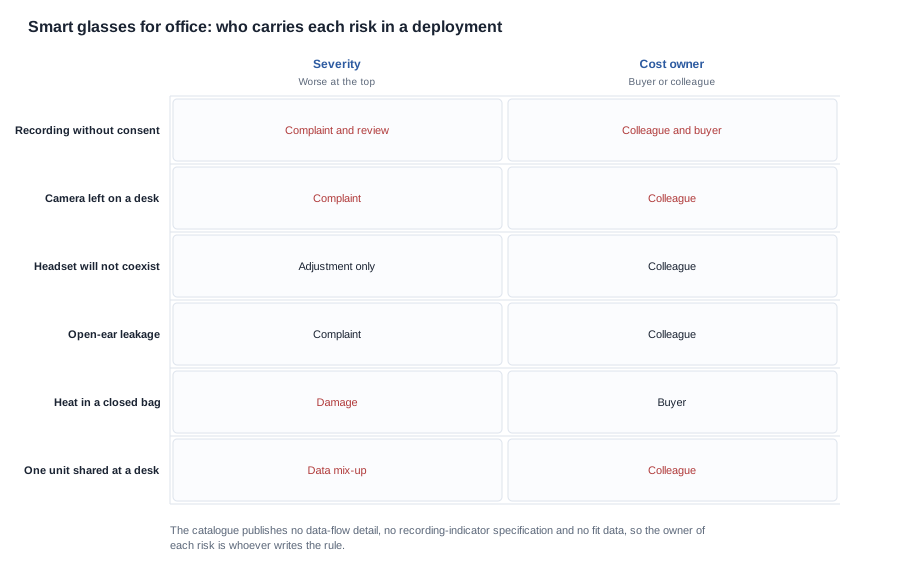
Smart glasses for office: seven risks ranked by who absorbs the cost
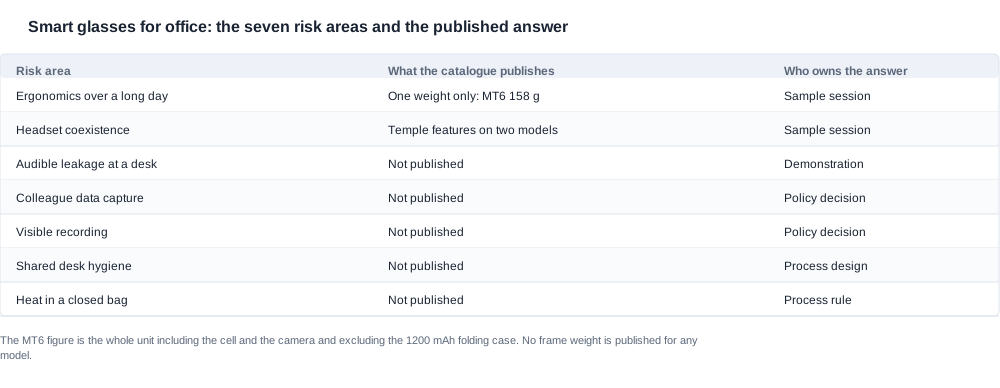
| Risk area | What the catalogue publishes | Who owns the answer |
|---|---|---|
| Ergonomics over a long day | One weight only: the MT6 at 158 g | Sample session |
| Headset coexistence | Temple features on two models | Sample session |
| Audible leakage at a desk | Not published | Demonstration |
| Colleague data capture | Not published | Policy decision |
| Visible recording | Not published | Policy decision |
| Shared desk hygiene | Not published | Process design |
| Heat in a closed bag | Not published | Process rule |
The ranking that matters is the third column. A risk that lands on the buyer can be handled with a budget line, a replacement reserve and a claim route. A risk that lands on a colleague can only be handled with a rule, because the colleague is not party to the procurement and will not read the acceptance criteria. The two rows at the top of that middle block are the ones that will cost you the rollout.
The seven areas are not equally likely. They are ordered here by consequence, not by frequency. An office that already operates a hot-desk policy is managing the shared-unit risk; an office where the same person sits at the same desk every day does not have that risk at all. Which three of the seven actually apply is a function of the deployment model, and establishing that is the first thing to do — before selecting a model, before choosing a quantity, and before anyone writes a policy that describes a risk that was never present.
How to score the seven in your own deployment. Give each area a one-word verdict against three questions: does it land on the buyer or on a colleague, can a written rule remove it, and can a measurement confirm it has been removed. A buyer cost with no rule and no measurement is the expensive cell, and it is usually the shared-desk area or the privacy area. A colleague cost with a rule and a measurement is manageable. A design limitation — the open-ear inability to deliver private audio — is neither, and it is handled by scoping the deployment to tasks where it does not matter rather than by trying to solve it.
One of the seven is a limitation rather than a risk. The open-ear design exists to keep the person at the desk aware of the room. That is a design intent, and it is also a permanent inability to make the audio private. No policy changes it and no firmware update changes it. A buyer who discovers it during a pilot will treat it as a defect; a buyer who expects it from the start treats it as a specification, and the difference between those two positions is worth several hundred avoided returns.
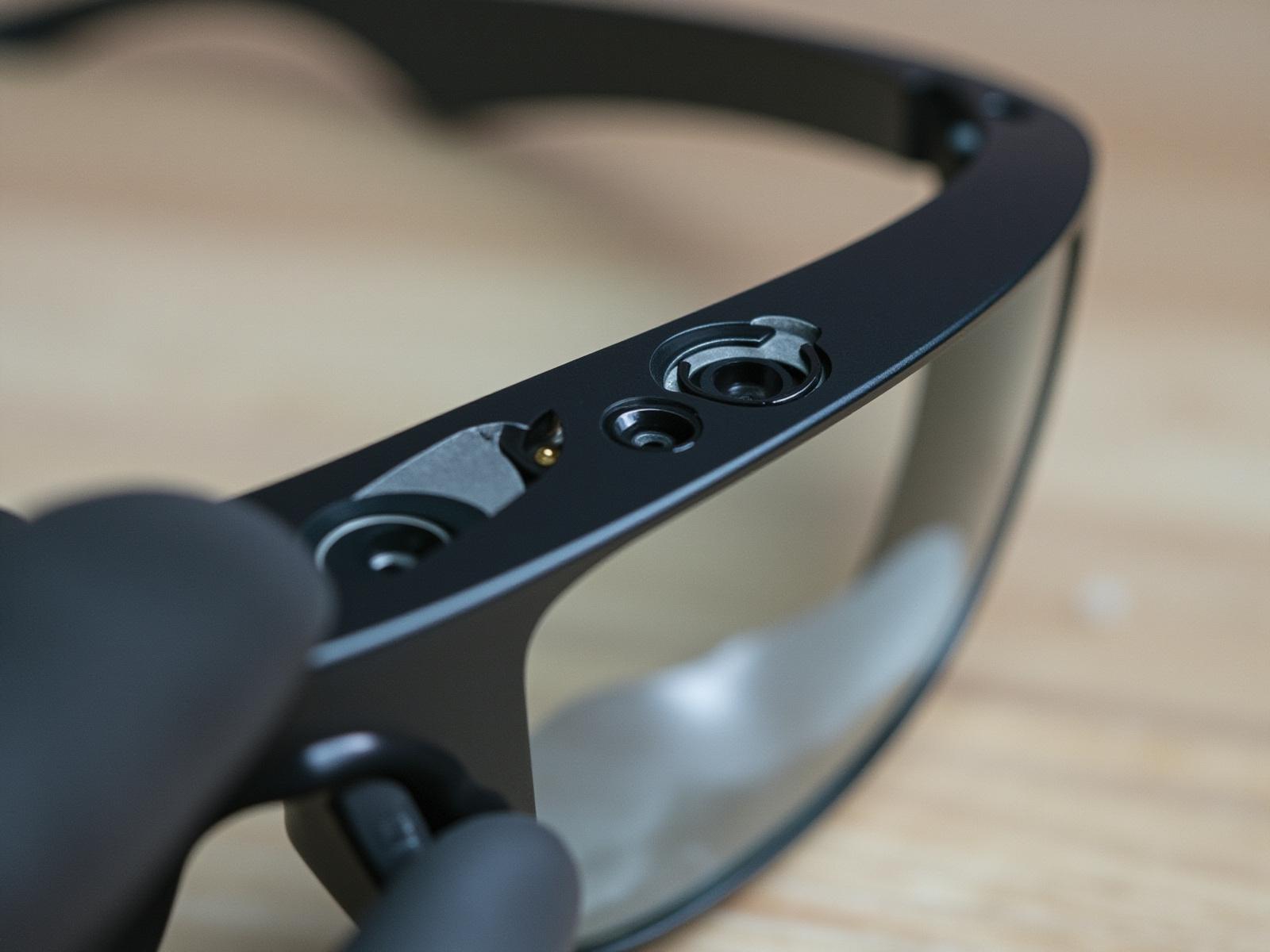
The camera in a room full of people who were not asked
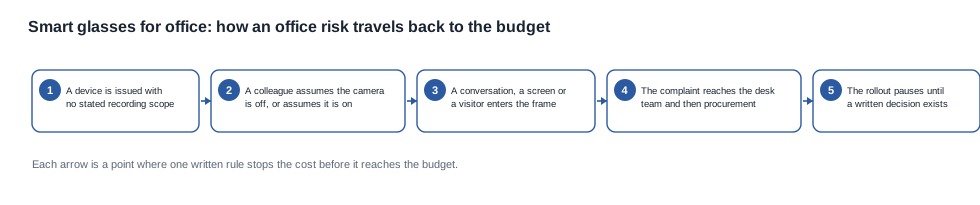
A camera-equipped device in an office captures three categories of people who have no idea it is present: colleagues who are not part of the deployment, visitors who were never told, and anyone whose screen happens to be within the field of view. The third category produces the serious complaint, because a screen can contain a record, a name, a salary band or a piece of information the organisation has a duty to protect, and no amount of good intent survives that.
What we publish about this is nothing. We publish no data-flow detail for any model: not where captured content is written, not whether it leaves the device, not how long it is retained, not whether it is retrievable by another party, and not what happens to it when the device is handed back. In a workplace this is not a specification detail. It is the question a colleague's privacy depends on, and the only defensible answer is a policy that states the device's behaviour in your environment even when the supplier cannot state the device's behaviour in general.
The visible indicator is the second half of the problem. A colleague who cannot tell whether a recording is happening will either behave as though it always happens, which destroys the trust a deployment depends on, or behave as though it never is, which is the assumption that eventually produces the complaint. We publish no recording-indicator specification for any model, so where the indicator is implemented, whether it can be switched off, and what happens when the application is not running are all questions for the sample session and for your acceptance criteria.
The regulation does not answer the question for you. The EU position runs through the Radio Equipment Directive (Directive 2014/53/EU) for radio equipment and through GPSR (Regulation (EU) 2023/988, applicable since 13 December 2024) for traceability and economic-operator obligations. Neither framework tells you whether a colleague in a meeting room may be captured, because that is a matter of employment law, data-protection law and your own policy rather than a matter of radio conformity. A supplier who points at a directive and treats the question as answered is avoiding it.
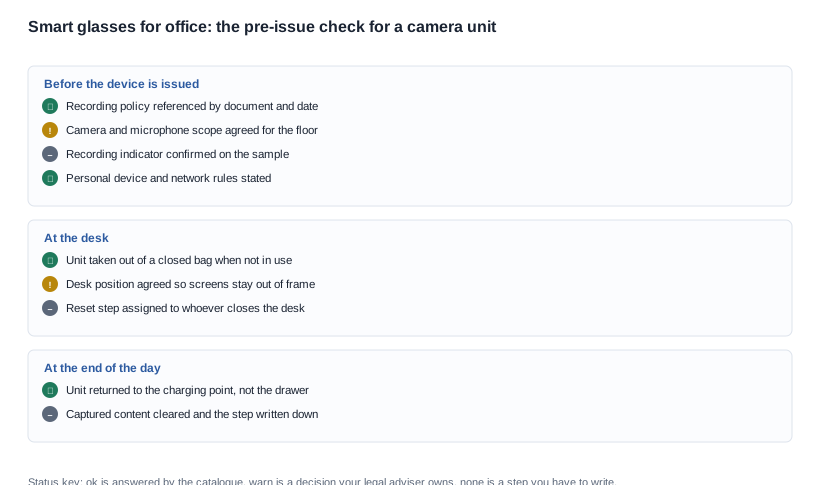
The checklist above is the minimum set of controls that makes a camera unit defensible to issue. The first item is the only genuinely load-bearing one: a recording policy referenced by document name and date, so that when a colleague asks in month three there is something to show. The remainder are process rules, and process rules only work if they are written down and owned by a named person.
What to ask the supplier in writing. Three questions settle most of this area, and all three belong in the purchase file rather than in a meeting. Where is captured content stored, and is it on the device or on a server? What is the retention period, and who can retrieve it? What is the indicator behaviour when the application is not running? A supplier who answers all three in writing has a product; a supplier who answers them verbally has a conversation, and a conversation does not survive an audit by the organisation's own information-security team.
A scoping decision is usually cheaper than a control. If the business case for the pilot is hands-free documentation at a workstation, then the deployment can be scoped to a single team on a single floor with a written recording scope, and the exposure is bounded by construction. If the business case is ambient capture across an open floor, then the controls above have to be much stronger, and the honest description is a security programme with a device attached rather than a device rollout. Deciding which of the two you are running is a scoping question, and it belongs with the procurement lead rather than with the product team.
The headset collision that no order form ever captures
The office ear is usually occupied. A frame and a headset have to coexist, and whether they do is a function of temple geometry and head size rather than of the electronics, which means no datasheet settles it and no order form captures it. The failure is not dramatic. It is a temple that has to be moved on every use, a control position that cannot be reached once the headset is on, and an assistant who eventually stops using the device because the routine is annoying.
This is the one risk in the list that is specific to the office, it is common, it is easy to overlook, and it is cheap to test on a sample. The test is not complicated: put the frame on with the headset the organisation actually uses, and leave it there for an hour. What an hour establishes is which temple has to move and in which direction, whether the frame's control position stays reachable, and whether the audio channel is still intelligible with the headset in place. The hour is the whole test. It costs nothing except an hour of somebody's time, and it is the cheapest hour in the entire procurement.
What the catalogue gives you here is narrow. The G07 publishes an ultra-slim and detachable temple, and the YK12 publishes a slim temple. Those two are the only temple-related features published anywhere in the range, and they are the only ones you can cite when the question of headgear compatibility arises with a customer. Everything else — temple length, adjustment range, head-size coverage, the profile of the temple against a headset band — is not published. For the remaining models the question is a sample question, and it should be written as one.
How to turn the hour into a criterion. Before the session, write down what a pass looks like: the device stays in place without adjustment, the control is reachable without removing the headset, and speech on a call remains intelligible at working distance. Then record the result against those three lines. A test that produces an opinion cannot be written into incoming inspection, and an opinion written into an acceptance clause is unenforceable; a test that produces three pass lines can be enforced on a delivery.
The interaction with an open-plan floor is worse than the interaction with a headset. A temple that has to be moved for a headset also has to be moved for a hat, a hood, a hard hat or a pair of safety glasses, and each of those is a different geometry. If the deployment crosses into any regulated environment, the headgear interaction becomes a specification requirement rather than an ergonomic question, and a specification requirement needs a number. We do not publish one, so the number has to come from the supplier in writing or from your own measurement, and it has to arrive before the purchase order rather than after it.
How this risk is usually missed. It is missed because it is tested once, quickly, by the person who is most motivated to make it work, with the headset that person happens to own. The test that predicts deployment behaviour is the one run with the most common headset on the floor, by somebody with no stake in the outcome, for a full hour. If the organisation has a purchasing policy for pilot evaluation, this belongs at the top of the sample protocol.
Open-ear audio in an office that has to hear a colleague
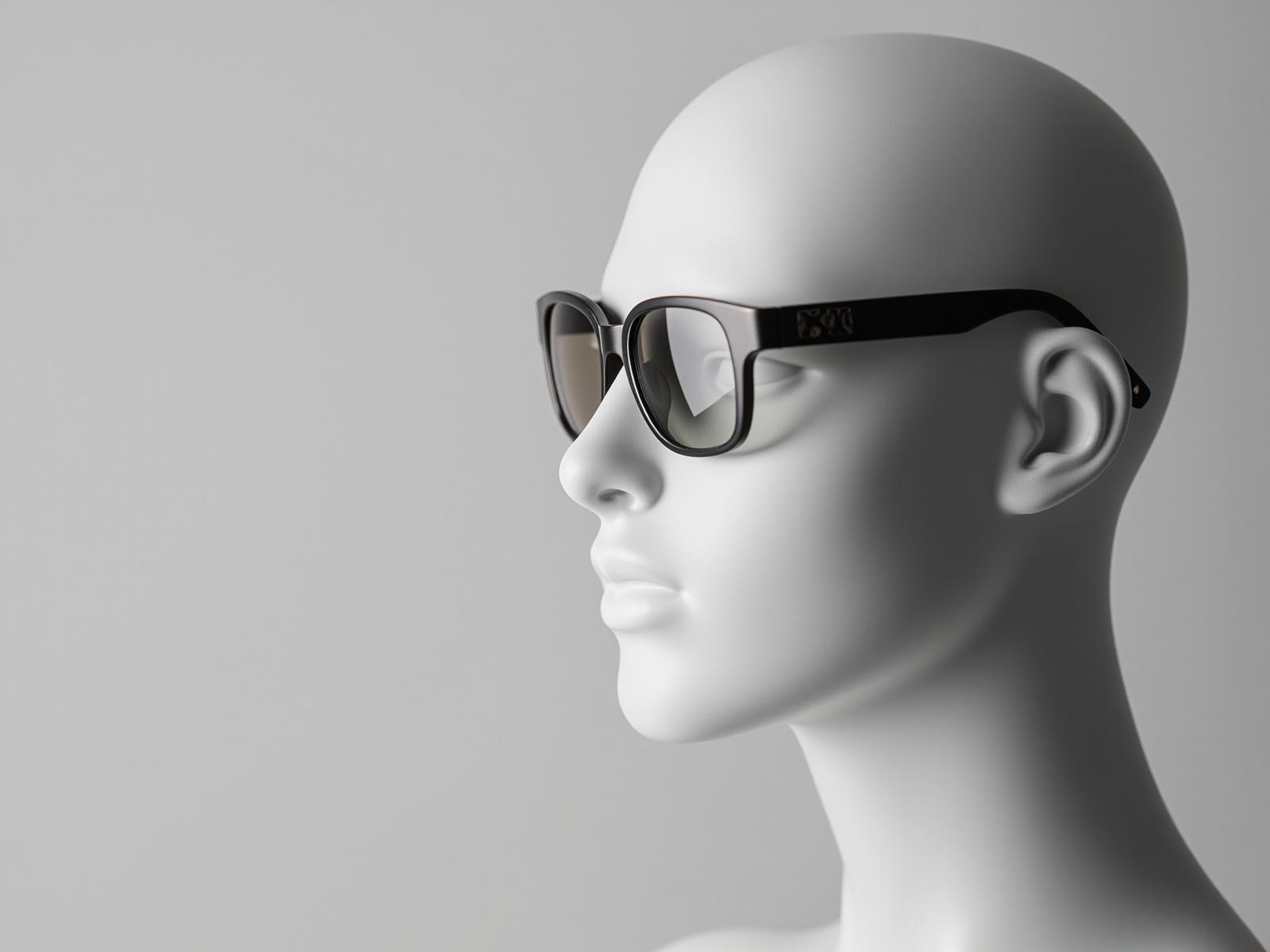
Open-ear designs genuinely help at a desk for the same reason they help outdoors: the person at the desk keeps hearing the room. Someone who can hear a colleague approaching and a door opening retains situational awareness that an isolated over-ear headset removes, and on a floor where the work involves moving between spaces that awareness is a practical benefit rather than a novelty.
It is also, unavoidably, a design that cannot deliver private audio. Acoustic leakage is not published in our documentation, and neither is microphone pickup distance, driver unit size or frequency response, so the honest position is that the open-ear architecture is known to leak relative to an open-back over-ear design and that the magnitude in your room is a measurement you have to make. What can be said from the design principle is that open-ear designs exist to reduce leakage, not to eliminate it.
The question this raises is a workplace question. A desk near a colleague who handles a customer call will hear that call. That is a courtesy problem before it is a compliance problem, and in practice it is solved by a placement rule rather than by a device change: which desks carry an audio device, which do not, and who decides. A buyer who writes that rule before the rollout avoids an argument in week two, and a buyer who does not write it will have the argument anyway, in a corridor rather than in a policy meeting.
The safety-adjacent reading is worth stating carefully. A person at a desk who cannot hear a colleague or a door may miss something, and an office where that happens is a workplace carrying an avoidable risk. That is a reason to treat open-ear as a deliberate design choice rather than a compromise, and it is also a reason not to present it as a safety feature. We do not describe open-ear as a safety feature, because presenting a design intent as a tested protection level is exactly the claim we will not make anywhere in this category. The open-ear audio page sets out the design principle as a design principle.
How to check it in a room that matters. Two colleagues in the open-plan area, one reading a standard paragraph aloud at a normal speaking volume, the other wearing the device at working distance. Whether the second person can pick up the words is the observation you need, and it belongs in the acceptance criteria rather than in a demonstration. Microphone pickup distance is unpublished, so the question runs the other way as well: can a speaker two metres away be heard clearly on a call, and does the answer change when the office is busy.
The two-tier version of the same check. If the deployment mixes an audio tier and a camera tier on the same floor, run the leakage observation on both, because the form factor and the temple geometry differ and the published rows do not tell you they behave the same. A leakage failure found in week three of a mixed deployment is a visible failure on a floor where the audio tier has already established a good reputation.
Heat on a desk and a device that moves between three people
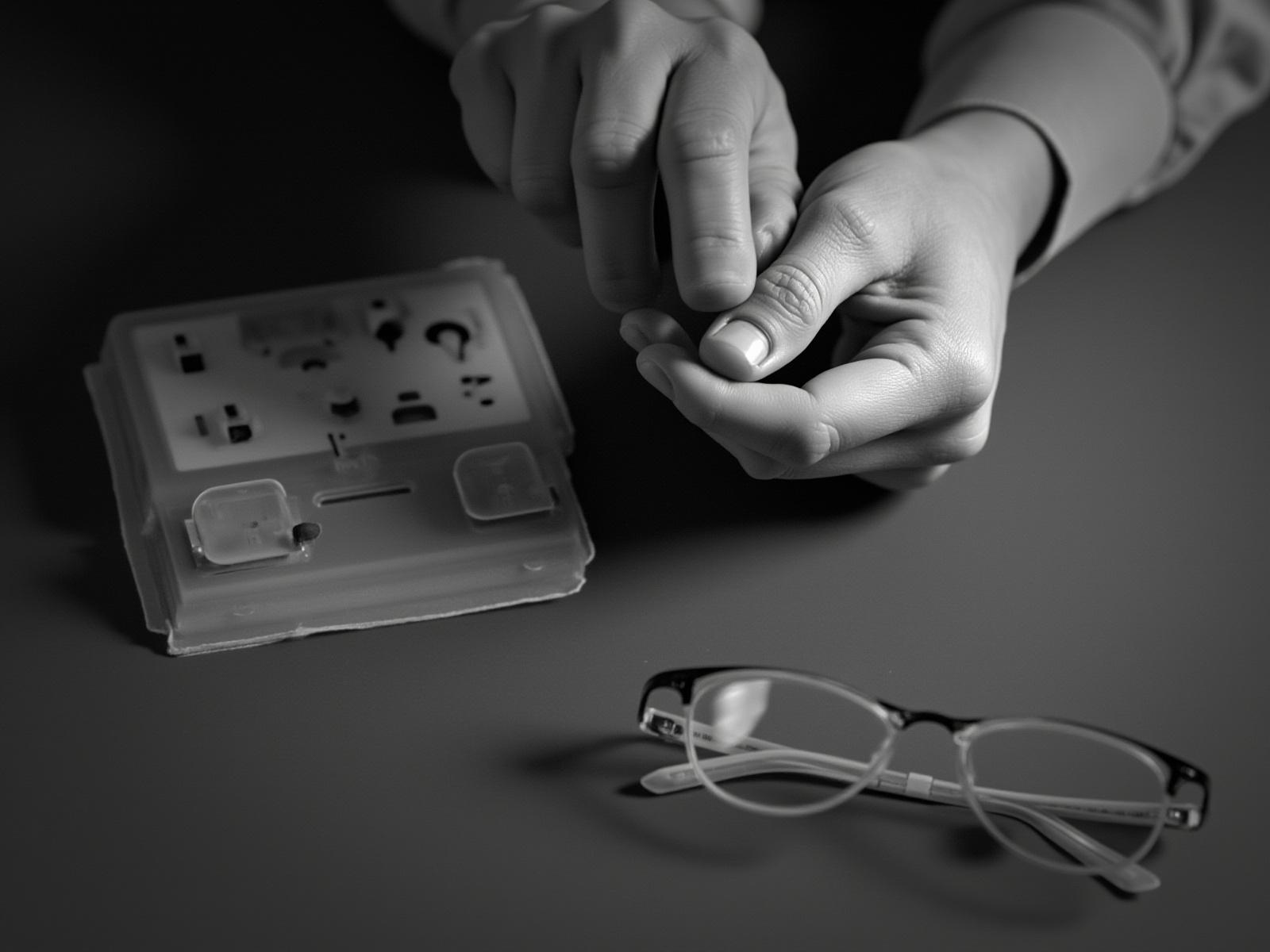
Heat. A device left in a laptop bag in a warm office is a small computer in a closed enclosure, and we publish no thermal data for any model: no operating temperature range, no thermal behaviour under sustained use, no standby draw. The rule that follows is simple and costs nothing: take it out. This is a process rule rather than a technical limitation, and it belongs on the desk card if the deployment issues devices rather than issuing them to a person.
A unit that moves between three people accumulates other people's voices and images. On a hot-desk arrangement the device is not a person's device for most of the day, which changes the risk profile in two ways. The first is that the unit is handled by more people, so physical damage and interface contamination are more likely. The second is that captured content accumulates on a device that several people can reach, and the clearing step between users is what makes that arrangement defensible. The clearing step is one line in a policy and one line in the desk card, and it is the line that turns a shared device from a privacy question into a managed one.
The interface is where the contamination shows. Magnetic charging in this range relies on a contact surface free of contamination, and the most common cause of an intermittent charge in a shared deployment is a contact that has picked up material from a pocket or a bag. That is a servicing problem with a simple answer and a small consumable cost, and it is worth putting the wipe-and-check step into the shared-desk routine rather than treating it as a fault. The charging solutions page covers the interface split across the range, and the consumable cost belongs in the costing of a first order.
The verification side of the same risk is the retained reference unit. A deployment of any size should keep a small number of units from the production batch, in the box, logged, and not issued. Those units are what make a batch question answerable: a fault that appears on a retained unit points at the product, and a fault that appears only on issued units points at the handling, the environment or the policy. Without a retained reference, every fault becomes a dispute, and disputes are settled against the buyer. The quality consistency page describes the batch evidence a claim needs.
What we will not certify on your behalf
The short answer: we publish the hardware configuration and the gaps in it, that we will not describe a recording device as a neutral office tool, and we will not publish a data-flow detail, a recording-indicator specification or a sizing figure for any model.
We will not present an open-ear design as a safety feature in a way that implies testing we have not done. We will not state that any model in our range is tested to an ingress protection level, because the catalogue's IP54 marking on the V06 and the S7 is a catalogue annotation without a third-party test report number behind it. We will not supply a frame weight for any model other than the MT6, where the catalogue publishes 158 g for the whole unit including the cell and the camera and excluding the 1200 mAh folding case. And we will not support a listing that makes a clinical, therapeutic or workplace-wellbeing claim about this category, because a substantiation dossier for such a claim is not something a hardware catalogue contains.
On the compliance route, one distinction worth holding. Buyers will ask about CE, FCC and RoHS, and REACH and the Bluetooth SIG qualification, and asking is correct: those are the documents a customs broker, a retailer and a market-entry file will want. What our catalogue does not contain is any reference to them, and there is no per-model certification row anywhere in it. The catalogue carries a company-level export certification page whose content is images rather than text, so it cannot be read as evidence for a given model either. The practical consequence is that the certification scope of a specific model is a document to request in writing and to obtain before the first shipment, not a fact to assume from the fact that a supplier exports. The certification checklist is the working list for that request, and the EU compliance route sets out the framework a buyer in that market is working to.
What we can do is narrow the range against the scenario, and tell you which of the seven areas our documentation answers and which are decisions only your organisation can make. The channel context is under smart glasses for office, the product selection is in office product recommendations, and the service routine is in the office device service routine.
Related reading
- The product selection — office product recommendations
- The service routine — the office device service routine
- The specification rows — office configuration template
- What the channel adds — smart glasses for office
Tell us what the person at the desk does all day and we will tell you which of the seven areas our documentation answers and which three are yours to decide.


