

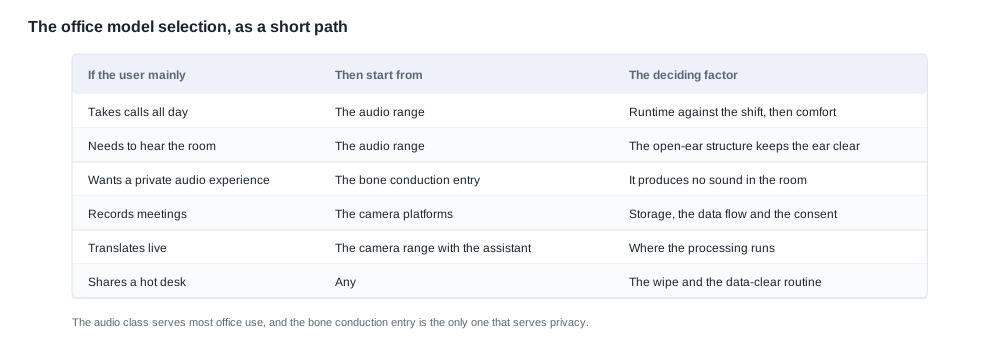
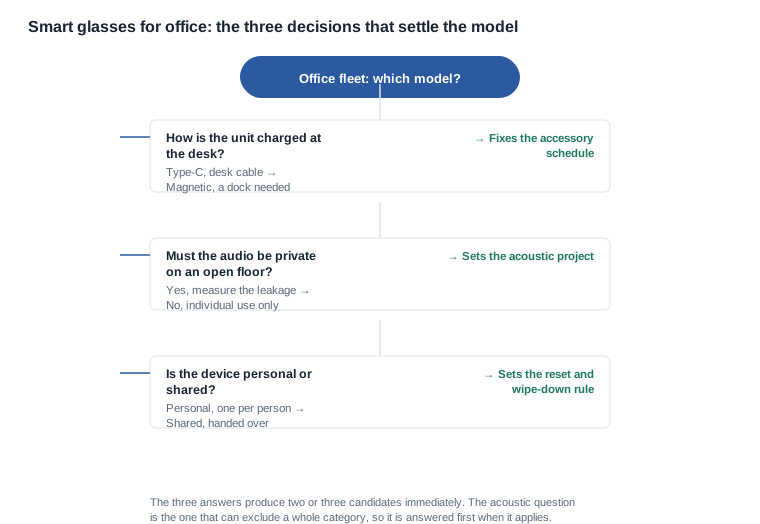
The decision is a fleet decision, not a device decision. Smart glasses for office procurement is settled by three things, and none of them is the cell capacity: how the unit is charged at the desk, whether the audio has to be inaudible to a colleague, and whether the device is personal or shared. Those three produce a shortlist of two or three models almost immediately, and everything after that is configuration, paperwork and the fleet economics. The reason this ordering matters is that the office failure mode is quiet. A unit that is technically correct and taken off at lunchtime does not appear in a specification comparison and does not appear in a supplier's defect report. It appears four months later as a return rate, by which time the packaging, the listing and the channel agreement are already committed.
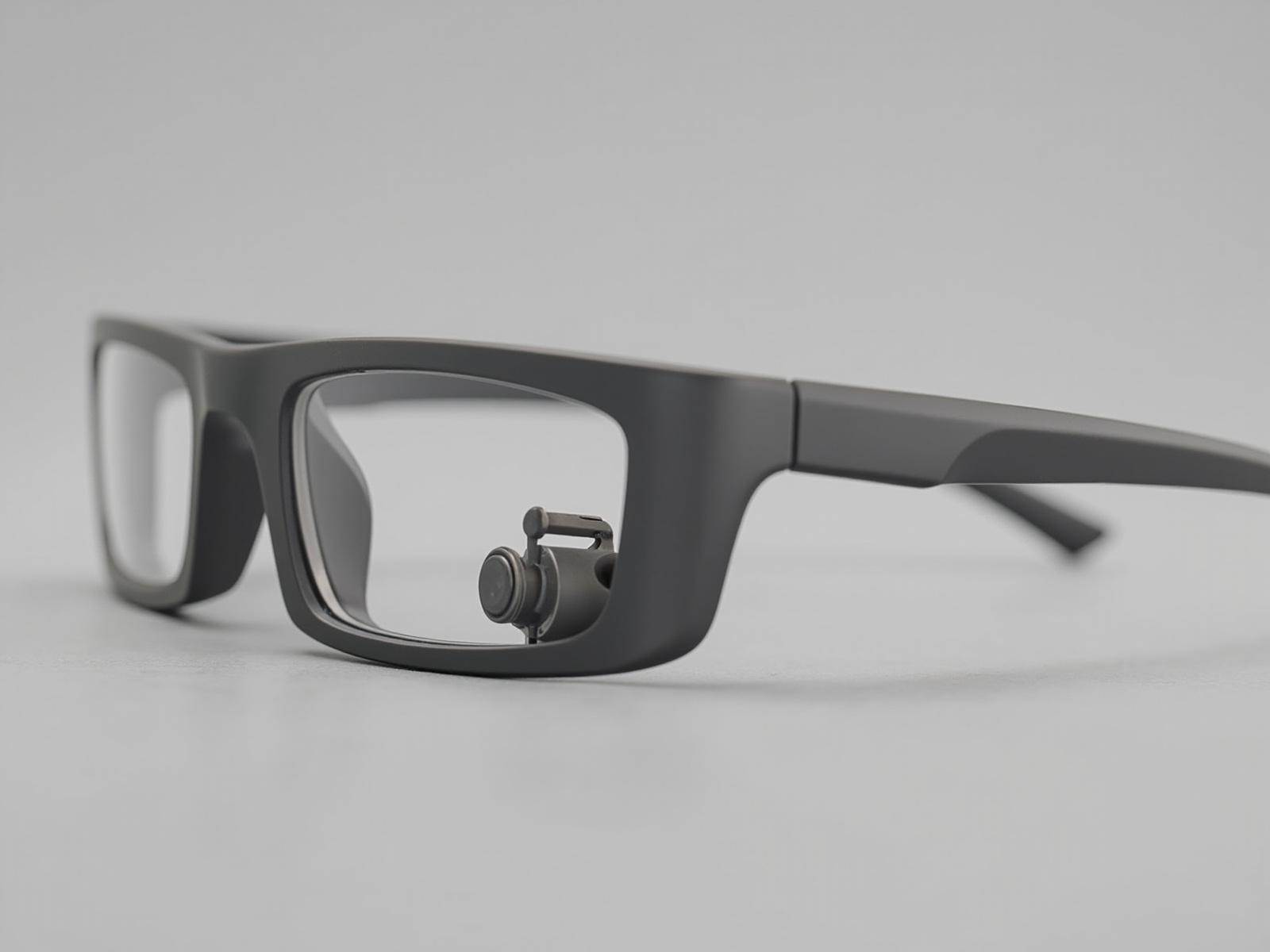
Smart glasses for office: the fleet decision behind the model decision
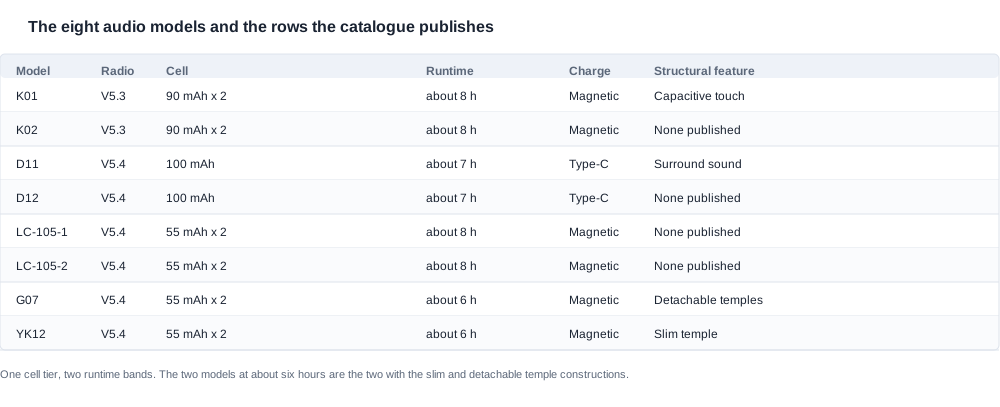
The audio tier in full, because it is short. Our catalogue carries eight audio models. The K01 and the K02 publish Bluetooth V5.3, two 90 mAh cells, a charge time of two hours or less, a rated use of around eight hours and magnetic charging; no model in the range publishes a touch row, so the temple control is a question for the supplier rather than a catalogue fact. The D11 and the D12 publish Bluetooth V5.4, a single 100 mAh cell, two hours or less of charging, a rated use of around seven hours and Type-C charging; the D11 additionally publishes a surround sound feature. The LC-105-1 and the LC-105-2 publish Bluetooth V5.4, two 55 mAh cells, two hours or less, around eight hours and magnetic charging. The G07 publishes Bluetooth V5.4, two 55 mAh cells, around six hours and magnetic charging, with ultra-slim detachable temples. The YK12 publishes Bluetooth V5.4, two 55 mAh cells, around six hours and magnetic charging, with surround sound and a slim temple. The full range is at Bluetooth audio glasses.
Why the fleet framing changes what you compare. A single-unit purchase is a comparison of products. A fleet purchase is a comparison of provisioning systems: how many distinct SKUs the support desk has to recognise, how many spare units the store room holds, how many accessory types appear on a purchase order, and what happens to the procedure when someone returns a unit that is not the one they were issued. Those questions are settled by the model choice, and they are not in the datasheet. A range that spreads a hundred-desk fleet across four models produces a procurement file with four lines and a store room with four bins; the same fleet on one platform produces one line and one bin.
The unit price is the wrong line to optimise. In the office tier the differences between models are small in specification and large in operating consequence. The runtime bands sit between roughly six and eight hours; the interfaces are Type-C on two models and magnetic on the rest; the cell configurations are two 55 mAh cells, two 90 mAh cells, or a single 100 mAh cell. Those are not large differences in the product. They are large differences in what the buyer has to stock, charge, explain and re-order.
What is not published in this tier, and therefore has to be requested. No third-party acoustic measurement. No leakage figure. No runtime test condition. No frame weight for any audio model. No cycle life rating. No acoustic noise-cancelling specification. A buyer who needs an acoustic claim, a runtime guarantee or a weight on the packaging has to obtain all three in writing, and the request has to be made before the artwork is locked rather than after.
The audio tier rows and the two figures nobody publishes
| Criterion | How to read the published row | Pass line for an office fleet | A weak answer in practice |
|---|---|---|---|
| Charging interface | Magnetic on most audio models, Type-C on the D11 and the D12 | The interface the customer's desk already supports | Both interfaces claimed without a configuration map |
| Cell configuration | 55 mAh × 2, 90 mAh × 2, or a single 100 mAh | A figure traceable to the model quoted | "Long battery life" with no number |
| Rated runtime | Around 6 h on the G07 and the YK12, around 7 h on the D11 and the D12, around 8 h on the K01, the K02 and the LC-105 pair | A figure that covers the day, with the condition stated | A rating quoted as a working day |
| Radio version | V5.3 on the K01 and the K02, V5.4 on the other six | A version per model, on the listing and the paperwork | One version for the whole tier |
| Structural features | No published touch row on any model, surround sound on the D11, surround sound with a slim temple on the YK12, ultra-slim detachable temples on the G07 | A feature that answers a specific office need | A feature name with no use case |
| Leakage | Not published | A measured figure at a stated distance and volume | A privacy claim the documentation cannot carry |
| Cycle life | Not published | A figure, or a stated test plan | Silence |
| Frame weight | Published for one model in the whole catalogue only | A measurement before packaging is frozen | A category average |
One cell tier, two different runtimes. The four audio models built on two 55 mAh cells do not share a runtime figure. The LC-105-1 and the LC-105-2 publish around eight hours; the G07 and the YK12 publish around six. The two models at the shorter figure are the two with the slimmer temple constructions — the G07 with its ultra-slim detachable temples, the YK12 with the slim temple — and that is not a coincidence a buyer should try to engineer away. It means cell capacity does not predict runtime within a tier, and it means the runtime you are quoted is a property of the specific model rather than of the cells. The practical rule is to compare models on published runtime, never on published cell capacity.
The Type-C models are the ones that remove an object from the routine. The D11 and the D12 publish a Type-C charging row; the rest of the audio tier is magnetic. The difference is not the two-hour charge time, which is published across the tier. It is that a Type-C unit recharges from the cable already at the desk, while a magnetic unit needs a dock that has to be placed, counted, replaced when it is lost, and mentioned in the onboarding material. Over a hundred desks that is a different provisioning decision, and in a fleet it is usually worth more than the unit price difference between two otherwise similar models.
The radio version splits the tier in two. The K01 and the K02 publish V5.3; the other six publish V5.4. That matters for a fleet because a listing, a specification sheet and a support guide all have to carry the right value for the model they describe, and a buyer who treats the tier as one radio generation will eventually ship a V5.3 unit against a V5.4 specification line.
The two structural features that answer a real office requirement. No model in the range publishes a touch row, so whether the temple carries a control surface at all has to be confirmed with the supplier before a specification is written — and that matters where a colleague is close by, because a click is the thing a colleague notices. The detachable temples on the G07 are a sizing system rather than a cosmetic option: one outer frame can serve different temple lengths and head shapes, which in a workforce with a wide size range turns a sizing problem into a stock problem. The YK12's slim temple and surround sound row point the same way.
The two figures that decide an office claim and are not published. Leakage and cycle life. Leakage decides whether the device can be sold into an open-plan floor or whether it can only be sold into a private office or a home-working arrangement, and it has to be measured at a stated distance and a stated volume rather than asserted. Cycle life decides whether a two-year replacement assumption can be put into a budget. Neither figure appears in our catalogue, so a buyer needs both in writing before the listing goes live.
Three thresholds that turn a working pattern into one model
Threshold one: the charging arrangement has to match the desk. A magnetic device needs a dock per position, a spare pool and a replacement rate for the docks themselves, because a dock is lost and a lost dock is a unit that cannot be charged. A Type-C device needs a cable, and a cable is consumable. The threshold to hold is a written count of the charging hardware per desk, with the replacement rate for the magnetic dock calculated from the insertion cycles the contacts survive. Neither figure is published, and both are operating costs that a buyer has to model before the purchase order rather than after the first quarter.
Threshold two: the acoustic privacy requirement decides the architecture, not the volume. Open-ear audio is not private, and that is a property of the design rather than a defect in it. A buyer who needs privacy in a shared space cannot solve it by turning the volume down, because the requirement is that a colleague at conversational distance does not hear it. The available answers are a different architecture, a sealed earphone, or a different deployment setting — a private office, a home-working arrangement, or a role where the audio is not used at all. The privacy question in detail is at will others hear my music, and the request to the supplier is a leakage figure at a stated distance and volume, with the measurement method.
Threshold three: personal or shared changes the packaging, the device association behaviour and the support load. A shared office device has to be wiped down between people, it has to re-pair to a new handset, and it has to be handed back without data from the previous person still on it. All three are product behaviours rather than instructions, and none of them is published for this tier. The threshold is a written statement of the device association behaviour, the reset behaviour and the storage behaviour, so that the wipe-down procedure can be written from the product's actual behaviour rather than from an assumption. The office procedure is at the office upkeep procedure, and the workplace considerations are at office safety considerations.
The two configurations that resolve most office decisions. The LC-105-1 and the LC-105-2 are the most consistent pair in the tier for a fleet that wants the same unit on every desk: Bluetooth V5.4, two 55 mAh cells, around eight hours and magnetic charging, with no distinguishing feature row to remember. The D11 and the D12 carry the interface advantage that matters in an office — Type-C charging, a single 100 mAh cell and around seven hours — with surround sound published on the D11. The G07 and the YK12 publish around six hours, the shortest runtime band in the audio tier, and in exchange they carry the slim and detachable temple constructions that matter in a workforce with a wide size range. Which of those pairs is right depends on whether the constraint is the desk, the hours, or the head shape, and a buyer who has not decided which one is constraining will pick a model for the wrong reason.

The acoustic privacy question, measured rather than asserted
Why an office floor is the hardest room for open-ear audio. The measurable condition that matters is a colleague at conversational distance in a room with reflective surfaces. That is where leakage becomes audible, and it is why a device that is acceptable in a home or a vehicle can be unacceptable in an open-plan office. It is also why leakage cannot be inferred from the published runtime or the published cell configuration: it is a property of the acoustic path, and the catalogue does not carry it.
The threshold to hold. A leakage figure measured at a stated distance, at a stated playback volume, with the method stated, and ideally at a third-party laboratory rather than in the supplier's own room. If the supplier will not publish one, the honest position for a listing is not to make a privacy claim at all, and to state the deployment condition in the listing instead — for example, that the model is intended for individual use rather than for open-plan floors. A claim that the documentation cannot support is worse than no claim, because it is the kind that gets challenged.
The internal communication that this decision triggers. An office buyer is buying a device that will be on staff during working hours, in a room that may be under a workplace policy about what is recorded and what is overheard. The safety and workplace considerations are at office safety considerations, and a brand buyer should also establish whether the device records at all in the configuration being supplied, because the camera models in the same catalogue are a different product entirely and a mixed line can produce a policy question.
The specification consequence. If the answer is that leakage has to be low enough for an open-plan floor, then a measurement programme is required, and the measurement programme is a project: samples, a protocol, a laboratory, a timeline and a cost. That has to be scoped before the model is chosen, because it may exclude the entire open-ear range and leave a completely different product category. A buyer who discovers this after the artwork is approved has a sunk cost and no alternative.
What we will and will not say about it. We publish the radio version, the cell configuration, the charge time, the rated runtime, the charging interface and the structural feature rows exactly as the catalogue states them. We publish the absence of a third-party acoustic measurement, of any leakage figure, of any runtime test condition, of any frame weight and of any cycle life rating with the same prominence. We will not rank two of our own models on an acoustic characteristic nobody has measured, and we will tell you when two models are effectively the same platform, which in this tier they frequently are.
What has to arrive in writing before an office fleet order
- The runtime figure with its measurement condition, per model — against the customer's actual call pattern rather than a laboratory profile, with the workload, the volume level and the ambient state written down before the measurement is taken.
- The leakage measurement, at a stated distance and volume with the method stated, where privacy in a shared space is part of the requirement.
- The charging hardware count, with the insertion-cycle life of the magnetic contacts and the replacement rate for the docks and the cables.
- The cycle life figure or the test plan behind it, so that a two-year replacement assumption can be put into a budget rather than guessed.
- The model designation table and the certificate register, with every number checked in the issuing body's public register through the procedure at certification checklist, and the model string on each document compared character by character against the model string that will appear on the box.
- The sample configuration confirmation and the battery transport file, using the procedure at samples for the first and battery transport for the second.
The sample round for an office fleet is a desk test, not a bench test. Two units per shortlisted model, used across a full working pattern on more than one person, with the charging arrangement in place, the device association behaviour observed at the point where a new person takes the unit, and the pressure and stability checked at the end of the day rather than at the start. The frame weight is not published for any audio model, so the sizing and the stability are sample-stage facts, and the observation protocol has to be written before the first session.
Documents to request before a deposit. The runtime figure with its test condition per model, the leakage measurement with its method where privacy matters, the charging hardware schedule with the contact life, the cycle life figure or test plan, the device association and reset behaviour statement, the model designation table, the certificate register, the packaging artwork proof including the wipe-down procedure for a shared device, and the agreed incoming inspection criteria. Two references cover what is left: the contractual phrasing is at contract terms, and the commercial arrangement behind a first order at pricing.

The commercial structure of an office order, and what we publish
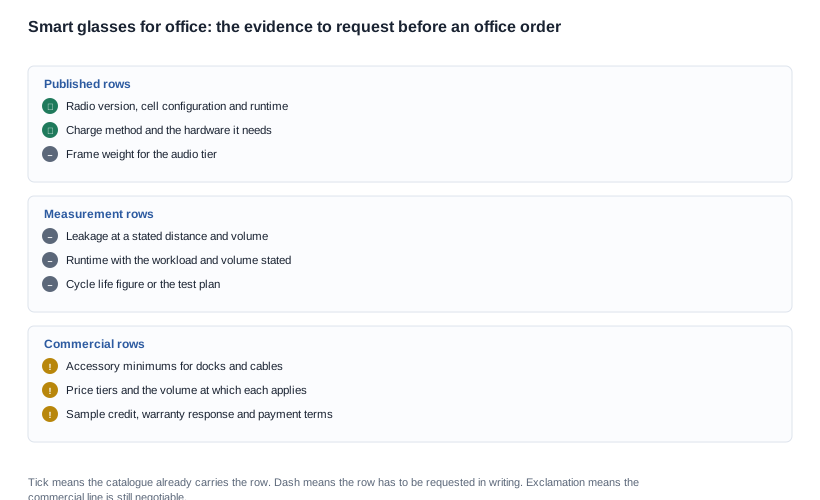
The lines that decide the order. The minimum order quantity per model, the lead time from purchase order to shipment, the production capacity behind the quoted date, the price tiers and the volume at which each one applies, the accessory schedule with its own minimum quantities for the docks and the cables, the artwork and packaging setup cost, the sample cost and whether it is credited against the first order, the warranty period with a stated response time and a written definition of a defective unit, and the payment terms including the deposit structure. For an office fleet the accessory schedule is the line most often forgotten and it is the one that generates recurring spend.
What is fixed and what is negotiable. The acoustic architecture, and therefore the leakage ceiling and the level the user receives, is fixed. The cell configuration, and therefore the runtime ceiling, is fixed. Certification cost and certification lead time are fixed, because they are a per-model cost and a laboratory queue. A one-off charge for tooling is usually amortised across the first order, so the questions worth asking are over what volume it is amortised and what happens to it if the programme is discontinued. What is negotiable is the interface choice, whether two models share a purchase order, the minimum order quantity tiers, the colour, the temple configuration, the logo, the lens tint and the packaging, whether the supplier funds a second sample round for the acoustic and endurance testing, and whether a first run is split into two deliveries against a staged payment.
Where the negotiating capital actually is. Spend it on the accessory minimums, the artwork round count, the spare-unit ratio, the sample credit, the warranty response time and the payment terms. Do not spend it on the unit price of a single model in a single market, because that is the number the supplier has already decided.
What goes into the agreement. The exact model designations attached to the order. The published row values the quotation was priced against, including the radio version and the cell configuration, since a listing and a support guide will both be built from them. The runtime with its measurement condition. The leakage figure and its method where privacy is part of the requirement. The documentation package with an obligation to re-issue it after any configuration change and to notify the buyer before one. The warranty terms carry three things that are often missing: the duration of the cover, a committed response time, and what the buyer treats as a defective unit. A defect and replacement regime that states the replacement rate for the charging accessories.
What we publish and what we do not. The catalogue carries a company-level export certification page and no per-model certification row, and it contains no CE, FCC or RoHS marking for any model, so the certification scope for a specific model is material to be requested in writing with the quotation rather than something a buyer can read off a product page. We do not publish frame weights for the audio tier, and we will not estimate them. We do not publish an acoustic measurement or a leakage figure, and we will not characterise a model's privacy behaviour from an unmeasured assumption.
What to send us. Send the working pattern, the charging arrangement at the desk, whether the device is personal or shared, the fleet size, the channel and the price band, and we will narrow the range to the two or three models that suit and list the data you have to obtain before the order. The scenario entry point is smart glasses for office.
Related reading
- The scenario's opening — smart glasses for office
- The extent of the range — Bluetooth audio glasses
- The maintenance procedure — the office upkeep procedure
- The safety considerations — office safety considerations


