
Smart glasses for security: the condition that puts custody above camera spec
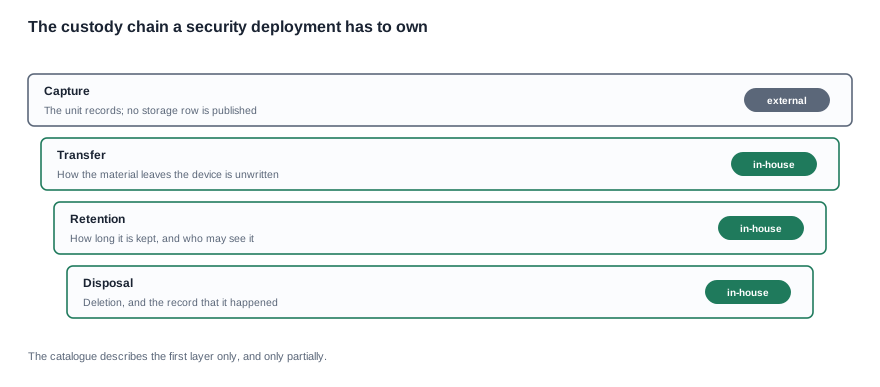
Smart glasses for security comparisons fail in a specific and predictable way: they get made on camera specifications, and the specifications are the part that matters least. In a security deployment the device is not a consumer product with a picture quality promise; it is an instrument whose output may be relied on later by somebody who was not present. That single change of frame changes what has to be compared. What has to be compared is the custody chain: who holds the unit, how the recording leaves the unit, who can see it, how long it is kept, what happens to it when the shift ends, and what the organisation can actually prove about any of it.
Against that frame, the catalogue is unusually honest about its own limits, and the limits are the finding. For the eleven camera models it publishes the pixel class, the cell, the charge time, the charging interface where one exists, the rated runtime, the charging-case capacity where one exists, and the ingress marking on two of them. It publishes no storage capacity, no recording format, no frame rate, no time-stamping, no Bluetooth version, and no data-handling architecture. A security buyer who accepts that list as the comparison basis has just discovered that the comparison cannot be made on the device alone, and that the procurement question is really about what has to be bought and written alongside the device.
Who this is for and what is being bought. The reader is a brand buyer, a channel buyer or a solution provider assembling a wearable kit for a security operation — a patrol team, a site-response team, a retail loss-prevention team, a private contractor — and the task is to compare the candidate models and, just as importantly, to specify the custody and evidence rules that the comparison depends on. The risk being managed is not a defective device. It is an incident: footage that cannot be accounted for, a unit that cannot be tied to a person and a shift, or a data-handling practice that a client discovers was never specified at all.
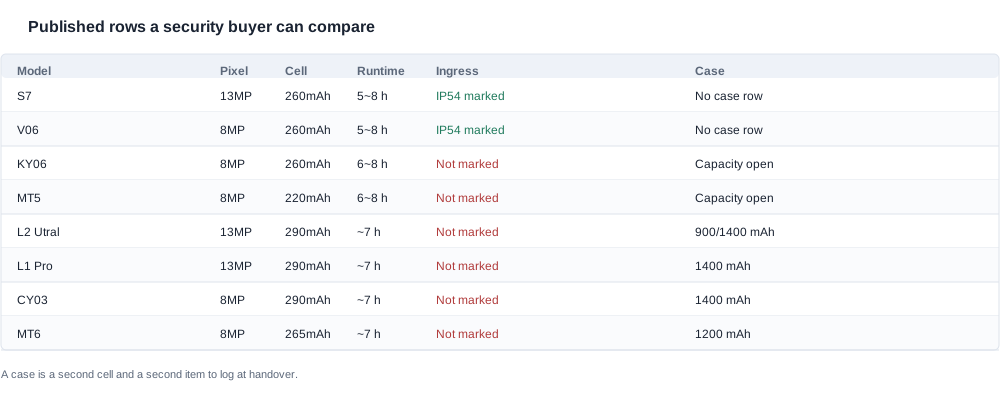
The published rows a security buyer can compare.
| Model | Pixel class | Cell | Runtime | Ingress | Case row |
|---|---|---|---|---|---|
| S7 | 13MP | 260mAh | 5~8 h | IP54 marked | No case row |
| V06 | 8MP | 260mAh | 5~8 h | IP54 marked | No case row |
| KY06 | 8MP | 260mAh | 6~8 h | Not marked | Capacity open |
| MT5 | 8MP | 220mAh | 6~8 h | Not marked | Capacity open |
| L2 Utral | 13MP | 290mAh | ~7 h | Not marked | 900/1400 mAh |
| L1 Pro | 13MP | 290mAh | ~7 h | Not marked | 1400 mAh |
| CY03 | 8MP | 290mAh | ~7 h | Not marked | 1400 mAh |
| MT6 | 8MP | 265mAh | ~7 h | Not marked | 1200 mAh |
Why the case column matters more here than it does in a retail range. In a security deployment a charging case is not an accessory, it is a second lithium cell that has to be declared for transport, and it is a second object that has to be accounted for at shift handover. The camera tier publishes the case in four different ways — a published capacity on the L2 Utral and the CY03, and the L1 Pro and the CY05, a 1200 mAh folding case on the MT6, a case of unpublished capacity on the KY06 and the MT5, and no case row at all on the V03 and the V06, and the S7 — so a security kit is a kit specification, not a model selection, and the two decisions have to be taken together.
What the catalogue withholds, and why that is the security question
The recording side is entirely unstated. No camera model in the catalogue publishes a storage capacity, a recording format, a frame rate, a video resolution, a time-stamping method or a transfer mechanism. That means four questions a security buyer must answer cannot be answered from the catalogue at all: where does the recording live before it is transferred, how does it leave the device, what identifies the recording as belonging to a specific unit and a specific time, and who is authorised to take it off the device. These are not gaps to be filled with a typical figure; they are specifications that have to be written by the buyer, or obtained in writing from a supplier who has them, and they should be written before the model is chosen because they determine whether a particular model is usable at all.
Audio is a liability in this context, not a feature. Eight audio models exist in the range and none of the camera models publish an audio row. Where a security requirement asks for an audio function — for a dispatcher, for a two-person entry protocol, for a supervisor listening in — the position is awkward, because no leakage figure is published for any audio model and the same catalogue publishes no audio row at all for the camera models. A buyer who wants audio in a security context therefore has two honest routes: order a model that publishes no audio function at all, or specify the audio use, the operating rule for it, and the leakage measurement the buyer is prepared to stand behind.
Ingress matters for a patrol, and it is published on two models only. The V06 and the S7 carry an IP54 marking, and no third-party test report sits behind it. The other nine camera models carry no marking at all, which means a buyer deploying outside cannot describe them as water-tolerant. The remaining camera models are not disqualified by that — most deployments are indoors or partly sheltered — but the claim has to be written per model, and the marking's absence cannot be quietly upgraded.
The Bluetooth gap has a security consequence. The catalogue publishes no Bluetooth version for any camera model. For a consumer device that is a specification annoyance. For a device moving image data across a radio link, the buyer needs to know the radio profile the supplier supports and whether it is configurable, because a fixed radio link is a fixed attack surface and a configurable one is not. This is a question to the supplier, and it belongs in the technical file rather than in a comparison chart.
The compliance frame a security buyer will be asked about. Placing a wireless device on the EU market means the buyer will be asked for a declaration of conformity against the Radio Equipment Directive (EU) 2014/53/EU, and a general consumer product placed on the same market will raise the General Product Safety Regulation, EU 2023/988, and the technical file that supports it. The catalogue contains a company-level export certification page and no per-model certification row, and the document set a buyer requests is at GPSR. The correct posture for a procurement file is therefore to request the documentation and to treat its absence as an answer, rather than to infer it from a product page.
What a security buyer is really comparing, restated. Not the pixel class: that decides what the footage looks like. The custody chain: who holds the unit, how the recording moves, who can retrieve it, how it is deleted. Then the shift arithmetic: the rated runtime against the shift length, the charge time against the break, the case against the charging point. Then the claim set: ingress, radio configuration, and the absence of published storage behaviour. A shortlist that carries all three is shortlist a procurement team can defend; a shortlist built on the first alone is a shopping list.
Building a security shortlist when the recording rows are not published
The method below puts the unanswerable questions first, because they are the ones that can disqualify a model outright and they are cheapest to ask at the start.
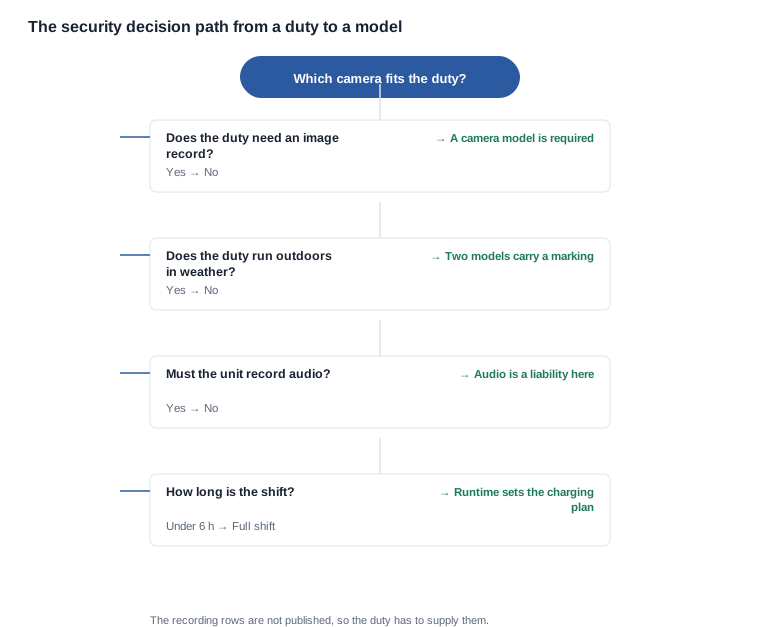
- Write the duty requirement before the model list. Shift length, indoors or out, whether an image record is needed at all, whether audio is needed, how many people, and how the units are issued. Every later comparison inherits this wording.
- Separate the recording requirement from the hardware. Decide what has to be true about the transfer, the retention and the deletion, and write those as requirements. Then ask which models can meet them. It is entirely possible that the answer is "none of the published models, so the recording is handled by an accessory we specify separately".
- Take the model designation and the configuration list for each candidate, and note the case row, because the case is a second cell and a second custody item.
- Confirm the runtime and charge time rows, and the interface row where it exists. Four camera models publish no charging-method row at all, so for those the kit assumption has to be written down explicitly.
- Ask for the radio configuration in writing, the supported profile and whether it is configurable, given that no Bluetooth version is published for the camera models.
- Ask for the ingress position per model, including whether a test report sits behind the marking on the two models that carry it.
- Agree the shift charging plan in writing, covering where the units charge, who holds the charger, and what the log records — because the charging point is where custody usually leaks.
- Request the battery transport documentation for the configuration including the case, and check the certificate register entries at certification checklist. The transport file is set out at battery transport.
- Confirm the sample unit is the production configuration using the procedure at samples, and write the incoming inspection criteria, including how a unit with a damaged contact or a missing accessory is adjudicated on arrival.
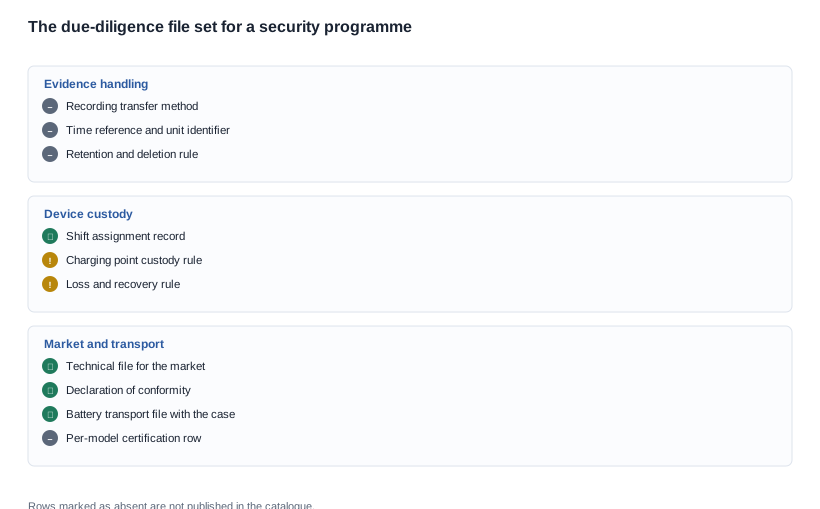
The file set a security order should not be signed without. The duty requirement, the recording and custody specification, the designation and configuration table, the radio configuration statement, the ingress position with the report question answered, the charging and custody plan, the battery transport file covering the case, the certificate register, the technical file and declaration of conformity for the market, and the incoming inspection criteria with the accessory-attribution rule. For clause language go to contract terms, and for the commercial structure of a first order go to pricing. The product family is at AI camera glasses and the imaging material is at camera imaging.
A security deployment decided from the published rows
Take a regional facilities contractor equipping 40 mobile response officers across four sites, working twelve-hour shifts in pairs, with a mix of indoor plant rooms and outdoor perimeter patrols, a client that will require a documented chain of custody for any footage used in a dispute, and a hard rule that no device leaves the vehicle unassigned. The first screen is the duty requirement: twelve-hour shifts, outdoor patrols at two of the four sites, and an image record required. The second screen is the runtime, and it is where the published rows bite — the sport camera models publish 5~8 hours and the three 290 mAh models publish about seven, none of which covers a twelve-hour shift on one charge, so the charging plan is not a detail but a structural part of the deployment, and the kit has to include the charging point and its custody. The third screen is ingress, which narrows the outdoor candidates to the V06 and the S7 because those are the only models with a marking, and the client will accept the marking as a catalogue attribute provided the listing says so precisely. The fourth screen is the recording and custody specification, and this is where the buyer discovers that the published rows do not reach: the buyer writes the transfer rule, the retention period, the deletion rule and the assignment log, and asks the supplier for anything it can supply in writing about storage and transfer. The fifth screen is the kit: a case in a patrol vehicle is a second cell that has to be declared and a second object that has to be logged, so the models with no published case row — the V06 and the S7 — actually simplify the deployment rather than complicating it. The sixth screen is the paperwork, the technical file and the declaration of conformity for the market, with the certificate register checked rather than assumed. The result is a shortlist of two models with an outdoor marking, a charging and custody plan that treats the charging point as a controlled location, and an evidence-handling specification written by the buyer rather than inherited from a product page.
The security failures that surface as an incident, not a return
A unit with no owner at shift change. Devices are handed over verbally. The symptom is a missing unit discovered weeks later, or a recording that cannot be attributed to anyone. The root cause is no assignment log and no custody rule. The prevention is a written handover record that names the unit, the officer, the time and the charge state, and a rule for what happens when the record is incomplete.
A recording nobody is authorised to retrieve. The device holds material and there is no published mechanism and no written rule for who takes it off the unit. The symptom is a data-handling question raised by the client at an audit. The root cause is that the recording side was never specified, because the catalogue does not describe it. The prevention is a written retrieval rule agreed before deployment, with the authorisation list attached to it.
A footage request that cannot be answered. A dispute arises and nobody can establish which unit or which shift produced the material. The symptom is a claim that has to be settled without the record. The root cause is no time reference and no unit identifier in the process. The prevention is an assignment and time-keeping discipline that exists even if the device does not publish either one.
Audio left enabled without a rule. A model that publishes an audio function is issued without an operating rule for it. The symptom is a complaint about being overheard, or an internal objection about monitoring. The root cause is that audio was treated as a feature rather than a controlled function. The prevention is either a model without an audio row, or a written rule with a measured leakage position.
A claim of water tolerance applied to the range. The deployment note says the units are weather resistant, and only two models carry a marking. The symptom is a damaged unit after a wet patrol. The root cause is a range-level claim built on a model-level attribute. The prevention is a per-model claim sheet, signed, with the marking's digit written into it.
A case that was never declared. A configuration includes a case, the transit file did not cover it, and the clearance question arrives at the port. The symptom is a delay that lands on the deployment schedule rather than on the procurement desk. The root cause is that the case was added to the kit after the transport file was requested. The prevention is a per-configuration bill of materials signed before the order, with the transport file requested against it.
An incoming unit that cannot be read as the production configuration. A sample was used to test the process and the shipment differs. The symptom is a deployment that stalls on the first shift. The root cause is no configuration check at incoming inspection. The prevention is the designation table, printed on the inspection sheet, with the configuration line the checker reads against.

Where a security order has room to move and where it does not
The elements of a security order that are fixed before the price conversation. The pixel class, because it is what the sensor builds and what the price ladder sits on. The cell configuration and the charge time that follows from it. The ingress position, because it belongs to the catalogue and cannot be widened by agreement. The certification cost and its lead time, and the time the technical file takes to assemble. The tooling, amortised across the first order and quoted as its own line.
The elements where the commercial room sits, in the order a security buyer should spend it.
- The configuration of the deployment. One model across all four sites, or a camera model outdoors and a different one indoors, is a decision with a price consequence and a training consequence. A buyer who takes one platform where it will do reduces the number of designation rows, the number of incoming inspection rules and the number of spares in the vehicle.
- The charging and custody design. A charging cabinet per site, a per-unit charging cradle, or a case-based rotation are three different capital and logistics profiles, and the buyer has more room here than on the unit price because the supplier rarely supplies the answer.
- The share of units taken at a pilot tier. For a security deployment this is also the trial that proves the custody procedure, and a pilot that tests the procedure is worth more than a pilot that tests the device.
- Whether the evidence-handling specification is written by the buyer or supplied. A supplier who can hand over a transfer and retention procedure saves the buyer a week of design work, and one who cannot will need to be asked explicitly rather than assumed.
- Minimum order quantity tiers, and whether the outdoor and indoor models can share a purchase order and an inspection. Shared handling at the depot is worth more than a unit price movement on a 40-unit order.
- Splitting the first run into two deliveries against a staged payment, which for a site rollout usually maps onto the first two sites, and which gives the buyer a chance to fix the custody record format before it is replicated.
- The spare and replacement rule, including what happens to a unit that failed in service and whether its material is deleted under the same rule as any other unit. On a security order that rule is part of the evidence policy, not just the warranty.
The buying checklist at security buying checklist and the trade-offs at security pros and cons cover the same ground from a different direction.
What we will substantiate for a security programme, and what we will not
To put it plainly — we publish the rows a security buyer can order from: the pixel class, the cell capacity, the charging interface where the catalogue publishes one, the ingress marking where it appears, the rated runtime, the charging-case capacity where it appears, the charge time, and the structural features where they are published. We publish the absence of a storage capacity, of a recording format, of a frame rate, of a time-stamping method, of a Bluetooth version for the camera models, of a leakage figure and of a third-party test report behind the ingress marking with the same prominence as the rows themselves.
What we will not do is describe any camera model as suited to evidentiary use, because that is a property of a system and a procedure rather than of a device. We will not state that a product is tested to IP54. We will not fill the recording rows with a typical specification, and we will not quote the one weight figure in our catalogue as a security figure — it belongs to the MT6, a camera model with a 1200 mAh folding case, and it is the weight of the glasses body including its battery and camera and excluding the case, whose weight is not published. We will not infer a per-model certification position from a company-level export certification page.
What we will do is take the duty requirement, the shift pattern, the outdoor exposure, the recording and custody expectations, the price band and the markets, and return the published rows that apply, the rows that do not exist, the specification the buyer has to write, and the documents that have to be settled in writing before a purchase order is raised.
Send us next. Send the duty requirement, the shift length, the indoor and outdoor split, whether audio is required, the price band and the markets, and we will return a comparison of the surviving candidates with the custody and evidence specification written out as a list of the buyer's own obligations. The scenario entry point is smart glasses for security.
Related reading
- The scenario's starting point — smart glasses for security
- The family this product sits in — AI camera glasses
- The buying checklist — security buying checklist
- The market compliance route — GPSR
Send the duty requirement and the shift pattern, and we will return the comparison with the custody specification written out.


