

Smart glasses frame materials: no material name is published
A frame material comparison has to be built on properties rather than on names, because we publish no material name, no temple dimension, no hinge detail and no frame weight for any model in the range. The single weight figure we hold is 158 g for the MT6, as a whole-unit figure that includes the battery and the camera module. The consequence for a buyer is that two candidate platforms cannot be separated on published data, so the comparison has to be a procedure: four properties to measure on each sample, a fixed order of testing, and an agreed tie-break rule to use when the properties come out equal. A supplier who answers a material comparison with a material name has answered a question that carries no decision value.
The short answer: do not compare frames on material names, and do not compare them on a total weight alone. Measure mass distribution, flex set, hinge play and surface resistance on samples of both platforms, in that order, and use the tie-break rules below when the results come out level. The first question is not about material at all. It is whether the two candidates are physically different products, because two names for one mould is a comparison of a platform with itself, and the real decision is commercial. Set the thresholds before the first sample is opened, not after, and put the acceptance criteria into the purchase order rather than into an email.
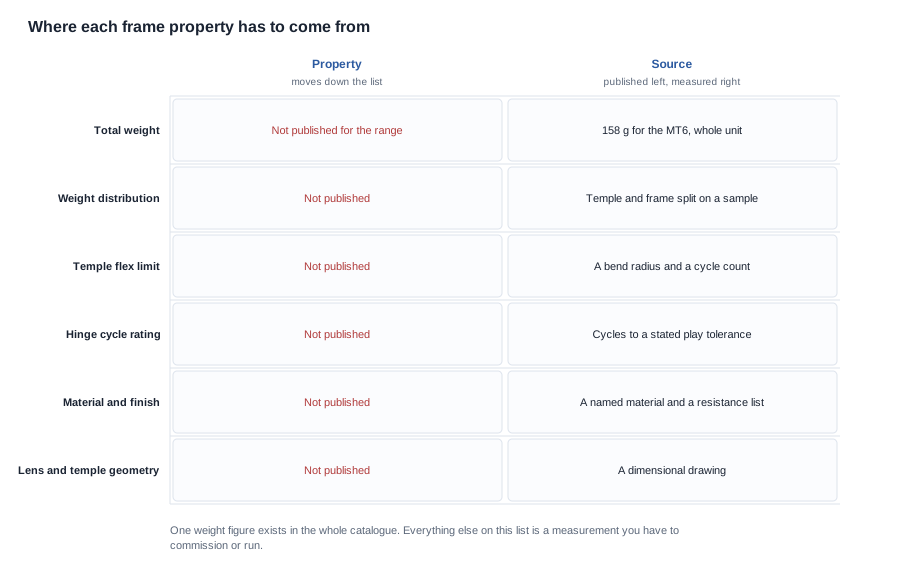
The buying task behind the comparison
The reader is a brand buyer, a product manager or a channel buyer who has two candidate frame platforms in front of them and has to choose one to build a product line on. The specific problem is that the published documents look equivalent, so the decision drifts towards whoever sent the more persuasive sample or the more recent quotation. The buyer's actual task is to build a comparison that produces a decision the rest of the team can defend — a product manager, a compliance reviewer and a finance approver all need to be able to see why one frame was chosen.
The risk being managed is the channel failure mode: a frame that passes a showroom inspection and then generates a steady trickle of returns for a defect the specification never mentioned. This is the failure that is invisible at the quotation stage and expensive afterwards, because the returns arrive under a mixed description — uncomfortable, cheap, broke after a month — and a support team handling them one at a time will not find the pattern.
There is a second, quieter failure, and it is the one that costs the most: a comparison run on a promotional sample and then applied to a production build. The sample is heavier, better finished and often a different colour from the units that ship. A comparison that transfers its conclusion from the sample to the production line without a configuration check is a comparison of two different products, and the discovery usually arrives after the first container has landed.
The published configuration rows and the reasoning behind them are at materials and ergonomics.

The four properties that decide a frame, and how each of them fails
Material name is a label. These four are physical, measurable, and each one maps to a specific way the product fails in a customer's hands.
-
Weight and its distribution. Not the total — where the mass sits relative to the ear and the bridge of the nose. Two frames can differ by several grams in total and feel entirely different, and a total weight on a data sheet cannot tell you which one you have. The failure this prevents is a channel of "too heavy" returns in the first month, which is usually a distribution problem rather than a mass problem.
-
Flex behaviour at the temple. Whether the temple takes a permanent set after a season of being folded into a pocket or a bag, and at what cycle count the set becomes visible. The failure this prevents is a product that looks bowed at the hinge end after normal use, which a customer photographs and which a listing cannot explain.
-
Hinge durability. The number of open-close cycles before lateral play appears, and the tolerance in which it is judged. The hinge is the highest-return mechanical component in this category, because it is the one part of the frame that moves every time the product is put on and taken off. Play is visible without instruments, which is why this is the cheapest property to test and the most frequently skipped.
-
Chemical and skin contact resistance. What the surface resists, and against what specifically. A generic "hypoallergenic" claim without a list is a claim the support team has to defend one complaint at a time, and a resistance list is what lets the claim be written narrowly and defended.
The four are not equally important in every programme. A product sold for all-day use is decided by distribution and hinge. A product sold into a school bag or a sports bag is decided by flex set and surface resistance. A product sold as a fashion item is decided by finish, and the finish is the part of the frame that most often gets specified as a picture rather than as a requirement.
Setting the tolerance before the first article
A tolerance written after the first article is a tolerance that has already been missed, and tightening an enclosure after tooling is orders of magnitude more expensive than specifying it before. That rule is usually written for seals and enclosures, and it applies to frames with the same force. The three thresholds worth fixing in advance are the flex cycle count, the lateral play figure the hinge is judged against, and the difference in mass between the front and the rear of the temple that you will accept.
The flex cycle count should be chosen from how the product is actually used rather than from a round number, because a count nobody can connect to a customer behaviour is a count that will be argued about in a rejection. The play tolerance should be expressed in the way the factory can measure, with the instrument named, because "no visible play" is not a criterion and "no play detectable by the method in the drawing" is. The mass split should have a direction, not just a number, because a supplier who is told the frame must not be rear-heavy has one problem to solve and a supplier told only a gram figure has none.
None of these three thresholds requires a factory to have been chosen, and all three are much harder to introduce once a mould exists. Set them in the RFQ, carry them into the sample acceptance criteria, and put them in the purchase order, where they become a basis for refusing a lot rather than an argument between two suppliers.
The procedure for two candidate platforms
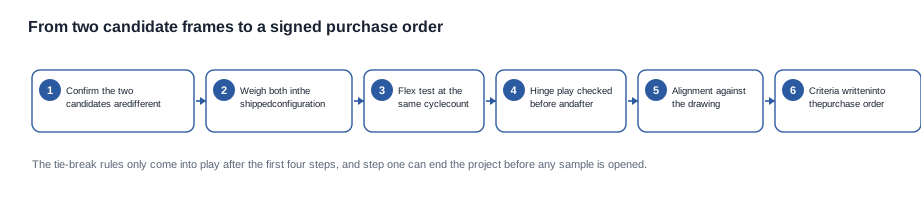
-
Confirm the platforms are actually different before testing anything. Ask for the model designation, the frame drawing and the configuration list for each candidate. A supplier who answers the "are these different" question hesitantly has just saved you the cost of the rest of the procedure, and the answer belongs in writing because a later change of designation would otherwise be a defence against your own criteria.
-
Weigh both units, in the shipped configuration. If only one figure is available, that is a finding worth recording rather than working around. A total weight without a configuration is not a weight.
-
Run the flex test on both, to the same cycle count. The procedures are set out in how to test frame materials. Use the same count on both, because a comparison at different cycle counts is not a comparison, and record the count you chose as part of the result rather than as a footnote.
-
Check the hinge for lateral play on both, before and after the flex test. Play is visible without instruments, and it is the first symptom of hinge failure. Testing it twice separates a hinge that was already loose from one that was loosened by the flex procedure, and those are different findings with different owners.
-
Compare the lens mounting and the temple alignment against the specification drawing. A frame that passes the flex test can still ship with a crooked temple, and the acceptance criterion has to be a drawing rather than an opinion. This is the step that turns a physical comparison into an inspection criterion the factory can actually work to.
-
Check the surface against the resistance list the supplier gave you, not against a generic expectation. This is a specification check, and it belongs in the incoming inspection criteria. A list of specific agents, each with a stated method, is what makes it enforceable; a general promise is not.
-
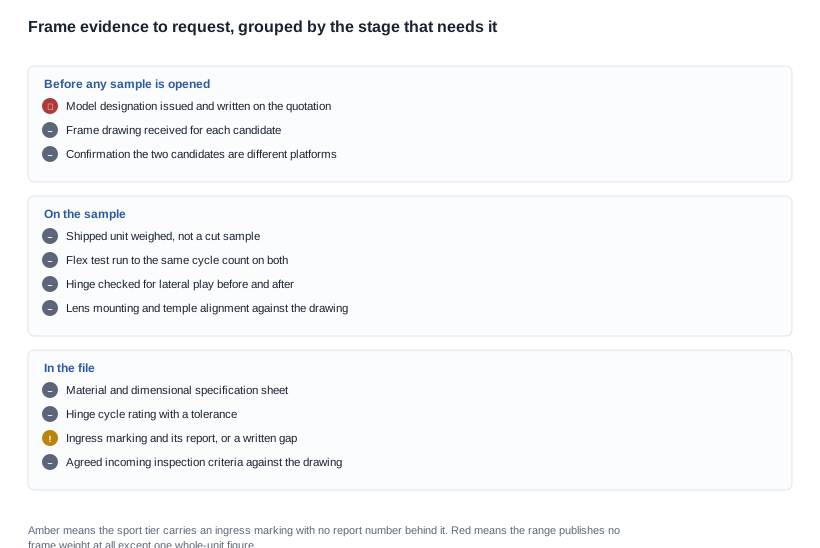
Check the ingress marking and its report. The V06 and the S7 carry an IP54 marking, and no test report behind it is published, which changes both what can be claimed and what can be promised to a customer. The marking is explained at IP ratings.
-
Confirm the samples are representative of the production configuration, using the procedure at samples. A comparison run on a promotional sample is a comparison of a different product.
The same questions in checklist form are at frame materials buying checklist, and a general material comparison across the industry is at what frame material is best.

Tie-break rules, and the four ways a frame comparison collapses
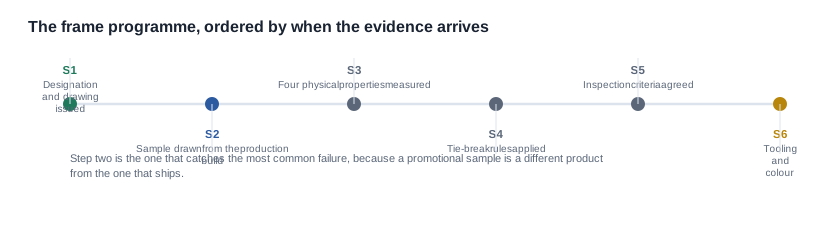
Tie-break rule one: weight distribution beats total weight. If two frames are within a gram of each other in total, the one whose mass sits further forward on the temple is the one a customer will describe as heavier. Where the split is not published, ask for it in writing and treat the refusal as information.
Tie-break rule two: the hinge rating beats the material. Two frames of the same material and the same mass can differ completely in service life, and the hinge is the part that generates the returns. A cycle count with a stated tolerance is worth more than a material name, because it is the only one of the two that can be turned into an incoming inspection criterion.
Tie-break rule three: the configuration that is documented beats the configuration that is better. A platform with a full dimensional drawing, a hinge cycle rating and a resistance list is worth more than a marginally better frame with two of those missing, because the documented one can be inspected and the other can only be trusted. This is the rule that most often decides the comparison in a buyer's favour, because it converts a preference into a control.
The failure mode of comparing on names. "TR90" or "titanium" covers a wide range of formulations, and a buyer who shortlists on the name has no way to compare two suppliers, no way to write an incoming inspection criterion, and no way to argue a defect claim. The name is a label; the properties are the specification.
The failure mode of comparing on the specification sheet alone. Every figure in this category is a whole-unit figure or a category claim, and neither predicts how a particular customer will use the frame. A comparison that stops at the data sheet has not tested anything, and the two platforms may differ in ways the data cannot express.
The failure mode of testing two samples of the same product. This is more common than it should be, and it happens when a supplier sends a premium unit for evaluation and ships a standard unit. The defence is to require the sample to be drawn from the production configuration and to state that requirement in the purchase order.
The failure mode of deferring the comparison to the customer. "Let the end user decide" transfers a specification decision to a channel that has no way to express it, and converts a solvable problem into a return rate.
The failure mode of writing the criteria after the first return. A tolerance agreed after a customer complaint is a tolerance that has already been missed. The moment a defect is found, the criteria are a record of the past rather than a control on the future.

What a frame decision costs, and which parts of it are fixed
A frame is one of the more expensive parts of the product to change, and it is the part that sets the tooling. The mould, the temple geometry, the hinge and the lens mounting are all fixed once the tool is cut, which means the frame decision is the one decision in this category that is genuinely hard to reverse. Everything downstream — the colour palette, the packaging, the listing images, the fit — inherits it.
Frame tooling and the moulds are not a negotiation target, and neither is the certification work needed to support any claim made in the listing. Hinge and temple geometry are fixed once the tool is cut, because changing either after that point means a new tool and a new schedule.
The colour palette is a merchandising decision and cheap to change between runs, so it belongs on the negotiating list, along with lens tint and finish, logo placement and packaging. Whether the detachable inner frame is offered as a fit kit or a single configuration is a structural choice worth pricing properly — the sport range, with the detachable inner frame on the V06 and the S7, is at sport smart glasses. Minimum order quantity tiers, and whether the two candidate platforms can share a purchase order, are also negotiable, as is splitting a first run into two deliveries against a staged payment. The largest single lever on frame cost is tooling amortisation across a larger first order, and that is a quantity decision rather than a price negotiation.
The file to request before the deposit on a frame programme is: the material and dimensional specification sheet per model, the hinge cycle rating, the total and split weights, the ingress marking with the test report or an explicit statement that none exists, the packaging artwork proof, the agreed incoming inspection criteria with the drawing to inspect against, and the model designation table. For the record: the contractual wording is at contract terms, and how a first order is structured commercially at pricing.
The clauses for a frame programme are: the model designation as a line item, with the drawing attached; a notice obligation before any change of material, hinge, temple geometry or lens mounting, because each of those invalidates the acceptance criteria you have just agreed; the acceptance criteria from the sample protocol, with the cycle counts and tolerances stated rather than referenced; and a clause on who bears the cost when a lot fails the acceptance criteria, together with one on the sample configuration the production units must match.
A frame comparison decided, and the boundary of what we publish
Read what follows as an illustrative case rather than a client project. Assume a brand-side buyer for a light retail audio line, comparing two platforms from two different suppliers that use the same electronics and two different frame moulds, with a first order of a size that justifies a tooling amortisation conversation.
Step one: are they different? The first supplier confirms two distinct designations and sends a dimensional drawing with the frame width, temple length and lens size. The second supplier replies that the frame is the same across its range, with a drawing on request and no hinge data at all. The asymmetry settles the first branch of the comparison without a sample, and the buyer writes the second supplier's missing drawing into the pre-deposit document list.
Step two: the physical rows. Both units are weighed in the shipped configuration, the flex test is run to the same cycle count on both, the hinge is checked for play before and after, and the alignment is compared against each drawing. One frame returns a visible set at the cycle count they agreed; the other does not. The hinge on the second platform shows lateral play before the flex test at all, which is the more serious finding, because a hinge that starts loose is a hinge that was assembled with the wrong clearance.
Step three: the tie-breaks. The totals are close, so rule one applies and the split weight becomes the tie-break; the supplier that would not name the split weight is asked for it in writing, and the request itself becomes the finding. Rule two then settles the comparison in favour of the platform with a hinge cycle rating, because a cycle count is the only row on either platform that can be turned into an incoming inspection criterion.
Step four: the commercial structure. The buyer negotiates tooling amortisation against a committed quantity rather than a unit price, splits the first run into two deliveries against a staged payment, and ties the production units to the sample configuration in the purchase order. The result is a programme where the frame criteria are inspectable rather than arguable, which is the thing a return-rate improvement actually requires.
Our own position is that we publish the 158 g whole-unit figure for the MT6, the removable inner frame on the V06 and the S7, the ultra-slim detachable temple on the G07, the slim temple on the YK12 and the flexible temples on the V03 Pro, because the catalogue states them. We publish no material name, no temple dimension, no hinge detail and no frame weight for the rest of the range, and we will not fill those rows with typical values from the industry to make a comparison table look complete. A guessed weight in a comparison table is worse than an empty cell, because an empty cell prompts a question and a guessed cell does not.
That is also the boundary of this article. We can tell you which of the four properties our documentation answers today, which have to be measured on a sample, and which have to be confirmed by the factory in writing before a purchase order is signed. We will also tell you if the two candidates are the same platform, because that is a more useful answer than a comparison table.
What to do next. Send us the two candidate platforms, the use case, the channel and the volumes you have in mind, and we will say which rows we can answer, which have to be measured, and which have to be written into the agreement before the deposit.
Related reading
- The four properties and why they matter — materials and ergonomics
- The physical test procedures — how to test frame materials
- The same questions as a checklist — frame materials buying checklist
- The sport models with structural features — sport smart glasses
Tell us the two platforms you are comparing, and we will tell you which published properties separate them and which do not.


