

What frame material is best is a question with no answer available from this catalogue, and the reason is worth stating at the front rather than at the end: the catalogue publishes no material name for any of its twenty-eight entries. There is no material row, no composition table, no grade, no finish description and no weight row for twenty-seven of the twenty-eight. A buyer who asks this question is therefore not short of options; they are short of the published attribute the question depends on. What the catalogue does publish about frames is narrower and, once understood, more useful: one weight figure in the whole range, two entries with published colour, three entries with a published removable element, and a set of feature rows that describe what a frame has to do rather than what it is made of.
That is the situation this page works through, using four beliefs that recur in this category and the verification action that closes each one. The beliefs are not exotic. They are the four sentences a buyer or a channel partner tends to accept without a source: that a material name predicts how a frame handles, that the name is what identifies the frame for a specification, that the name is what justifies a price, and that the name settles the substance questions that come with a product. Each of them is plausible, each of them is wrong in a specific way, and each of them has one request attached to it that closes the gap. A fifth belief — that there is a best material — is addressed separately at the end, because it is the one that most often causes a buyer to spend an afternoon on a comparison that cannot be completed.
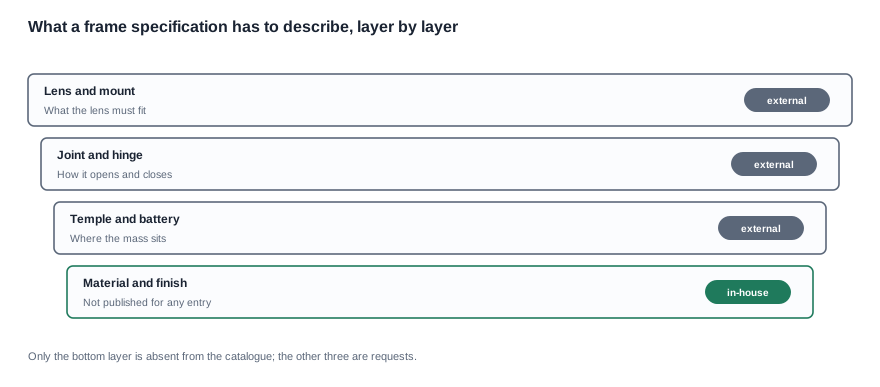
The reason to spend that effort at all is that a frame in this product class is not a fashion component fitted around an electronic product. It positions the speaker against the ear, it carries the battery and the electronics, it moves heat away from them, it holds a hinge that opens and closes thousands of times, and it decides whether a prescription lens can be mounted at all. A material name contributes to maybe one of those jobs. The rest are decided by geometry, by the joint, by the mounting and by the seal, and those are the attributes a buyer should be specifying.
The four beliefs about frame material, and what closes each one
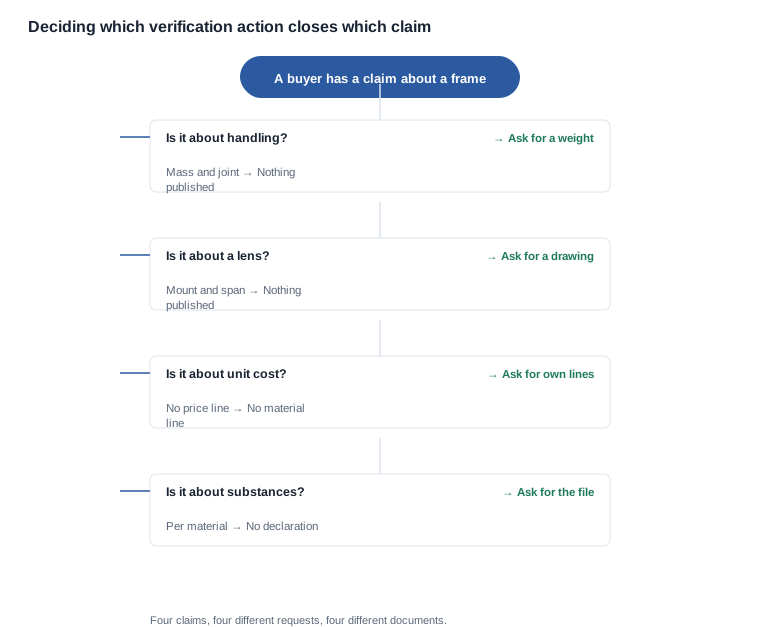
The first belief is that the material name tells you how a frame will handle in service — its mass, its stiffness, how it survives a drop or a pocket. The catalogue's position on this is that it publishes nothing on the subject, and that the name would not answer the question even if it did. Mass in a frame is a distribution problem rather than a material problem: where the cell sits relative to the ear, how the temple is tapered, whether the battery is carried in the temple or the front. A name says nothing about any of those.
The second belief is that the material name is what identifies a frame for a specification. It is closer to the opposite of the truth, because a material name is the least identifying attribute a frame has. Two frames of the same material can differ in every way that matters to a buyer, and two frames of different materials can be interchangeable. What identifies a frame is the geometry: the temple span, the lens mounting, the adjustment mechanism and the removable elements. The catalogue publishes three such rows, and they are more useful to a buyer than a material name would be: a removable inner frame on the V06, a removable inner frame on the S7, and a removable temple on the G07. A slim temple is published on the YK12 and a flexible temple on the V03 Pro.
The third belief is that the material name is what justifies the price. Nothing in the published material supports a price comparison of any kind, because the catalogue publishes no unit price, no price tier and no material line, and because the material name is not the line that a quotation is built from. A quote that carries a material name without the assembly weight, the temple construction and the lens mounting alongside it is a quote that cannot be evaluated against another quote, because the two answers are describing different objects.
The fourth belief is that the material name settles the substance questions that come with a product in a regulated market. It does not, and the reason is worth being precise about: a name is an identifier, and the artefact that answers a substance question is a declaration written against a material and a threshold. Where a name is not published at all, the declaration has to be requested for each material, and the removable elements have to be named individually, because a frame is a set of materials rather than one.
| The belief | What actually governs the outcome | The request that closes it |
|---|---|---|
| The name predicts handling | Mass distribution and joint design | Assembly weight, temple build, flex result |
| The name identifies the frame | Geometry and mounting | Dimensioned drawing, span, lens mount |
| The name justifies the price | The quotation's own line items | Frame material as a separate quoted line |
| The name settles substances | A declaration per material | Material declaration and substance statement |
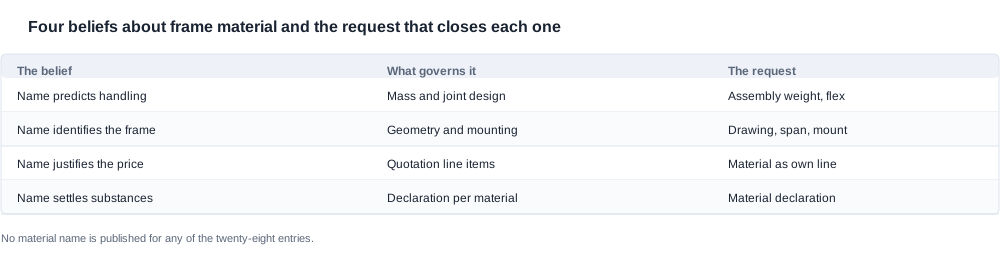
The four requests are deliberately small, and that is the point. None of them requires a laboratory and none of them requires a sample to be shipped, which means they can be issued at the same time as the quotation request and answered inside the same cycle. A buyer who sends them with the first enquiry gets a frame specification that can be compared across suppliers; a buyer who sends them later gets a frame specification for the model they already chose, which is a much narrower win.

What the catalogue actually publishes about frames
The published position on frames is short and worth reproducing exactly, because most of what buyers want to know about frames is not in it and a buyer who assumes it is will find the gap at the point where the artwork is being approved.
What is published: one weight figure for the whole range, 158 g for the MT6 glasses assembly including the battery and the camera and excluding the folding charging case, and no weight for any other entry. Two entries publish colour, the V03 Pro with three options and the V06 with four. Three entries publish a removable element, the inner frames on the V06 and the S7 and the temple on the G07. The V06 and the S7 also publish an ingress marking, and the V06 publishes an ergonomic design line and the S7 a thirteen-megapixel resolution class.
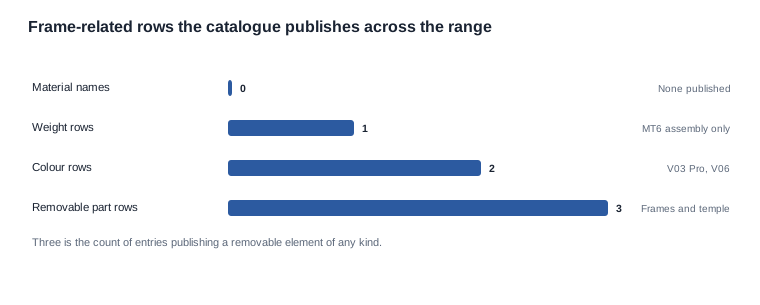
What is not published: a material name for any entry, a composition or a grade, a finish, a frame weight for twenty-seven of the twenty-eight entries, a temple span, a lens mounting, a hinge construction, a cycle count, a flex result, and any dimension. That last group is the important one for a procurement team, because those are the attributes a frame specification is actually made of. A frame specification without a span, a mounting and a joint is a description of a shape rather than a specification, and a supplier who quotes against it can supply anything that roughly matches the picture.
There is one further published row worth noting, because it is the kind of figure that gets quoted without its context. The bone-conduction entry publishes an amplification gain of 35 dB. That is a catalogue row and it can be quoted as one, but it describes an electrical characteristic of that entry rather than a property of a frame, and it raises a regulatory question of its own that is not a materials question at all. Buyers in this category should keep the two things separate: what the frame is made of, and what the device does.
One more published item bears on materials indirectly. A company page in the catalogue presents the company's patent portfolio as images — ten certificates in all — and the catalogue text contains no reference to CE, FCC or RoHS. A patent on an appearance design tells a buyer that a shape was registered; it does not tell a buyer what the shape is made of, and it is not a substitute for a material declaration. Where a buyer needs the substance position for a market, that request belongs in the compliance file rather than in the frame specification.
How to run the four verification actions
Each belief has one request, and each request is worth writing in a form that produces an answer a buyer can file. The wording matters more here than in most categories, because the requests are all for attributes rather than for opinions, and a supplier can answer them precisely if they are asked precisely.
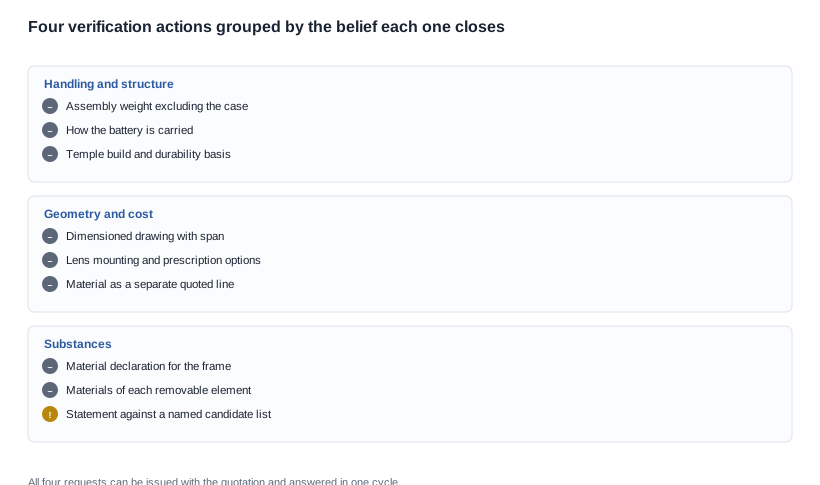
For the first belief. Ask for the weight of the glasses assembly in the configuration being ordered, excluding any charging case, and ask how the battery is carried in the frame. Ask for the temple construction and, where a claim about durability exists, for the basis of it. The catalogue's 158 g figure for the MT6 is the model of what a usable answer looks like: a figure, a scope and a stated exclusion. Note the exclusion carefully, because the folding case on that model is separate, and a buyer who compares an assembly weight with a packaged weight is comparing two different objects.
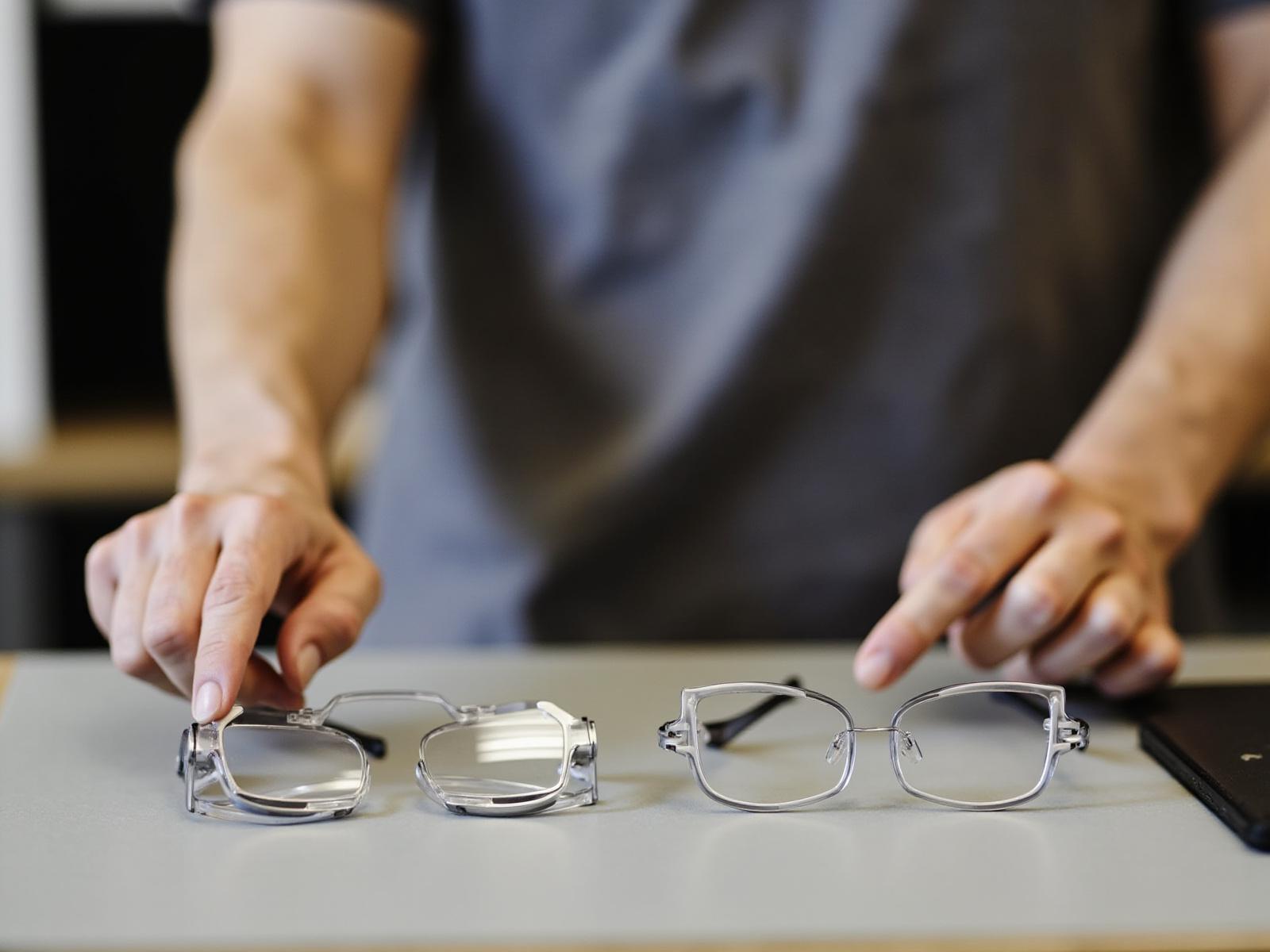
For the second belief. Ask for a dimensioned drawing rather than a photograph, and ask specifically for the temple span, the lens mounting, the adjustment mechanism and the removable elements. Then ask how a prescription lens is mounted and what options exist. This is the request that decides whether the frame can carry a customer's lens, and it is the one most often skipped because the catalogue's product imagery suggests the question does not arise.
For the third belief. Ask for the frame material to appear as its own line in the quotation, separately from the electronics and from the accessories, and ask for the assembly weight on the same basis as the first request. A quotation structured that way can be compared with another quotation structured the same way, and one that merges the frame into a single product line cannot. The material names for the frames and the temple options are covered in more detail in the frame material customisation note and the temple material note.
For the fourth belief. Ask for the material declaration and the substance statement covering the frame, and ask for the materials of the removable elements separately, since those elements are often produced in a different plant and from a different supply chain. Ask for the statement to be written against a named candidate list rather than as a general assurance, because a general assurance cannot be compared with another supplier's general assurance. The what to ask a supplier about frame materials note sets out this request set in more detail.
The evaluation criteria for the four replies are worth setting before the requests go out, because the answers will arrive in shapes that are easy to confuse. A supplier who answers the weight request with a packaged weight has answered a different question and has to be asked again. A supplier who answers the drawing request with a photograph has answered a different question. A supplier who answers the material request with a marketing phrase has answered a different question. A supplier who answers the declaration request with a general assurance has answered a different question. Each of those is a short exchange, and each of them is cheaper than discovering the difference after the artwork is approved.
Putting two suppliers' frames onto one basis
Four answers become commercially useful only when they can be set side by side, and a frame specification is the easiest place for a buyer to lose that possibility. Two quotations for the same product can carry different frames, describe them in different words and cost different amounts, and a buyer who has no common basis for comparing them ends up choosing on the word "material" — which is exactly the attribute neither of them has quantified.
A common basis is not difficult to build. It takes four lines per frame, each of them a measured or named value rather than an adjective: the assembly weight excluding the charging case, the temple construction and where the battery is carried, the dimensioned geometry including the span and the lens mounting, and the material named on its own line in the quotation with the removable elements listed separately. Two quotations that carry those four lines can be compared on the same terms, whether the materials named are the same or not. Two quotations that carry a material name and nothing else cannot be compared at all, because there is no second quantity to compare the name against.
The comparison that follows from those four lines is not a ranking of materials. It is a comparison of delivered specifications: which supplier has answered the assembly weight with the same scope, which has treated the removable elements as part of the frame, and which has quoted the frame as a line a buyer can change without reopening the electronics. Those are the criteria that decide a frame selection, and every one of them is visible in the quotation once the request set has been run.
There is a discipline worth attaching to this, because it is the one that gets lost between the first order and the second. Every time a frame is respecified — a colour added, a market added, a lens option introduced, a packaging revision — the same four lines have to be re-requested, because a frame that is unchanged on paper and changed on the line is a different frame. A buyer who treats the frame specification as settled after the first quotation is relying on a document that describes a configuration that no longer exists, and the error surfaces at the point where the artwork is approved or the packaging is printed, when neither is cheap to change.
The value of that discipline is cumulative, and it is worth describing for a buyer who is deciding whether it is worth the effort. The first order establishes a comparable basis across suppliers. The second order reuses it, because the specification and the request set are already written and the replies arrive in the same shape. By the third order the frame is the least disputed line in the file, and the negotiation has moved to where the value actually sits, which is in the electronics and the schedule. That progression is the real answer to the material question: a material name is a starting point for a specification, not a substitute for one.
What frame material is best, and what to write into the specification
Published: no material name, composition, grade or finish for any of the twenty-eight entries; one weight figure in the range, 158 g for the MT6 glasses assembly including the battery and the camera and excluding the folding charging case; colour on two entries, three options on the V03 Pro and four on the V06; a removable inner frame on the V06 and the S7, a removable temple on the G07, a slim temple on the YK12 and a flexible temple on the V03 Pro; an ingress marking on the V06 and the S7; an amplification gain of 35 dB on the bone-conduction entry; and a company page presenting ten patent certificates as images, eight appearance designs and two utility models. Not published: a frame weight for twenty-seven entries, a temple span, a lens mounting, a hinge construction, a cycle count, a flex result, any dimension, any material declaration and any substance statement. Ask the supplier: the assembly weight excluding the case, how the battery is carried, the temple construction and the basis of any durability claim, a dimensioned drawing with span and mounting, the frame material as a separate line in the quotation, and a material declaration covering the frame and each removable element separately.
The wording rule that follows is narrow, and it protects the buyer from a claim that is easy to make and impossible to support. A product page may describe the published rows, may show the published colours, may state the assembly weight for the one entry that publishes it, and may describe the removable elements as catalogue-listed features. It may not name a frame material for any entry, may not describe a frame as lightweight, durable or premium in performance terms, and may not present a patent page as a material or conformity statement. The trap in that last sentence is the direction of the negation: the catalogue publishes no material name. That is not a statement that the frames are made of nothing in particular, it is a statement that the material has not been published, and the difference is why the four requests above exist.
For a buyer specifying a frame in this category, our position is that the material question is the wrong first question and that the four requests are the right substitute for it. Naming the material would settle almost nothing that a buyer needs; naming the assembly weight, the temple build, the span, the mounting and the materials behind the removable elements settles nearly everything. That is a trade-off a procurement team can evaluate quickly: a shorter request, a set of answers that can be compared across suppliers, and a frame specification that survives the questions a channel partner will ask about it.
Related reading
- The request set for a frame, in full — what to ask a supplier about frame materials
- What the datasheet leaves out — what the spec sheet does not tell you
- The material and temple options on record — frame material customisation
- The temple options on record — temple material customisation
- A checklist for the procurement file — frame materials procurement checklist
Ask for the weight, the drawing, the quotation line and the declaration, and the frame can be specified from what is published rather than from what is assumed.


