

Smart glasses frame materials smart glasses buying checklist is a list of ten items, and the reason it has to exist is that we publish one weight figure across the whole range. 158 g for the MT6 glasses unit, including the battery and the camera module and excluding the foldable charging case. No material name, no temple dimension, no hinge detail, no frame weight for any other model, and the weight of the case itself is not published either.
A buyer who wants to select a frame on its merits has to establish ten things that are not in a document. Each item below carries a pass criterion, because "check the frame" is not an instruction a factory can act on.
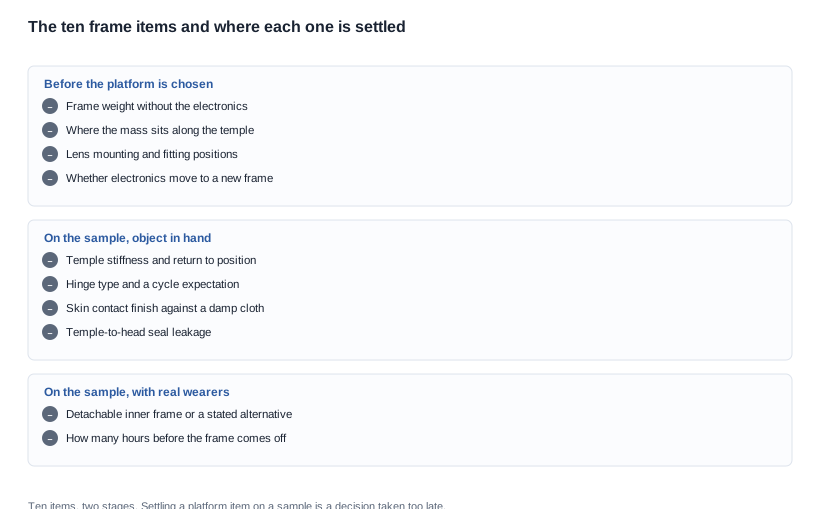
Smart glasses frame materials: ten items and where each is settled
Why a checklist is a document rather than a list
A list of things to look at is a shopping list. A checklist is a set of lines, and each line has to carry three things: the item, the pass criterion and the owner who closes it. Without all three, a checklist becomes a list of things somebody remembers to ask about during a sample review, and the outcome depends on whether the person in the room happened to have a frame in their hand.
The reason this matters more in frames than in most categories is that the ten items fall into two groups with different consequences. Four of them change what the product is, and they have to be settled before the platform is chosen. Six of them change what the product does, and they cannot be settled until a physical unit exists. A buyer who treats the second group as if it were the first loses a tooling cycle; a buyer who treats the first group as if it were the second loses a platform.
The table below is the whole list, with the stage against each line, so that the two groups can be worked separately.
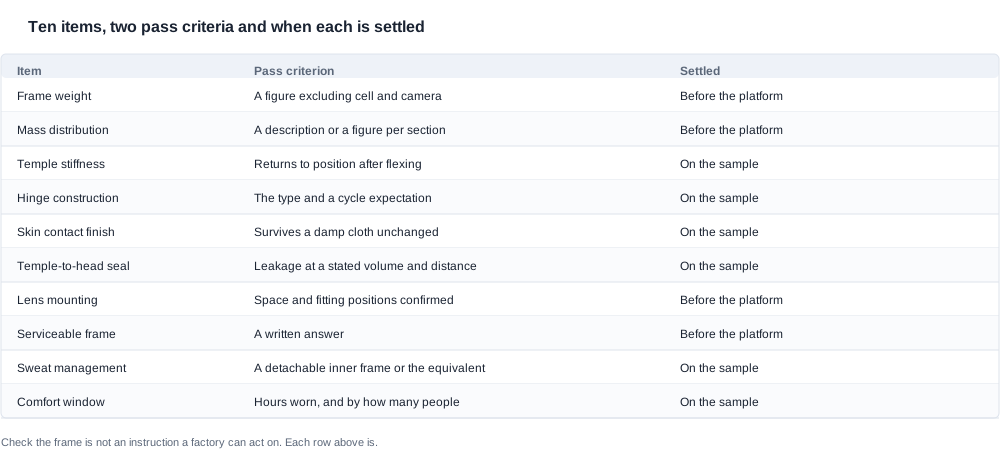

The four items that decide the platform before a sample exists
These four lines are settled in writing, before the platform is chosen, and they are the four with the largest effect on what the finished product turns out to be.
Item one: the frame weight, separately from the unit weight
A whole-unit weight is dominated by the electronics, which are a fixed cost in the total. What differs between models is the frame itself, and that is the number you need. Pass criterion: a figure that excludes the battery and the camera module.
Our catalogue publishes a whole-unit weight for one model in the entire range, and it is 158 g for the MT6 glasses unit, excluding the foldable charging case. Nobody should read that as a frame weight, and no buyer should use it as the basis for a freight calculation.
Item two: where the mass sits
Along the temple, or concentrated at the front. Pass criterion: a description of the distribution, or a weight figure per section. A frame whose mass sits forward puts pressure on the bridge of the nose rather than spreading it, and that is a structural consequence rather than a preference.
This item is worth asking for in the same request as the weight, because a supplier who has weighed the sections has usually already decided where the electronics go, and that decision constrains the section thickness.
Item seven: the lens mounting
Pass criterion: the space and the fitting positions confirmed for the target market. Our general guidance is that the AI camera and audio models generally reserve space for an insert lens and carry the mounting positions, while electronically tinted and display-equipped designs can be constrained by where the module sits — and it has to be confirmed model by model.
This is the item most often left open, and it is the one that collides with the tinting question. The V03 Pro is published with a photochromic lens configuration, so a model with a lens decision in it has two variables rather than one, and the combination has to be confirmed rather than inferred.
Item eight: whether the electronics can move to a replacement frame
Pass criterion: a written answer. This is the item with the largest effect on the after-sales budget and it is rarely asked. If the frame is a serviceable part, a scratch or a broken hinge is a small part and a small cost. If it is not, every frame issue becomes a full unit return, and the service cost of the line changes by an order of magnitude.
The six items that need the object in your hand
These six are settled on a sample, because each of them requires the physical object and a specific procedure rather than a document.
Item three: temple stiffness
Pass criterion: the temple returns to the same position after flexing, and the figure is a test result rather than a material description. A soft temple changes the speaker alignment on an open-ear model and the contact pressure on a bone conduction one, so the same stiffness question has two different answers depending on the model.
Item four: the hinge construction
Pass criterion: the type of hinge, and a cycle expectation stated. On an electronic product a hinge failure is a warranty event rather than a matter of taste, and the cycle count is the number that decides whether it happens in year one or year three.
Item five: the skin contact area and its finish
Pass criterion: a finish that survives a damp cloth without changing appearance or transferring. A product in contact with the face for hours is judged on this, and it is the surface the customer touches most.
Item six: the temple-to-head seal
Pass criterion: the leakage at a stated volume and a stated distance, within what the listing will promise. This is the variable that decides whether an open-ear product produces a complaint, and it is a frame property rather than an electronics one.
Item nine: the sweat answer
Pass criterion: either a detachable inner frame or a stated alternative. The V06 and the S7 publish a detachable inner frame, which is the industry's answer to a frame that accumulates contamination at the skin contact.
Item ten: the comfort window
Pass criterion: how many hours the frame stayed on, and by how many people, before it came off. This is a test result with real users, and it is the only figure that predicts the late complaint, because the complaint arrives late — the first few hours pass easily on almost any frame.


Writing a pass criterion a factory can act on
The most common failure in a frame checklist is a criterion that cannot fail. "Good build quality" cannot fail. "Reasonable temple stiffness" cannot fail. A criterion that cannot fail is a criterion that will be reported as passed, and it will be reported as passed whether or not it was.
A pass criterion in this category has three properties. It is measurable, so it does not depend on the opinion of whoever inspects. It is bounded, so that there is a number on each side of it. It is repeatable, so that a second inspector gets the same answer.
Written properly, the ten criteria above read as follows. A frame weight is a figure in grams, excluding the battery and the camera module, with a stated tolerance. A hinge is a named construction with a cycle count that the supplier stands behind. A temple returns to the same position after a stated number of flexes, with the deviation bounded. A skin contact surface shows no visible change and no transfer after a stated number of wipes with a stated cloth. A temple-to-head seal leaks no more than a stated volume at a stated distance. A detachable inner frame is confirmed present and confirmed to detach and refit a stated number of times.
The discipline is worth stating plainly: every criterion has to name a method, a number and a condition. A criterion with two of the three is a preference, and a preference on a factory floor is a negotiation rather than an acceptance test.
Who owns each line, and on what date it has to close
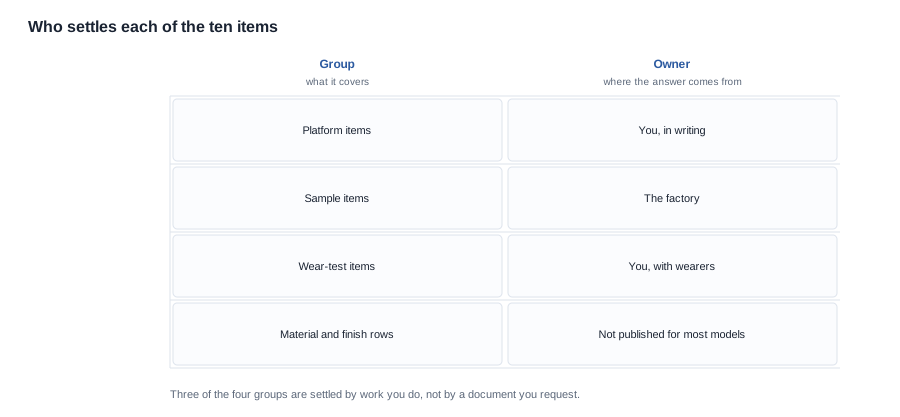
Three of the four groups above are settled by work that you do, not by a document you request. That is the part of the checklist that surprises buyers who expect the whole list to be answered by the supplier.
The platform items are yours to request in writing and yours to hold the supplier to. The sample items are the factory's to produce and yours to verify against a criterion. The in-use test items cannot be delegated at all, because nobody outside your organisation can run them with your population. And the material and finish rows are, for most models in this category, simply not published anywhere — which is why the last line of the matrix above is the one that generates work rather than answers.

The checklist as a gate, with an owner and a date
A checklist that is not a gate is a document. A gate has three properties that a list does not.
It has an owner. Each line has a named person on the buying side who closes it, not a team. A team owner means the line stays open through three handovers and nobody notices.
It has a date. Each line closes before a specific event, and the events are the ones that cannot be recovered. The platform items close before the tooling is released. The sample items close before the first article is approved. The in-use test items close before the packaging artwork is signed off, because the artwork is where the change stops being cheap.
It has a stop condition. Some lines have to be capable of stopping the programme, and they need a rule for what happens when they fail. The rule is more important than the line. A tolerance that fails at first article and moves the schedule by six weeks is a tolerance that should have been written before the tooling, which is why the platform lines are not optional.
The commercial value of a gate like this is easier to quantify than most. The four platform lines are cheap to close and expensive to change. The six sample lines are moderately expensive to close and impossible to close after launch. The in-use test lines are the cheapest to close and the slowest to run, so they need to start first. A programme that closes them in that order finishes on time more often than a programme that closes them in the order they are easiest to reach.
What each line costs to close, and what it costs to miss
A checklist line has a cost to close and a cost to leave open, and the second one is almost always larger than the first. Sorting the ten lines by that ratio is how a buyer decides where to spend attention.
The four platform lines are the cheapest to close and the most expensive to leave open. Closing them is a written request and a supplier's answer; leaving them open means choosing a platform on an assumption, and the assumption becomes tooling. The specific cost of leaving a platform line open is a non-recurring cost on a moulding that may not be the right moulding, amortised across the first programme and paid for whether or not the programme succeeds.
The six sample lines are the most expensive to close and the most expensive to leave open. Closing them needs a sample, a procedure and an inspector's time. Leaving them open means the first article is approved against an opinion, and the first article is the point at which an opinion becomes a retool.
The in-use test line is the cheapest to close and the slowest to run. It needs no supplier documentation at all, only people and time, which means it is also the line most often deferred because nobody owns it. It is the line that changes the product page, the sizing guidance and the after-sales expectation, and it is the line that can be running while every other line is still open.
There is a fourth category that is not on the list at all and that every buyer should add to their own version: the lines that can stop the programme. A programme needs at least one line with the authority to say no, and that line has to be written with a criterion rather than with a preference. A line that cannot stop anything is a note.
A hypothetical gate, worked through
This is a worked case rather than a live order. It intends to show the choices.
Assume a brand-side product manager qualifying a camera model for a European retail channel. The line has a fixed launch date, a fixed artwork approval date, and a model that has to be signed off by a retailer before it goes on a shelf.
Step one: the sort. The manager splits the ten items into the four platform lines and the six sample lines, and gives each line an owner and a date. The four platform lines are closed in the first week, before the order for tooling is placed.
Step two: the platform lines. The frame weight comes back as a figure excluding the electronics, which is the criterion the manager asked for. The mass distribution comes back as a description. The lens mounting is confirmed for the target market, and the manager learns that the photochromic configuration adds a variable to the mounting question, which changes the packaging concept. The serviceability answer is a written "no", and the manager now knows that a frame issue becomes a unit return, which goes into the after-sales budget at the start rather than the end.
Step three: the sample lines. The sample arrives and the six sample items are worked through. Two fail: the hinge cycle expectation does not cover the retail channel's use pattern, and the skin contact finish transfers on the damp cloth test. Both are supplier conversations rather than programme failures, and both are found in week two of a sample review rather than in year two of the warranty file.
Step four: the wear-test lines. That test runs with a group of people who match the channel's customer profile, and the result is that the frame comes off after four hours for a subset of the group. That is a product finding rather than a defect, and it changes the product page, the sizing guidance and the expectation set for the channel. It also arrives early enough to act on, because the gate gave it an owner and a date.
Step five: the closing. The gate closes with two lines still marked as not published rather than as passed. Those two lines become requests against the first production order, and the manager files them in the technical file with the model and the configuration so that the next programme inherits the answers instead of repeating the questions.
Step six: what the gate actually changed. The manager compares the programme against the one before it and finds three differences that were not on the checklist at all. The lens mounting answer changed the packaging concept, which is a change to a launch date. The serviceability answer changed the after-sales budget, which is a change to a price. And the in-use test result changed the product page, which is a change to what the retailer will approve.
None of those three was a materials question in the narrow sense, and all three were found because the checklist had a line for the underlying property — the mounting space, the serviceability, the time on the head — rather than for a material name. That is the argument for the ten items being written as behaviours with a pass criterion rather than as properties of a substance. A substance has no pass criterion. A behaviour does.
The programme launched on its original date, and the finding that mattered most came from the cheapest line on the list.
What our published rows can and cannot answer here
Stated plainly: the frame is an engineering component, and the material question is a proxy for the ten items above. We publish the figures we hold, which is one whole-unit weight, and we will not fill the rest with typical values from the industry, because a material name copied from a competitor's specification sheet tells a buyer nothing about the frame in the box.
We will also say plainly what that means for the checklist. Of the ten items, our published rows can answer one — and only partially, since 158 g is the MT6 glasses unit and excludes the foldable case. Item seven has a partial answer in the published flexible-temple and detachable-temple configurations. Item nine has a partial answer in the V06 and the S7. Items one, two, three, four, five, six, eight and ten are not published for any model in the range, and each has to be requested from the factory or measured on a sample.
What we can do is answer these ten for a specific model where our documentation holds the answer, and tell you plainly which ones have to go to the factory. The material and fit context is under materials and ergonomics, the sample protocol is in how to test frame materials, and the direct version of the question is in what frame material is best.
Related reading
- The sample protocol — how to test frame materials
- The properties behind the items — why frame materials matter
- The selection method — how to choose frame materials
Send us the ten answers and we will tell you which of them are consistent with the published configuration for the model.


