
Smart glasses frame materials: what a sample settles
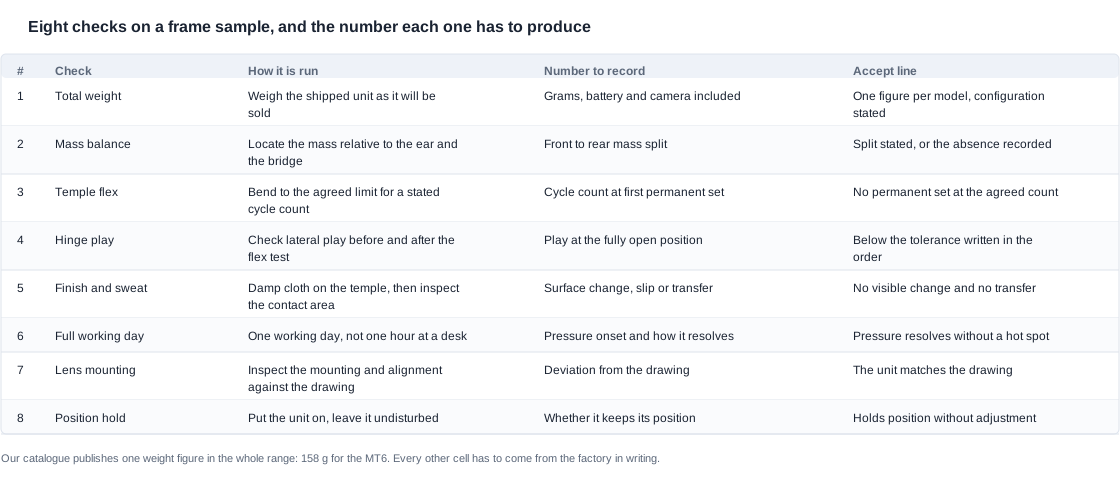
A frame sample settles in one working day what a specification sheet cannot settle in a year. If you are comparing two suppliers on frame materials, the decision you are making is not "which material is better", because nobody publishes that in a form you can compare. The decision is "which of these two units produces the same result twice, and what that result is". Eight checks, run in a fixed order, turn a frame into four numbers a purchase order can accept: total weight, mass balance, a temple flex cycle count, and a hinge play tolerance, each recorded against the condition it was measured under.
That distinction matters because our own catalogue is a good illustration of why samples are not optional here. We publish one weight figure across the entire range, 158 g for the MT6 as a whole-unit figure including the battery and the camera module. We publish no material name, no temple dimension, no hinge detail and no frame weight for any other model. A buyer who wants to compare frames cannot compare documents here, because for almost the whole range there is nothing to compare. The sample is the only place the questions that decide whether the product survives a year of ordinary use can be answered.
The cost of skipping it is not immediate, and that is what makes it easy to skip. Frame quality is a slow-failure property. A frame that will not last looks acceptable on the desk, in the photograph, and in the first hour. The evidence appears in the returns data months later, by which point the packaging artwork is printed, the listing photographs are live, and the colour that sold best is the one that shipped worst. The buyer's task is to compress that year into a day and to record the outcome in a form the supplier can be held to.
The decision this protocol is built to support
The reader here is a brand-side product manager working a new frame, a channel buyer stocking one, or a sourcing lead who has been handed two quotations and told to pick one. What sits on the desk is usually less than the decision requires: a sample box, a catalogue page, a unit price, and a lead time. What is missing is any measurement at all.
The three things the buyer is afraid of are specific and they are all expensive in different currencies. The first is a returns trend that arrives gradually and cannot be attributed, because nobody defined what the frame should have been. The second is a shipment that arrives inconsistent, where one unit in the batch feels different from the next, and the buyer cannot tell whether it is the design or the production run. The third is a supplier conversation that cannot be closed, because the buyer's evidence is "it does not feel right" and the supplier's evidence is "this is what the sample was".
Each of those three is cheap to prevent at the sample stage and expensive to prevent afterwards, and the reason for the timing is a scheduling fact rather than a technical one. The documentary and artwork work runs on the brand's own timeline, not the factory's, and the artwork sits at the end of it. A frame decision taken in week three becomes a reprint in week twelve, and a reprint in a multi-market launch is a label set, a manual, a quick start guide and a support script.
Why the order of the checks is not cosmetic
Weight and balance come first because they decide whether the remaining checks mean anything. A frame that sits badly on a head will fail the seal and the full-day test for reasons that have nothing to do with the material, and the result will be attributed to the material. Durability comes next, and the full-day test comes last because it is the only check that needs the earlier results to be interpreted.
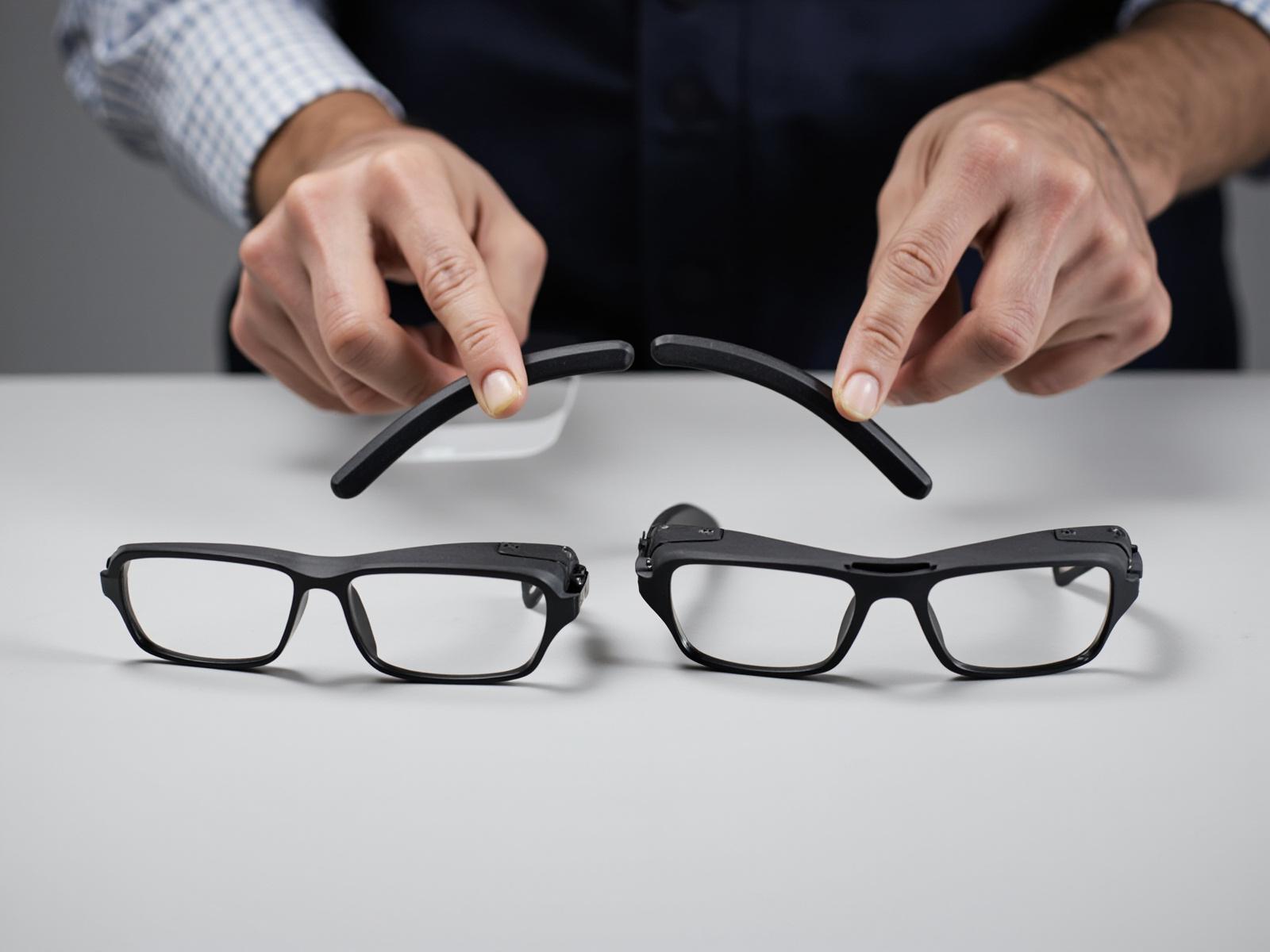
There is a second ordering rule that buyers rarely observe and suppliers rely on. Checks that are non-destructive come before destructive ones. The temple flex test deforms the unit slightly and the hinge play measurement afterwards will read differently than it did before, which is why the hinge figure is taken twice and reported as a before-and-after pair rather than a single number. Record them in the wrong order and you lose the ability to tell a design characteristic from a test artefact.
The eight checks, and the threshold each one has to beat
A measurement without a failure level is a description of a sample. Every check below therefore produces a number and a threshold, and the threshold is the part that goes into the purchase order. The thresholds are not ours to invent — they are the ones you write, agree with the supplier, and then hold both sides to. What follows is the form those thresholds take and the questions each one raises.
Total weight. Weigh the shipped unit exactly as it will be sold, with the battery fitted and the camera module present, and record the configuration in the same line. A weight figure without its configuration is not a weight figure, it is an anecdote. The question to ask the supplier is what else they publish, and the answer in our catalogue is the MT6's 158 g and nothing else for the rest of the range. The threshold to set is a band rather than a point: a tolerance of a few grams is normal for a moulded frame with a battery in it, and what you are really detecting with the band is a configuration change or a component substitution.
Mass balance. Determine where the mass sits relative to the ear and the bridge, and express it as a front-to-rear split. For a smart glasses frame this is not a comfort question, it is a question about what the product does in use, because a camera module and a battery pull the balance forward of the ear and the temple length then governs how the mass is carried. The supplier's likely answer is that the split is not available, and that answer is legitimate — it is the absence of a measurement, not a refusal. What you need in that case is the reason in writing, because "we do not measure it" and "the camera module sits at the front" are very different positions when you are negotiating a weight tolerance.
Temple flex. Bend the temple to the agreed limit for a stated cycle count and record the count at which a permanent set appears. A permanent set means the temple no longer returns to its original angle, and it is the failure mode that turns a frame into a returns driver, because the product then sits at the wrong angle on the customer's face for the rest of its life. The threshold is a cycle count, and it has to be set before the test, not after the first set appears. Ask the supplier for the hinge cycle rating and the flex limit they work to, and compare it with the count you intend to order at.
Hinge play. Measure the lateral play at the fully open position, then measure it again after the flex test. A frame that passes the flex test but develops play afterwards has a hinge whose tolerance is not stable under repeated loading, and that is a materially different product from one that simply starts loose. The threshold is a play figure against a stated tolerance, and it is the easiest number in this category to make binding because it costs nothing to measure and nothing to inspect at goods-in.
Finish and sweat. Wipe the temple with a damp cloth, then examine the skin contact area for a change in appearance, a surface that has become slippery, or a finish that transfers to the cloth. None of these appear in a datasheet and all three are decisive, because the temple is the surface held against the face for hours. The threshold is written as a condition and an observation rather than a number: no visible change, no transfer to a white cloth, and no change in grip. Ask what the coating is, what the finish is applied over, and whether the coating is a coating or a moulded texture, because those two answer the question differently.
Full working day. Wear the unit for a full working day, not an hour at a desk, and record when the pressure establishes itself and how it resolves. This is the check buyers compress, because an hour is easy to schedule and a day is not. It is also the check that predicts the complaint, because the first hours are comfortable for almost any frame and the pressure only establishes itself once the wearer has stopped thinking about the device. The threshold is a resolution: pressure must resolve without a hot spot forming at a single point.
Lens mounting. Check the mounting and the alignment against the specification drawing. This is a production check rather than a material check, and it is the one that catches sourcing errors, because a frame that does not match its drawing is a production fault no matter how the material performs. The threshold is a zero-deviation requirement, which makes it the easiest criterion in the set to write into incoming inspection.
Position hold. Put the unit on, leave it undisturbed, and observe whether it reaches a stable position and keeps it without adjustment. A frame that will not hold its position is a returns driver that no amount of material quality compensates for, and it is one of the few frame faults that a customer reports as "it does not fit" rather than as a defect, which means it never appears in a defect rate at all.
Thresholds that can go straight into incoming inspection
| Check | What to record | Threshold to agree | Who can confirm it at goods-in |
|---|---|---|---|
| Total weight | Grams with the configuration stated | A band, wide enough to absorb normal variation and narrow enough to catch a substitution | Yes, on a calibrated scale |
| Mass balance | Front to rear split, or a written reason why not | The split stated, or the absence recorded as an open item | No, supplier statement only |
| Temple flex | Cycle count at first permanent set | No permanent set at the agreed count | No, destructive |
| Hinge play | Play at full open, before and after flex | Below the tolerance in the order | Yes, with a gauge |
| Finish and sweat | Surface change, slip, transfer | No visible change and no transfer | Yes, with a cloth |
| Full working day | Onset and resolution of pressure | Resolves without a hot spot | No, requires a person |
| Lens mounting | Deviation from the drawing | Zero deviation | Yes, against the drawing |
| Position hold | Stability without adjustment | Holds position | Partly, subjectively |
Three of the eight checks can be repeated at goods-in without destroying the unit, and those three are where an incoming inspection earns its cost. The rest are sample-stage criteria, which means they can only be enforced through a clause and a trust relationship, and a clause is worth more than a preference.
Running the checks so the result survives a supplier argument
The protocol is only worth the time it takes if the record is defensible later. A supplier will accept a result it can reproduce and will challenge a result it cannot, and the difference is almost entirely in how the conditions were written down. Every step below assumes the one before it passed, because a failure at any step tells you what the next step would have told you, and the order is what makes that true.
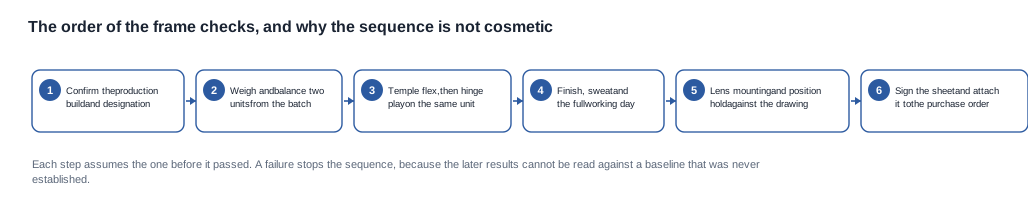
Confirm the unit is the production configuration, not a promotional build. Use the procedure at sample evaluation. This is where a weight figure is either valid or meaningless, because a promotional batch with different internals will give a different answer on every measurement. Confirm the model designation on the unit against the purchase order at the same time, since traceability is what lets you attribute a defect rate to a batch afterwards. Without it, a defect found at goods-in cannot be argued with the supplier on evidence.
Look up every certificate number in the issuing body's own register. Check the model, the configuration covered and the validity date, using the list at certification checklist. For the models that carry an ingress marking, note that the V06 and the S7 are the only entries in our catalogue annotated with IP54, and no test report number sits behind that annotation. What the marking covers is set out under IP ratings, and the sport models themselves are at sport smart glasses. This matters to a frame test because a frame that has been opened, reworked or fitted with a different interface is a different configuration, and the marking stops applying to it.
Re-run the weight, flex and hinge checks on a second unit from the same batch. Two units cost almost nothing and they answer the question that matters most, which is whether the variation you measured is a design characteristic or a production inconsistency. If two units from one batch disagree by more than the band you agreed, you have a supplier quality conversation before you have a purchase order. If they agree, you have a baseline you can hold the incoming shipments to.
Record conditions, not conclusions. Write down the flex limit, the cycle rate, the cloth, the duration of the full-day test and the ambient conditions of the finish check. "Flexed until it went" is not a record. "Flexed to 30 degrees over 200 cycles with the temple at the hinge, then re-measured" is. The second version survives a supplier challenge; the first one becomes an argument about vocabulary, which is a fight no buyer wins.
Photograph the unit at each stage. Before, immediately after the flex test, and after the full day. The photographs are the only evidence that the unit in your file is physically the same object as the one you tested, and they are the only way to settle a dispute about the finish after three months of shipping.
Check the lens fitting route if the product will be sold to prescription wearers. A lens question is a returns driver that has nothing to do with the frame's material, and the route is at prescription lenses. Finding out at sample stage that the fitting route you assumed does not exist for your configuration is worth more than any material measurement on this list.
Where a frame programme goes wrong after the sample passes
The sample passed and the production batch does not. The symptom is an incoming inspection finding a weight or hinge figure outside the band on a later shipment, after the purchase order has already been placed. The root cause is that the band was set from a single unit rather than from two, so the tolerance reflects a best case rather than a normal case. The prevention is the second-unit repeat, and it is cheap: it is one extra frame from the same batch.
The frame matched the drawing and the product still failed. The symptom is a return rate that no one can attribute, with a spread of reasons in the customer service tickets. The root cause is that the eight checks measure the frame and not the assembly around it — the temple flex result says nothing about how the electronics are carried in it. The prevention is to add the mount and the balance results to the sample sheet, so that the acceptance criteria describe the product rather than one part of it.
The full-day test was skipped because the deadline was close. The symptom is a complaint pattern that arrives six months after launch, in the form of a slow drift rather than a spike, which is the hardest kind of returns data to analyse. The root cause is a scheduling decision, not a technical one. The prevention is to start the full-day test first, because it is the longest check and the only one that cannot be compressed without destroying the result. A day that is scheduled on day one costs nothing; a day that is scheduled after the artwork is approved costs a reprint.
Two suppliers were compared on different units and different days. The symptom is a result the buyer cannot explain and the supplier cannot reproduce, so the comparison is thrown out and a third sample is ordered. The root cause is that the protocol was improvised rather than written down, and each buyer's version was reasonable. The prevention is to fix the script, the conditions and the scoring before the first recording, and to send the same script to both suppliers.
The finish check found a transfer and it was treated as cosmetic. The symptom is a customer complaint about discoloration on the skin contact area, reported as unhygienic rather than as a defect, which routes it to support rather than to quality. The root cause is that no threshold was agreed, so there was nothing to fail. The prevention is to write the finish criterion as a pass or fail condition before the sample arrives, and to put it in the incoming inspection sheet so the question does not come up again at goods-in.
The weight figure was recorded without the configuration. The symptom is a mismatch between the datasheet the supplier sent and the datasheet the buyer published, on the same model, discovered by the retailer's technical team. The root cause is that the weight was quoted with the camera module removed. The prevention is to require the configuration to travel with every number, in every document, every time, and to treat a number without its configuration as a missing number.

The mould is fixed; the first order is not
In frame sourcing the negotiable surface is narrow, and it is narrow in a specific place: everything that happens before the tooling is cut can still move, and everything after it cannot. A buyer who understands that spends the negotiating energy on the front of the schedule rather than on the unit price, which is the number with the least room in it.
Frame tooling and the moulds themselves are not a negotiation target. Certification cost and certification lead time are not either — the cost is per product family and the elapsed time belongs to the test laboratory and its review queue, not to the size of your order. Hinge and temple geometry become fixed once the tooling is cut, because changing either after that point means a new tool and a new schedule. A supplier who will not discuss the seal geometry, the temple section or the hinge type is telling you the geometry is settled, and your programme should be built around that rather than against it.
What does move is the palette and the finish schedule, lens tint and lens finish, logo placement and the packaging structure, the minimum order quantity tier, and whether the detachable inner frame is offered as a fit kit or as a single configuration. Two of these carry more money than the unit price gap. Tooling amortisation across a larger first order is usually the largest single lever on frame cost, and it is a quantity decision rather than a price negotiation — which means it belongs to the demand plan, not to the purchase order. Whether the supplier funds a second unit for the repeatability check is worth asking for directly when the weight and hinge data are entirely unpublished, because you are asking them to fund the evidence for a claim they have not yet made.
Delivery structure is the other quiet lever. Splitting a first run into two deliveries against a sample-approval milestone is usually granted more easily than a price concession, and for a frame programme it is worth more than a price concession, because it moves the artwork decision to after the sample result rather than before it. The clause language is at contract terms, the commercial structure of a first order is at pricing, and the selection procedure that leads to this test is at how to choose frame materials.
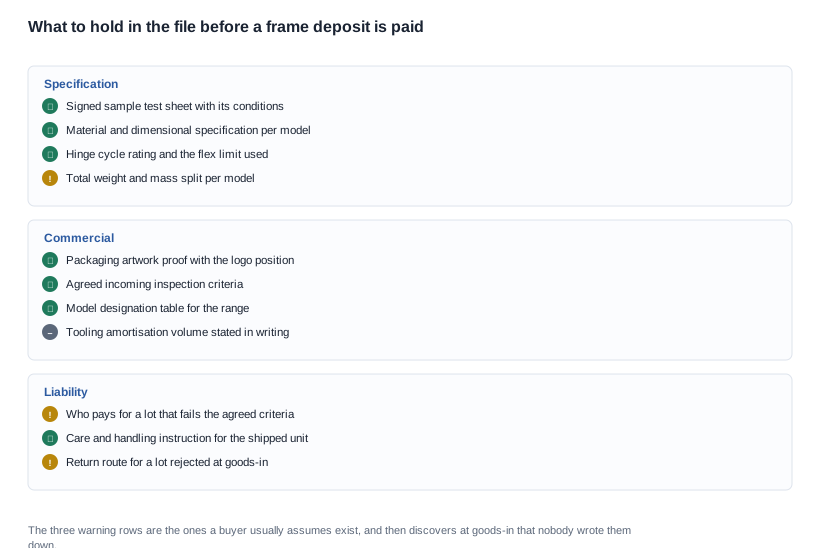
Documents to request before the deposit. The signed test sheet with its conditions. The material and dimensional specification per model. The hinge cycle rating and the flex limit used. The total weight and the mass split per model. The ingress marking with the test report or an explicit statement that none exists. The packaging artwork proof. The agreed incoming inspection criteria with the drawing to inspect against. The model designation table. The background to the published structural rows is at why frame materials matter, and the open-ear architecture that shares the same frame constraints is at how open-ear audio works.
A hypothetical pilot run scored against the eight results
This is a constructed scenario rather than a client project, and it is here to set out the decision sequence rather than to report an outcome.
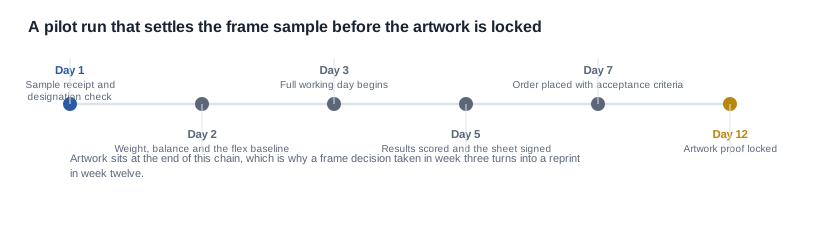
Assume a mid-size brand preparing a sport line for two markets, with a purchase order that has to be signed before the packaging artwork is approved. Two suppliers have quoted, both on the same model family, and the difference in unit price is smaller than the difference in what each of them will put in writing. The binding constraint is not price. It is that the brand has already reworked artwork once on a previous product line, and it has no appetite for a second one.
Step one, the exposure. The brand writes down the environment before it writes the requirement: the product is sold for outdoor use in rain and sweat, sold with a charging case in one market and without one in the other, and sold in a market where the listing is read carefully by a retailer who has rejected a listing before for an unsupported claim. That last fact is what turns the frame test from a quality exercise into a gate.
Step two, the documentation request. The brand sends the eight-check protocol and a document request as a list, not as a question. The request names the report number, the model designation, the tested configuration and the seal material. One supplier answers all of it. The other answers with a specification sheet and a promise, and the number of days it takes them to produce a signed sheet is itself the answer.
Step three, the sample. The brand weighs two units from the same batch. One is inside the band it set, the other is not, and the difference is traceable to the camera module fitted in one of them. That difference is not a defect in the frame; it is an undocumented build option, and the discovery is worth more than the weight number itself, because it tells the brand that the model's specification has a variant nobody had told them about. The brand adds the build option to the change-control list at this point, while the cost of adding it is an email.
Step four, the hinge and the temple. The temple flex test produces a permanent set at a cycle count below the one the brand would have ordered at. The supplier's own stated hinge cycle rating does not match the flex behaviour on the unit. This is the point at which the brand has a supplier quality conversation, and the conversation is short because both sides have a number in front of them rather than an impression.
Step five, the full day. The full-day test runs from day three, deliberately started early. It produces a hot spot at the temple contact area on the unit with the heavier build, which the brand would not have found in an hour, and which maps directly onto the build variant found in step three.
Step six, the commercial structure. The brand negotiates the palette and the finish schedule, which it had assumed were fixed and which moved, and it does not spend negotiating energy on the unit price, which did not. It splits the first delivery against the sample-approval milestone, so the artwork decision lands after the sample result rather than before it, and it keeps the eight-check sheet attached to the purchase order as the acceptance criteria, with the three non-destructive checks written into the incoming inspection sheet.
The result is a programme with one named build variant and one documented hot spot, both of which were found in one working day, and an artwork approval that did not have to be repeated. The decisive decisions were all made before the purchase order was signed, and none of them was about which material is better.
What our catalogue publishes about frames, and what it leaves open
The boundary we hold: we publish the structural rows the catalogue states and mark the rest as open, because a buyer checking a claim should be able to check ours first. In our catalogue the removable inner frame appears on the V06 and the S7, the ultra-slim detachable temple appears on the G07, the slim temple appears on the YK12, and the flexible temples appear on the V03 Pro. The IP54 ingress annotation appears on the V06 and the S7 only, of all twenty-eight catalogue entries.
We publish one weight figure in the entire range, 158 g for the MT6, and we publish no material name, no temple dimension, no hinge detail and no frame weight for anything else. We will not fill those rows with typical values from the industry, because a guessed weight in a specification is worse than an empty cell: an empty cell prompts a question, and a guessed cell does not. The background is at materials and ergonomics.
The three things to send us this week
Write down the exposure before you write the requirement. One line per channel: what the frame meets, for how long, and what happens afterwards. A line that says "occasionally, in the rain" describes a splash case. A line that says "washed down with a pressure washer" describes a different product entirely, and the codes for the two are not comparable.
Send the document request as a list, not as a question. The signed test sheet with its conditions, the material and dimensional specification per model, the hinge cycle rating, the total weight and mass split, the ingress marking with the report or an explicit statement that none exists, and the agreed incoming inspection criteria. A supplier who answers all six has a documentation habit. One who answers two is telling you something you need before the deposit.
Send us the use case, the channel, the price band and the countries you are shipping into. We will tell you which of the eight checks decides the project for that combination, which published structural features match, and which numbers have to be confirmed by the factory in writing before a purchase order is signed.
Related reading
- The properties behind the published rows — materials and ergonomics
- The selection procedure — how to choose frame materials
- The models with structural features — sport smart glasses
- The lens route for prescription wearers — prescription lenses
Tell us the use case and the channel, and we will say which published properties apply and which have to be measured.


