
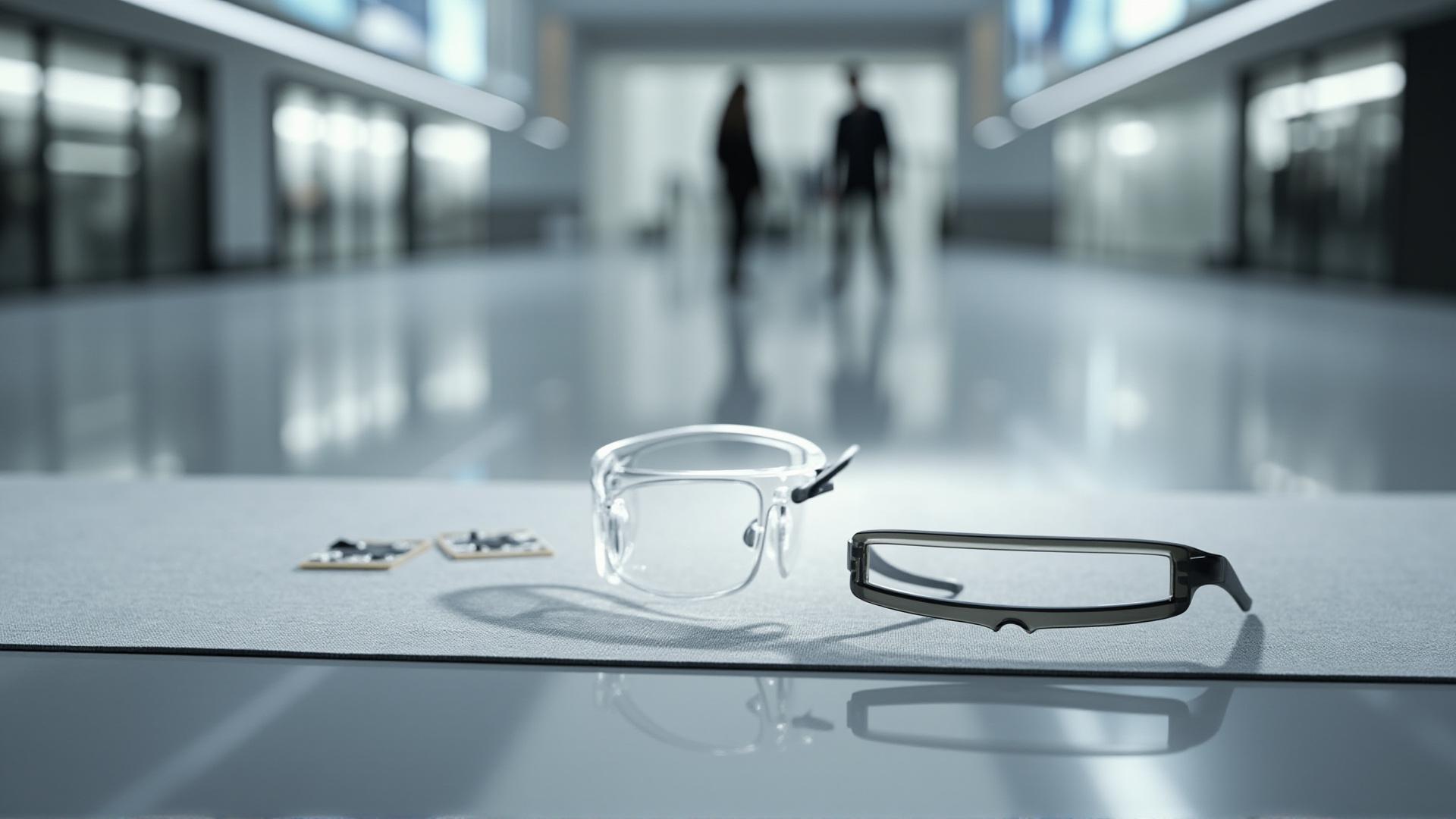
CY03 smart glasses sit in an unusual position inside the camera range: the catalogue publishes a 1400 mAh charging case for this platform and, on the same page, publishes no charging interface for the glasses themselves. That combination shapes everything about a private-label programme here. The case is a second moulded part with its own colour, its own tooling and its own approval cycle, so it carries more of your brand than the frame does. The charging interface, by contrast, is a gap in the published record, and a gap has to be closed in writing before a purchase order is worth drafting.
Most buyers arrive at this model from one of two directions. A camera buyer arrives from the image side and wants to know what the sensor does. A channel buyer arrives from the box side and wants to know what travels in the carton. Both groups hit the same two walls on this platform: the published camera information stops at a resolution class, and the published charging information stops before the interface. The article below is written as the sequence that gets past both walls in the order that costs the least when something is wrong.
CY03 smart glasses customisation: two moulded parts in one order
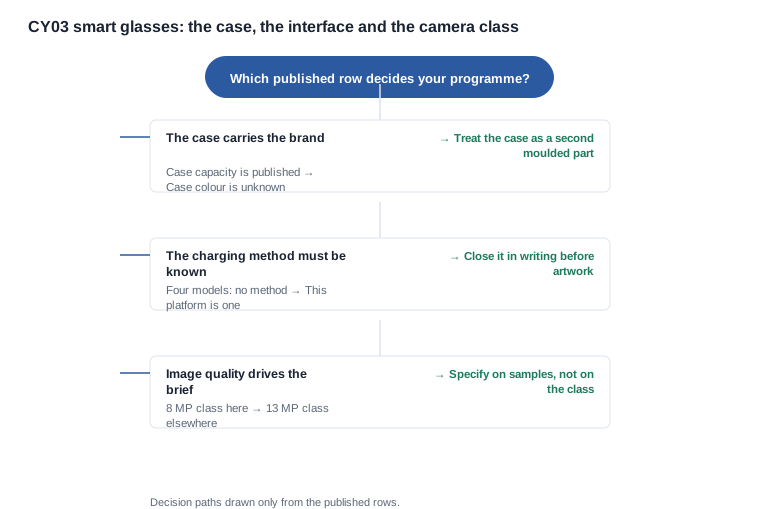
A private-label programme on this platform is really two programmes that meet at the carton. The frame is the product the customer recognises, and it is the part whose electronics are fixed: the cell, the camera class and the charging arrangement do not move because your artwork says so. The case is a separate physical object with a separate tool, and on this model it is the larger branding surface in pure area terms — the carton, the insert and the case lid are all read at the same moment, in the same hand, in the first five seconds of unboxing.
That asymmetry creates the most common failure on this model, and it is not a failure of quality or of supply. It is a failure of sequence: the frame artwork is signed off while the case is still being described in adjectives, and the case then arrives as a different colour, a different finish or a different logo treatment from the one the listing photographs implied. Nothing was fabricated by the supplier. The buyer simply never obtained a written specification for the part they assumed was easy.
The second structural point follows from the published numbers rather than from the artwork. Four camera models in this range publish no charging method at all: the MT6, the L1 Pro and the CY03, and the CY05. All four of them publish a charging-case capacity, and this platform publishes 1400 mAh. That combination tells a procurement team something specific and useful: the case exists and is a published part of the product, but the way the glasses themselves reach the case is unstated. Those are two different facts, and a brief that treats them as one fact will end up with the wrong cable, the wrong insert and the wrong box contents.
Where the branding actually lives on this platform
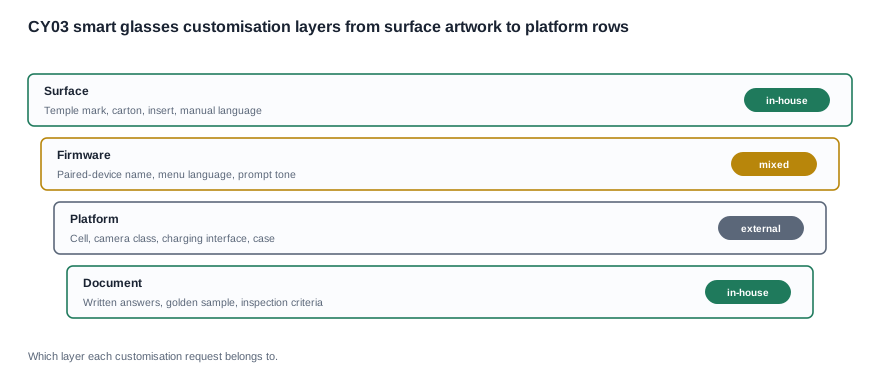
Four surfaces carry a brand mark on this model, and only one of them is the object most buyers think about first.
- The temple of the frame. The mark sits on the arm that carries the electronics and, on a two-sided package, it is read from the side as often as from the front.
- The charging case. A larger surface than the temple, with a lid that can be printed, embossed or moulded, and therefore with a tooling conversation attached to it.
- The carton and insert. The insert does the structural work, so the artwork on it has to agree with the way the product is seated, not just with the mock-up.
- The electronic identity. The name that appears in a paired-device list is the brand name a customer sees when a unit refuses to connect, and it is the one surface that requires firmware work rather than tooling.
The order of those four is not accidental. The electronic identity is cheapest to change while the platform is open, the case is the most expensive to change once tooling is committed, and the temple sits between them. Most buying mistakes on this model are sequence mistakes: an expensive part is frozen before a cheap one is settled.
The three parties a case pulls into the file
A case does not sit inside the supplier's product definition the way a firmware string does. It pulls three parties into the same conversation, and each of them carries a different risk.
- The product side has to confirm how the case interfaces with the glasses, what the case does when the glasses are seated, and what happens when a unit is returned without its case. Those answers determine whether the case is an accessory or part of the product.
- The commercial side has to price the case as a separate line, because it has its own material, its own weight in the carton and its own packing step.
- The compliance side has to decide what goes on the case and in the insert, since the label area of a case is where most of the regulatory text of an electronic product actually lives.
Treat the case as a second product with its own specification sheet, and all three conversations happen once. Treat it as a freebie in the carton, and all three happen late, usually during inspection, when the least leverage exists.

What the published rows fix on this camera platform
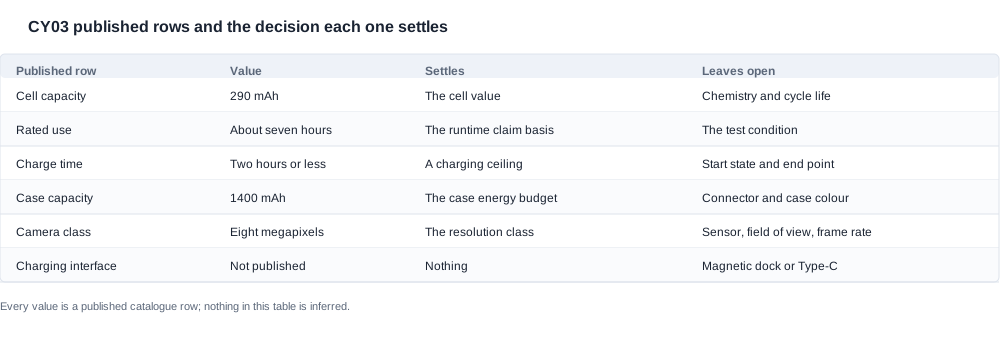
Five rows are published for this model, and they are worth reproducing exactly because they are the whole of the documented basis for the platform. The battery is published as a 290 mAh cell. Rated use is published as about seven hours. Charge time is published as two hours or less. The charging case is published at 1400 mAh. The camera is published in the eight megapixel class.
Two things are conspicuously absent, and a buyer who reads the list quickly will usually supply both of them from memory rather than from the page.
No charging interface row. The published set jumps from charge time straight to case capacity. Magnetic docking and a Type-C socket are not interchangeable for a programme: they decide the cable in the box, the insert, the charge indicator behaviour, the tooling on the case, and whether a customer who loses the cable can charge the product at all. On a platform where the interface is unstated, all of that is a question rather than a decision.
No Bluetooth version row. None of the eleven camera models publishes a Bluetooth version, and this one is no exception. A connectivity claim in a listing cannot be traced to this platform's own page, and if a channel partner needs a version, it has to arrive as a written confirmation that names the model.
The published cell sits in a wide camera tier
The 290 mAh cell on this platform is not a distinguishing number in the camera range, and a specification sheet that presents it as one will mislead anybody comparing it against the other ten camera models. Four camera models publish 290 mAh: this one, the L1 Pro and the L2 Utral, and the CY05. The MT6 publishes 265 mAh alongside a folding case of 1200 mAh. The V03 Pro and the MT5, and the V03 publish 220 mAh. The V06 and the S7, and the KY06 publish 260 mAh.
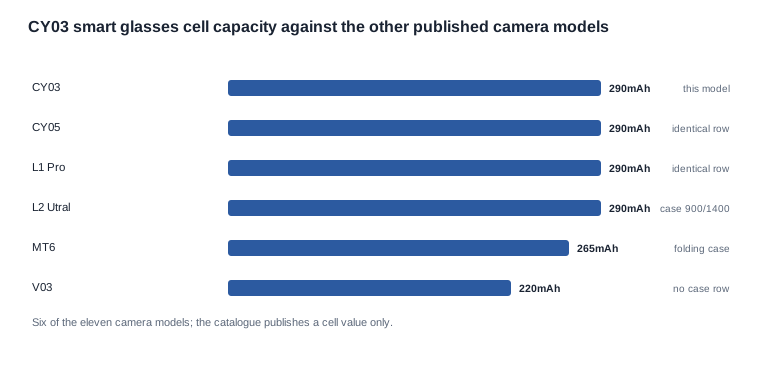
What that distribution gives a buyer is a constraint rather than a ranking. Capacity on this platform is close to the middle of the camera range, so a programme that needs longer runtime between charges cannot get it by choosing a different cell within the same tier. It has to come from the case, from the charge cycle in the field, or from a model whose published runtime row is a range rather than a single figure.
Two further constraints come from the same table. First, the charge time of two hours or less is a ceiling, not a measurement. The catalogue publishes neither the starting charge level of the cell nor the condition that ends the cycle, so the figure cannot be converted into a claim about how long a part-charged unit needs before it is usable again, and it cannot be used to plan a turnaround on the case. Second, the 1400 mAh case capacity is an energy figure, not a cycle count: it says how much the case holds, and nothing about how many full charges a unit draws from it or how quickly the case itself recharges.
The case is one of five with a published capacity
Camera models in this range come in three states regarding the case, and the difference is worth holding on to because the middle state is easy to mistake for the first.
- Capacity published: the CY05 and the CY03, and the L1 Pro — each at 1400 mAh; the L2 Utral at 900 or 1400 mAh; the MT6 at 1200 mAh in a folding form.
- Case present, capacity not published: the KY06 and the MT5.
- No case row at all: the V03 and the S7, and the V06. The catalogue simply does not list a case for these three, which is an absence of information rather than a statement that the case does not exist.
So the 1400 mAh figure on this model is real and specific, and it is also the kind of number that stops a buyer from asking the next question. Because a capacity is published, a programme may assume the case is settled. It is settled on one dimension only. Nothing on the published page tells a buyer the case's connector, its colour options, its material, its weight, or whether the glasses charge through the case at all.
The camera row is a class, not a specification
The camera on this platform is published in the eight megapixel class, alongside seven other camera models. A second class exists in the range, the thirteen megapixel class, and it covers the L2 Utral and the S7, and the L1 Pro. That two-class structure is the whole of the published camera information across eleven models.
What the catalogue does not publish for any of the eleven camera models is the part that actually determines whether a photograph is usable: sensor model, field of view, frame rate, video format, stabilisation, low-light behaviour, storage capacity and file format. A buyer who reads "eight megapixels" and stops has a resolution number and no basis for a camera brief. The honest position is the one this article takes: the platform publishes the resolution class and nothing further about the imaging chain, so every claim beyond that class has to originate from your own samples and be written into your own acceptance criteria.
That is not a weakness of the model. It is a description of what documentation exists, and it tells you exactly where your own testing budget has to go.
Closing the charging interface gap in writing
The interface gap is the part of this platform where a well-run programme and an unlucky one diverge most, because the gap is invisible on the page. Nothing is written that is wrong; something simply is not written.
The first rule is to specify the question rather than the answer. "What is the charging method for the CY03?" invites a market-ready reply. "Please confirm in writing, for the model designation as ordered, the charging interface on the glasses, the connector on the case, the charging behaviour of the case when a unit is seated, and whether the glasses can be charged without the case" produces a specification. The second rule is to require that the answer arrives attached to the designation, because four camera models share this gap and a supplier answering for the platform rather than the model leaves the file ambiguous again.
Three interface paths and what each one commits you to
There are only two published charging methods in the range, so a written answer on this model resolves into one of three practical paths, and each carries a different downstream commitment.
- Magnetic docking into the case. The unit seats in the case, the case carries a connector, and the cable in the carton charges the case rather than the glasses. This path makes the case a required part of the product, which strengthens the case branding but also means a customer who loses the case has a product that cannot be charged.
- A Type-C socket on the glasses. The carton carries a cable, the case becomes an optional carrier, and a customer who loses the cable can still charge. This path simplifies the box contents and weakens the case as a mandatory brand surface.
- A dock or proprietary connector. This path would create a second cable, a second documentation obligation and a second support script, and it is the path that most often surprises a buyer who assumed one of the two published methods.
The published case capacity of 1400 mAh does not tell you which path you are on. A case can exist and be a storage and charge accessory, or exist and be the only charging path, and the catalogue page reads the same in both cases. That is precisely why the question has to be closed in writing before anyone commits money to case artwork.
What to ask for, in the order that costs the least to obtain
- The charging interface on the glasses, named per model designation.
- The connector on the case, and whether the case charges the glasses directly or only holds them.
- Whether a unit can be charged without the case, and if so through what.
- The colour and material options for the case at the volume being discussed.
- Whether the case has its own tooling, and how many units the supplier is willing to hold that tooling for.
- The case's published capacity, its charge behaviour and whether it can be charged while a unit is seated in it.
None of these questions asks the supplier to invent a number. Each asks for something that exists in the production file, and each answer becomes a line in your inspection plan. That last point is the one that matters most: an answer obtained before the order can become a criterion, and the same answer obtained during inspection can only become an argument.
Camera rows, resolution classes and what a sample must prove
Since the published camera information stops at a resolution class, the sample programme on this model carries more weight than it would on a platform with a full imaging specification. A sample here is not a formality that confirms a decision already made on paper; it is the only document that can tell you what the camera does.
Building a camera test that produces evidence rather than impressions
The failure mode for camera evaluation is a general impression — the footage looked good, the colours seemed natural — which is useless in an inspection dispute and useless in a listing. A usable test fixes the conditions in advance and records the results against pre-agreed thresholds.
- Fix the lighting before the test, not after. Record it as a condition: a defined scene at a defined brightness, shot twice, with the second run used to check repeatability rather than to hunt for a better frame.
- Capture motion at the intended use. Frame rate behaviour under movement is the most common gap between a published resolution class and a usable recording, and it is precisely what the catalogue does not state.
- Test the boundary conditions your channel will hit. Low light, backlight and reflective surfaces are where image chains separate from one another, and they are where a listing photograph can overstate what a customer will receive.
- Confirm storage behaviour. How recordings are held, how long they take to write and whether the unit signals remaining capacity are all unpublished, and all three become support questions if the platform is sold to end users.
- Record serial numbers against every result. A sample without an identifiable serial produces an opinion; a sample with one produces evidence you can compare against the next shipment.

Case behaviour is part of the camera brief
There is a specific camera risk on this model that comes from the case rather than the sensor. If the glasses charge through the case, then the camera's operating life in the field is bounded by the case's own state, and a customer who stores the unit in the case overnight may find it charged, or may not, depending on the case's charge management — which is not published. If the glasses charge on their own, the case is a carrier, and the risk moves to capacity and to the number of units in the box.
Either way, the behaviour is unpublished, and it determines the customer's expectation of a product that is sold as a camera. Ask for it in writing: what happens when a unit is placed in a case that is itself below its charge threshold, and what the unit's indicator shows at each stage. These are the answers that turn an unstated behaviour into a support script you can write.

The procurement sequence and the purchase order terms
The order of work on this platform is worth fixing in advance, because the two gaps on the page — the charging interface and the camera detail — both sit upstream of expensive steps, and both can be closed by asking rather than by spending.
- Split the brief into two columns before anything is drawn. Anything you control is a surface line; anything the platform fixes is a platform line and belongs in a model-selection question.
- Put the platform lines back to us as written questions. For this model that covers how the unit is charged, what the camera records, which radio revision ships and how the case behaves.
- Have every answer written against the model designation, not the platform. A note that names the platform rather than the model is left ambiguous in the file, since four camera models share this gap.
- Settle the case specification — colour, material, connector, logo treatment — before any case artwork is drawn.
- Settle the barcode, the paired-device name and the language of the manual ahead of artwork sign-off, since each of the three lands on packaging that is already committed.
- Approve artwork against a drawing, not a render. A render shows the intent; a drawing shows the placement, and on a camera frame the difference is where a mark collides with a hinge or a port.
- Seal one golden sample and record its serial against the approved artwork and the written answers.
- Run a pilot and inspect against your own criteria. What the catalogue page states can be checked today; anything resting on the written answers has to wait for them.
The sample evaluation guide has more on the closing two steps, and the OEM-ready platform page sets out how the surface layers are usually packaged.
Five terms that belong in the order document
The designation, on every line. The order line has to carry the model designation together with the five published rows it is written against. An order that says "a 290 mAh eight megapixel camera frame with a 1400 mAh case" is an order with four ambiguities in it, because three other models publish 290 mAh and several publish a case.
The confirmed charging arrangement, itemised. Interface, connector, whether the case charges the unit, and what travels in the carton. One sentence that says "standard charging accessories" gives a supplier room to deliver a cable for a platform that docks.
The case as a separate line with its own acceptance condition. Colour against an agreed reference, mark placement against the approved drawing, connector behaviour, and the condition under which the case charges the unit.
The camera acceptance criteria with their conditions attached. Resolution class, the lighting condition, the motion condition, the storage behaviour and the serial-based comparison method, all agreed before the pilot rather than after it.
The certification document set, named and dated. Certification for this platform is documented once at company level, on a catalogue page that carries images rather than extractable text, so the catalogue wording itself names no CE, FCC or RoHS mark for any model. Nothing in the per-model rows can be read across as certification: the document scope here is something the two sides agree in writing, and a buyer who waits for it to appear in a catalogue will wait indefinitely.
What an inspection plan looks like when the page is short
Because the published base is short, the inspection plan is mostly a set of comparisons against evidence the buyer holds rather than a set of checks against specifications the supplier publishes. For each unit or each sampled unit: the model designation as marked, the mark placement against the approved drawing, the paired-device name as configured, the case colour against the agreed reference, the charging behaviour as specified in the written answer, and the camera output against the criteria you set on the pilot.
The value of that plan is that it does not depend on the catalogue being longer than it is. It depends on the buyer having converted each gap into a written answer before the order, which is the only moment at which a gap still has leverage.
CY03 smart glasses: the boundary of what we will confirm
Some things on this platform we will state, and some we will not, and the line is drawn at the same place for every model in the range: we speak only to what the catalogue publishes, and we will say so plainly when a line is unstated rather than implying it is settled.
We will confirm the 290 mAh cell, the roughly seven hours of rated use, the ceiling of two hours or less for charging, the 1400 mAh charging case and the eight megapixel resolution class for this model. We will confirm that the charging interface is not published for this model and that the same gap applies to three other camera models, and we will help you turn that into a written specification the supplier can answer. We will also confirm what our catalogue does not contain anywhere: no touch row for any model, no translation row for any model, no per-model certification row, and no reference to CE, FCC or RoHS in the catalogue text.
Nothing on the platform's own page names a sensor part, an angle of view, a frames-per-second figure, a stabilisation mode, a low-light result, a mass in grams, a colour range or a cycle count, because none of those values appear anywhere in the catalogue document. We will not turn the roughly seven hours of rated use into a guarantee for your channel, and we will not convert the charge-time ceiling into a promise about a part-charged unit. And we will hold the line that applies to this entire category: nothing we publish will be read as a vision, eye-health or medical-benefit claim.
With five rows on the page, artwork is rarely the opening question. The opening question is charging and what the camera records, because those two answers decide what the rest of the private-label project is worth.
Related reading
- The published rows of the platform next door — CY05 smart glasses buyer review checklist
- Where the case line sits in the range — charging case options for AI camera glasses
- Building the file that supports a claim — export documentation
- Getting a sample evaluated before a bulk order — sample evaluation
- The AI camera glasses range overview — AI camera glasses
Send the destination market, the annual volume and the configuration you need, and we reply with what is in the catalogue and what is not.


