
The audio model in this article publishes a Bluetooth version, a 100 mAh cell, roughly seven hours of rated use, a charge time of two hours or less, and Type-C charging, plus two feature lines — one of which is an acoustic descriptor. That descriptor is the most quotable item on the page and the least measurable: no driver size, no frequency response, no leakage figure, no microphone pickup distance and no amplifier rating appear in the catalogue. A brand programme has to handle that gap without over-claiming or leaving the strongest line unused.
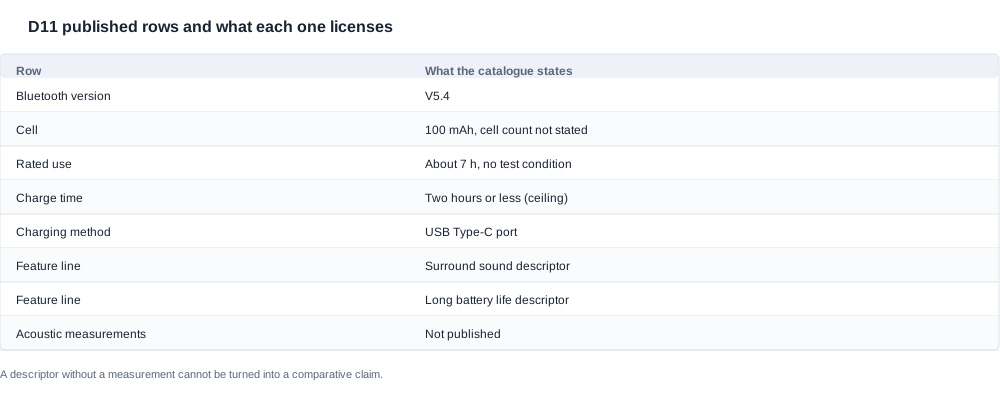
The D11 publishes Bluetooth V5.4, a 100 mAh cell, roughly seven hours of rated use, a charge time of two hours or less, Type-C charging, and two feature lines: a surround-sound descriptor and a long-battery-life descriptor. The second is a restatement of the runtime row. The first is an acoustic claim, and it is worth knowing where it sits — two of the eight audio pages in the catalogue carry a surround-sound descriptor, this one and the YK12's, whose page also lists a slim temple, while the remaining six audio pages carry no acoustic line at all.
So this model arrives with one genuine marketing asset and one real liability. The asset is the most quotable line on the page. The liability is that nothing published can support it, so a brand that puts it on a pack or a listing has to either substantiate it with a test it defines, or keep it as the supplier's descriptor rather than as its own claim. The decision to make is which of those two it is, and the decision has to be made before the artwork exists.
D11 published rows, and the acoustic descriptor with no measurement
Here is the published row, in full and with nothing added:
- Bluetooth version: V5.4.
- Cell: 100 mAh, with no cell count stated.
- Rated use: about seven hours, with no test condition attached.
- Charge time: two hours or less, written as a ceiling rather than a measurement.
- Charging method: Type-C.
- Feature lines: a surround-sound descriptor and a long-battery-life descriptor.
There is no charging case on this page, no colour list, no weight, no temple or lens dimensions, no ingress rating, no touch row, no translation row and no per-model certification entry.
What the two feature lines actually do
The long-battery-life line adds nothing to the seven-hour row. It restates it in marketing form. That is not a criticism of the catalogue — it is how a product page is written — but it does mean a brand should treat the two as one fact. It also means the runtime cannot be inflated twice in a listing by quoting both the descriptor and the number.
The surround-sound line is a label on a product whose acoustics are unmeasured. Nothing published describes how the label is implemented: not the number or size of drivers, not the amplifier, not the processing mode or the preset, not whether it engages automatically or by control, not the frequency response, not a leakage figure, not the microphone pickup distance, not the rated output. Two products with the same label can behave very differently, and a buyer cannot tell them apart from this page.
The practical consequence for a brand is a choice of attribution. There are two honest ways to use the line. The first is to reproduce it as the supplier's published descriptor, attributed to the model, without adding comparative or experiential wording of your own. The second is to build a claim, and that requires a test you have defined, run, and recorded — with the content, the level, the environment and the pass condition written down before the test is run, not after it looks good.
The rows that will be asked about anyway
The 100 mAh figure does not state a cell count. Whether the product uses one cell or more is not published, and that is a warranty scenario as much as a specification one: a single-cell product and a two-cell product fail differently, and the replacement path differs. The same gap exists on the charge-time ceiling, which does not state the starting state or the completion point, and on the runtime, which does not state the conditions behind about seven hours.
The Bluetooth row is published here, and the version is worth confirming against the firmware branch you buy. It tells you the radio generation, and it does not tell you the codec support, the multipoint behaviour, the update mechanism, or whether a customised firmware build stays eligible for the platform's later releases. On a branded programme, that last question is a commercial one, because an ineligible build is a support cost transferred to you.
How an acoustic label is verified before it goes on a pack
This is the part of a brief that usually arrives late — as a copy approval, when the artwork is already at print. Moving it earlier is the single most useful thing to do with an acoustic descriptor, because the test is cheap to design and expensive to retrofit.
Define the test before you run it
A listening test that can settle a claim needs five things fixed in advance: the content (a track or a clip, specified by name, with the same source for every unit), the level (a stated playback volume or a stated setting), the environment (a quiet room, the same room, and ideally the same listener position), the comparison (the unit under test against a stated reference, or against a stated expectation), and the pass condition (what must be true for the unit to pass). Without a written pass condition, the test produces an opinion, and an opinion cannot be used in a listing or defended in a claim.
Ask the supplier what the descriptor refers to
Four questions to ask close the gap cheaply. Is the surround-sound behaviour a hardware arrangement, a processing mode, or an equalisation preset? Does it engage automatically, and does the customer have to find a control for it? Does the behaviour change with a firmware version, and specifically with a customised build? And is the descriptor a description of the product or a summary of the platform's intention? The answers tell you whether the line survives on a branded unit, and whether a firmware customisation puts it at risk.
Decide the attribution before the copy
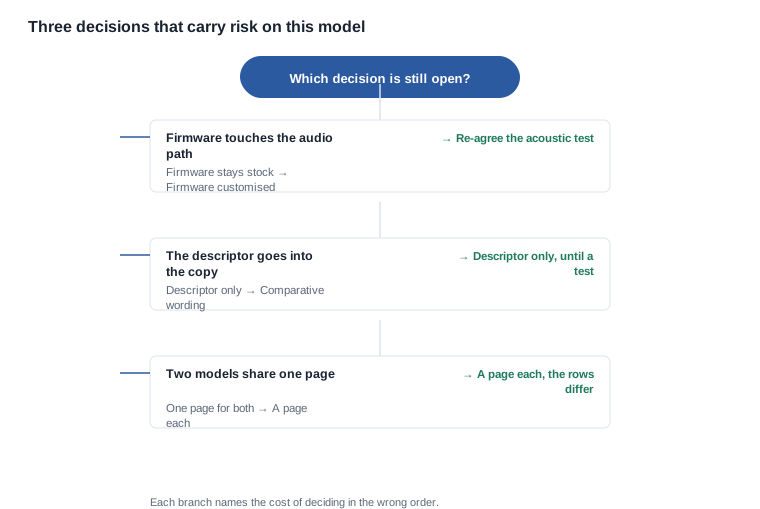
The copy decision is not a copywriting decision. If the answer to the first two questions above is that the behaviour is a processing mode in the firmware, then a firmware customisation is a change to the thing the descriptor describes, and the descriptor has to be re-established against the customised build. If the answer is that the behaviour is fixed in the hardware, the descriptor survives a firmware change. Either way, the answer determines what the brand can print.
And a red flag worth naming. If a supplier responds to the request for a listening test with a marketing sentence, the descriptor has no measurable referent and should be treated as decoration rather than as a claim. That is not a reason to drop the model; it is a reason to attribute the line to the supplier and write nothing of your own around it.
No charging case, so the brand sits on the frame and the box
The second thing this model's page does not contain is a charging case, and that absence changes the shape of the programme more than most people expect.
What disappears. On a case-equipped model, the frame and the case have to arrive in a matching finish, and a mismatch reads as two products in one box — which is a tooling conversation and a colour-approval conversation. There is also a dock question, because where a dock sits inside an assessed configuration is a real question, and there is a return scenario when a customer loses a proprietary accessory. None of those three exists here. The Type-C port on the frame is the whole of the charging arrangement, and the only accessory in the box is a cable.
What that does to the brand. It concentrates the identity. With no case to carry artwork, the brand lives on the frame — the logo, the colour, the device name — and in the packaging, which then has to do more work: the quick start, the market leaflet, the operator details, the markings and the language set all have to fit into a box that is not carrying a second printed object. The simplicity of the hardware is real, and the design load simply moves.
And it makes the acoustic claim the heavier of the two. A model with a case has a hardware customisation story and a modest evidence obligation. This model has no hardware story to tell and one unverifiable claim to substantiate. If the brand is not prepared to define a listening test, the honest position is to attribute the descriptor and to invest the design effort in the frame and the packaging instead.
The parcel question
A single cable and a frame make the simplest carton in the audio range, which usually means fewer packaging stock keeping units, fewer print runs and fewer barcode variants. It also means the carton has to carry the whole product story on its own surfaces, and it means the packed weight and dimensions have to be measured on a physical unit rather than estimated from a page that publishes no weight. The sample evaluation notes cover how to take the measurements that a quotation and a freight quote will depend on.
What the simple box does not remove
A case-less product removes tooling and matching work, and it does not remove the aftersales line. Three costs remain, and they belong in the total cost of the programme rather than in the incidental column.
The first is the support cost of a product whose identifier is the brand's own. When the device name and the packaging are yours, a customer who cannot connect calls your service line, not the factory's. The number of calls is a function of the setup instructions and the firmware's behaviour, not of how simple the box was.
The second is the accessory line. A USB-C cable is not a trivial item: its specification, its length, its branding and the number of languages printed on it are all decisions, and if a destination market requires a particular cable standard, that is a question to ask before the box contents are fixed rather than after.
The third is the loss profile. With one accessory instead of a case, a parcel is lighter and a lost accessory is cheaper to replace, but the loss rate is not zero and the replacement process still has to be designed. A model with fewer parts is not a model with no aftersales.
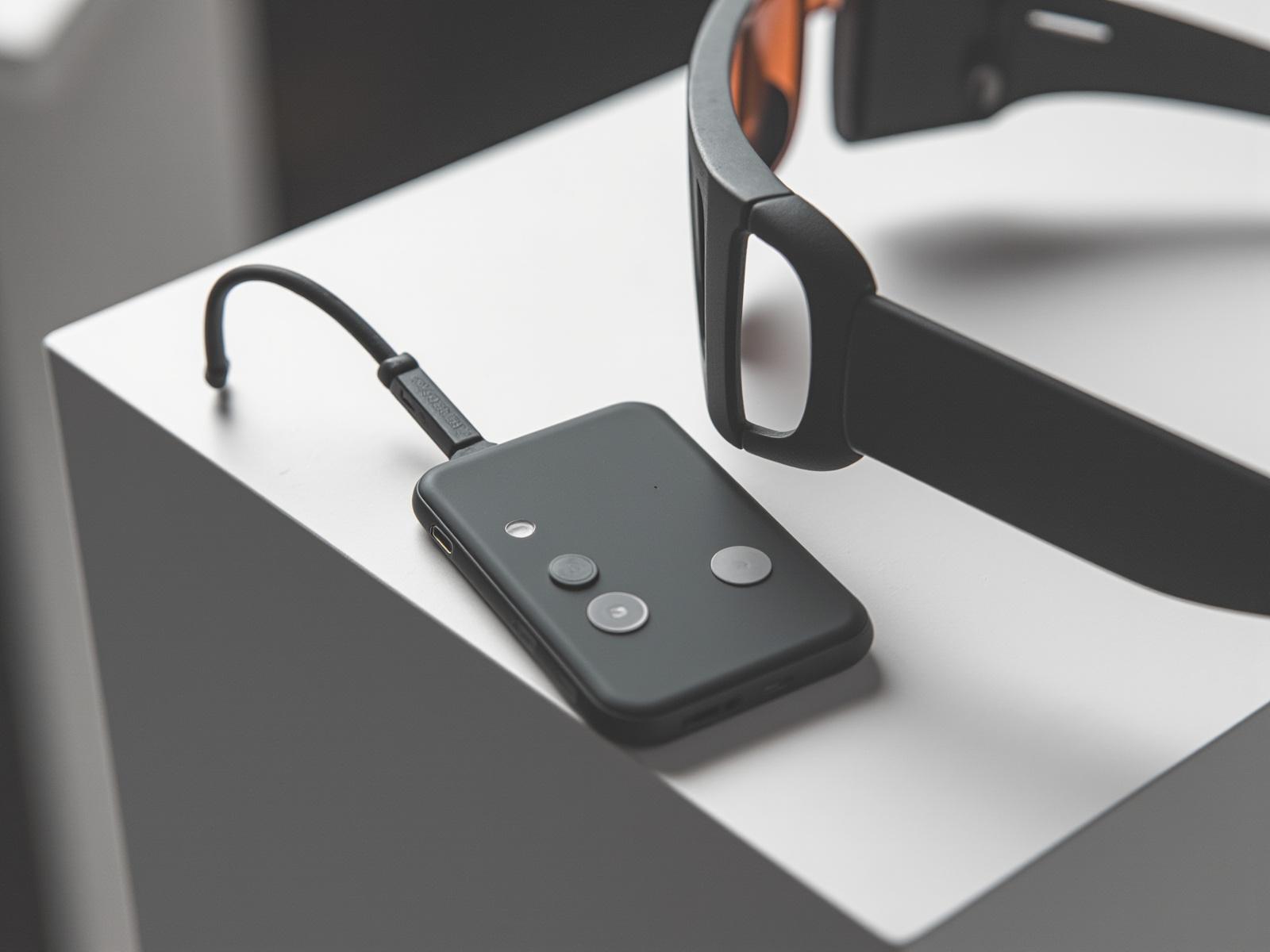
The D11 and the D12 publish the same standard rows
The model on the page immediately after this one publishes the same five standard rows: Bluetooth V5.4, a 100 mAh cell, about seven hours, a charge time of two hours or less, and Type-C charging. Its page carries no feature line at all. The difference between the two is one row, and it is an acoustic one.
What that means for a range. A document that names this model does not cover the other one, and the two cannot share a listing page, a box artwork or a certificate application as a single model. If a brand intends to run both, it is running two products that look identical on paper except for one acoustic line, and a customer comparing them will ask the question that the catalogue does not answer: what actually differs.
What to ask, and in writing. Ask whether the difference between the two is hardware, firmware or configuration, and ask whether it is visible to the customer at all. If the answer is that the difference is not customer-visible, then the second model is a variant and should be positioned as one rather than as a separate product — and that is a commercial decision, not a specification one. If the answer is that the difference is audible, then the acoustic descriptor is doing real work on one model and nothing on the other, which changes which one carries the marketing.
What must not happen. No price or tier comparison can be made from these pages, because no price, tier, volume or delivery commitment is published for any model in the range, and we do not quote one. A range plan built on an assumed difference between two models whose pages differ by one row is a plan built on an assumption.
The order that closes an audio programme before the artwork
- Lock the model designation and the firmware branch. The model number travels on the box, the mark, the manual, the certificate application and the transport paperwork. Settle it in writing before artwork starts.
- Get the acoustic descriptor defined. Ask the four questions — hardware, processing or preset, how it engages, and how a customised build affects it — and record the answers next to the artwork file.
- Decide the claim attribution. Either the brand defines and runs a listening test with a written pass condition, or the descriptor stays attributed to the supplier and the brand writes nothing of its own around it. Decide before copy, not at copy approval.
- Fix the brand layer on the frame. Device name first, because it is embedded in firmware and appears in the pairing instructions, in the packaging and in every support ticket afterwards. Then logo placement confirmed against a drawing, then colourway confirmed against an approval unit, then the packaging artwork per market.
- Build the per-market box list. The frame, a USB-C cable, the printed quick start in the market language, the warranty card, the market leaflet, the operator details and the compliance markings. One cable, and what that means for the parcel, is covered in the charging options analysis.
- Request the documents that name the model. The catalogue carries a company-level export certification page whose content is images rather than text, the catalogue text contains no reference to CE, FCC or RoHS, and there is no per-model certification row anywhere — so the file that covers this model and its final configuration has to come from the supplier.
- Freeze the file and seal a sample. Artwork, production file, marking, model number and the certificate file stored as one package, with the approved unit sealed alongside it as the reference for inspection.

Two sequencing errors are worth naming because they are expensive rather than embarrassing. If the acoustic claim is written into the copy before the descriptor has been defined, the copy has to be withdrawn or the test has to be built under deadline pressure, and a test designed after the fact is not a test. If the device name is settled after the packaging is printed, the instructions a customer follows contradict the name in their own device list, and the support tickets that follow are brand-shaped rather than supplier-shaped.
Evidence, and the limits of what we can say
The evidence file is what makes the second order safer than the first, and it is what a compliance lead, a customs broker or a customer will eventually ask for. This is the checklist we would hold.
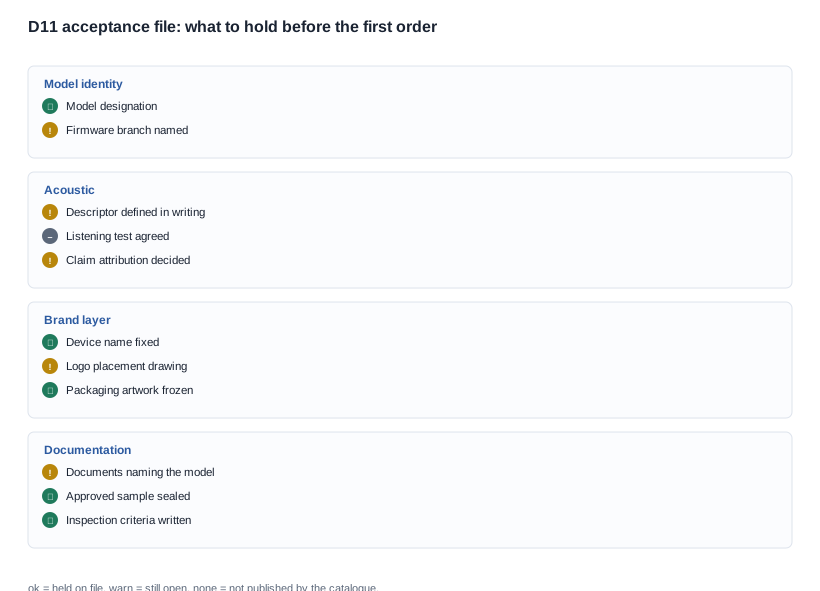
| Evidence | Who owns it | Due when | If it never arrives |
|---|---|---|---|
| Model designation and firmware branch | Buyer approves, supplier confirms | Before print | Documents have to be reissued |
| Acoustic descriptor definition, in writing | Supplier answers | Before copy is written | The strongest line stays unusable |
| Listening test with a written pass condition | Buyer defines, supplier accepts | Before the claim goes on any artefact | A comparison claim cannot be defended |
| Device name and interface strings | Buyer supplies, supplier implements | Before pairing copy is written | Instructions contradict the product |
| Logo placement drawing and colour approval | Supplier confirms | Before artwork approval | The mark does not sit where it was approved |
| Documents naming the model and configuration | Supplier issues | Before the consignment is booked | No documented conformity position |
| Approved sample, sealed | Buyer approves and stores | Before the production run | No reference unit for inspection |
| Written inspection criteria | Buyer writes, supplier accepts | Before the run is released | Inspection becomes a negotiation |
What this model will not let you skip. Every row in that table can be deferred, and none of them can be skipped, because each row corresponds to a piece of paper that somebody will ask for later. The two rows specific to this model are the acoustic definition and the listening test, and they exist because the strongest published line on the page has no published measurement behind it.
The line we hold on the audio model
On this model, our position is narrow and stated up front rather than sold around. We will quote the row exactly as the catalogue states it: Bluetooth V5.4, a 100 mAh cell, roughly seven hours of rated use, a charge time of two hours or less, Type-C charging, and two feature lines — a surround-sound descriptor and a long-battery-life descriptor. We will not quote a driver size, a leakage figure, a frequency response or an amplifier rating, because none of those is published for this model or for any other.
We will not turn a descriptor into a comparative claim on your behalf, and we will not present about seven hours as a tested working day, because no test condition is published. We will not state a cell count that the 100 mAh row does not state, we will not write two hours or less as "under two hours", because a ceiling and a measurement are different assertions, and we will not publish a price, a minimum order quantity, a lead time or a volume in an article — our internal documentation still holds conflicting minimum order quantity figures that have not been arbitrated.
What we will do is answer the acoustic and configuration questions for this model in writing, tell you which lines are already closed and which are open, and confirm what is available for the configuration you are actually buying. The family sits on our bluetooth audio glasses range page, the routes a brand programme covers are set out in OEM and ODM services, and the route from a first conversation to a sealed sample is set out in partnering with a factory that ships.
Related reading
- The range this product belongs to — bluetooth audio glasses for private-label programmes
- What a cable-only box means for the parcel — charging options for audio glasses
- The documents a programme has to collect — export documentation checklist
Send us the market, the quantity and the changes you need, and we will tell you which lines are already closed and which one we would chase first.


