

When a factory partner starts describing what it can do for your programme, the first question is not what the options are. It is what kind of statement each answer is, because the three kinds lead to three entirely different uses in an agreement. Some answers are graded, which means the supplier's own record attaches a level of confidence to them and they can go straight into a specification sheet. Some are annotated, which means the record carries a note beside them saying what is still open, and they belong in an open items register rather than in a specification. Some are unbacked, which means nothing in the record points at a document that contains them, and they can only be moved by a document request or by a visit. Sorting the answers before you write them down is the substance of a disciplined OEM ready platforms partnership, and it is a discipline that costs nothing in the first week and a great deal in the last.
The reason this is worth doing at the start rather than the end is that the record a factory keeps about its own products usually mixes the three kinds together. A single table row can carry a graded specification value in one column, a category-wide capability sentence in another, a certification claim with a footnote in a third, and an empty promise of a technical file in a fourth, and a buyer reading it in a single pass will take all four at face value. That is not scepticism, it is arithmetic: the row looks the same in every case, and the certainty is not.
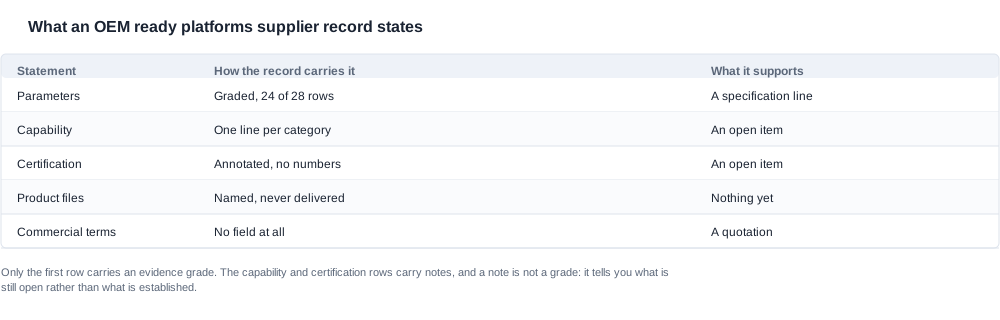
Three kinds of statement in a supplier record
The classification is simple, and it is worth writing down at the beginning of a partnership because it changes what you do with an answer rather than how much you believe it. A graded statement is a value the supplier's own record treats as read directly from the product, and it is the only kind that can be written into a specification sheet as fact. An annotated statement is one that carries a qualification: the record says what the claim is and says, in the same cell, that a specific detail is still to be confirmed. An unbacked statement is one where the record names a field, or a category of document, and then does not contain the thing it names.
| Statement | How the record carries it | What it can support |
|---|---|---|
| Parameters | Graded in 24 of 28 rows | A specification line |
| Capability | One line per category | An open item |
| Certification | Annotated, numbers outstanding | An open item |
| Product files | Named in the field, delivered in no row | Nothing yet |
| Commercial terms | No field in the record | A quotation |
The distinction between the first two is the one that gets lost, because an annotation reads like a fact with a caveat attached. It is not. A grade is a statement about how the value was obtained, and a note is a statement about what has not yet been obtained. If a supplier's record says of a model that a cell of a particular size is in that model, and separately says of the same model that the conformity document behind it has not been issued, then two entirely different questions have been answered in two entirely different ways, and the second answer tells you nothing about the first. Merging them into a single confidence judgement is how a buyer ends up treating an open item as a settled one, usually because the settled one was written next to it.
The third kind is the one that decides whether a partnership can be audited at all. A statement is unbacked when the record names a thing that does not exist in the record: a technical file, a detection report, a certificate, a per-model certification line. A field titled for images, video and technical files can be present in every row of a product table and still contain no technical file in any of them, and a partner who has sent you that table has not sent you the files it promises. This is not a reason to walk away from the supplier. It is a reason to know, before the programme starts, that the file shelf is empty and that filling it is work you have to schedule rather than a document you can assume.
What follows is how those three kinds appear in our own product record, because it is the clearest example available: the record grades its parameters, annotates its capability and certification statements, and names a file field it does not fill. The OEM ready platforms model readiness record sets out the readiness checks that run alongside this classification, and this piece is about the other half of the same problem, which is what a written agreement should do with each kind.

What the record grades: parameters, and only parameters
The product record carries a column whose name is a grade column, and it is worth being precise about what it grades. It grades parameters. Twenty-four of the twenty-eight rows carry a plain fact grade against their specification, meaning the values on that row are read directly from the published product pages. Four rows carry a partial grade rather than a plain one, and the partial grades are informative rather than decorative: one row marks an extra capability as an observation rather than a fact because it comes from a different source than the catalogue, two rows are graded on their parameters while noting that the model code itself is not settled, and one row is graded on its parameters while noting that the function set is not settled.
Those four exceptions are the useful part of the column, and the reason the column is worth reading at all. A buyer who reads only the headline of the grade column sees twenty-four confident rows and treats the sheet as uniformly reliable. A buyer who reads the qualifiers sees that the record is confident about values and careful about identities, and that the two questions are independent: a model can have every parameter graded and still not have a code that a certificate, a warranty file or a purchase order can reference. The OEM ready platforms export documentation piece covers why an unnamed product is unusable in a compliance file even when its specification is impeccable.
A second limit on the grade is worth stating plainly, because the word grade invites a stronger conclusion than it should. A grade is a statement about where the value came from, not about whether the value has been verified by anyone else. The published endurance figures in this catalogue, for example, carry no test conditions at all: no laboratory, no load, no ambient description, no method. They are graded facts about what the catalogue prints, and they are not measurements a buyer can rely on. The distinction is the same one that separates a specification from a test report, and it is the reason a graded parameter can go into a specification sheet while a claim about how the product performs in a customer's hand still cannot.
So the practical use of the grade column is narrow but real. It tells a buyer which rows of a specification sheet may be written as settled values, which rows must carry the qualifier that travelled with them, and which rows are not parameters at all. That is enough to build the first document of a partnership, and it is enough to build it correctly, because the errors that cost a programme money are mostly made in the rows that were never graded.
What the record annotates instead of grading
The capability and certification fields are the two that a reader is most likely to over-read, and they are annotated rather than graded for a reason that is visible in the record itself. The certification field carries three states across the catalogue, and not one of the three is a claim: a framework that is named with no document attached to it, a framework plus a marking that the catalogue itself describes as an annotation without a third-party test report number behind it, and a category where the certification position is not published at all. Those three states need three different responses from a buyer, and the OEM ready platforms certification coverage notes piece works through what each one means for a programme.
The capability field is annotated in the same way, and it carries one structural feature that changes how it should be used. The record has a column for the customisation a model can take and a second column for the manufacturing and development cooperation available for that model, and in every one of the twenty-eight rows the two columns contain exactly the same text. There is one capability statement in this record, and it is printed twice.
Read down the table, that duplication looks like corroboration. It is not, and the difference matters, because a buyer who finds the same sentence in two differently named columns will reasonably conclude that two separate assessments agree. They do not. One sentence has been copied into two places, and copying it does not add a second opinion, a second source or a second party who checked it. If you are evaluating a supplier on whether its cooperation capability has been assessed, the honest count of assessments in this record is one, per category, and the record does not say who performed it or on what basis.
The second structural feature is that the statement is copied across a category rather than written per model. Across the twenty-eight rows there are seven distinct capability strings. The nine camera models share one string, character for character; the eight audio models share one; the five sport models share one; the three children's models share one; and the three entries without a settled model code carry their own. The capability surface therefore varies by category and not by model, and the record's own axis counts follow the same shape: seven recorded axes for the camera category, five for audio, five for sport, two for children, three for the entry with no settled code that is nonetheless described in configuration terms, none disclosed for bone conduction, and nothing recorded for the augmented reality entry.
Here is the trap, and it is a trap of layout rather than of content. Every row of the record carries a model code at the far left. A capability sentence printed inside a row that begins with a model code reads, to the eye and to a hurried reader, as a statement about that model. It is not: it is the category statement, repeated, with the model code attached by position rather than by content. The record's category-level nature is easy to miss precisely because the layout does the opposite of what the content does.
The consequence for a partnership is concrete. A requirement written from a capability line is a requirement the record does not support for that model, because the record made no model-level statement. The right use of the capability field is to tell you which questions are worth asking, and then to ask them per model, in writing, before anything is designed around them. The OEM ready platforms minimum order quantity discussion makes the same point for commercial terms: a conversation that starts from a configuration rather than from a number is the only one that produces a number you can use.

Where the source column points, and what it does not reach
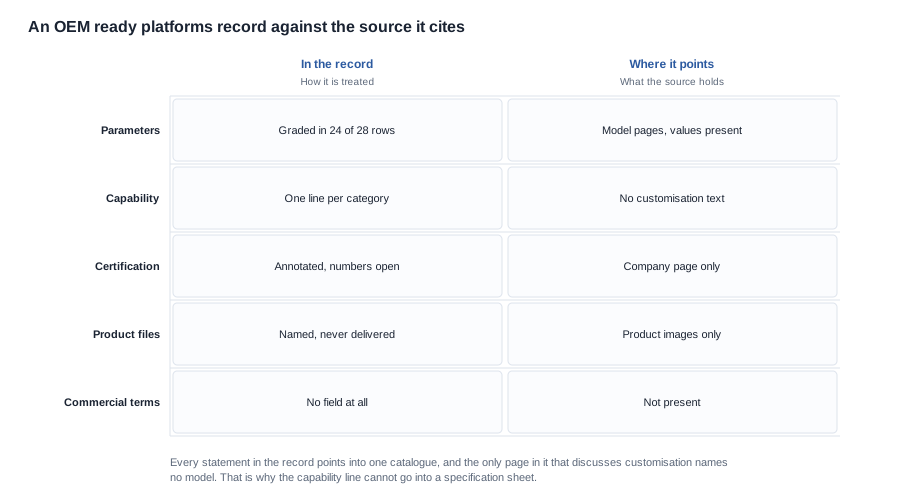
Every row of the record carries a source column, and reading it produces the sharpest finding in the whole document. All twenty-eight rows point into the same source: one product catalogue, cited by page range, across seven different ranges of pages. The nine camera rows cite one range of pages, the eight audio rows cite another, the five sport rows cite a third that spans two blocks, and the three entries without a settled code each cite a single page reference.
Now take the capability statement and follow its own citation. The model pages that the camera rows cite contain specifications: pixel counts, cell capacities, charge limits, endurance figures, case configurations, colour options and ingress markings, in a fixed layout on thirty-three pages of product imagery and text. The word for customisation, and the abbreviations for the two kinds of manufacturing partnership, appear on exactly one page in the whole catalogue, and that page is the company profile. It describes the company and its position as a manufacturing partner for wearable devices, and it names no model, no configuration axis, no procedure, no tooling position and no document. The capability statement's cited source is a set of pages that do not contain the detail of the capability statement, and the one page in the catalogue that discusses the subject is not cited by the capability field and does not identify a model.
That is not a contradiction; it is a normal outcome of a record assembled from a catalogue rather than from production records. It does mean that the capability sentence is a company-level claim reproduced per category, and that it can be checked against nothing in the documents the supplier has published so far.
The same pattern shows in the files. The record has a column for the images, video and technical files available for marketing use, and in twenty-eight rows it delivers product images, some functional diagrams, and no technical file at all, while saying in one form or another that video is not available. Not one row in twenty-eight delivers a technical file, and every row carries a pending item recording that no real photographs, no video and no detection report have been provided. The certification material in the catalogue is presented the same way: a company-level page of certificate images rather than a per-model line, which is why a buyer cannot pair a claim with a certificate from the catalogue alone.
What a partnership therefore has on day one is a graded parameter table, a category-level capability sentence, a certification position in three states, and an empty file shelf. That is not nothing, and a buyer who asks for a technical file and is told it does not exist yet has learned something useful for the cost of one email. It is also not the same thing as a supplier who can hand over a document for every claim, and a programme that plans around the second will lose a month when it discovers the first.
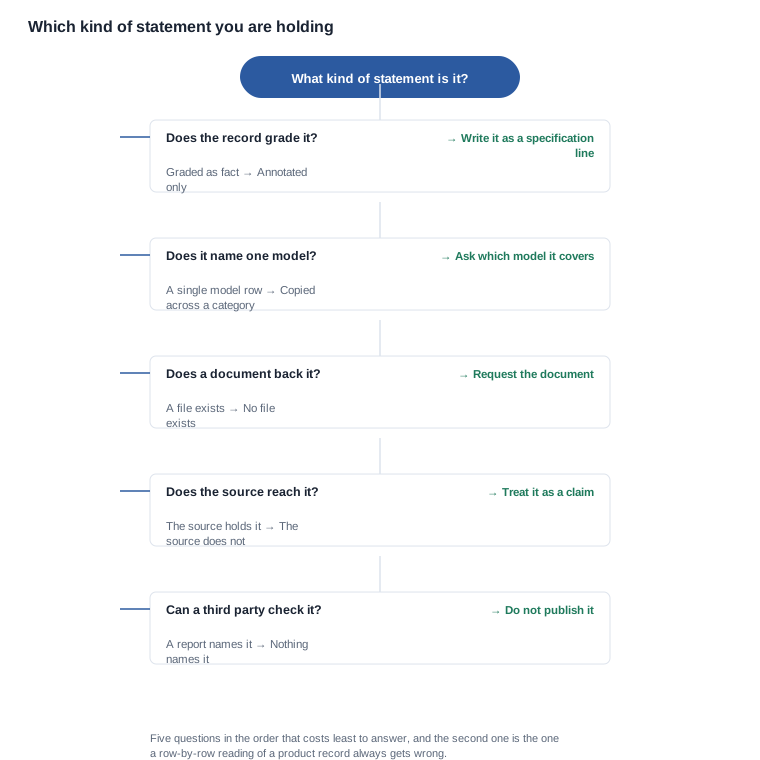

What an OEM ready platforms partnership should put in writing
The three kinds of statement turn into three documents, and keeping them separate is the discipline. A specification sheet carries only graded values, written as the supplier's own reading, with the model code attached to every line. An open items register carries every annotated statement, with the qualifier intact, the question to be answered, the party who owes the answer and the date it is needed by. An evidence file carries the documents that have to arrive before anything is published, listed by model and by revision, with nothing on it treated as delivered until it is.
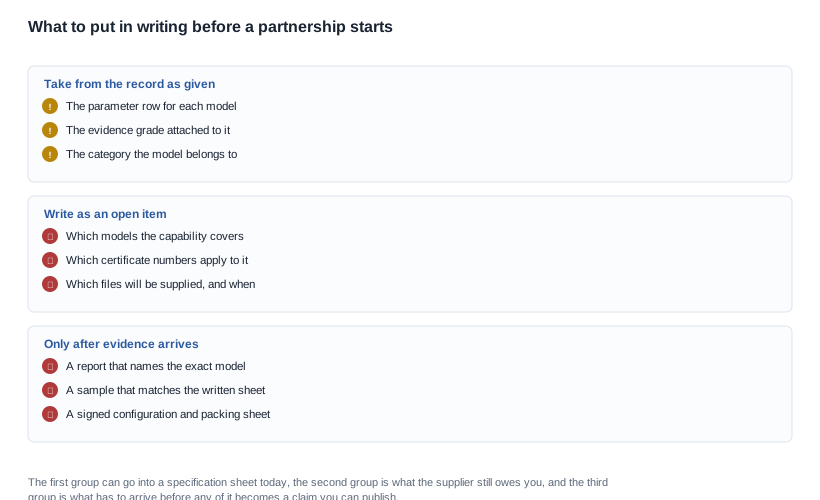
There are five criteria for a specification sheet that will still be defensible in six months, and they are the criteria we would want a supplier to accept before the first sample rather than after the first shipment.
- Every line starts from a graded value. If a row on the sheet cannot be traced to a parameter the record grades, it does not go on the sheet. It goes on the register, where it is visibly unfinished.
- Every capability statement names the models it covers. A category-level sentence is written as a category-level sentence, with the model codes it applies to listed underneath it. The alternative, a per-model line copied from a category, is the exact error the record's own layout invites.
- Every certification line carries the model and the number, or it is not on the sheet. A claim and an annotation are different objects, and a specification sheet is the wrong place for the first one.
- Every file is named by model, by revision and by format. A file that is not named cannot be checked, and a file that cannot be checked cannot be relied on when a customer asks for it.
- Anything that is not in the three documents is not agreed. This one is worth arguing for, because it is the point at which most disagreements surface: what was said in a meeting is not a commitment until it is in writing, and what is in writing is not a commitment until it is in the right document.
There is a trade-off here and it is worth naming rather than pretending away. A document-driven start is slower. It moves a supplier through several rounds of clarification before anything is ordered, and it means asking a partner to commit to positions in writing that they would rather discuss loosely. In exchange, the programme stops generating surprises in the months when a surprise is most expensive, and the agreement survives the departure of the person who negotiated it. For a buyer running more than one programme at a time, the second half of that trade-off is usually the one that decides it.
The questions to ask the supplier are the practical output of the classification, and for this product line they are short enough to send as a list.
- Which models does your capability statement cover, and where is it documented for each one?
- Which configuration options are already defined for this exact model, and which are options you could develop?
- Which certificate numbers apply to this model, and can you send the certificate itself?
- Which ingress or safety marking will appear on the packaging for this model, and which report supports it?
- Which technical files exist for this model today, and in what format and revision?
- Which detection report can name this model, and can it be issued against our sample rather than against yours?
- What is the agreed sample reference, and what does the written specification say it must match?
- Which parts of the packing instruction are fixed by us and which are yours?
Those questions are deliberately phrased so that a negative answer is still a usable answer. A supplier who replies that no detection report can yet name the model has told you something you can plan around; a supplier who replies with a category-level answer to a model-level question has told you that the question needs to be asked again, per model, in writing.
There are red flags in a factory conversation that are worth recognising early, and they are all failures of specificity rather than failures of capability. A supplier who cannot say which models a capability line covers is describing a category. A supplier who answers a question about one model with a statement about the family is describing a category. A supplier whose technical file is a link to a product page has no technical file. A supplier who answers a request for a report with a photograph has no report, and a photograph of a product is not evidence about that product. And a supplier who volunteers a certificate number without being asked which model it covers has usually quoted a company-level number, which is the case the procurement certification checklist exists to catch.
Two commercial parameters sit outside all three documents and need their own conversation, because a configuration and a market are needed before either number means anything: the order quantity and the lead time. Those two are best handled as quotations against a fixed configuration rather than as entries on a specification sheet, and the OEM ready platforms pricing tiers piece covers the discipline of keeping a published specification and a quoted price in separate documents. What a sample has to settle before any of it is ordered is covered in the OEM ready platforms sample before bulk piece, and the checks worth running when it arrives are in AI camera glasses quality checks.
What the record supports today
We will put a graded parameter into a specification sheet, an annotated statement into an open items register, and nothing else into either, and we will tell a buyer which of the three a given line is before we tell them what it means. We will not present a category-level capability sentence as though it were a model-level commitment, and we will not treat a statement repeated in two columns as two assessments agreeing. We will not print a certification mark next to a model name while the numbers behind it are outstanding, and we will not describe a catalogue annotation as a test report. And where the record names a file it does not contain, we will say that the file is missing rather than treating the field as if the file were in it.
What the record does support is a defensible first document. Twenty-five models carry a settled code and a published page; twenty-four rows carry a plain fact grade against their parameters and four carry a qualified one, which is enough to write a specification sheet that a supplier can sign without either side inventing a value. Five categories carry a recorded configuration surface, and the capability statement for each of them is one sentence with a note attached, which is enough to write the register. Three entries have no settled code at all, which is enough to know that the certificate and the warranty file for those three cannot start until the codes do. And the file shelf is empty for every model in the range, which is enough to know that the first three documents have to be requested in the first week rather than found in the first month.
For a buyer, the practical sequence is short. Take the graded parameters and write the specification sheet. Take the annotated statements and write the register, with the questions in the order above. Take the named-but-absent files and request them by model and by revision. Then let the sample and the sample before bulk sequence do what no document can do, which is settle whether the product matches the sheet. The OEM ready platforms range is where the model set starts, and the smart glasses wholesale page covers the commercial terms that a quotation attaches to.
Tell us the models you have shortlisted, the configuration you need and the markets you are shipping to, and we will tell you which of the three kinds of statement each line of our record falls into, and what we would need to collect before it can be written into your agreement.


