

Two published rows on this model make its customisation programme unusual, and they pull in opposite directions. The first is a pair of variant names — the catalogue lists both Utral and Pro Max on this model's row — which means the designation is not a single fixed string but a decision the programme has to make and then hold consistently everywhere the name appears. The second is a charging case with two published capacities, 900 mAh and 1400 mAh, which makes this the only model in the catalogue where a brand can choose between two documented accessory configurations on the same platform.
Between those two decisions sits everything else, and most of it is thinner than a programme would like. The camera is published in the thirteen megapixel class with the L1 Pro and the S7, and beyond the class the catalogue publishes no sensor model, no field of view and no video specification. The frame cell is 290 mAh, the rated use is about seven hours, the charge ceiling is two hours or less and the charging interface is Type-C. The frame weight is not published, there is no ingress marking, no colour list and no per-model certification row. So the name and the case can be decided from published rows, while the imaging claim, the fit and the file have to be built from requests and measurements.
This article walks the programme in the order the decisions bind, for the two people who have to answer for it: the buyer who owns the commercial outcome and the compliance owner who owns the file. Nothing here quotes a price, a minimum quantity, a lead time or a certificate number, because none of those is published for this model or any other, and a programme built on an assumption about them is a programme that discovers them late.
L2 Utral customisation: what the catalogue already fixes
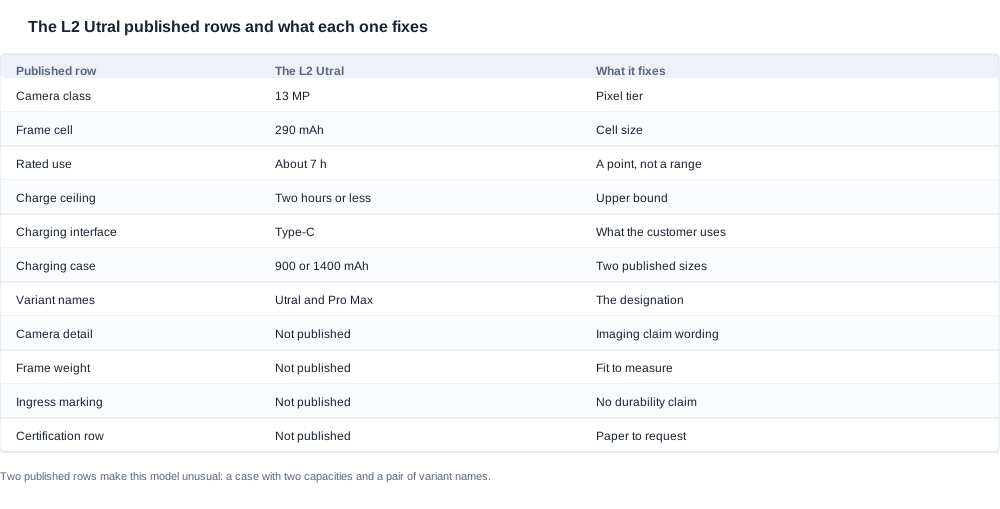
Eleven rows are published for the L2 Utral, and two of them are unusual enough to build a programme around. The first is the case: this model publishes a charging case in two capacities, 900 mAh and 1400 mAh. Every other model in the catalogue publishes at most one case capacity, or publishes the existence of a case without a figure, or — for one camera model — states explicitly that there is no case. A two-capacity case is a merchandising decision that the catalogue has already made possible, and it is the reason a programme on this platform can offer an endurance tier and a standard tier without inventing a third configuration.
The second unusual row is the pair of variant names. The catalogue lists Utral and Pro Max as the variant names published against this model, alongside the Type-C charging interface. What the catalogue does not publish is any difference between the two names — no specification row separates them, no feature line belongs to one of them, and the cell, the rated use, the charge ceiling, the interface and the two case capacities are published once for the model as a whole. So the names are a published fact and the difference between them is an open question, which is precisely why the name has to be settled first and in writing.
The rest of the published set is straightforward and should be treated as fixed rather than as a subject for negotiation. The camera sits in the thirteen megapixel class with two other models, the L1 Pro and the S7, and the eight-megapixel class holds eight models. The frame cell is 290 mAh, a figure the catalogue shares with the CY05 and the CY03, and the L1 Pro. Rated use is about seven hours, which is a point figure rather than a range, and the charge ceiling is two hours or less. The charging interface is Type-C, one of seven Type-C frames in the catalogue.
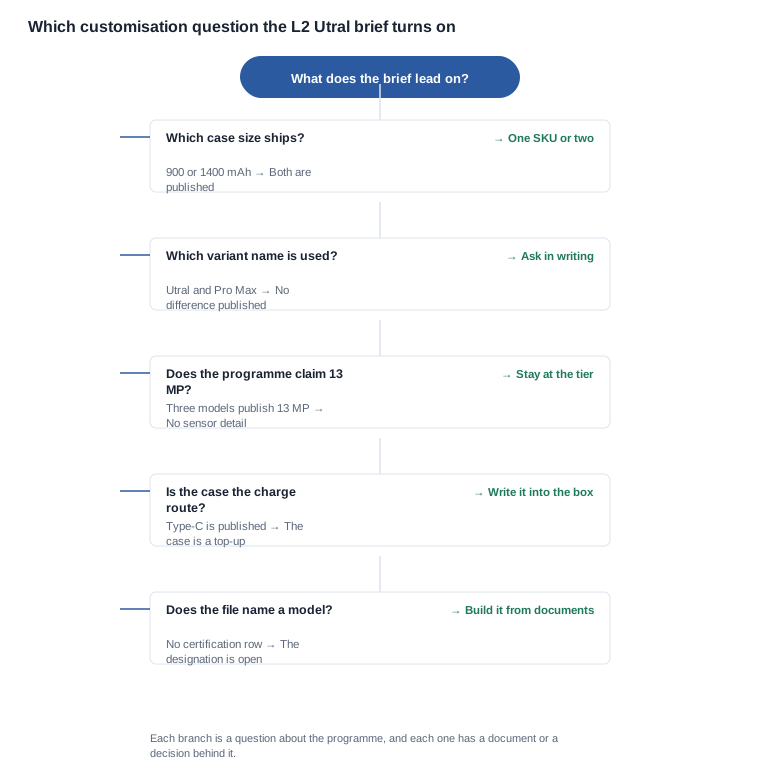
What is not published is equally defined. No sensor model, no field of view, no video specification, no frame weight, no ingress marking, no colour list, no radio version for any camera model, and no per-model certification row for this model or any other. Those are not gaps to be papered over with a generic claim; they are the specific items on the list of things the programme has to request, and the request is part of the programme rather than an exception to it.

Step one: lock the designation, and then never vary it
The name is the first decision because it appears in more places than any other single item in a private label programme. It appears on the product, in the conformity file, on the packaging artwork, in the printed insert and the quick start, on the shipping paperwork, in the retailer listing, and in every support ticket that will ever be raised about the product. A designation that changes between two of those places is not a naming inconsistency; it is a file that does not match the goods, and it is the kind of discrepancy that surfaces at the point where it is most expensive to fix.
The particular question on this model is which of the two published variant names the programme uses, and whether the programme uses one of them at all or a brand-facing name of its own. Those are three different answers with three different consequences. Using a published name means the programme is working inside a documented designation, which is convenient for anyone comparing the product against a catalogue row and awkward if the brand's own name has to appear on the box. Using a brand name of its own means the conformity file has to carry that name and every document behind it has to be consistent with it. And using both, one on the product and one on the paperwork, is the option that produces the mismatches described above.
The second question is what the two published names mean in practice, and the catalogue does not answer it. The programme therefore needs the difference in writing: what the two names carry, whether they differ in configuration or only in naming, and whether the supplier's documentation exists under one of them, under both, or under neither. The certification checklist sets out the document set that a programme assembles, and the point of asking these questions before artwork is that the name on the artwork is the name that has to appear on the file.
A third point belongs here rather than later, and it is a matter of method: the designation should be recorded once, in one place, with the versions that are not permitted alongside it. A programme that keeps a single approved designation string, together with a list of the abbreviations and short forms that are acceptable in operational documents and the ones that are not, will not spend a production cycle discovering that its packing list and its file name the same product differently.
Why the designation is a commercial question and not only a paperwork one
The designation travels further than the file. It travels onto the carton, into the product listing, onto the commercial invoice, into the shipping paperwork, into the import record, into the warranty registration and into the support script that a distributor's staff will read out to a customer. Each of those places wants a slightly different form of the same information, and each of them has a cost when the form is wrong: a carton that does not match the listing is a listing correction, an invoice that does not match the file is a customs question, and a warranty registration that does not match the product is a customer who cannot be served.
That is the practical reason for locking the string early rather than treating it as a naming preference. It is also the reason to keep the short forms list short. A programme that permits three abbreviations for one product will find all three in use, usually in the places where nobody looks — a purchase order, a carton label, a freight booking — and the next order will be placed against a name that exists in no file. The criteria for a usable set of permitted forms are simple: each one has to be unambiguous when read on its own, each one has to be on the approved list, and the list itself has to be the version that the file carries.
Step two: the case, which is where the options are
The two published capacities are the clearest commercial decision on this model, and the reason to take it early is that the case changes the parcel, the freight and the transport file, none of which are cheap to change once the artwork is approved.
The two capacities are not two colours of the same object. A 900 mAh case and a 1400 mAh case are different objects with different weights, different dimensions, different packaging cavities and different transport characteristics, and a programme that offers both is running two accessory configurations with two artwork versions and two sets of packaging, exactly as it would with two colourways. What the catalogue establishes is that both configurations exist and are documented for this model, which is what allows the choice to be a choice rather than a question.
The trade-off runs through the accessory routine and the parcel together. The larger case extends the interval between charges, which is the argument for it in a channel where customers charge weekly or on the move. The smaller case is lighter per unit, which is the argument for it in a channel where the parcel is the binding constraint, and a second lithium cell in every unit affects both the freight class and the transport documentation. Neither capacity is published with a weight, a dimension, an interface or a charge time, so the parcel comparison has to be built from a measured unit rather than from the catalogue. The AI camera glasses charging case options analysis covers the accessory economics and the shipping weight breakdown covers the arithmetic on the parcel side.
There is a third option that the two capacities make possible, and it is worth deciding explicitly rather than by default: the case as an accessory rather than as part of the box. Because the charging interface on the frame is Type-C, the customer can charge the frame without the case in hand, which means the case can be positioned as a top-up item rather than as the thing the product depends on. That changes the box contents, the accessory line, the stock profile and the story on the product page, and it is a decision rather than a default. What to ask is which configurations the programme intends to hold, on what terms, and how a case is replaced for a customer whose case is lost or damaged.
What a two-capacity case does to the accessory line
The accessory line is where a two-capacity case becomes a commercial structure rather than a specification, and it is worth writing the consequences down before the artwork. If the case ships in the box, the programme holds one accessory configuration per case size and the customer has a complete kit on delivery; if the case is optional, the programme holds a frame-only configuration and a frame-plus-case configuration, which means two artwork versions and two stock profiles for the same product, and it also means the programme has to decide whether the case is sold once or replenished.
The replenishment question is the one that gets skipped. A case that ships in the box eventually gets lost, and a customer who cannot replace it has a product they can still charge because the frame takes a Type-C cable, which is precisely why the interface being published matters to the accessory plan. Whether a spare case can be bought separately, in which capacity, and on what terms are all commercial items, and all three are easier to settle while the programme is still one decision rather than four.
There is a transport dimension as well, and it belongs in the same request. Two capacities means two packaging cavities, two carton designs and two sets of transport documentation, because a 900 mAh cell and a 1400 mAh cell are not the same thing to a carrier or to a freight forwarder. The programme that chooses one capacity for the whole range avoids all of that duplication, and the programme that runs both has to price the duplication into the artwork plan rather than discovering it when the second cavity is drawn.
Step three: the behavioural tier, last and slowest
The imaging question on this model is a claim question rather than a specification question. The catalogue publishes thirteen megapixels as a class for this model, the L1 Pro and the S7, and it publishes nothing else about the camera — no sensor model, no field of view, no video format, no frame rate, no stabilisation and no low-light behaviour, and no storage capacity or overwrite rule. A programme can therefore say that the camera is in the thirteen megapixel class, and it cannot widen that into a statement about image quality without evidence it does not have.
This matters more on this model than on an eight-megapixel one for a specific reason: the class is the top of the published range, so a customer comparing it against the rest of the catalogue will read the number as a quality statement whether or not the page says so. The published rows also do not say how the thirteen megapixel class performs in the condition the camera is used in, which means the difference between the classes is a pixel count and not a measured outcome. The programme that wants to make something of the difference has to obtain it, and the request for it belongs in the same document as the conformity questions.
The runtime interacts with this in a way worth stating plainly. The published figure is about seven hours, and on a camera product the camera is the dominant load, so the condition behind the figure matters more than usual. The programme should ask what the camera was doing during the measurement, whether the radio link was active and whether the figure came from one unit or a batch, then measure on a sample in the condition a customer will create and record the condition beside the number. The AI camera glasses battery comparison covers how the cell and the case column change between models in this range.
The final item in this step is the slow one, and it is the variant difference. The two published names carry the same published rows, so what separates them is either a configuration difference that the catalogue does not publish, or a naming convention. Either way the answer has to be written down, because a programme that runs two variant names without knowing what separates them is running two SKUs on the strength of an assumption, and the assumption will surface in the file rather than in the product.

The rows that stay open regardless of what the programme decides
Four positions are unaffected by the decisions above, and it is worth having them on one page because they are the items that get discovered late. The imaging detail stays open: the class is published and the behaviour is not. The frame weight stays open, because the only published weight anywhere in the catalogue belongs to a different model, and a figure from another platform is not a proxy for this frame. The ingress position stays open, because this model carries no ingress marking and no durability statement can be made from it. And the certification position stays open, because the catalogue's certification material is company-level and its text carries no per-model certification row, which means the programme's file is assembled from documents it requests.
There is one more open position that is specific to this model and that sits inside the case decision rather than beside it. The catalogue publishes the case capacity and the charging interface of the frame, and it does not publish the case's own interface, the case's charge time, its weight, its dimensions or whether it carries a battery indicator. Those are the numbers that decide the packaging cavity, the customer's weekly routine and the support question pattern, and all of them have to come off a unit.
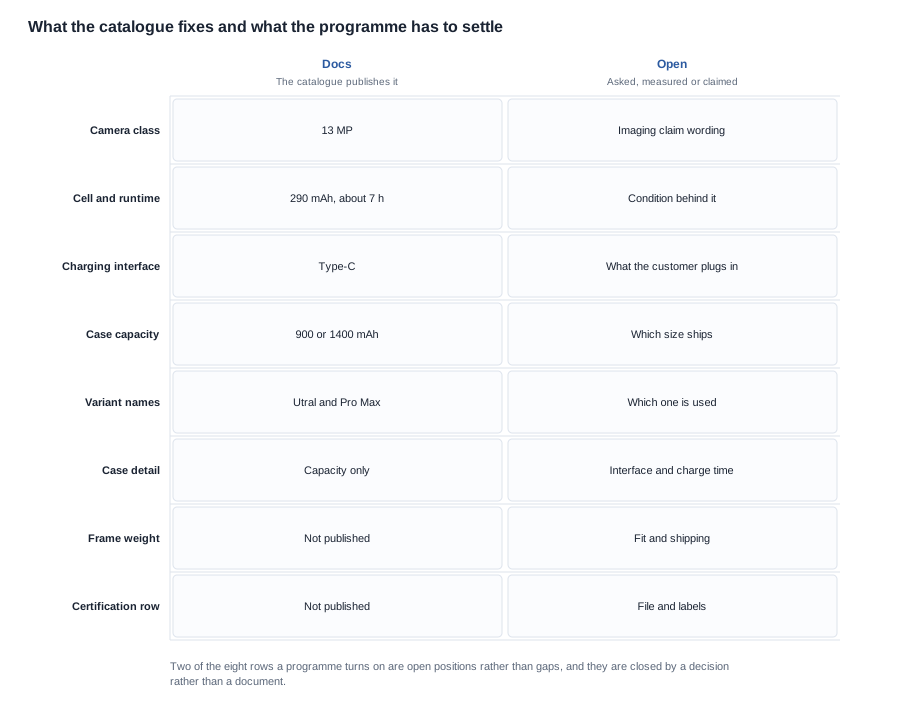
The matrix above is the summary that a compliance owner and a buyer should agree on before the first order. Each row pairs what the catalogue publishes with the single item that closes the gap beside it, and the two open positions in it — which case size ships, and which variant name is used — are closed by a decision rather than by a document, which is why they have to be taken before the artwork rather than after.
The five questions to ask before you commit
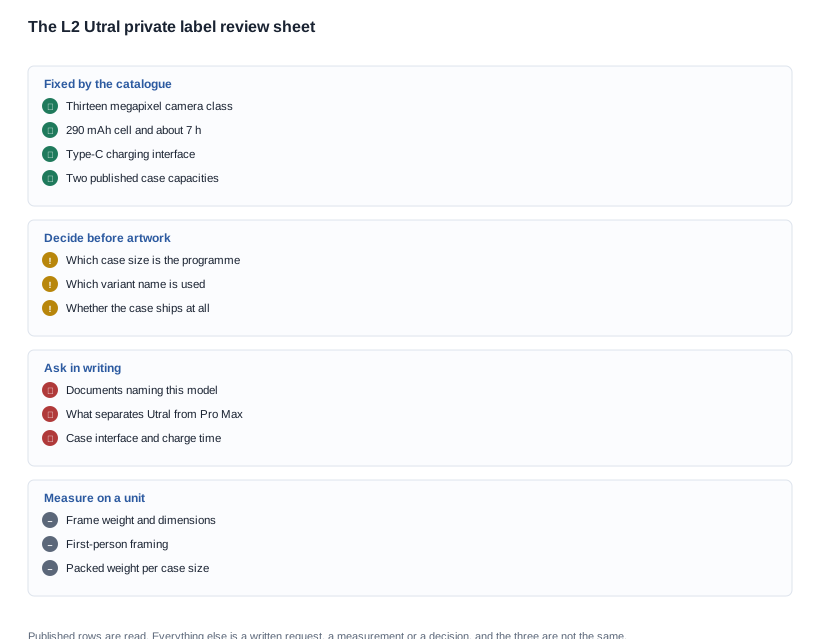
- Which designation does the programme use, and which forms of it are permitted? One approved string, a short list of acceptable short forms, and the documents each one appears on.
- What separates Utral from Pro Max, in writing? Configuration, naming, or nothing — and if nothing, what the documentation says.
- Which case capacity ships, and is the case in the box or an accessory? Both are legitimate; both have consequences for the parcel, the stock and the file.
- What may be claimed about the camera, and on what evidence? The class is published, the behaviour is not, and the request is part of the programme.
- Which documents name this model and this configuration? Test reports, the component and module list, the cell documentation for the frame cell and the case cell, the marking artwork, the instructions and the technical file index.
The criteria for the order of those five are simple: the designation and the case first, because they appear in every document and in the artwork; the camera claim and the documents last, because they can be gathered in parallel with the artwork work and they are the items most likely to arrive late.
On this model, our position is that it publishes two rows a brand programme can genuinely build on — a pair of variant names and a case with two documented capacities — and that everything else it publishes supports a narrow, accurate description rather than a broad one. We will place the camera in the thirteen megapixel class and no further, because no sensor model, no field of view and no video specification are published. We will not publish a weight, an ingress marking, a radio version or a certificate number that the documentation does not contain, and we will not treat two published names as two products without a written statement of what separates them.
Tell us the target market, the volume and the configuration, and we will tell you which of the five items above are defined today and which have to be requested. The platform options are on our OEM ready platforms page, and the camera range this model belongs to is on the AI camera glasses page.
Related reading
- The accessory pricing logic — AI camera glasses charging case options
- The freight arithmetic — AI camera glasses shipping weight
- The document set a private label needs — certification checklist


