

Smart glasses factory audit: five process changes that remove the findings
The conclusion on the five changes that move a score
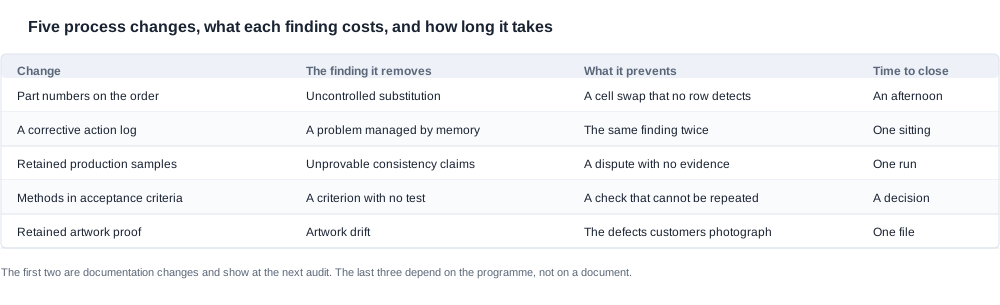
An audit score moves when the underlying process moves, and in this category the two cheapest process changes also remove the two most common findings. The first is to put part numbers on the purchase order with written sign-off required before any substitution, which takes an afternoon and is the only change on this list that prevents a recurring risk rather than documenting a past one. The second is to start a corrective action log, which produces the largest improvement in a single sitting because the first entry is usually a problem that was being managed by memory. The remaining three, retaining production samples per run, writing methods into the acceptance criteria, and retaining the signed artwork proof, depend on the programme rather than on a document and take longer to show. One thing will not move the score at all: presenting capability figures that cannot be evidenced. We do not publish capacity figures, line counts, daily output or defect rates for that reason, and an auditor who asks for the basis of a number and receives an assurance will discount the rest of the file.
Who is reading this, and what the audit is for
The reader is a brand-side procurement lead, a channel buyer or an importer. The situation is one of three: an audit is scheduled and the buyer wants to know what will be examined and what to fix first; an audit has happened and the findings list is longer than the buyer expected, and the buyer needs to know which findings are worth closing; or the buyer is deciding whether to accept a supplier's audit findings at all, and needs a way to tell the ones that describe a real gap from the ones that describe a measurement nobody took.
The thing being managed is not a score. It is the question of whether the factory's process would produce the same product next quarter without the buyer watching. An audit score is a proxy for that, and a weak proxy, because the score rewards documentation and the thing that matters is behaviour. The factory audit section covers what an audit examines, and the reducing audit findings article covers the four groups the findings fall into.
The market backdrop: what makes this category hard to audit on paper
The published range carries 28 models, and the configuration space inside them is what makes a document-based audit weak here. One camera model is published with a 900 mAh or a 1400 mAh case option, one has a folding case at 1200 mAh, two carry a case whose capacity is not published, and the V03 Pro has no case at all. Several models are published with three or four colourways, and assembly steps, packaging artwork and cosmetic inspection all vary with colourway while the electronics do not.
That variation is why the most common finding in this category is not a missing document but an uncontrolled substitution, and why the most common evidence gap is a consistency claim with nothing behind it. It is also why an audit that only reads files cannot find the problems that matter. A factory can have an immaculate file and a line that builds units nobody has reconciled against the part list, and an audit that never walks the line will not find it.

The five changes, in the order they work
Change one: fix the component list
Part numbers on the purchase order, with written sign-off required before any substitution. It takes an afternoon, it is the single most common finding in this category, and it is the only change here that prevents a recurring risk rather than documenting a past one.
It matters because of what a substitution does to the buyer's evidence. The published rows, cell capacity, charge time, rated use, Bluetooth version, charging method and case capacity, do not change when a same-capacity cell vendor is swapped. Nothing built on those rows detects it, and the detection arrives as a return instead. The control does not prevent the substitution itself; it prevents the substitution from being invisible, which is the part that matters for a buyer who is not on site.
Change two: start a corrective action log
The second most common finding, and the one that produces the largest improvement in a single sitting. The first entry is usually a problem that was being managed by memory, and writing it down is what turns a habit into a process.
The log needs three things to be worth anything: what happened, what was done, and what would show that it did not recur. A log of problems without the third column is a complaints file. The value to an auditor is that it demonstrates the process exists, and the value to the buyer is that it turns a recurring finding into a closed one with a date against it.
Change three: retain production samples
Two finished units per run, labelled with the run, kept for twelve months. This is what makes a consistency claim checkable, and it is the item most often listed as absent because nobody has asked for it until the dispute.
The cost is small and it scales with the number of runs rather than with the volume. The reason it matters so much in this category is the same reason change one matters: without a retained sample there is no way to establish what a unit from a given run actually was, and every consistency question then becomes an argument rather than a comparison. The quality consistency section covers the measurements that retained samples make possible.
Changes four and five: methods, and the artwork proof
Put methods into the acceptance criteria. The rows in this category most often missing a method are packaging print registration, lens condition, charging function on a sample, and pairing across at least two phone models. None of these requires equipment; all four require a decision about how the check is performed. A criterion that says "packaging print registration is acceptable" is an instruction. A criterion that says how the registration is measured, against which sample, by whom and recorded where, is an acceptance criterion, and the difference is the difference between a check and a wish.
Retain the artwork proof. The signed pre-production proof, kept with the run file. The drift it prevents, print registration, colour, substrate, is the defect customers photograph most often, and it is traceable to a proof when one exists. It is also the cheapest of the five, because the proof is produced anyway and the only decision is where it is filed.
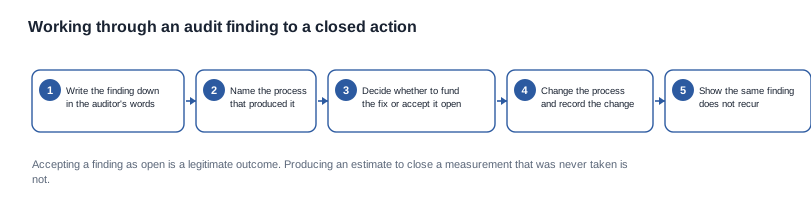
How an audit finding is worked through to a closed action
The five steps, and the point at which a finding may be left open
- Write the finding down in the auditor's words. Rewriting a finding in the factory's own vocabulary before acting on it is how a real gap becomes a wording difference. The finding as written is the thing that has to be closed.
- Name the process that produced it. A finding about artwork drift points at the artwork approval step. A finding about substitutions points at the purchasing step. Without this step the corrective action addresses the symptom, and the same finding reappears in the next audit.
- Decide whether to fund the fix or accept it open. This is a legitimate decision and it should be made explicitly, with a name against it and a date for the review. A finding that is worth closing but is not worth funding now is still a finding, and closing it with a placeholder number is the one response that is worse than leaving it open.
- Change the process and record the change. A corrective action that is not written down cannot be demonstrated to a later auditor, and a buyer asking about the previous finding's status will get a recollection rather than a record.
- Show that the same finding does not recur. The close is confirmed at the next audit by the absence of the finding, not by a claim that it was fixed. This is the step that turns a corrective action into a controlled process.
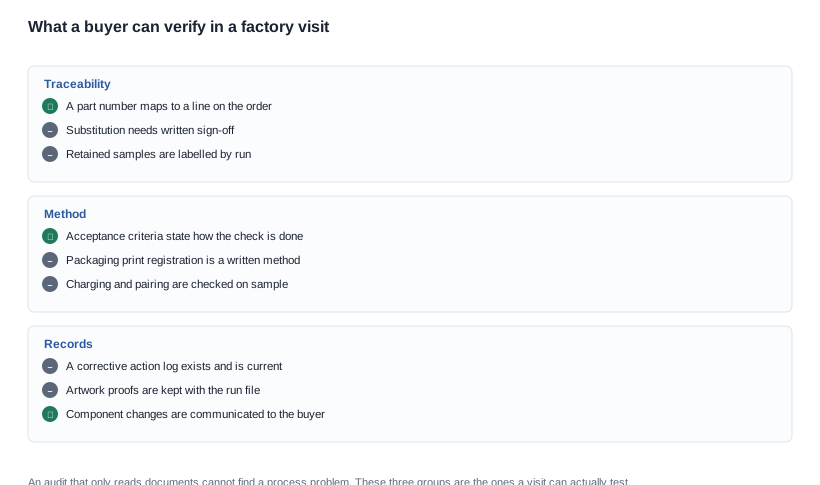
The questions a buyer can ask during the visit
An audit that is conducted entirely from a meeting room produces a documentation finding list. A visit that includes the line produces a process finding list, and the second is more useful even when it is shorter. These are the questions that only work in person.
- Which part number does this unit on the line correspond to, and where is it recorded?
- If this cell were unavailable tomorrow, what would be substituted, and who signs that?
- Show me the run file for the current run. What is in it?
- Show me the retained samples for the last three runs. Are they labelled with the run?
- How is print registration checked on this line, and where is the result written?
- Which phone models is the pairing check run against?
- Where is the artwork proof for the current run, and who signed it?
- Show me the corrective action log. What was the most recent entry and what closed it?
The last three are the ones worth asking even if the rest is skipped, because they test whether the process is documented at all rather than whether it is documented well.

What will not move an audit score, and what to expect afterwards
The figures that cannot be evidenced
Presenting capability figures that cannot be evidenced is the single most effective way to make an audit score worse. An auditor who asks for the basis of a number and receives an assurance will discount the rest of the file, and will be right to. We do not publish capacity figures, line counts, daily output or defect rates for that reason, and a factory that publishes them is making a claim it cannot support in the room where the claim matters.
The alternative is not silence, it is a describable method. A factory that says "we test every unit for a full charge cycle before packing, and the test record is kept with the run file" has said something an auditor can check. A factory that says "our defect rate is under one per cent" has said something an auditor has to decompose, and the decomposition usually ends badly.
What to expect in the audit cycle afterwards
The first two changes are visible at the next audit and are the cheapest score improvement available. Expect the first audit after the changes to produce a shorter finding list in the documentation group and an unchanged one in the capability group, which is the correct outcome, because those findings describe measurements that were never taken, and closing them means deciding whether to fund them or to plan without them.
The third and fourth take longer, because they depend on the programme rather than on a document. The fifth depends on whether anything changes in the artwork, and on nothing else. That is the useful thing to tell a buyer who wants a schedule: the changes are not uniform in their effect, and the audit that follows the first two is the one where the score moves.
Deciding which findings to close and which to leave open
A buyer receives a findings list with a finding count, and the instinct is to close all of them. That is usually the wrong decision, and it is expensive. The useful triage is on two axes: whether the finding describes a gap that can cause the buyer a commercial problem, and whether closing it costs anything the buyer is better spent elsewhere.
A finding about the component list is worth closing immediately, because it is an afternoon's work and it prevents a recurring risk. A finding about a measurement that would only be useful if the programme grows is worth recording and deferring, with a review date. A finding about a capability figure is worth closing by removing the figure rather than by producing a number, and that is a legitimate close. The typical range article covers what finding counts usually mean in practice, and the distinction matters because a list of thirty findings and a list of three findings can describe the same factory.

Scoping the audit before it happens
Why the scope is the decision that matters most
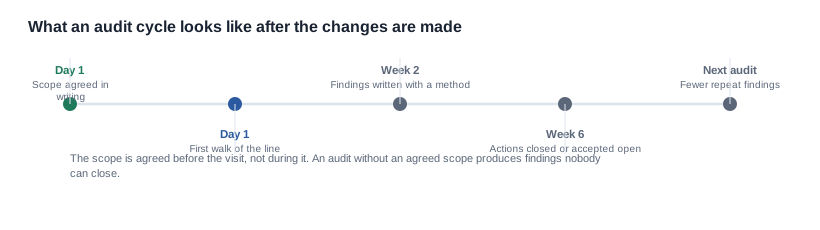
An audit that has been scoped in advance produces findings that can be closed. An audit that has not produces findings about things nobody intended to examine, and the effect of that is a list that neither party can act on. This is the single most common reason an audit disappoints both sides, and it is entirely avoidable.
The scope should be written down before the visit and should answer four questions: which model and configuration is being audited, which sites and which lines are in scope, which of the four finding groups will be examined, and who is present from the buyer's side. The fourth question matters more than buyers expect, because an audit conducted by a buyer who is not technical enough to recognise a weak answer produces findings that are easy to dismiss and impossible to close.
The four finding groups, and what each one is worth
The findings in this category fall into four groups, and the groups are useful because they are closed in different ways and at different costs.
The documentation group is the largest and the cheapest to close. These findings describe a document that should exist and does not, or exists in a form nobody can use. A component list, a corrective action log, a retained sample record and a retained artwork proof all sit here, and all four are closed by a decision rather than by an investment.
The capability group describes measurements that were never taken: a defect rate, a first-pass yield, a daily output figure, a test capacity. These findings are the ones that cannot be closed by producing a number, and closing them by producing a number is the mistake that turns an honest audit into a meaningless one. The honest close is either to fund the measurement or to record the finding as open with a review date.
The process group describes a procedure that exists but is not controlled, most often a substitution without sign-off or a configuration change that is absorbed into the next build rather than raised as a change. These findings are the most valuable to close because they prevent rather than document, and the three changes at the top of this article sit in this group.
The traceability group describes the absence of a link between a unit and the run that produced it. Without it, consistency claims cannot be substantiated, and it is the group that most often determines whether a dispute can be resolved. It is closed by run labelling and by retention, not by a policy statement.
Preparing the audit rather than rehearsing for it
The most effective preparation is not a rehearsal and it is not a document sweep. It is deciding, in advance, which findings the buyer is willing to leave open and which ones it will fund, because the factory should not have to guess. A buyer that arrives with a triage rule gets a shorter and more useful audit, and it gets a capability group that stays open without being argued about.
The second most effective preparation is naming the document holders before the visit. In this category the holder is often a person rather than a system, because the run file is assembled by whoever is on shift. A visit that asks for the current run file and gets it within minutes is a visit that found something. A visit that gets an answer of "it is with the production manager" is a visit that found a finding about the process, and that finding is worth more than any document gap the visit was originally looking for.
The buyer's follow-up, which is the part usually skipped
The audit report is not the end of the exercise. The valuable part is the follow-up, and it consists of three things: a written response to each finding stating what the factory will do, by when and who owns it; a named review date for the findings recorded as open; and the agreement of which findings will be checked at the next audit and which will not.
That last item is where a buyer can improve the next cycle rather than repeat the current one. Findings in the documentation group should be checked, because they are closable and their recurrence is a statement about the factory. Capability findings should not be re-raised, because they describe a decision not to measure, and a decision that has been reviewed and accepted should not be reopened every cycle as though nobody had looked at it.
The boundary of what we will close in a smart glasses factory audit
We will host an audit, agree the scope in writing beforehand, and close the findings that describe a documentation gap. Where a finding describes a measurement we have not made, we will say so rather than produce an estimate to close it, and we will accept a finding as open when closing it is not worth doing.
The scope is agreed before the visit rather than during it, because an audit without an agreed scope produces findings nobody can close, and a visit without a named document holder produces an argument about what the file was supposed to contain. We will tell the buyer in advance what the audit will and will not cover, and we will mark the capability findings as a separate group so that a buyer can plan without them rather than negotiating them.
What to send us about an audit scope
Send the model, the configuration, the volume and the destination market, and we will tell you what an audit of that build would examine, which findings the documentation group would typically contain, and which capability findings would remain open because no measurement behind them exists.
Send the configuration, the volume and the market, and we will say what an audit of that build would examine and which findings would stay open.


