

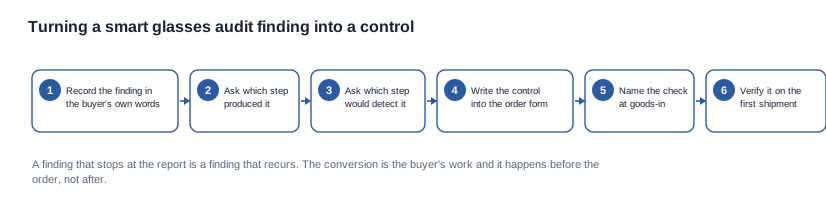
A factory audit is not a tour, and the findings it produces are not the point. The point is what the buyer does with them. An audit that ends in a report nobody has read has cost the buyer a visit and a day of preparation. An audit that ends in six written findings, each converted into a control that is checked at goods-in, has permanently removed six ways for the programme to fail.
That is the whole method for reducing audit findings, and it is worth stating up front because it changes what a buyer asks for. A buyer asking for "a factory audit" will receive a tour. A buyer asking for a written scope, a documented walk, a findings list in the buyer's own wording and a corrective action with an owner and a date will receive something usable.
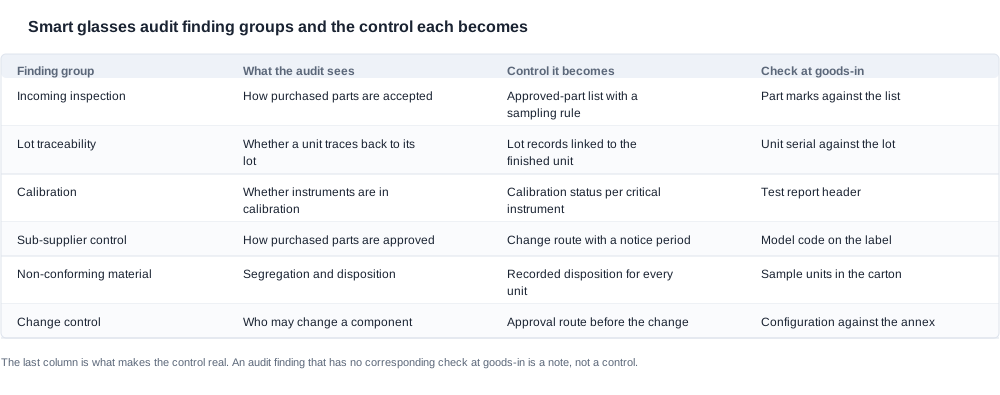
The findings themselves in this category cluster into six groups, and each group has a control that is already known. The buyer does not have to invent them. What the buyer has to do is insist that they are written down, and that the one which is hardest to close gets closed first.
Smart glasses factory audit: what the visit has to leave behind
The reader here is a procurement manager on the brand side, a channel buyer or an importer, and the situation is one of three: a supplier has offered an audit before the first order and the buyer needs to decide whether it is worth accepting; an audit has been done and the report is sitting in an inbox; or a programme has already had a quality problem and the buyer is deciding what to audit next rather than auditing the same thing again.
Underneath all three is the same question, which is not whether the factory is good. It is whether the buyer's programme can survive a bad shipment, and whether the evidence that says so exists in a form the buyer can use after the audit visit is over and the people who hosted it have moved on.
The commercial fear underneath an audit enquiry is rarely a discovered failure. It is the opposite: a visit that produced a warm impression and no process evidence, which is the finding that costs the most because it looks like a pass. Buyers who have been burned by that tend to over-correct, and the over-correction is to ask for a very long scope, which the supplier either cannot satisfy or satisfies with a pre-written presentation. The efficient scope is a short written list of the process steps where this product type can go wrong, walked live, with the records behind them requested on the day.
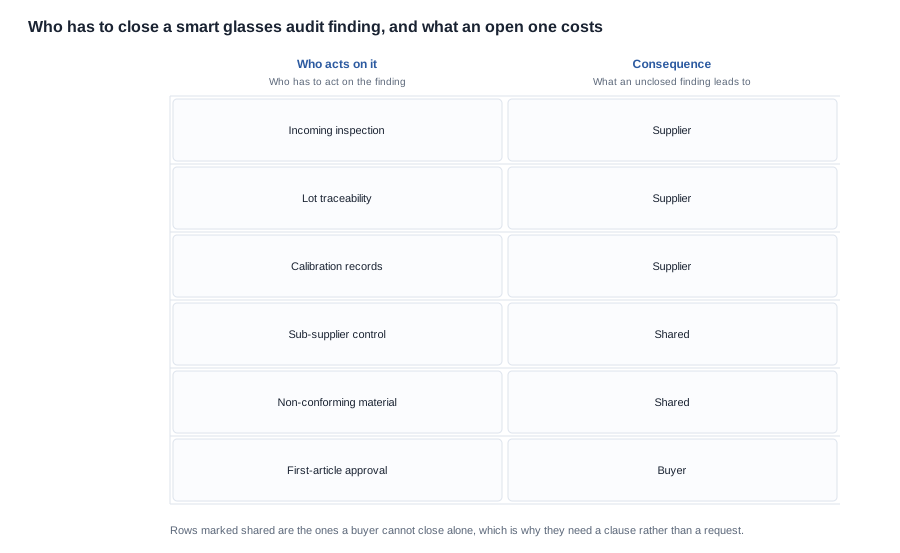
One structural point is worth making early, because it decides how much of the audit the buyer can control. A buyer can verify a process step, or ask about one. What a buyer cannot do is close a finding alone. Most of the findings in this category belong to the supplier's own process, and a buyer who expects to close them personally will be disappointed; a buyer who expects a clause for each one will not.
The six finding groups a smart glasses audit produces
Incoming inspection. This is where the audit usually starts and where it usually stops being informative. The finding to look for is not whether there is an incoming area — every factory of this size has one — but how a purchased part is accepted and what happens to a part that does not match. The control that closes it is an approved-part list with a stated sampling rule, and the check at goods-in is whether the marks on the delivered parts correspond to that list. This matters more in smart glasses than in many categories because the build contains a rechargeable cell, a charge control circuit and, on the camera models, an optical and imaging assembly; a wrong component in any of those is not a cosmetic fault.
Lot traceability. The question is whether a finished unit can be traced backwards through its own route to the components it was built from, and whether that trace is performed live or merely described. Lot records that stop at the carton are the most common finding in this category, and they are the finding that makes a field failure unmanageable: without a link from the unit to its component lot, a quality incident cannot be scoped and a recall cannot be bounded. The control is a required link between the unit identifier and the lot record, and the goods-in check is the unit serial against the lot record.
Calibration and test equipment. Which instruments are used for the critical measurements, and whether their calibration status is evidenced rather than asserted. The findings here are usually partial: an instrument present and in use with no current certificate. The control is a calibration status per instrument, and the check at goods-in is the test report header, which should carry the instrument reference and the date.
Sub-supplier control. How purchased components are approved, how a new sub-supplier is brought in, and whether the buyer is told when one changes. A purchase accepted on a sub-supplier's assurance alone is a finding, and in this category it is expensive, because the sub-tier is where a camera module or a battery cell actually comes from. The control is a change route with a notice period, and the goods-in check is the model designation on the label against the configuration annex.
Non-conforming material. How a unit or a component that does not conform is identified, segregated, and dispositioned. A re-work area with no records is a finding, because it means the history of the unit is unknown after the fact. The control is a recorded disposition for every unit, and the goods-in check is a sample against the units in the carton.
Change control. Who may change a component, a sub-supplier or a process, and how the buyer finds out. This is the finding that links an audit to the contract, because the audit can establish what the control is today and cannot establish that it will be there tomorrow. The control is an approval route, and the goods-in check is the delivered configuration against the annex.
What closes a finding, and what only records it
The distinction between these two is the difference between a productive audit and an expensive one, and it is worth setting out the test explicitly.
A finding is closed when three things are true: the process step that produced it has changed, the change is documented somewhere the buyer can point at, and the buyer has a check that would catch a recurrence at goods-in. A finding is recorded when the report contains a statement, a commitment or a plan. Almost every supplier will offer a recorded finding, because it costs nothing and it satisfies the request as it was phrased.
The table below is the working criteria set for judging an audit finding. Each row states how the finding is measured, the line it has to meet, and how an inflated answer shows up.
| Audit attribute | How it is measured | The line it has to meet | How an inflated answer shows up |
|---|---|---|---|
| Steps actually walked | Ask which production steps the visit covered and which were not | Every step in the route is either walked or listed as unvisited | Assembly walked, incoming inspection skipped |
| Trace demonstrated live | Ask for a finished unit to be traced to its component lot | The trace is performed on the day, not described | Records exist, the link to the unit is manual |
| Calibration evidence | Ask which instruments make the critical measurements | A current status per instrument | Instruments present with no certificate |
| Sub-supplier approval | Ask how purchased parts are approved and changed | An approval route and a change route, both documented | Parts accepted on a supplier's assurance |
| Non-conforming material | Ask how a non-conforming unit is segregated and dispositioned | A visible segregation area and a recorded disposition | A re-work area with no records |
| Corrective action ownership | Ask who owns each action and when it closes | A named owner and a date per action | A commitment with no owner and no date |
Two rows deserve a second reading. The first is the scope row, because the gap between the written scope and the full production route is the most useful output of the entire conversation — more useful than the findings themselves. A visit that covered assembly and skipped incoming inspection has told the buyer nothing about where bad parts enter, and it has done so while producing a comfortable report.
The second is the corrective action row. Ask a supplier for the actions from previous audits and whether they were verified closed. A supplier who shows only the closed actions is telling you, without saying so, that the open ones are the interesting ones. In a category where the range is narrow and the processes are shared, an open action from two years ago is a strong predictor of what your own audit will find.
The questions to ask, and the red flags that answer them
A buyer who has to choose between two suppliers will usually compare them on the audit report. That is the wrong comparison, because the report is written by the party being audited. The comparison worth making is on the answers: a supplier who answers the eight questions below in the same order and with the same specificity is telling you something that a report cannot.
The questions to ask, in the order they produce useful information:
- Which production steps did the visit cover, and which were not walked?
- Can a finished unit be traced to its component lot, live, on the day?
- Which instruments make the critical measurements, and what is their calibration status?
- How is a purchased part approved, and who is told when an approved part changes?
- Where does non-conforming material go, and how is its disposition recorded?
- What came out of the last audit, and which of those actions are still open?
- Who owns each corrective action, and on what date does it close?
- What would you have to change to make the finding go away for good?
The last question is the one that separates a finding from a symptom, and it is worth asking last so that the answer is not shaped by the earlier questions. A supplier who answers it with a process change has something; a supplier who answers it with a retraining plan has a plan.
The red flags in this category are unremarkable individually and serious in combination. An audit that was scoped verbally rather than in writing. A scope that covered assembly and stopped before incoming inspection. A traceability answer that describes a system rather than demonstrating one. Calibration described as regularly checked with no certificate. An approved-part list that is not available on the day. A findings list that arrives with no owners. A supplier who is unwilling to produce the corrective actions from a previous audit.
None of these proves anything is wrong. Together they mean that the buyer is relying on an impression, and an impression is not a control.
Before you order, the practical test is whether the audit produced something the buyer's own goods-in team can use. If the answer is no, the audit did not reduce any findings; it produced a document. And the total cost of an audit that produced only a document is not the visit fee, it is the visit fee plus the first shipment that goes wrong.

Preparing the supplier so the first visit finds less
The second half of the reduction is upstream. Most of what an audit finds can be removed before the visit, and the removal costs the buyer a phone call rather than a relationship.
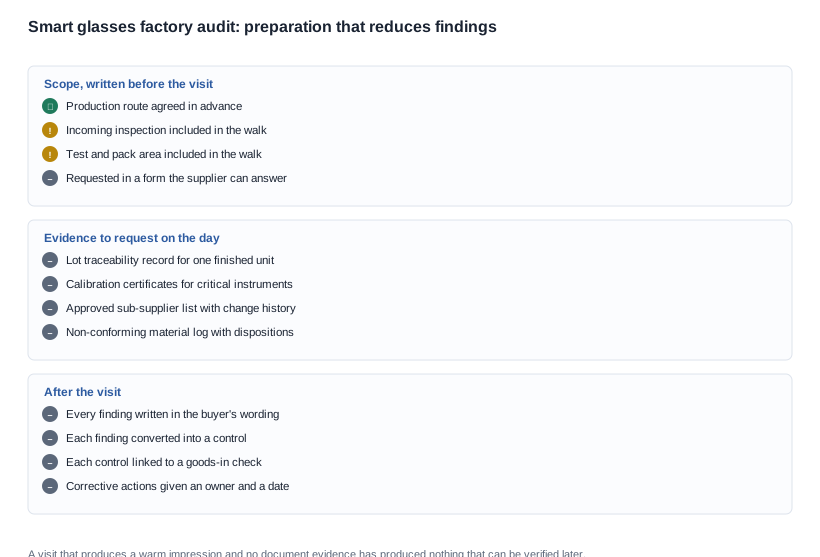
Send the scope in advance, in writing, and ask for the parts that cannot be covered. A supplier who cannot walk a step will say so before the visit rather than during it, and the buyer gets that on the record. Where a step is genuinely outside the supplier's own premises — a sub-supplier's line, a third-party laboratory — the answer is useful in itself, because it tells the buyer where the real risk sits and what evidence would cover it instead.
Ask for the records before the visit, not during it. Lot records, calibration certificates, the approved sub-supplier list with its change history, and the non-conforming material log. A supplier who assembles these beforehand has done the work; a supplier who assembles them during the visit has told you how the visit will go.
Name the configuration the audit is about. An audit of "the production line" is a tour. An audit of the line that builds your specific model code, in your specific colourway, with your case option, is a process review. This matters more here than in most categories because the configuration options are numerous: four colourways on the V06, three on the V03 Pro, two case options on the L2 Utral, and four camera models that carry a charging case capacity but no charging method row at all.
Ask for one unit, live. Ask the supplier to pull one finished unit and trace it backwards while you watch. That single demonstration covers lot traceability, the identification method and the record structure in about twenty minutes, and it is the highest-value twenty minutes of any audit in this category.
What a closed corrective action has to contain
A corrective action is closed when four things are true, and the fourth is the one that is usually missing.
- The process step that changed is named. Not "training was conducted" but "the incoming sampling rule was changed from visual to AQL sampling, effective from a date".
- The change is documented in a place the buyer can point at. A procedure, a work instruction, a revised approved-part list — something that exists independently of the person who made the change.
- A verification date exists. The date the change will be checked, and by whom. Without it, a corrective action is a statement of intent with a date on it.
- The buyer can check the outcome at goods-in. This is the part that closes the loop and the part that almost nobody asks for. If the buyer cannot see the effect of the correction in the delivered goods, then the correction is unverified, and an unverified correction is an open finding with better paperwork.
The same four-part test applies to the findings themselves. A finding that satisfies all four is closed. A finding that satisfies three is nearly closed and is worth a written date. A finding that satisfies two is a plan, and the buyer should treat the risk as live until the goods arrive.

Where a factory audit programme goes wrong
The audit that never reached the incoming gate. A walk of the assembly line gave a good impression and told the buyer nothing about where bad parts enter. Require the visit to start at incoming inspection and follow the route to despatch.
The trace that ended at the carton. Lot records existed for components but did not link to the finished unit. Ask for a live trace and require a defined link between the unit identifier and its lot. This is the finding that makes a field incident unscopable.
The concession nobody logged. Non-conforming units were re-worked or used without a recorded disposition. Ask for the log and the approval route, and check that both exist as documents rather than as a practice.
The audit that became a presentation. The visit produced a warm impression and no process evidence. Insist on a written scope, a documented walk and a findings list with owners and dates.
The audit that produced findings nobody owned. The report went to the buyer's inbox and the supplier's sales team, and no one was made responsible for closing anything. This is the most common outcome and the least visible, because nothing has gone wrong yet. The prevention is to name a person on the buyer's side who owns the findings list, and to treat the list as an order document rather than as correspondence.
None of these is a reason to change supplier. Each is a line that should have been in the order, and each is much cheaper to write before the first shipment than to discover afterwards.
What we will put in an audit scope, and what we will not
Concretely, the published specification is the part of the process we can stand behind, and everything else belongs to the supplier's own file and has to be verified there. We publish the specification rows we hold, we mark the rows that are open, and we will not fill an open row with a typical figure from a supplier's general data.
Concretely, for this range: the camera resolution tier per model, with eight camera models at 8 MP and three at 13 MP; the battery capacity, runtime, charge time and charging method per model, with the four camera models that carry no charging method row named as open; the charging case capacity where the catalogue states one, at 1400 mAh, at 900 or 1400 mAh, and at 1200 mAh on the MT6's foldable case; the Bluetooth version per model where it applies; the ingress marking on the two models that carry one, the V06 and the S7; and the unit weight of the one model where a weight is published, the MT6 at 158 g for the glasses body including battery and camera and excluding the foldable case.
We do not publish defect rates, yield, rework rates, incoming inspection sampling rules, calibration schedules, capacity figures, minimum order quantities or lead times, and we will not quote an audit scope that pretends otherwise. What we will do is take your model code, your configuration and your target market, produce the audit scope and the configuration annex that go with it, and tell you which parts of the process the buyer can verify from outside and which parts need a document.
For the wider framework, the factory audit section sets out the assessment structure, documents to request is the paper trail, the advanced audit guide covers what a second visit samples, and improving your audit score is the same six finding groups treated from the other side.
Send us the model code, the configuration and the target market, and we will tell you which findings this configuration is most likely to produce and what evidence closes each one.
Send the configuration, the quantity and the market, and we will say which findings to expect and which controls close them.


