
What a typical smart glasses factory audit covers, and what a typical one leaves out
A typical smart glasses factory audit covers five places on the production route, a set of per-model documents, and a written scope agreed in advance. That is the standard scope, and it is a reasonable one: it is enough to establish that a supplier can build a configuration and to establish whether its controls are documented, and it is not enough to settle a capacity question, a cost question or a long-term relationship question. Knowing which of those three a given audit is capable of answering is the difference between buying the right thing and buying a familiar thing.
The second thing a typical scope leaves out is equally important. It does not establish the process behind the goods you are already receiving, because that requires your own units rather than a walk, and it does not establish whether the factory's controls held on the run that produced your last shipment. A typical first-visit audit is a forward-looking instrument. It answers questions about the next programme, not about the last one, and a buyer who wants the second kind has to ask for a different scope rather than a deeper one.
What follows sets out the scope in three parts: the published data that makes a typical scope checkable, the difference between company-level claims and model-level data, and the phase-by-phase coverage of a standard visit — followed by the cases where the typical scope is the wrong one.

The published data that makes a typical audit's scope checkable
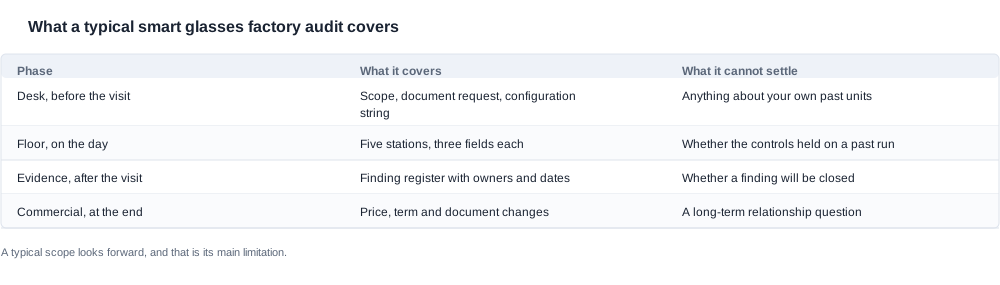
A scope is only useful if the buyer can check it against something, and in this category there is a substantial amount of published per-model data to check it against. The catalogue carries 28 model rows, and the pattern of what is published and what is not is itself the most useful thing a buyer can know before the visit, because it tells you which questions will be answerable from a document and which will need a unit in your hand.
The counts below are the published position across the 28 rows, and they are worth reading as a map of where the gaps in this category actually sit.
| Published item | Models covered | What that means for a typical audit |
|---|---|---|
| Charge time | 28 of 28 | Comparable, but without a starting state or a full-state criterion |
| Rated use | 28 of 28 | Published as a range on several models, so not a pass criterion |
| Camera tier | 11 camera models | 8 MP on eight models, 13 MP on three, all named |
| IP54 marking | 2 models only | The V06 and the S7, as a catalogue marking with no published report number |
| Charging method | 24 of 28 | Magnetic on 17, Type C on 7, and not stated on four camera models |
| Bluetooth version | 14 of 28 | Published on the audio and sport tiers, not on the camera tiers |
| Charging case capacity | 5 camera models | Published for three at 1400 mAh, one at 900 or 1400 mAh, one at 1200 mAh |
| Frame weight | 1 model only | A single published weight, and it is a whole-unit figure for a camera model |
Two conclusions follow from that table, and they shape a typical scope. First, the electrical rows are strong enough to be audited against, so a typical scope can insist on a per-model configuration match without any ambiguity — the camera tier, the cell capacity, the interface and the case option are all named, and a unit that does not match is visible on the bench. Second, the gaps are concentrated in three places: the certification documents, the charging method on four camera models, and the frame weights. A typical scope that ignores those three gaps will produce a clean report that says very little.

Company-level claims, model-level data, and the rows nobody publishes
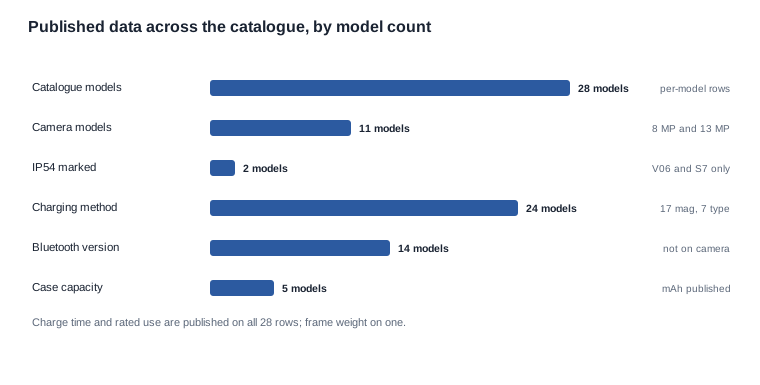
The distinction that most often causes confusion in a first visit is between what a company says about itself and what it publishes about a model. The catalogue's front matter carries company-level statements: the year the company was founded, the area of the production base, the size of the engineering team, and the description of the export certification capability. Those are real statements and they are not disputed. What they are not is evidence about a line, and they should never be treated as a substitute for the per-model data a buyer is verifying.
The company-level certification statement is the sharpest example. The catalogue carries an export certification capability as a company attribute, and it carries no per-model certification row. A buyer therefore cannot infer, from the catalogue, that any particular model holds a particular certificate, and a supplier who quotes the company capability in answer to a model-level question has not answered the question. This is not an accusation; it is a category error, and it is the reason a typical audit scope asks for a document that names the model rather than a document that names the company.
The rows nobody publishes are the third column and they are not defects. Unit prices, minimum order quantities, production capacity, line count, the defect rate, the outgoing pass percentage and the lead time are not published for this range, and the unit weight is published for one model only. A typical audit scope that asks for these as documents will come back empty, which is why the scope has to be written as a set of questions the supplier can answer rather than as a list of figures the buyer expects to receive.
The practical instruction that follows is simple: a typical scope is written against what the supplier can produce, and the buyer's own list of what it wants is used to test the answers. Where the catalogue already publishes the answer, the audit confirms it. Where the catalogue does not, the audit has to find it elsewhere — in a document, in a sample, or in a contract term — and a scope that does not say which of those three it expects will produce an ambiguous answer.
There is one further distinction in this category that is worth making explicitly, because it is the one that trips up buyers comparing a catalogue against a factory. A catalogue entry is a description of a product. A factory document is a description of a process. A buyer's audit request, when it asks for the second, has to be worded as a process question rather than a product question, and the wording decides what comes back. Asking "do you have a certificate for this model" is a product question and gets a product answer, which is usually a list of certificates held. Asking "which document covers this model, what does it state, and who is able to produce it" is a process question, and it gets a document.
The practical test for a buyer is whether the answer can be attached to an order. If the answer is a sentence, it is a description and it belongs in the buyer's own file as a note. If the answer is a file with a model on it, it belongs in the order. A typical scope separates the two by asking for the file, and the separation is the point of the exercise.

The phase-by-phase coverage of a typical smart glasses factory audit
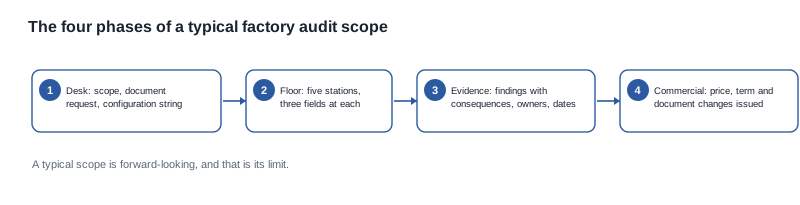
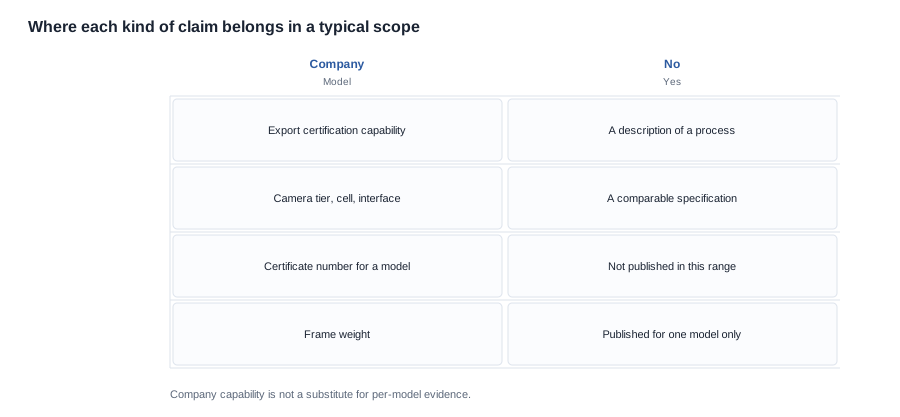
A typical scope divides into four phases, and the coverage of each phase is different, which is why a single day of visit cannot deliver the whole scope.
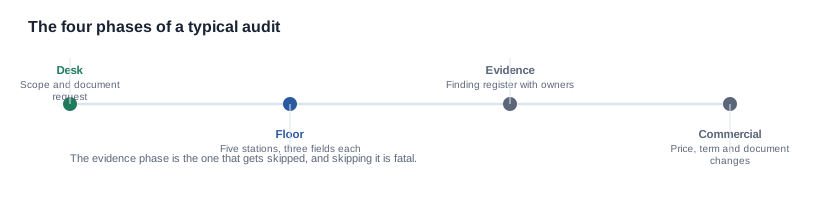
The desk phase, before the visit. The written scope, the document request, the configuration string, and the responses logged with dates and names. This phase typically removes a quarter to a half of a shortlist, and it is where a typical scope produces most of its value per pound. The documents to request article is the field-level list for this phase, and it is the one that should be issued identically to every supplier.
The floor phase, on the day. Five stations — incoming goods, assembly, test bench, packaging, document control — with three fields each. This is the part everybody imagines when they say "factory audit", and it is the part that produces the least durable output unless the observations are converted.
The evidence phase, after the visit. The findings consolidated into a register with consequences, owners and dates, and the documents requested with a date. This phase is the one most often skipped, and skipping it is the same as not doing the visit, because a finding without a consequence is an observation.
The commercial phase, at the end. The price change, the term change, and the document request with a date, issued as documents rather than as conversations. This is where a typical scope stops, and where a buyer who wants more has to extend the scope deliberately rather than expect the standard one to cover it.
How to choose the scope that fits your programme
The criteria for choosing a scope are simple enough to apply in five minutes, and the pitfall is that most buyers choose by habit rather than by criterion. The criterion that matters is one question: what decision is this exercise supposed to support? Every element of the scope should be traceable to a decision, and any element that is not traceable to a decision is an element that will consume a day of somebody's time and produce nothing.
If the decision is whether to place a first order, the scope is a first-visit scope: the parties, the configuration, the five stations, the six questions, and the outcome. If the decision is whether to continue with a supplier whose units do not match an approved sample, the scope is a process review and it starts from your own units, because the question is drift rather than capability. If the decision is whether a shipment can be filed in a destination market, the scope is a document scope and it contains no floor walk at all, because a floor walk does not issue documents.
How to evaluate a supplier against any of these is the same in every case: ask for the artefact, then ask for the record behind the artefact. A certificate without a number is a claim. A number without a record is an assertion. A record with a named owner and a date is evidence, and only the third of those three can be filed with a customer or a market authority. A buyer who applies that test consistently across a shortlist will find that the differences between suppliers are almost always in the second category rather than the first, which is good news, because the second category is closable.
The trade-off worth naming is between breadth and depth. A wide scope across many suppliers produces a comparison and a shortlist, and it will not settle a technical question. A narrow scope on one supplier produces a technical answer and it will not tell you whether you should have shortlisted it at all. Buyers who want both usually try to buy breadth with depth, which is why a two-day visit with a hundred-item form is such a common outcome, and why the same findings are re-discovered later at a much higher price.
Before you order: the questions a typical scope should have answered
A typical scope is finished when the following questions can all be answered in writing. This is the checklist version of the four phases above, and it is the list to work from before a purchase order is issued rather than after the first shipment.
- Which entity am I contracting with, and which entity is building the goods? If they differ, the relationship is documented and the export registration is held by the party that will appear on the customs paperwork.
- What is the configuration, written as a single line? Model, camera tier, cell capacity, charging interface, case presence and case capacity, colour. A configuration that can be read two ways is not a configuration.
- Which document covers this configuration, and who holds it? A file that names the model, not a file that names the company, and a named owner for the file rather than a named department.
- What is the evidence that the process held on the units I have already received? If there are no units yet, this is the acceptance rule that will be written into the purchase order, and it should be written before the order rather than after the first delivery.
- What is the binding constraint on the date, and who owns it? A named constraint with a named owner, and a date that is conditional on it.
- What is the price at my quantity, with the volume break points written down? A single number without breaks is a number you cannot negotiate against.
- What is the minimum order quantity, and what happens below it? Both the figure and the consequence, because a minimum order quantity quoted without the consequence is a number rather than a constraint.
- What happens to a unit that does not match? The disposition route, the record it produces, and who signs the concession.
- What has to be true before the deposit is paid? The conditions, in writing, attached to the purchase order rather than held in someone's head.
- Who do I call when something is wrong, and what happens in the first forty-eight hours? A name, a route and a response time, tested by asking it.
Before you order is the right moment for this list, because every one of these answers is cheaper to obtain before the commitment than after it. The total cost of the list is a few days of waiting and one visit. The cost of finding out afterwards is a payment dispute, a customs hold, a returns episode or a schedule that slips without anyone having decided to let it slip.
When a typical scope is the wrong scope for your programme
A typical scope is the right instrument for a first order in a market where the buyer holds no units and no file. It is the wrong instrument in three situations, and they are common enough to be worth recognising.
The first is a programme where the problem is drift rather than capability. If units are already arriving and they are not what was approved, the scope that helps is a process review, which starts from a defect and works backwards through the route, and it needs your own units, a sample of the failing configuration, and the records for the batch it came from. A typical first-visit scope will not find this, because everything it looks at is current and correct.
The second is a programme with a market-access deadline. If the constraint is a document against a model for a specific destination, the useful scope is document-shaped: which document, which model, which configuration, issued by when, and what it costs. The how to increase capacity article and the how to reduce cost article cover the commercial levers on either side of that constraint, and they matter more than a visit once the date is the binding constraint.
The third is a high-volume programme where the question is repeatability rather than capability. At that point the scope that earns its cost is a process review against your own units plus a schedule with named owners, and the two are best commissioned together, because the first tells you whether the process held and the second tells you whether it will hold at the next volume.
A fourth case deserves a mention, because it is the one that causes the most argument: a programme where the buyer already knows there is a problem and is looking for the supplier to confirm it. That is a due diligence exercise of a different kind, and the scope for it is forensic rather than typical. It wants a specific batch traced, a specific document retrieved, and a specific question answered in writing. A typical scope will not find it, because a typical scope is designed to establish a general position and the problem is specific. When you know what you are looking for, the efficient approach is to ask for exactly that and nothing else.
Before you order, the summary of the whole argument is short. A typical scope is a good default because the published data in this category is strong enough to be audited against, and because the gaps it leaves are the gaps that are cheapest to close later. It is the wrong scope when the decision it supports is not "can this supplier build my configuration" but something narrower and more specific than that.
The boundary we hold: a typical scope is a good default rather than a fixed rule, and a buyer who is told "this is what an audit covers" should ask what the scope is designed to establish and what it will leave unresolved. We publish the 28 model rows that a scope can be checked against — camera tier, cell capacity, charge time, rated use, charging interface, case capacity, colour availability and the single frame weight we hold — and we do not publish unit prices, minimum order quantities, production capacity or lead times. The factory audit section sets out the wider framework, and we will tell you in advance which parts of a typical scope you can complete from your desk, which parts need a paid sample, and which parts need a day on site.
Related reading
- The field-level document request — documents to request
- The commercial levers when capacity is the constraint — how to increase it
- The commercial levers when cost is the constraint — how to reduce it
- The wider framework — factory audit
Send us the model, the configuration, the destination market and the annual volume, and we will tell you whether a typical scope is the right one for your programme or whether a narrower, deeper or differently shaped scope would serve it better.


